
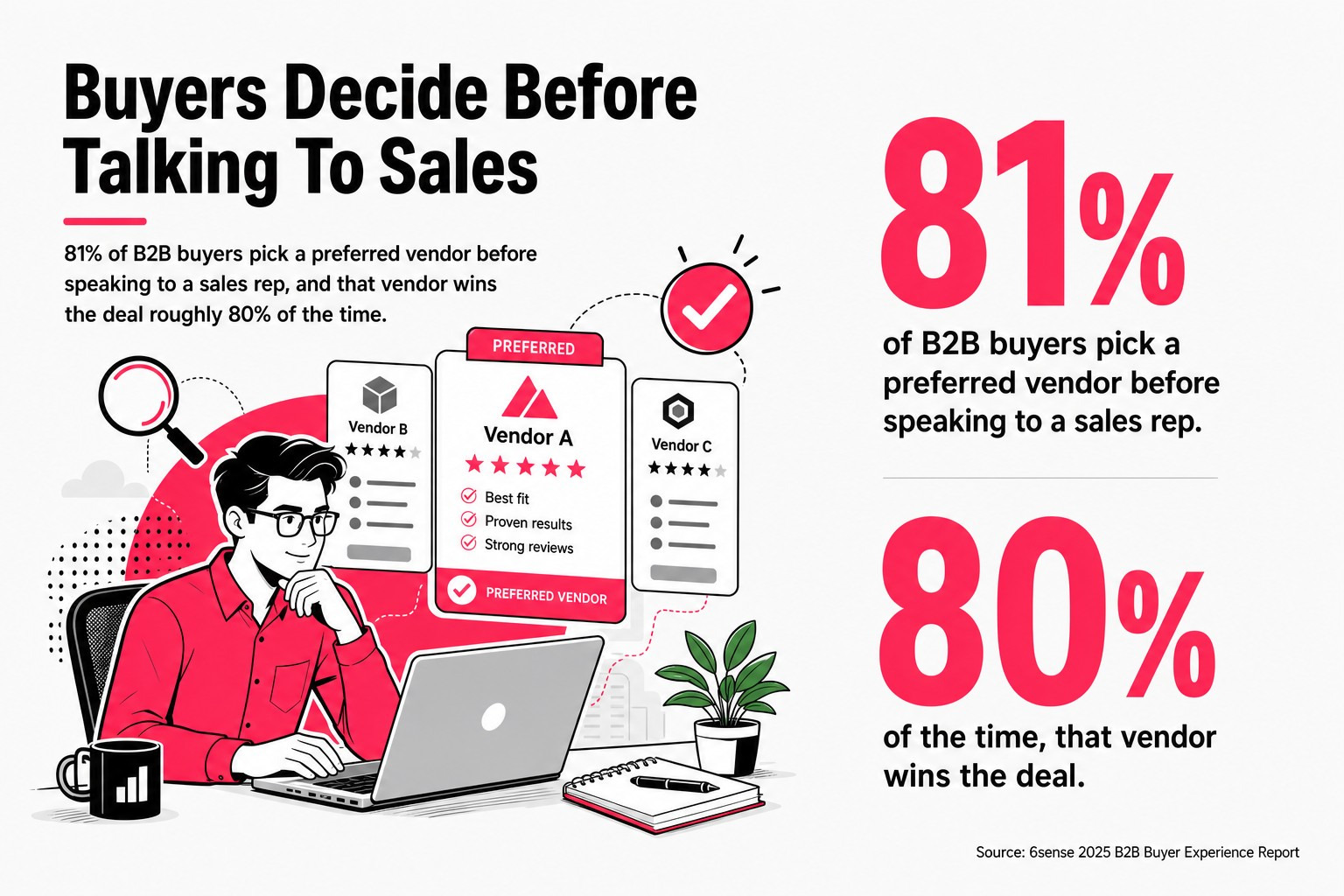
SEO for packaging companies works differently than most industries because the buyer journey starts long before anyone picks up a phone. According to 6sense's 2025 B2B buyer experience report, 81% of B2B buyers pick a preferred vendor before speaking to a sales rep, and that vendor wins the deal roughly 80% of the time. The packaging industry operates in a global market valued at approximately $1.22 trillion in 2026, meaning the competition for organic visibility is serious money. Packaging manufacturers that rank for the right searches, corrugated box suppliers, folding carton printers, flexible packaging converters, label manufacturers, are the ones getting shortlisted before the RFQ even goes out.
Most packaging companies I see are treating their websites like digital brochures. A PDF catalog, a contact form, and a stock photo of a box on a conveyor belt. That approach stopped working years ago. B2B buyers now do the research, compare options, and build their shortlists entirely online. If you are not ranking, you are not on the list.
Packaging manufacturers consistently underinvest in search engine optimization despite operating in one of the largest manufacturing sectors in the world.
The U.S. packaging market alone is on a path from $215.32 billion in 2025 toward $319.04 billion by 2035, according to Towards Packaging's market analysis. That kind of sustained growth attracts new entrants, which means search competition intensifies every year. Packaging companies that ignore SEO now will find themselves fighting for visibility against better-optimized competitors who moved earlier.
And the buyers have changed. Gartner's 2025 survey found that 61% of B2B buyers now prefer a rep-free buying experience. That is not a fringe preference. That is the majority of your potential customers choosing to research, evaluate, and shortlist without ever talking to your sales team. If your website is not doing the selling, nothing is.

There is also an AI search argument being made right now, and it is worth addressing directly. Ahrefs' B2B SEO data shows Google still sends 345 times more website traffic than ChatGPT, Gemini, and Perplexity combined. The AI Overview trend matters for content structure, but the core channel is still Google search. Packaging companies that optimize well for Google also tend to get cited in AI-generated answers, so the two goals are not in conflict.

The opportunity is real. Most packaging websites have thin content, slow load times, and zero strategy around the keywords their buyers actually type. That is fixable, and the companies that fix it first will own their category online. For a deeper look at how industrial companies approach this same problem, the B2B SEO ranking guide for industrial companies covers the full framework.
Keyword research for packaging manufacturers requires mapping search terms to the specific stage of the procurement cycle, not just chasing high-volume phrases.
The mistake most packaging companies make is targeting broad terms like "packaging solutions" or "custom packaging supplier." Those terms attract researchers and students, not procurement managers with budgets. High-intent keyword research means finding the phrases buyers type when they are close to a decision.
Each packaging category has its own search behavior. Corrugated packaging buyers often search for specifications: "double wall corrugated boxes 200lb test" or "RSC cartons bulk order minimum." Folding carton buyers tend to search by application: "pharmaceutical folding carton FDA compliant" or "retail folding carton printing supplier." Flexible packaging searches lean technical: "stand-up pouch with zipper food safe" or "flexible packaging converter minimum order." Label manufacturing searches often combine substrate and industry: "pressure sensitive labels GHS compliant" or "thermal transfer labels warehouse use."
Each of those search strings tells you exactly where the buyer is in their journey. Build landing pages and content around the specific terminology your buyers use, not the terminology your sales team uses internally.
Long-tail keyword research is where packaging manufacturers find their best qualified leads. A search for "custom corrugated packaging manufacturer minimum 500 units" is someone ready to get a quote. A search for "what is corrugated packaging" is someone in high school writing a paper.
Use Google Search Console to find the actual queries driving traffic to your site right now. Sort by clicks and impressions together. Any term showing high impressions but low clicks means your page is appearing but not convincing buyers to visit. That is a title tag and meta description problem, which is fixable in an afternoon.
The goal is a keyword map that covers buyer persona types: procurement managers searching by specification, brand managers searching by application, and sustainability officers searching by material or certification. All three need different content, and all three might end up in the same RFQ decision.
On-page SEO for packaging company websites requires structuring each page around a single buyer intent, not cramming every product into one generic "products" page.
I see this constantly. A packaging manufacturer has 15 product lines, all described in three paragraphs on one page. Google cannot figure out what the page is about. Neither can the buyer who lands on it. The fix is separating each product category, corrugated, folding carton, flexible packaging, labels, rigid containers, into its own dedicated page with its own targeted keyword, its own unique description, and its own call to action.
Every product or service page on a packaging website needs four things working correctly. First, a title tag that names the product type, the application, and where relevant, the geography. "Custom Folding Cartons for Pharmaceutical Packaging | [Company Name]" beats "Products" every time. Second, a meta description that speaks to the buyer's actual concern, lead time, minimums, certifications, not a generic company description. Third, header tags that organize the page content so both Google and a scanning buyer can understand the structure. Fourth, internal linking that connects related product pages so buyers and search engines move logically through the site.
Technical SEO for packaging websites also covers the basics that are surprisingly often broken. Page speed matters because B2B buyers frequently research on mobile during commutes or trade shows. HTTPS is non-negotiable. XML sitemaps help Google index product pages that might otherwise get missed. Structured data markup on product pages can generate rich results that make your listing stand out in competitive searches.
URL structure for packaging manufacturers should mirror the buyer's mental model, not the company's internal org chart. A URL like /products/corrugated/double-wall-boxes tells Google and the buyer exactly what the page is. A URL like /pg/cat2/item7734 tells nobody anything.
Keep the hierarchy clean: product category pages sit above individual product pages, industry application pages sit alongside product pages, and resource content sits in a clearly labeled blog or resources section. Clean architecture makes internal linking logical and helps search engines allocate crawl budget efficiently. For packaging companies with large catalogs, this architecture work is the highest-impact technical investment you can make. The manufacturing SEO guide covers site architecture decisions in detail for companies managing complex product hierarchies.
Content marketing for packaging manufacturers works best when it answers the specific technical questions buyers are already researching online, rather than publishing generic "industry insights" that nobody searches for.
B2B buyers in packaging are often engineers, procurement specialists, or operations managers. They search for answers to real operational questions. "What crush resistance rating do I need for stacked warehouse storage?" or "difference between compostable and biodegradable flexible packaging." Those are content opportunities that generate qualified leads because the person reading is already deep in a buying process.
Application-specific landing pages are the most under-used asset in packaging industry SEO. A food packaging landing page covers FDA compliance, moisture barriers, tamper-evident options, and cold-chain requirements. A pharmaceutical packaging page covers serialization, child-resistant closures, and clean room manufacturing. An e-commerce packaging page covers dimensional weight optimization, unboxing experience, and return-friendly design. An industrial packaging page covers crush strength, moisture resistance, and pallet compatibility.
Each of these pages targets a distinct buyer persona with distinct search behavior. A brand manager at a food company types different queries than a logistics director at an industrial manufacturer. One page cannot serve both well.
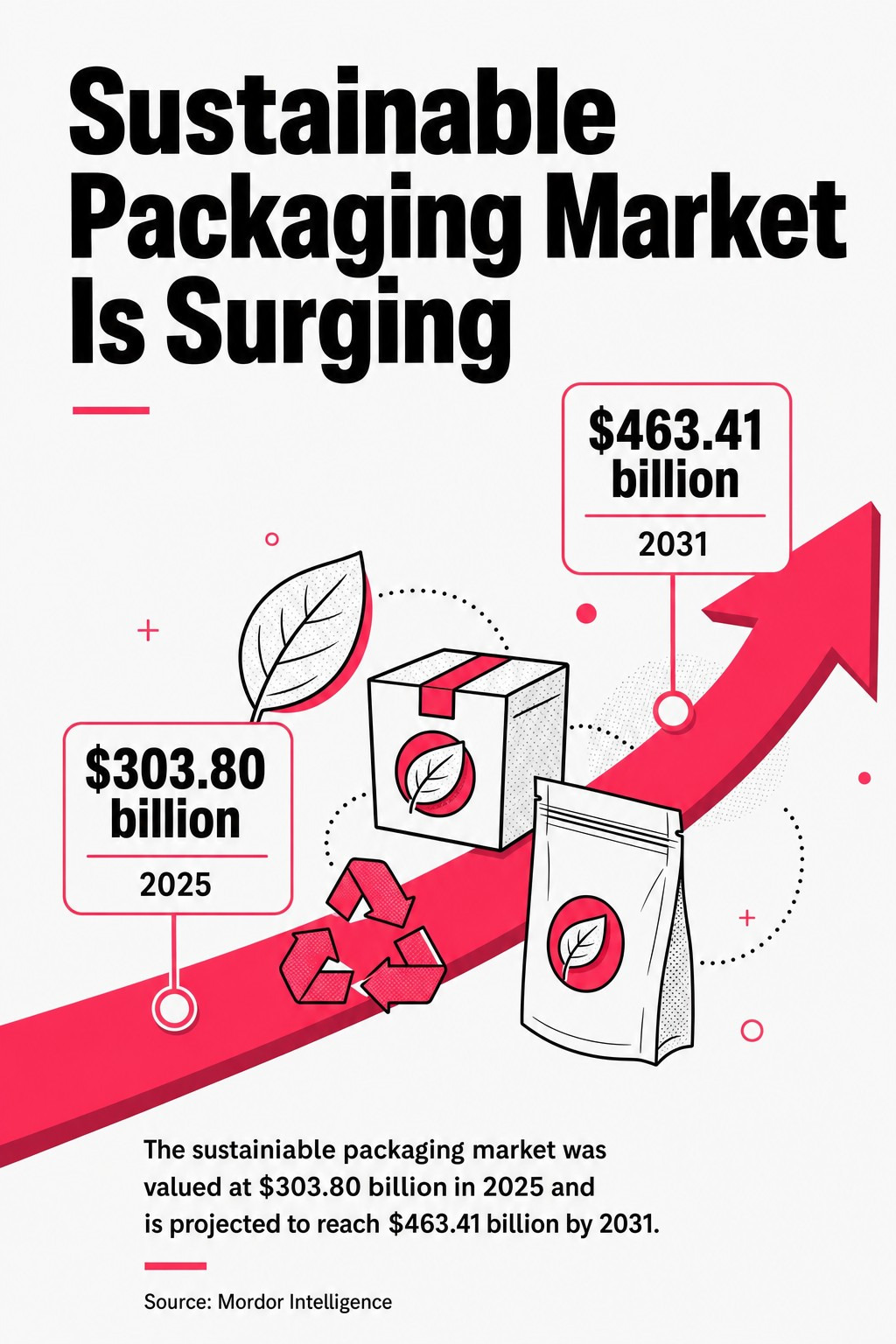
The sustainable packaging market was valued at $303.80 billion in 2025 and is projected to reach $463.41 billion by 2031, according to Mordor Intelligence's market report. That growth trajectory reflects a real shift in buyer priorities, and it creates significant keyword opportunities for packaging companies that can speak credibly to eco-friendly packaging options.
Sustainability content for packaging manufacturers should cover material specifics: PCR content percentages, compostability certifications, recyclability by material stream, and bio-based alternatives. Vague claims about "green packaging" rank poorly and convert worse. Buyers searching for sustainable packaging solutions are often operating under corporate sustainability commitments with specific material requirements. Content that matches their technical vocabulary earns trust and organic traffic simultaneously.
This is also one area where packaging companies with genuine certifications have a real SEO advantage. FSC certification, SFI certification, BPI compostability certification, these are search terms that buyers use and that most packaging company websites fail to feature prominently.
Local SEO for packaging manufacturers generates qualified leads from procurement buyers who prioritize regional suppliers for lead time, freight cost, or supply chain resilience reasons.
Geography matters in packaging procurement. A manufacturer in the Midwest sourcing corrugated boxes wants a supplier within driving distance for plant visits and quick replenishment. "Corrugated packaging manufacturer Ohio" or "custom packaging supplier Chicago" are high-intent, conversion-ready searches. If you are not showing up in those results, you are missing buyers who have already narrowed their criteria to your region.
A Google Business Profile is the starting point. It needs to be fully completed: correct NAP (name, address, phone), accurate business category, service area defined, and regular photo updates showing your facility and products. Packaging manufacturers often neglect this entirely, which means a competitor with a basic but complete profile outranks them in local map results.
Industry directory listings matter too. Thomasnet is the primary industrial buyer research platform in North America, and a complete, optimized listing there puts you in front of procurement teams running supplier searches. PMMI, the packaging machinery and materials trade association, maintains directories that buyers actively use. Consistent NAP information across your website, Google Business Profile, Thomasnet, and industry directories builds the local citation signals that support map rankings.
The playbook here is identical to what works for other industrial manufacturers. The SEO approach used for PPE manufacturers targeting industrial buyers maps directly to packaging, where the same local supplier preference and procurement research behavior drives search patterns.
Link building for packaging companies requires targeting the specific publications, directories, and associations that B2B buyers in the packaging industry actually read and trust.
Generic link building tactics do not work well here. A backlink from a lifestyle blog about packaging does nothing for your domain authority with industrial buyers. What matters is earning links from sources that your buyers recognize: trade publications like Packaging Digest, Packaging World, and Flexible Packaging magazine. Association websites like PMMI, FPA (Flexible Packaging Association), and TAPPI for corrugated and fiber-based packaging. Industry event sites and conference proceedings. University extension programs covering food science or pharmaceutical manufacturing.
Guest content in trade publications is one of the highest-value link building tactics for packaging manufacturers. A technical article about selecting the right barrier properties for fresh produce packaging, published in a recognized trade journal, earns a link, builds brand authority, and reaches buyers who are actively researching. That is three benefits from one piece of content.
Thomasnet and similar industrial directories provide high-authority links as part of their listing structure. These are easy wins that many packaging companies overlook entirely while chasing more complex link building strategies.
Supplier and partner co-marketing also generates links. If you supply corrugated packaging to a well-known regional brand, a case study published on your site and referenced on their supplier page earns a relevant, authoritative link. Buyers reading that case study are already qualified by the context they found it in. That is the kind of link building that also drives direct traffic, not just domain authority improvements.
Measuring SEO success for packaging manufacturers means tracking the metrics that connect organic traffic to the revenue outcomes your sales team actually cares about, not just rankings for their own sake.
Rankings matter, but they are an input, not an outcome. The metrics worth tracking in Google Analytics 4 and Google Search Console are the ones that tell you whether your organic traffic is turning into qualified leads and quote requests.
Organic traffic by landing page tells you which product and application pages are attracting buyers. If your corrugated packaging page gets 80% of your organic traffic but your folding carton page gets almost none, that is a signal to invest more in the folding carton content, not to rest on the corrugated success.
Conversion rate by organic traffic source tells you whether the buyers arriving from search are actually requesting quotes or filling out contact forms. A high-traffic page with a low conversion rate usually has a keyword mismatch: the people finding it are not the buyers you wanted to attract. Go back to the keyword research and realign the content.
Keyword position tracking for your highest-value commercial terms tells you whether your SEO investment is moving the needle. A tool like Semrush or Ahrefs lets you monitor position changes over time and identify new ranking opportunities as search behavior in the packaging industry shifts.

The most valuable measurement you can build is a lead source attribution that tracks which organic search queries generate RFQs. This requires connecting your form submissions or CRM entries back to the original traffic source in Google Analytics 4. When your sales team closes a deal, knowing that the buyer first found you through a search for "pharmaceutical folding carton FDA supplier" changes how you budget future ecommerce SEO work.
Website, blog, and SEO efforts ranked as the number one ROI-generating channel for B2B brands in 2024 according to HubSpot's marketing statistics data. That finding holds specifically for complex B2B products with long sales cycles, which describes packaging procurement precisely. Building the attribution infrastructure to prove that ROI internally is what turns SEO from a marketing expense into a sales investment. The data-driven industrial SEO tactics guide covers the full measurement stack for B2B manufacturers tracking organic leads through to closed revenue.
SEO for packaging companies requires prioritizing the actions that connect your organic visibility directly to the searches your best buyers are running right now.
E-commerce accounted for 16.9% of total U.S. retail sales in 2026, per U.S. Census Bureau data, up from the year before. Every percentage point increase in e-commerce creates more demand for custom packaging solutions, specifically e-commerce-optimized corrugated, flexible mailers, and branded folding cartons. Packaging manufacturers that build SEO content around e-commerce packaging applications now are positioning for a growing buyer segment, not a static one.
The priorities stack in a logical order. Fix the technical foundation first: site speed, HTTPS, clean URL structure, indexed product pages. Then build the content architecture: dedicated pages for each packaging type, industry application landing pages, and a targeted keyword strategy that maps to buyer intent at each stage of the procurement cycle. Then add local SEO and directory listings to capture regional procurement searches. Then build links through trade publications, association directories, and supplier partnerships. Then measure everything and reallocate toward what generates qualified leads.
None of this requires a massive budget or a complete website rebuild. Most packaging companies have more existing content equity than they realize, it is just not organized in a way that serves search engines or buyers. Reorganizing and optimizing what already exists often delivers faster results than creating everything from scratch.
The packaging industry is large, the buyers are active online, and most of your competitors are not doing this well. That combination does not last forever. For the complete B2B digital marketing strategy that sits alongside SEO, the B2B digital marketing guide for manufacturers covers the full channel mix that packaging companies can build around their organic search foundation.
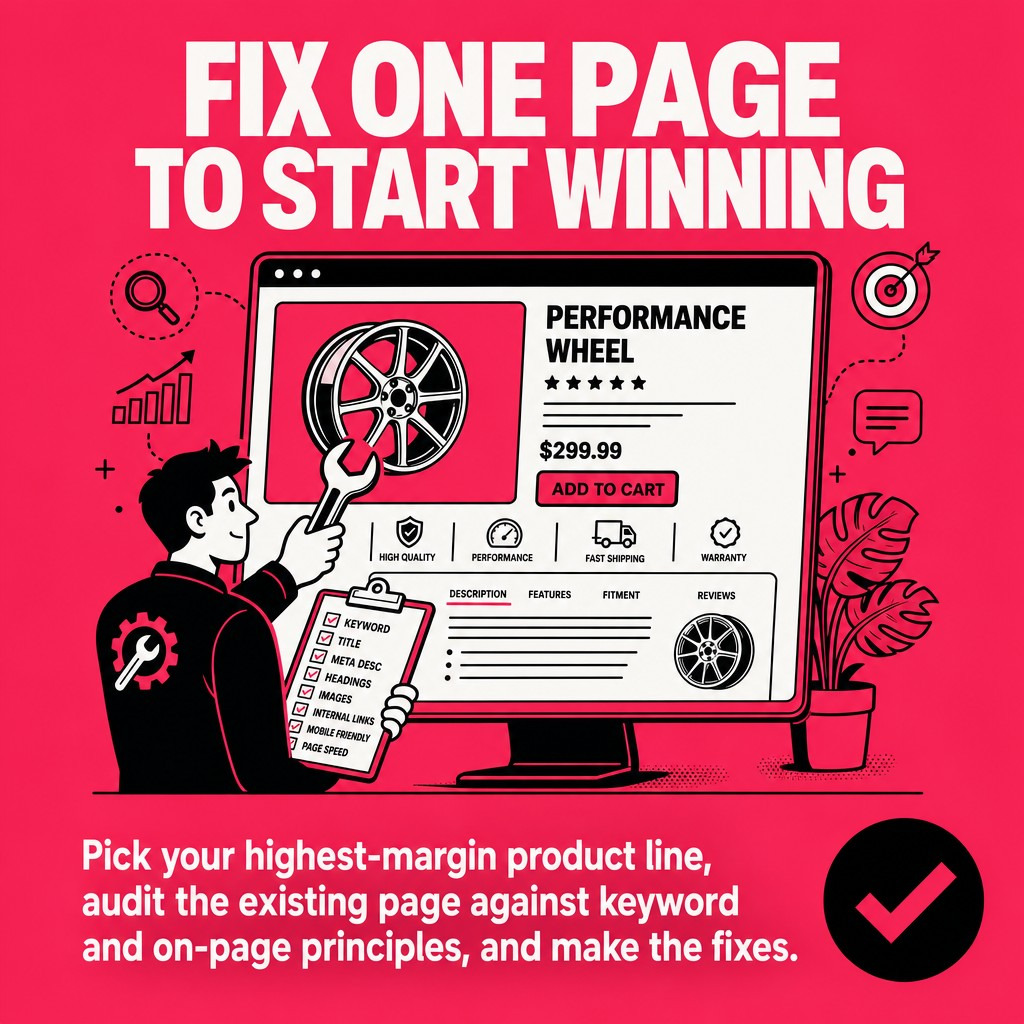
Start with one product category page today. Pick your highest-margin product line, audit the existing page against the keyword and on-page principles above, and make the fixes. That is your first win, and first wins have a way of building momentum.