Building materials SEO is the practice of optimizing your website so contractors, architects, specifiers, and dealers find your products through organic search before they ever call a sales rep. According to 6sense's 2025 B2B Buyer Experience Report, in 95% of B2B purchase cases, buyers ultimately purchase from one of four vendors on their "Day One" shortlist. If your brand isn't visible during that initial research phase, you're not losing deals at the finish line. You never entered the race.

I work with B2B brands selling products that contractors and architects specify, buy, and install. And the pattern I keep seeing is this: companies pour budget into trade shows and sales teams while their product pages sit at page four of Google, invisible to the buyers who've already made up their minds. This post lays out a direct strategy for fixing that.
Building materials SEO is a set of technical, content, and authority-building practices that help manufacturers, distributors, and suppliers rank in organic search for the queries their buyers actually use.
The market is enormous and moving fast. According to Precedence Research's building materials market report, the global building materials market was valued at $1.41 trillion in 2025 and is projected to reach $2.07 trillion by 2035. That's a lot of product decisions happening somewhere, and a growing share of them start with a search query.
The digital gap is still wide, but it's closing. Shopify's construction industry trends analysis puts only about 7% of B2B construction sales online today. But builders and contractors expect to source nearly half their materials online by 2030, according to Simon-Kucher's building materials supplier research. Brands that build SEO authority now will own those searches when the shift fully arrives.

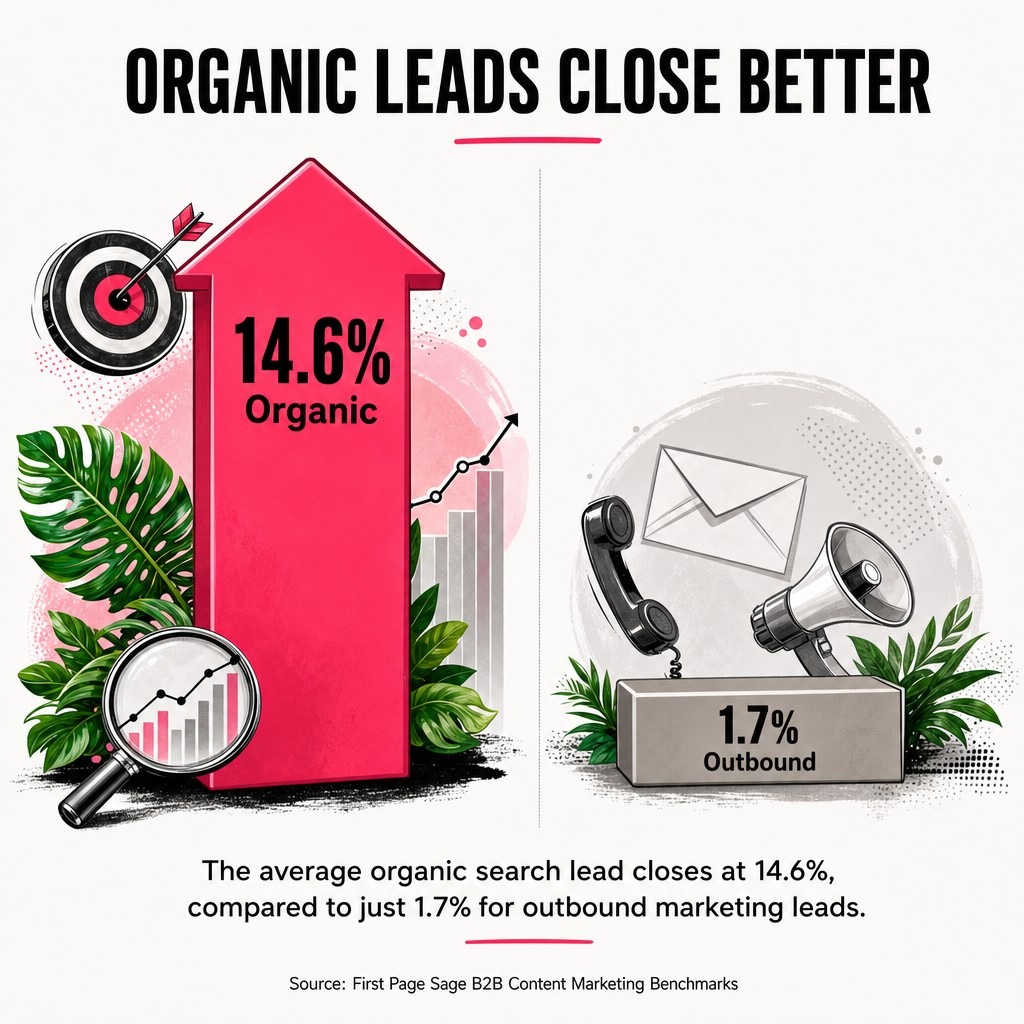
The organic channel delivers differently than outbound. First Page Sage's B2B content marketing benchmarks show the average organic search lead closes at 14.6%, compared to just 1.7% for outbound marketing leads. That's not a marginal improvement. It's a different class of buyer showing up at your door.
For a broader strategic view of how SEO fits alongside paid channels for building product brands, our guide on paid search for building products covers how the two work together.
Building materials SEO requires mapping content and keywords to four distinct buyer personas, each with different search behavior, different authority in the purchase decision, and different content needs.
Most SEO strategies treat the audience as one blob. In building materials, that's a costly mistake. A general contractor searching "bulk drywall pricing near me" is nowhere near the same buyer as an architect searching "fire-rated wall assembly specifications PDF." Both matter. Neither responds to the same content.

Search intent alignment is everything here. Contractors and architects aren't browsing. They're solving problems on active job sites or in active design phases. Content that answers a specific question beats generic category overviews every time.
Our SEO strategy guide comparing contractors vs. distributors goes deeper on how to split your keyword and content approach across these two very different B2B audiences.
Keyword research for building materials requires mapping product terminology, buyer personas, and purchase stages to find the specific search queries that drive commercial intent traffic.
Generic terms like "roofing materials" have volume but terrible conversion. The contractors and architects you actually want are searching for things like "standing seam metal roofing panel profiles" or "Class A fire-rated roofing underlayment specs." That specificity is where building materials SEO starts paying off.
We do marketing for construction supplies companies. SEO, PPC, analytics, and more.
Branded search terms include your company name or product line names. Non-branded terms are category, problem, or spec-based searches where buyers don't yet know who they'll buy from.
Both matter, but for different reasons. Branded terms are easier to rank for and signal existing demand. Non-branded terms build new reach. Most building materials companies dominate their own branded searches and ignore the non-branded queries where contractors and architects are comparing options.
Start your keyword research by pulling every product category you sell and building a keyword map that includes: the generic category term, spec-based variations, application-based phrases, and location-modified versions. Long-tail keywords like "tongue and groove cedar siding installation" or "R-38 blown-in insulation contractor pricing" convert far better than head terms and face less competition.
Long-tail keywords in building materials often mirror the technical language on your spec sheets and product data sheets. That's a direct advantage if you use it.
Architects search using terms from product libraries. Contractors search using trade terminology. Pull your product documentation and match those terms against keyword tools like Google Keyword Planner or Ahrefs to identify which technical phrases have real search volume. A product page that mirrors the exact language a specifier uses in their search query ranks and converts.


Product pages and category pages are the commercial core of building materials ecommerce SEO, and most brands underinvest in both relative to their blog content.
I see this constantly. A brand publishes twelve blog posts about "sustainable building trends" and then has category pages that read like inventory lists with three sentences of copy. Contractors and architects land on those pages and bounce. Google notices.
Each product page needs a unique H1 that includes the product name and primary descriptor, a meta description that answers the buyer's core question, structured spec data, and a clear path to download technical documentation or request a quote.
On-page SEO elements that matter most for building materials product pages include H1 tags with the full product name and key spec, meta descriptions that mention key performance attributes, header tags (H2/H3) breaking out specifications, applications, and installation notes, and internal links connecting to related products and category pages.
Schema markup on product pages tells search engines what you're selling in structured terms. Use Product schema with name, description, SKU, and where relevant, AggregateRating if you have reviews. For B2B ecommerce product pages, structured data helps Google present your products correctly in rich results.
Category pages serve two purposes in building materials SEO: they rank for broad category searches and funnel contractors and architects toward the right product pages.
A strong category page for, say, masonry products should open with a clear description of the category and who it's for, include internal links to subcategories (brick, block, stone, mortar), and contain enough content to demonstrate topical authority to both Google and a visiting architect. Thin category pages with no explanatory copy don't rank for competitive building materials search terms.
Technical SEO for building material websites covers the structural and performance factors that determine whether search engines can crawl, index, and rank your content at all.
Building materials sites have specific technical challenges. Large product catalogs create duplicate content risks. Downloadable spec sheets and PDFs need handling. Many sites run on legacy platforms that load slowly on mobile, which is exactly where contractors are searching from job sites.
Page speed matters more than most brands realize. Contractors searching for product availability on a mobile device while standing on a job site will not wait for a slow page. Google PageSpeed Insights will show you exactly where your site is losing speed and why.

Duplicate content is the most common technical SEO problem in building materials. Product variants, size options, and color options often generate near-identical pages that cannibalize each other. Use canonical tags to identify the primary version of each product URL. Make sure your site architecture allows Google Search Console to crawl and index all your important pages without wasting crawl budget on thin variants.
Schema markup at the site level extends beyond product pages. Use Organization schema on your homepage, LocalBusiness schema if you operate physical locations, and BreadcrumbList schema to help Google understand your category hierarchy. Structured data is one of the clearest signals you can send search engines about what your site contains and who it serves.
Mobile usability isn't optional. If your product pages require pinch-zooming to read spec tables on a phone, contractors won't use them. And Google won't rank them as highly as mobile-optimized alternatives.
For a deeper treatment of technical SEO in B2B contexts, our B2B SEO ranking guide for industrial companies covers site architecture and crawlability in detail.
Local SEO for building materials is the practice of optimizing your online presence so contractors and dealers in specific geographic areas find your locations, distribution points, and regional inventory through local search.
This is the most underused channel in building materials SEO. A roofing materials distributor with twelve regional locations often has one generic Google Business Profile for the corporate address. Meanwhile, contractors are searching "roofing supply near me" and landing on a competitor's optimized local listing instead.
Every physical location needs its own fully optimized Google Business Profile. That means accurate NAP (name, address, phone), category selection that matches what contractors search for, photos of the location and product inventory, and regular posts that mention current stock or promotions.

Local SEO for building material suppliers also requires building citations in relevant directories: construction supply directories, local chamber of commerce listings, and trade-specific platforms. Consistency in how your business name, address, and phone number appear across all platforms is a ranking signal Google weighs for local search results.
Geo-targeted landing pages serve contractors searching in specific markets. A page built around "masonry suppliers in [city]" or "lumber yard [metro area]" can rank for high-intent local searches that a generic product page never will.
If you sell through dealers, a well-structured dealer locator with individual dealer pages is both a user experience win and a local SEO asset. Each dealer page creates a geo-targeted content node that supports local search intent alignment for the surrounding region. Most brands treat the dealer locator as a widget. The smarter play is to treat each dealer page as a local landing page with its own content, keywords, and schema markup.
A content strategy for building materials SEO that earns topical authority combines product-adjacent expert content, application guides, comparison resources, and FAQ-format pages that match the specific questions contractors, architects, and specifiers search at every stage of the buying process.
HubSpot's 2024 marketing data identified websites, blogs, and SEO as the top marketing channels driving ROI for B2B brands. That shouldn't be surprising. But the difference between content that ranks and content that doesn't is specificity. A post titled "Types of Insulation" competes with every hardware retailer on earth. A post titled "Open-Cell vs Closed-Cell Spray Foam: Which Meets IECC 2021 Requirements?" speaks directly to the contractor or architect trying to answer a compliance question right now.
Application guides are the highest-value content format for building materials. They answer "how do I use this product for this specific job?" in the exact language contractors and architects use. They rank for long-tail keywords, build topical authority, and serve as internal linking anchors back to product and category pages.
Comparison content performs well because specifiers and architects frequently compare two products before writing a specification. "Fiber Cement vs Engineered Wood Siding: Fire Rating and Moisture Performance" is the kind of content that lands during the research phase and puts your brand on the shortlist.
FAQ pages built around the real questions contractors and architects ask during presales conversations are content gold. Pull questions from your sales team's inbox. Turn each one into a clear, direct answer. Group them by product category. That's a content cluster that supports both topical authority and featured snippet capture.
Our guide on B2B content marketing for manufacturers covers content cluster strategy and how to build out the supporting content that makes your primary pages rank faster.
Building backlinks for building materials SEO means earning links from trade publications, industry associations, product review platforms, and construction-adjacent media that Google recognizes as authoritative in the construction and building products space.
Generic link building advice doesn't apply here. You don't need links from lifestyle blogs. You need links from Architectural Record, Construction Dive, Builder magazine, the NAHB, regional construction associations, and the spec databases architects actually use. One link from a relevant trade publication is worth more than fifty links from unrelated directories.
Product inclusion in industry databases and specification platforms like ARCAT or Sweets creates authoritative backlinks and puts your products in front of architects and specifiers during the spec-writing phase. These aren't just links. They're placement in the exact research workflow your buyers use.
Trade publication contributed content earns links and credibility simultaneously. A technical article in a roofing or masonry trade journal demonstrates expertise to both human readers and search engines. It's the building materials equivalent of a peer review. The bar is high, but the payoff is a backlink from a domain that contractors and architects already trust.
Supplier and manufacturer co-marketing creates natural backlink opportunities. If you manufacture a product that integrates with complementary products, a joint technical guide earns links from both parties' audiences. Contractors and architects appreciate content that solves installation challenges across product systems, not just individual products in isolation.
And don't overlook your existing relationships. Dealers who carry your product and associations you belong to often have websites with relevant linking opportunities that brands simply never ask about.
Building materials SEO rewards brands that commit to it systematically, not brands that publish a few blog posts and hope for the best.
The opportunity is real and the timing is right. Sana Commerce's B2B ecommerce construction research found that 84% of construction suppliers anticipate moving all their sales online eventually. And SEOProfy's B2B SEO data shows 67% of B2B buyers already start their purchase journeys online. The contractors and architects you want are searching. The question is whether they're finding you or your competitors.

Start with a technical SEO audit using Google Search Console. Fix crawl errors, identify thin product pages, and address any mobile usability issues. That's your foundation. Then build out your keyword research map by persona: contractors, architects, specifiers, and dealers each get their own keyword clusters. From there, optimize your product pages and category pages before you write a single new blog post. Content strategy on top of a broken product catalog is effort in the wrong order.
Local SEO for building material suppliers is the fastest win for most brands. Claim and optimize every Google Business Profile for every physical location this week. It's free, it's fast, and most of your competitors haven't done it properly.

For brands selling through construction channels, our construction company marketing guide covers how SEO fits within a broader lead generation strategy for reaching contractor audiences at scale.
Building materials SEO isn't a quick fix. But brands that build technical foundations, optimize their product and category pages, create expert content that answers real buyer questions, and earn authoritative backlinks from trade sources will own their category searches for years. Start with the foundation. The rest follows.