

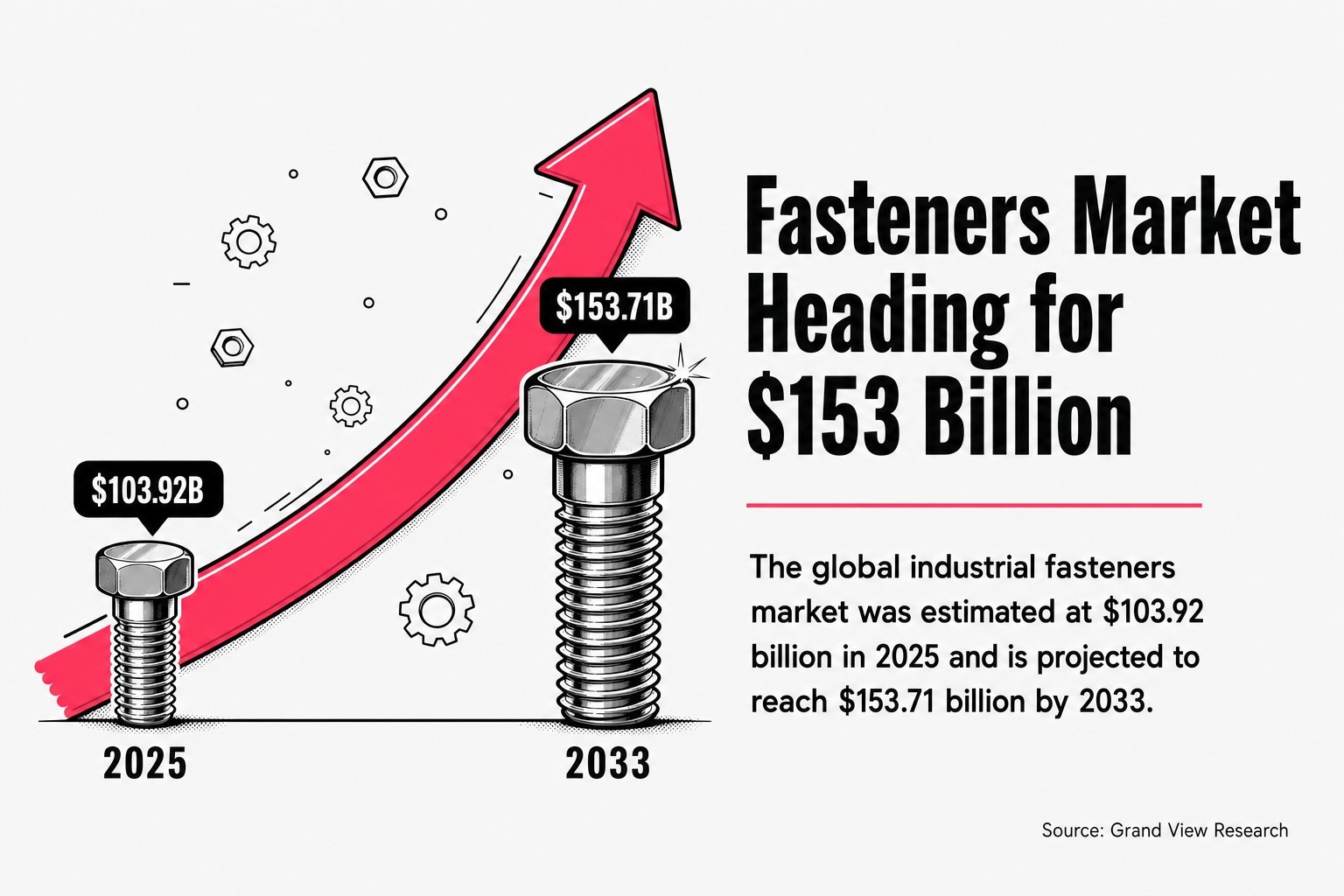
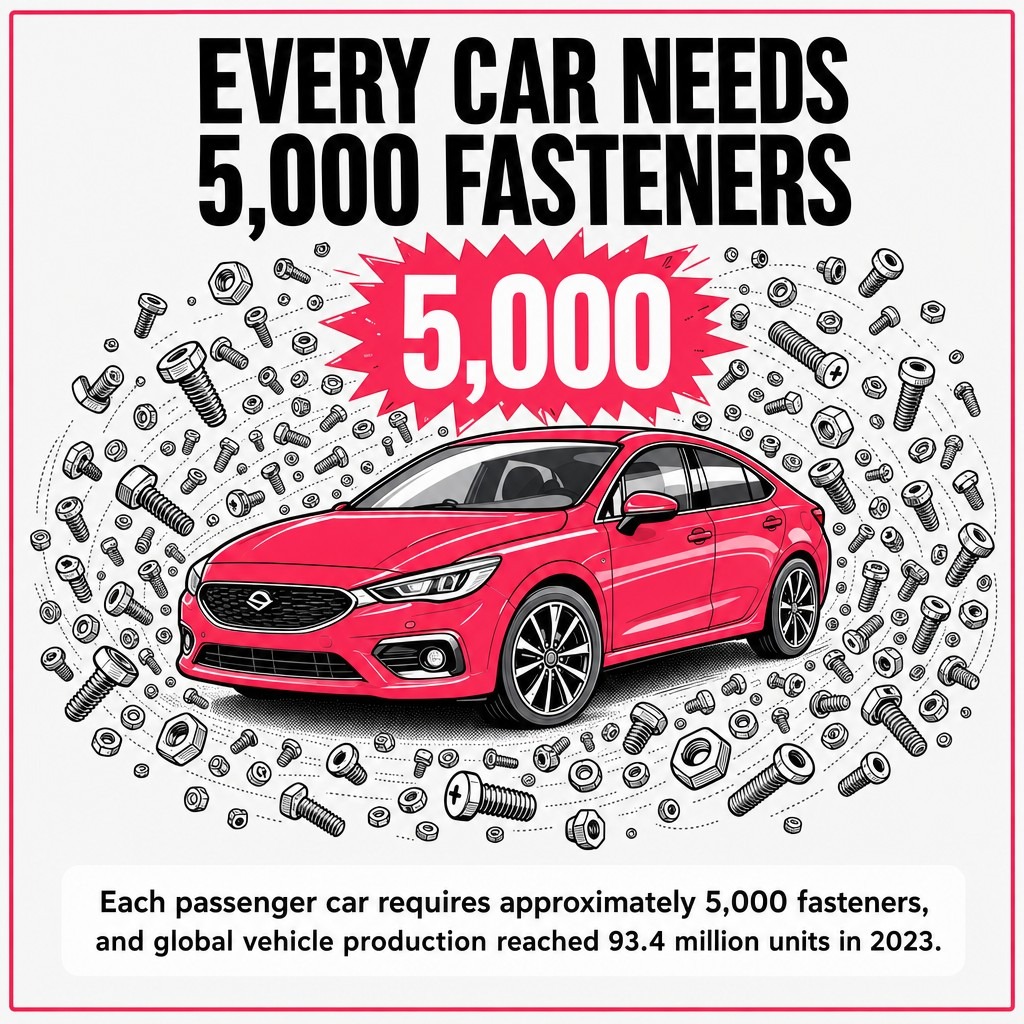
The global industrial fasteners market was estimated at $103.92 billion in 2025 and is projected to reach $153.71 billion by 2033, according to Grand View Research's industrial fasteners market analysis. The U.S. market alone sits at $17.78 billion in 2025, on a path to $28.10 billion by 2033. Metal fasteners hold 91.0% of market share today, while plastic fasteners are growing at the fastest CAGR of 5.8%. The automotive sector drives enormous demand, with each passenger car requiring approximately 5,000 fasteners and global vehicle production reaching 93.4 million units in 2023.
And yet, most fastener manufacturers market like it's still 2005. A brochure PDF on a website nobody finds, a trade show booth that costs $40,000, and a sales rep who calls the same ten contacts every quarter. The market is enormous. The marketing, often, is not. This guide bridges that gap, with the data, strategy, and specific steps you need to grow your share of a very large pie.
The global industrial fasteners market is on a clear growth trajectory, with one research firm projecting it will grow from $92.13 billion in 2026 to $113.33 billion by 2031, according to Mordor Intelligence's industrial fasteners market report. That's a significant amount of procurement happening somewhere, and the question is whether buyers can find your catalog or your competitor's.
To put the automotive opportunity in concrete terms: 93.4 million vehicles were produced globally in 2023, each needing roughly 5,000 fasteners. That's a demand base measured in the hundreds of billions of individual units, before you factor in aerospace, construction, renewable energy, or electronics.
The material split tells an important story for product strategy. Metal fasteners, specifically steel, stainless steel, aluminum, and titanium variants, dominate with 91.0% market share. Plastic fasteners, the smaller slice, are growing fastest at a 5.8% CAGR, per Grand View Research's press release on the global industrial fasteners market. That gap between dominance and growth rate is worth paying attention to when planning your product line expansion.
Asia Pacific leads global production and consumption. China and India are the primary manufacturing centers, and their continued infrastructure investment and EV expansion are keeping demand high. For fastener suppliers with international ambitions, or those looking to understand where pricing pressure originates, APAC dynamics matter deeply.
Electric vehicle production reached 14.2 million units in 2025, up from 13.6 million units in 2024, according to DataIntelo's automotive fasteners market report. EVs don't just need bolts and screws, they need specialized, lightweight, corrosion-resistant fasteners suited to battery enclosures, electric drivetrains, and aluminum-intensive body structures.
This is not a small distinction for fastener manufacturers. The specifications for an EV platform can differ substantially from a traditional internal combustion vehicle. Fastener suppliers who get ahead of those specs, and who can demonstrate compliance and precision engineering, will own the OEM relationships that last the next two decades.
For fastener marketing specifically, this creates a real content opportunity. Engineers searching for EV-compatible fastener specifications, torque standards, or material certifications are high-intent buyers. They're doing technical research before they ever contact a sales rep. If your website answers those questions, you're already in the room.
Aerospace demand for titanium fasteners and high-strength bolts and screws remains strong. Safety certification requirements mean procurement managers in aerospace and defense don't switch suppliers casually, which is actually good news for incumbents and a significant barrier for new entrants. If you're trying to break in, your marketing must emphasize traceability, certification documentation, and precision engineering credentials above all else.
Renewable energy adds another angle. Wind turbines require anti-corrosion, long-life fasteners capable of surviving decades in harsh environments. Solar installation is more volume-driven. Both are growing, both are opportunities, and neither segment is well-served by fastener suppliers who only speak "automotive" in their marketing materials.
According to a Gartner survey, 67% of B2B buyers now prefer a rep-free buying experience, meaning the majority of your prospects want to research, evaluate, and sometimes purchase without ever speaking to a human salesperson, per Gartner's sales survey findings. For fastener manufacturers who rely almost entirely on field sales and trade show relationships, that stat should feel like a cold shower.
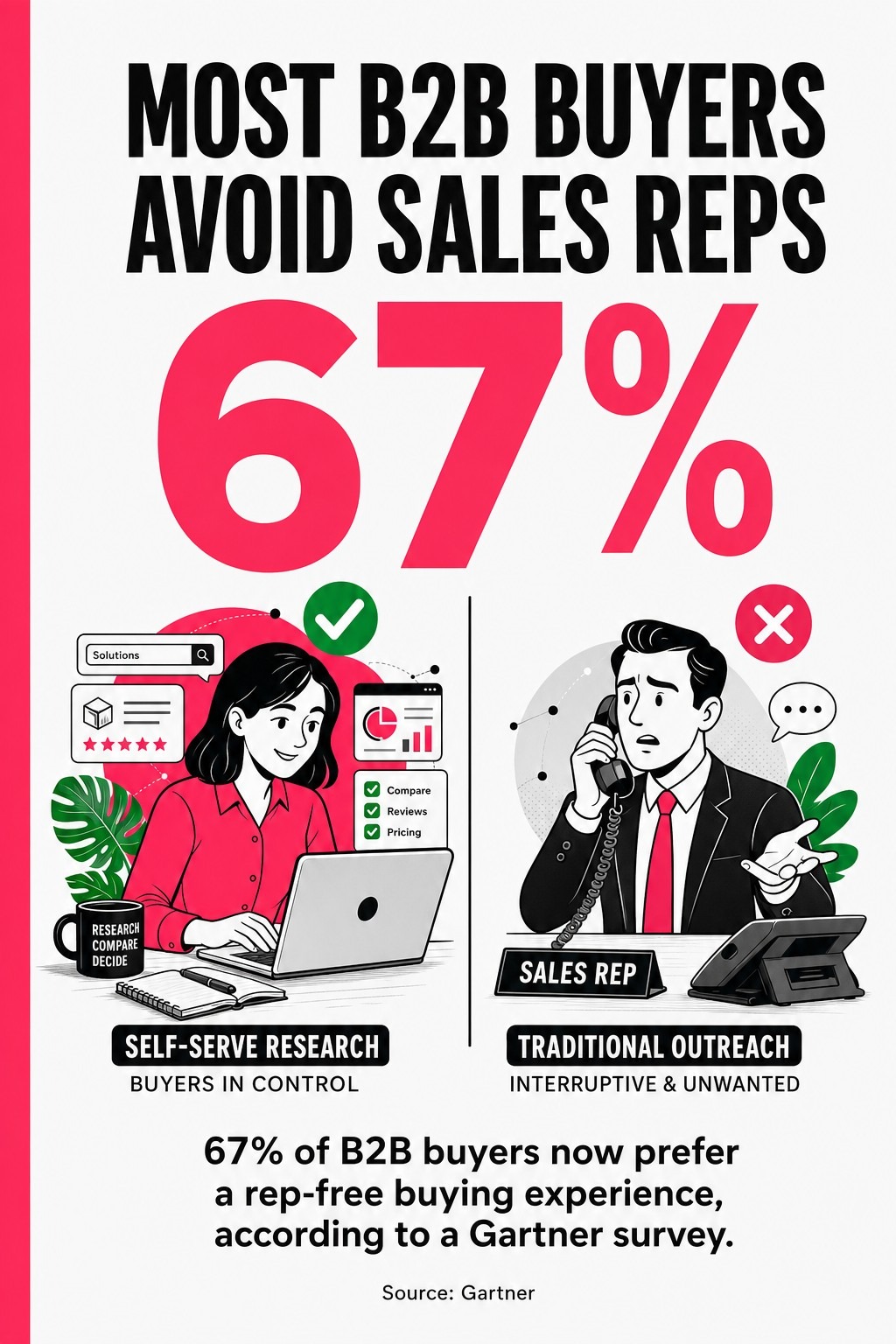
The implication is direct: if your website isn't doing sales work, you're losing prospects before a conversation ever starts. A procurement engineer at a Tier-1 automotive supplier isn't calling your rep to ask about thread pitch. They're searching, comparing specs, downloading datasheets, and building a shortlist, all without you knowing.
There's also a trust problem hiding in your current setup. Gartner's research found that 69% of B2B buyers report inconsistencies between information on a sales organization's website and what their sellers tell them, according to Gartner's B2B buyer research on website and seller information consistency. Nearly seven in ten buyers catch the contradiction. That kind of mismatch kills deals silently. You never know why the RFQ didn't come back.
Fixing this is both a technical and a marketing task. Your website's product data, certifications, tolerances, and material specs need to match exactly what your sales team quotes. That alignment alone puts you ahead of most fastener suppliers competing for the same accounts. For a deeper look at how industrial companies tackle this, the complete guide to industrial manufacturing marketing and ecommerce covers the full digital infrastructure question.
E-commerce is no longer just for consumer products. B2B buyers increasingly expect to place orders online, track shipments, and reorder standard fastener SKUs without calling anyone. For fastener suppliers who sell commodity bolts and screws alongside engineered specials, a two-track approach makes sense: self-serve checkout for standard products, consultative selling for custom or high-spec orders.
The distribution channel question matters for B2B leads too. Direct digital sales generate first-party data on what buyers are looking for, when they're searching, and what specs they care about. That data is marketing gold if you know how to use it for segmentation and remarketing.
Effective fastener marketing starts with knowing exactly which segment you're selling into, because "industrial fasteners" as a category covers everything from construction grade hex bolts to aerospace-certified titanium fasteners, and those buyers have almost nothing in common beyond the word "fastener."
The mistake most fastener manufacturers make is writing generic marketing content that speaks to everyone and converts nobody. A structural engineer sourcing anchor bolts for a bridge project has different pain points, different technical requirements, and different approval processes than an electronics OEM sourcing plastic fasteners for a consumer device enclosure.
Metal fasteners, covering steel, stainless steel, aluminum, and titanium, dominate the market and span the widest range of applications. Your marketing for metal fasteners should lean on strength specs, corrosion resistance certifications, and application-specific case data. Stainless steel fasteners marketed to food processing customers need to emphasize hygiene certifications. Titanium fasteners marketed to aerospace need to lead with weight savings and fatigue performance data.
Plastic fasteners are the growth segment, expanding at a 5.8% CAGR. The buyers here often come from electronics, automotive interiors, and medical device manufacturing. Their priorities are weight, chemical resistance, and non-conductivity. If you make plastic fasteners and you're marketing them the same way you market your steel line, you're leaving B2B leads on the table.
The automotive sector generates enormous fastener demand. As noted earlier, each passenger car needs around 5,000 fasteners, and global vehicle production is in the tens of millions annually. Marketing to automotive OEMs and Tier-1 suppliers means speaking the language of IATF 16949 certification, just-in-time delivery, and continuous improvement programs.
Aerospace buyers prioritize traceability and documentation over price. If you supply aerospace, your website should make it effortless to find your certifications, material test reports, and DFARS compliance status. That information should not be buried in a PDF nobody can find.
Construction and infrastructure procurement is often volume-driven and price-sensitive, but renewable energy is changing that within the sector. Wind farm developers need long-life fastener solutions with documented corrosion performance, and they're willing to pay for reliability over pure unit cost. That's a positioning opportunity for fastener suppliers with proven outdoor and marine-grade products.
For a detailed breakdown of how to structure your B2B SEO around these segments, the B2B SEO guide for industrial companies walks through the ranking strategy step by step.
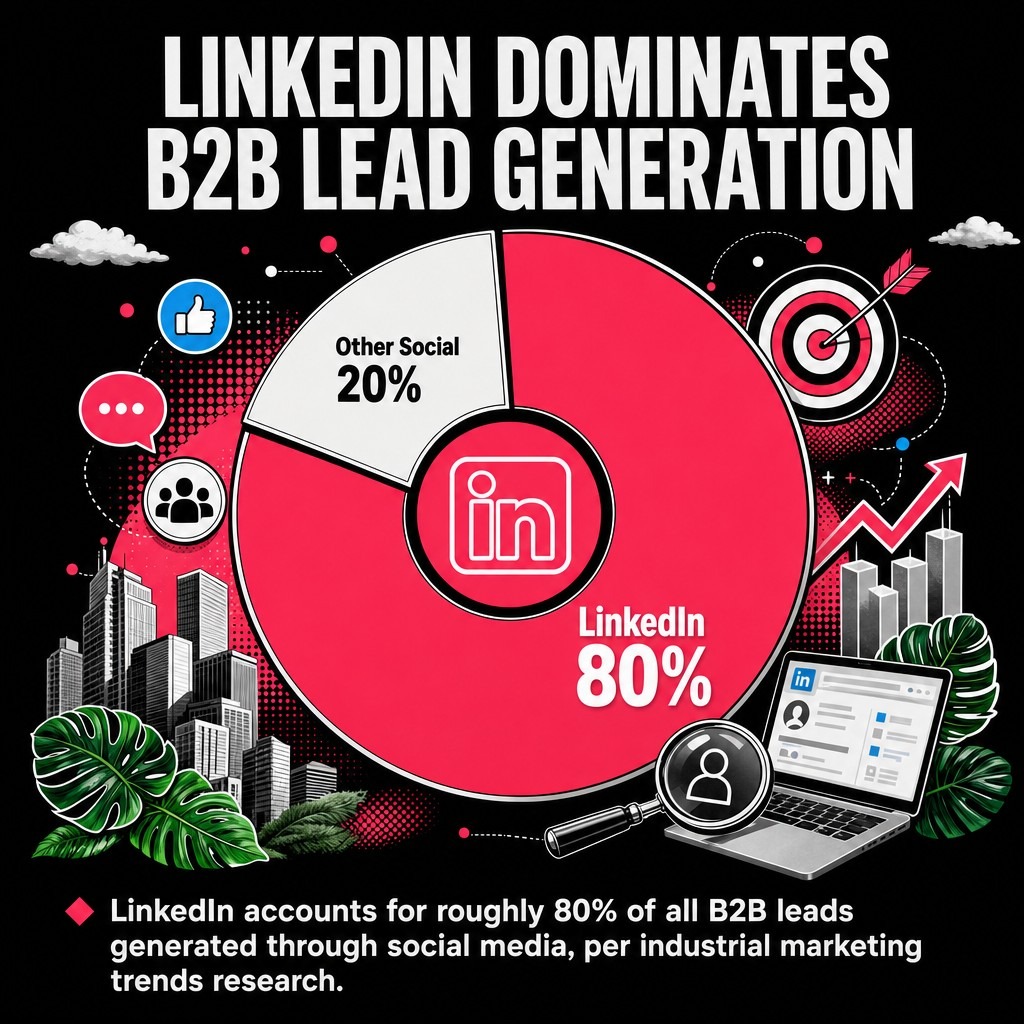
LinkedIn accounts for roughly 80% of all B2B leads generated through social media, according to industrial marketing trends research. For fastener manufacturers, that's not a statistic to file away, it's a direct instruction about where to spend your time and budget online.
Most fastener companies have a LinkedIn Company Page that posts once a month and gets twelve impressions. That's not LinkedIn marketing. Real LinkedIn strategy means your sales engineers are active, your company posts technical content worth sharing, and you're running targeted campaigns against job titles like "Procurement Manager," "Design Engineer," and "Manufacturing Director" at companies in your target verticals.
The highest-return activity on LinkedIn for fastener suppliers isn't paid ads. It's individual seller activity. When your engineers and sales reps share a post explaining why a specific thread form is better for aluminum assemblies, or what to consider when selecting fasteners for an EV battery pack, they attract exactly the audience you want: technical buyers who are actively thinking about fastener specifications.
Build a 90-day content plan for your key people. Four posts per month per person, covering product education, application examples, industry standards commentary, and company news. That's 48 posts per quarter if you have three active contributors. Consistency matters far more than production quality on LinkedIn. A photo of a fastener next to an installation example with a two-paragraph technical explanation outperforms a polished graphic with a generic caption every single time.
Pair that organic activity with targeted LinkedIn Lead Gen Forms. Set your audience to procurement and engineering titles in automotive, aerospace, or construction depending on your focus, filter by company size and geography, and offer something genuinely useful: a material selection guide, a torque specification chart, or a certification comparison sheet. Those documents cost you almost nothing to produce and attract the buyers who matter most.
A procurement engineer searching for "M12 stainless steel flange bolt DIN 6921" knows exactly what they want. If your website doesn't have a product page optimized for that search, you're invisible to them. And your competitor, the one who invested in product data and SEO, gets the RFQ.
Industrial fastener SEO is fundamentally a product data problem. Your catalog likely contains thousands of SKUs. Each one is a potential search entry point if you have the right title, spec data, and associated content. For the tactical approach to making this work, industrial SEO and product data for lead generation covers the mechanics in detail.
Long-tail search terms drive the most qualified traffic in fastener sales. Someone searching "hex cap screw grade 8 zinc plated bulk pricing" is much closer to buying than someone searching "fasteners." The volume is lower but the conversion intent is far higher. Building content and product pages around these specific terms is one of the highest-ROI investments a fastener supplier can make online. The long-tail keyword guide for industrial products explains how to find and prioritize these terms systematically.
Email remains one of the most cost-effective channels for fastener marketing, but only when the list is segmented properly. Sending the same newsletter to an aerospace procurement manager and a residential construction buyer is the equivalent of handing both of them the same product catalog and hoping one of them finds something relevant.
Segment your email list by industry vertical, by purchase history (commodity buyer vs. engineered specials), and by funnel stage. A prospect who downloaded a material selection guide needs different content than an existing account who last ordered six months ago. Map your email sequences to those distinctions and your open rates will improve, your unsubscribes will drop, and your B2B leads will increase.
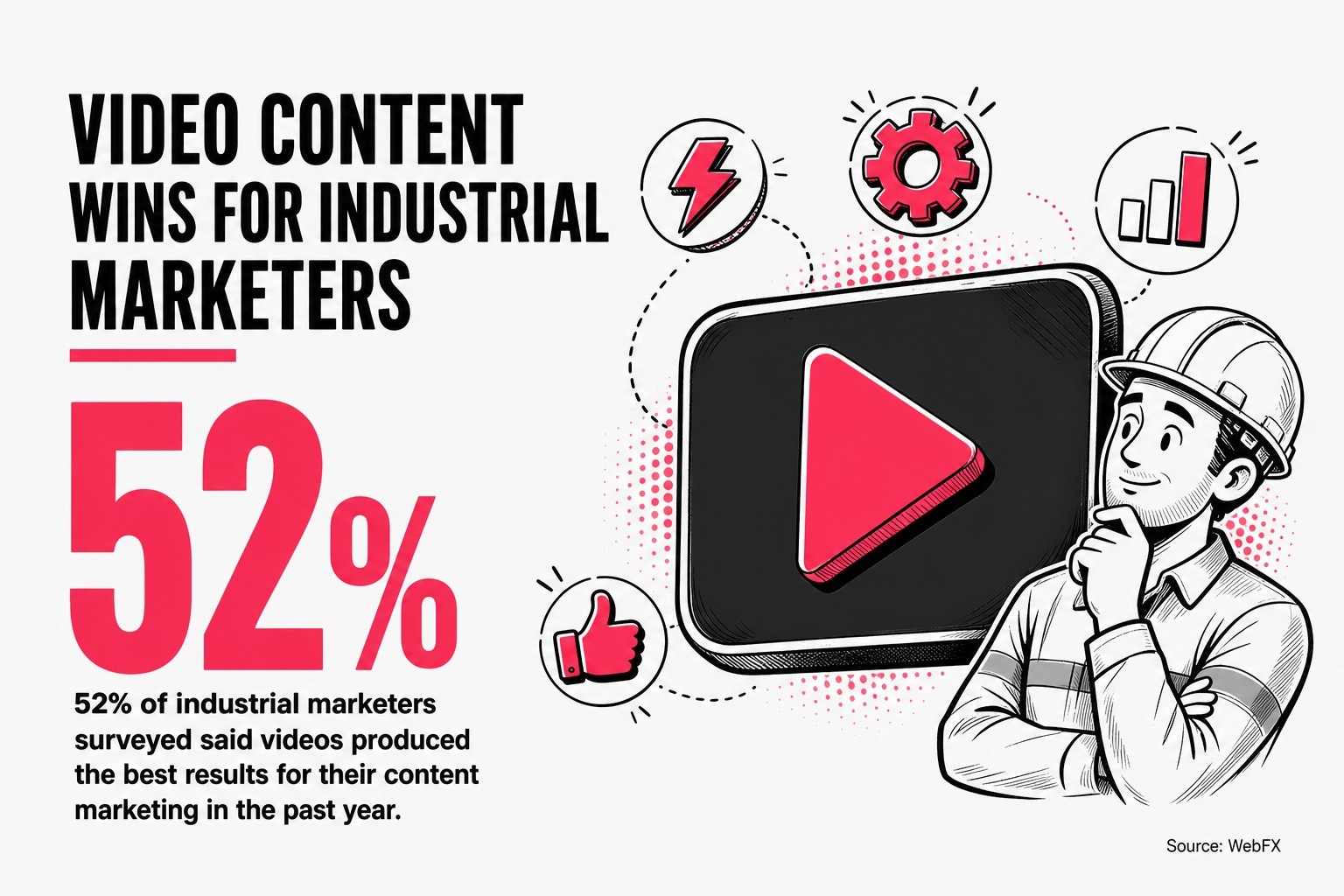
The majority of industrial marketers surveyed, 52%, said that videos produced the best results for their content marketing in the past year, according to WebFX's industrial marketing statistics research. If you assumed that fastener buyers don't watch videos, the data says otherwise. They absolutely do, especially when the video shows them something useful.
Authority in the fastener market is built by being the most useful source of technical information in your niche. That sounds obvious. The execution is where most manufacturers stop short.
The videos that perform best for industrial fastener brands are not company overview videos. They're technical explainers. A three-minute video explaining the difference between Grade 5 and Grade 8 bolts, or demonstrating proper installation torque for a flange nut, will accumulate more relevant search traffic than any brand video you produce.
Post those videos on YouTube with descriptive titles optimized for the searches your buyers make. Embed them on the relevant product pages of your website. Share them via LinkedIn with a brief written explanation. One well-executed technical video does triple duty across three channels with minimal additional effort.
Fastener failure analysis is another strong content angle. An engineer who just had a joint failure on an assembly is searching desperately for answers. If your content explains common causes, whether that's improper preload, incorrect thread engagement, or galvanic corrosion between dissimilar metals, you've just helped them solve a real problem. That kind of help builds the trust that converts to a supplier relationship.
Downloadable technical content serves two purposes simultaneously. First, it provides genuine value to engineers who need reference material. Second, it captures contact information when gated behind a simple form, generating B2B leads for your sales team to follow up.
The key word there is "genuine value." A spec sheet that's already available from any distributor doesn't earn a form fill. A curated torque specification guide covering your full range across multiple material grades, formatted for easy workshop use, absolutely does. Put the work in and the download rates will reflect it.
Case studies, even brief one-page versions, also work well. A documented example of a fastener solution that solved a specific application problem, with the customer's permission, carries more persuasive weight than any product description you write. Engineers trust peer experience. Give them something to trust.
Asia Pacific leads the global industrial fasteners market in both production volume and consumption, driven by manufacturing concentration in China, India, Japan, and South Korea. For fastener manufacturers based in North America or Europe, this creates both a competitive pressure from lower-cost APAC producers and an opportunity to compete on quality, certification, and supply chain reliability.
The U.S. market, at $17.78 billion in 2025 and growing toward $31.54 billion by 2035, per SNS Insider's industrial fasteners market report, represents a significant domestic opportunity for American fastener suppliers who can emphasize compliance, domestic sourcing, and supply chain security. Post-pandemic reshoring sentiment has made "made in America" a genuine procurement criterion for many buyers, particularly in defense-adjacent and critical infrastructure markets.
For North American fastener suppliers targeting domestic OEMs and distributors, the competitive message should center on supply chain reliability, faster lead times, and domestic compliance. DFARS compliance for defense contracts, Buy American requirements for infrastructure projects, and the ability to support rapid engineering changes without international shipping delays are all legitimate differentiators worth building into your marketing materials.
Trade shows remain part of the North American fastener marketing mix, with events like the International Fastener Expo providing concentrated access to distributors, OEMs, and buyers across multiple verticals. The smart play is to treat the trade show as a lead-generation event rather than a brand awareness event, and have a digital follow-up sequence ready to activate the day after the show floor closes.
European fastener buyers operate in a heavily regulated procurement environment. REACH compliance, RoHS for electronics applications, and EN standards matter as much as price. Marketing materials aimed at European buyers should make regulatory compliance information easy to find, not buried in a downloadable certificate that requires a sales conversation to obtain.
APAC market share opportunities for non-APAC fastener suppliers typically center on premium engineered segments, aerospace, medical, and high-precision automotive, where price competition from APAC producers is less intense and specification requirements favor established Western certification frameworks. If you're targeting APAC buyers, your digital presence in English needs to be strong, and a localized landing page strategy for key markets adds meaningfully to your reach.
The industrial fasteners market grows when manufacturing grows, and right now three specific forces are pulling demand forward: electric vehicle adoption, renewable energy infrastructure build-out, and infrastructure investment across major economies. Each one has direct implications for how fastener manufacturers should position their products and their brand.
Electric vehicle production hit 14.2 million units in 2025, requiring fastener innovation in lightweight materials, battery enclosure sealing, and thermal management assemblies. The marketing implication: if you supply EV-ready fasteners, say so explicitly. Name the vehicle platforms or application types your products suit. Engineers designing EV assemblies are searching for specific solutions, not generic fastener suppliers.
Renewable energy procurement, particularly wind turbine manufacturing, requires fasteners that can perform for 20-plus years in exposed environments. Anti-corrosion coatings, hot-dip galvanizing, and stainless steel grades suitable for offshore installations are all legitimate product differentiators with strong search demand from buyers in this sector.
Green manufacturing credentials are also increasingly relevant to procurement teams under ESG reporting pressure. If your fastener production uses recycled steel, lower-emission processes, or documented environmental management systems, those facts belong in your marketing. They won't close a deal on their own, but they remove objections from procurement teams who now have to justify supplier choices to sustainability committees.
Raw material price volatility, specifically steel and aluminum, is a persistent operational challenge for fastener buyers. Procurement managers who've been burned by supply disruptions are actively looking for suppliers with more resilient supply chains, domestic inventory depth, or vertical integration that reduces exposure to spot market pricing.
If your business has genuine supply chain advantages, inventory programs, preferred raw material partnerships, or domestic production, those are marketing messages, not just sales talking points. Put them on your website. Write a case study about how a customer avoided a production shutdown because you had stock when nobody else did. That story does more heavy lifting than a product brochure.
The industrial fasteners market includes several major players whose marketing approach reflects both their scale and their target customer segments. Illinois Tool Works, Stanley Black and Decker, SFS AG, and LISI Group are among the names that appear consistently in market analyses, and their strategies offer useful signals for fastener manufacturers of all sizes.
Large players compete on breadth of catalog, global distribution, and brand recognition built over decades. Smaller and mid-sized fastener manufacturers can't replicate that, and they shouldn't try. The competitive advantage for a specialized fastener supplier is depth, not breadth. Deep expertise in a specific material, a specific application, or a specific industry vertical is a more defensible position than trying to be the low-price generalist.
Quality assurance and anti-counterfeiting certification are genuine differentiators in markets where counterfeit fasteners create real safety risk. Aerospace and defense buyers already require strict traceability. Automotive buyers are increasingly asking for it. If your quality system includes certificate of conformance documentation, lot traceability, and third-party testing, your marketing should make that process transparent and easy to verify.
Acquisitions have shaped the competitive structure of the industrial fasteners market significantly. Larger players grow through acquisition of specialized suppliers, which creates two dynamics for smaller manufacturers: the risk of being outcompeted, and the opportunity to be acquired if you build enough niche authority and customer concentration to be worth buying. Either way, the answer is the same: build the strongest possible position in your specific niche.
The fastener companies winning online share a few observable traits. Their websites are searchable by specification, not just by product name. Their content addresses real technical problems buyers face. Their sales team is active on LinkedIn with real technical knowledge, not just company updates. And their product data is consistent, accurate, and complete across every channel.
None of that requires a massive marketing budget. It requires commitment to doing the unsexy work: writing accurate product specs, filming useful technical videos, maintaining a segmented email list, and posting consistently on LinkedIn. For the full digital marketing strategy framework that ties these together, the industrial digital marketing guide for 2026 covers each channel with specific implementation steps.
And if you want to see what happens when an industrial B2B company actually executes this kind of strategy well, the case study on 3x revenue growth for a B2B industrial supplies distributor makes the numbers real.
The industrial fasteners market is genuinely large, growing, and full of buyers who are actively searching for suppliers online. The problem is that most fastener marketing isn't built for how those buyers actually buy now, which is digitally, often without talking to a sales rep, and with a high tolerance for switching suppliers when a competitor's website is simply more useful.
Start with the highest-leverage fix: audit your website's product data for completeness and consistency. If your spec pages are thin and your certifications are hard to find, that's the first thing to fix, before social media, before email, before anything else. A buyer who lands on your product page and can't find the torque spec or material certification will leave in under thirty seconds.
From there, pick one content format and commit to it for 90 days. Video if your team has any comfort with it, technical blog posts if they don't. The goal is to become the most useful fastener resource for one specific buyer type in one specific vertical. Own that lane. Expand later.
The market will grow with or without your marketing effort. The question is whether that growth benefits you or your competitors. For a detailed look at how these digital marketing tactics apply specifically to industrial fastener marketing trends, the fastener industry marketing trends guide is the right next read.
You've got the market data. You've got the strategy. A market this large rewards the suppliers who show up consistently online with useful content and accurate product information. That's a solvable problem. Go solve it.