

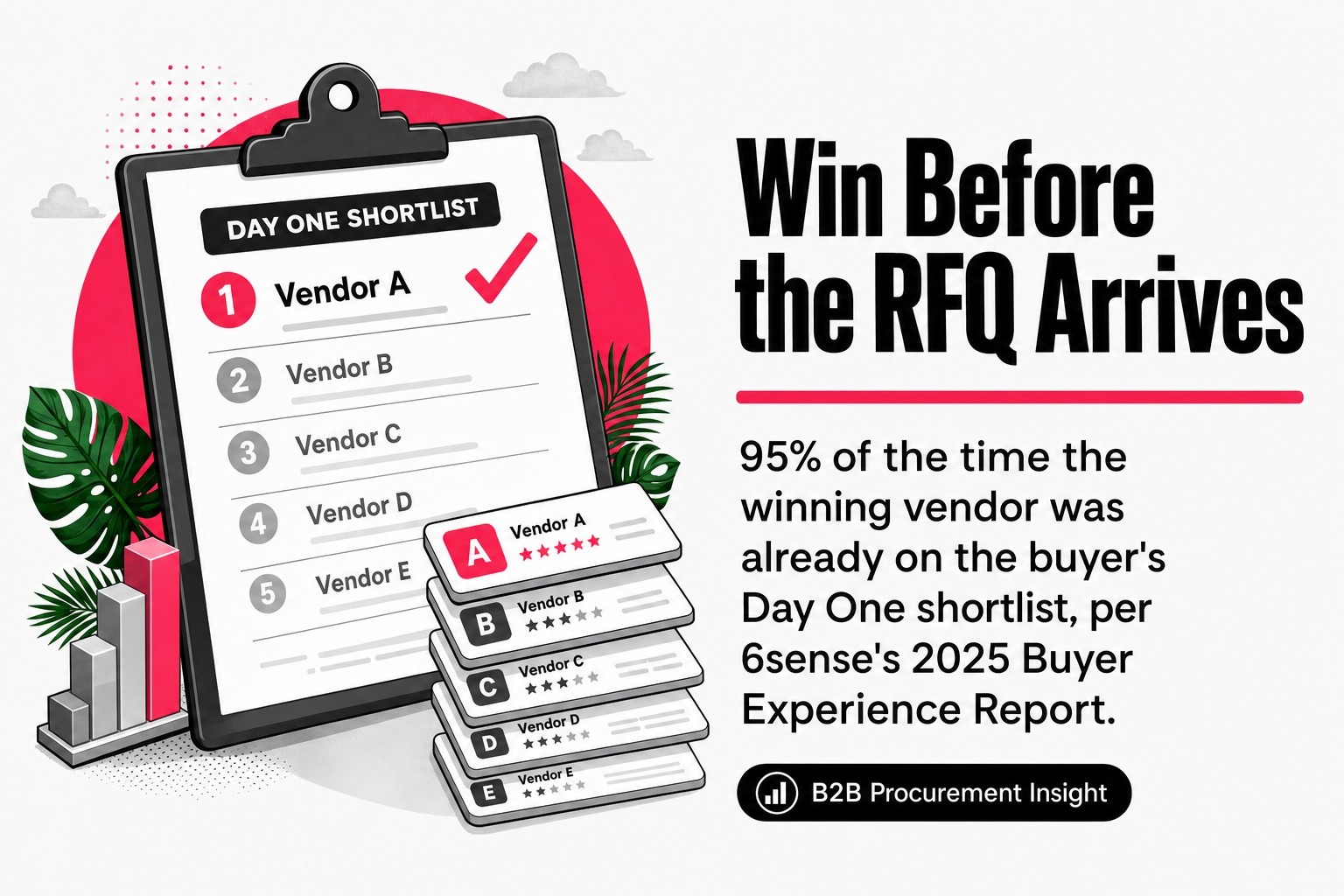
Fastener manufacturers who want more B2B leads need to get onto OEM procurement shortlists before buyers begin their formal vendor search. According to 6sense's 2025 Buyer Experience Report, 95% of the time the winning vendor was already on the buyer's Day One shortlist, meaning the real competition happens long before a single RFQ lands in your inbox. The OEM sales channel alone commanded 69.23% of the industrial fasteners market in 2025, per Mordor Intelligence. Winning in this market is not about cold calling harder. It is about being visible, credible, and positioned before the procurement team even opens a spreadsheet.
I work with manufacturers every day who have excellent products and zero pipeline. Not because their fasteners are bad. Because nobody outside their existing accounts knows they exist. That gap between capability and visibility is exactly what this guide addresses.
Traditional outbound tactics like cold calls, trade show booths, and distributor catalogs have lost their grip on modern OEM procurement teams, and the data explains why.
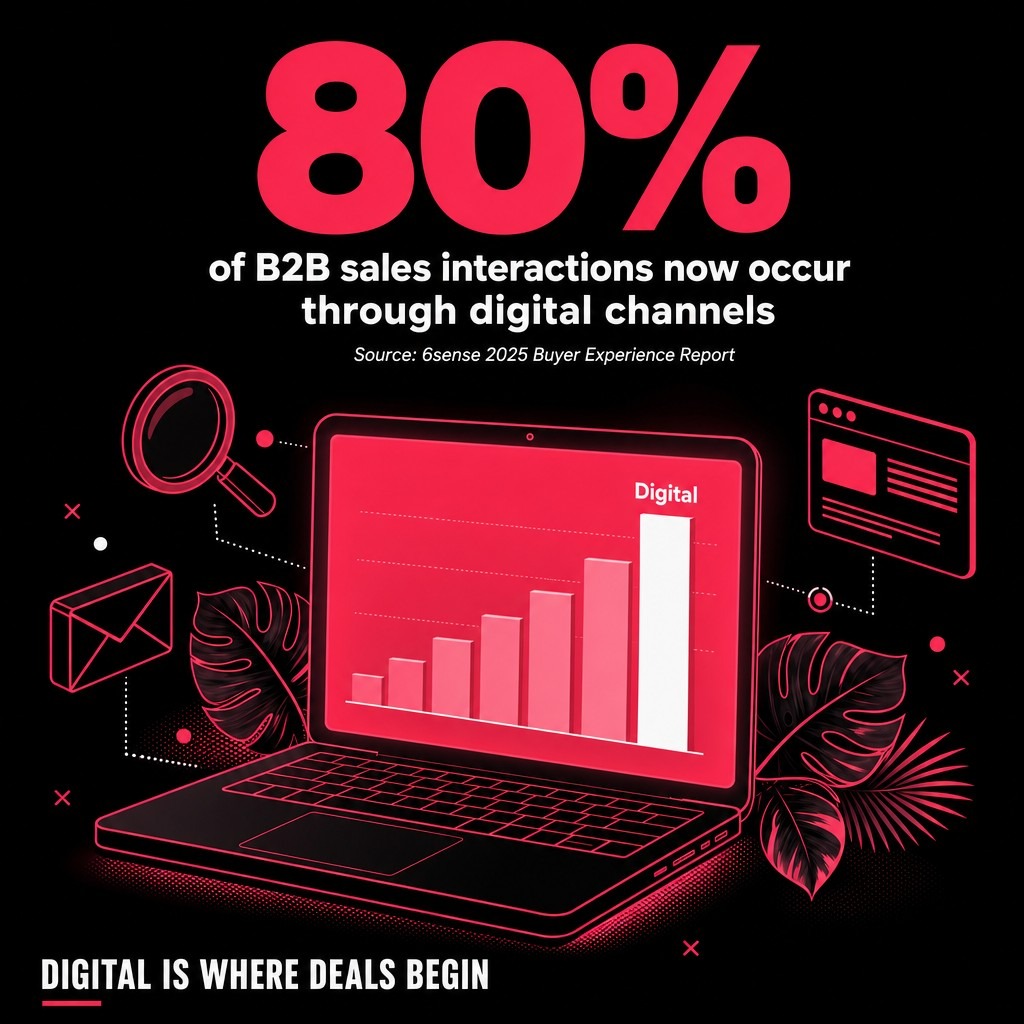
According to 6sense's 2025 Buyer Experience Report, 80% of B2B sales interactions now occur through digital channels. That is not a trend still forming. That is the current reality of how industrial buyers work. The procurement engineer at an automotive Tier 1 supplier is not waiting for your rep to call. They are running searches, reading technical content, and building their vendor shortlists on their own time.
Trade shows still have value for relationship maintenance. But they are poor primary lead generation channels for fastener manufacturers trying to reach new OEM accounts. The buyers you want are usually not walking the floor. They are back at their desks approving specs.
The old model assumed buyers needed you to find them. The new model requires you to be found first. For manufacturing lead generation to actually work, you need digital assets that work while your sales team sleeps.
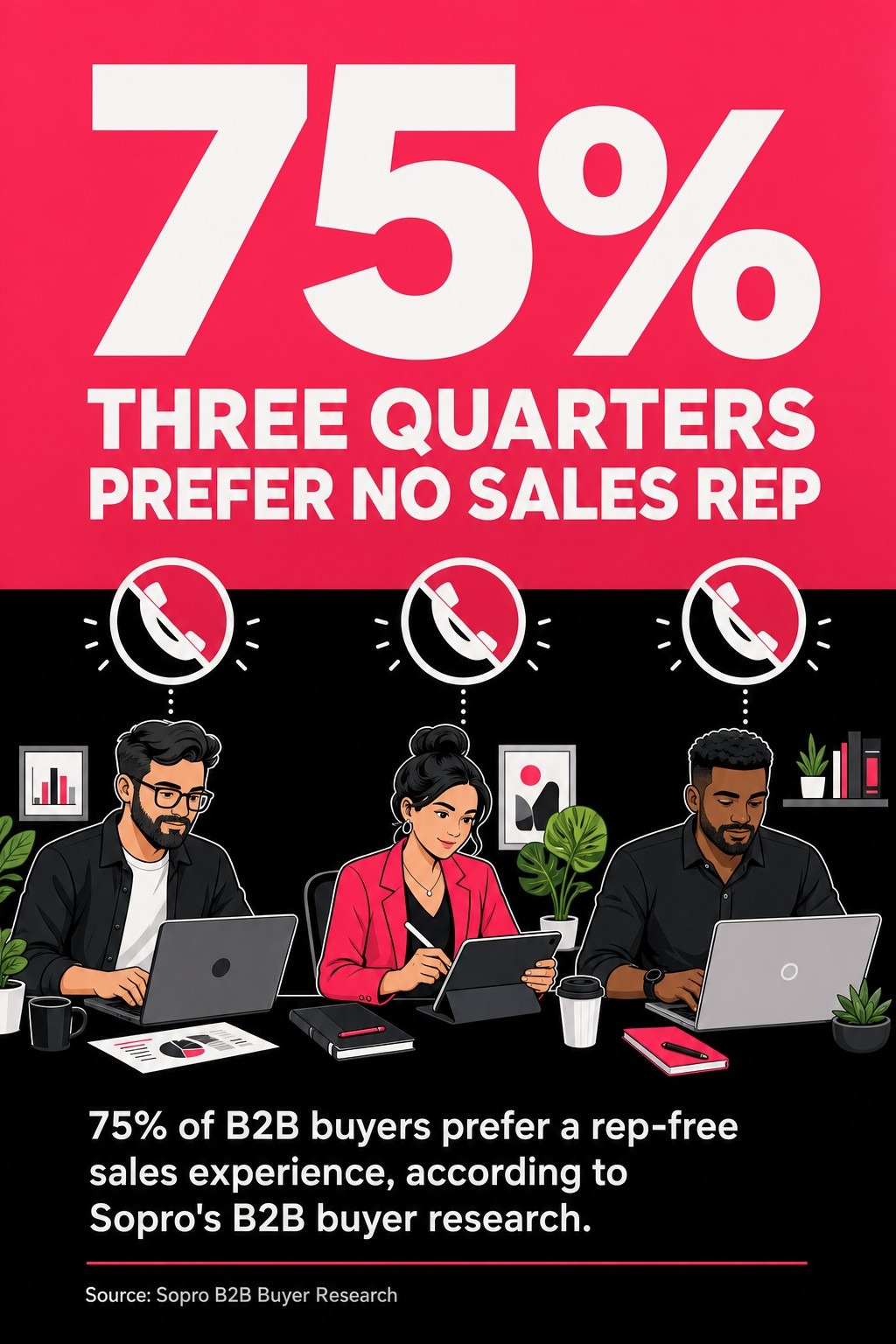
Sopro's B2B buyer research found that 75% of B2B buyers prefer a rep-free sales experience. Procurement teams want to research, compare, and shortlist without talking to a salesperson. They will contact you when they are ready, not before.
This creates a specific problem for fastener manufacturers: if your digital presence is thin, buyers complete their research without you and you never get a chance. Your lead generation strategy has to create enough digital surface area that procurement teams can find you, evaluate you, and add you to their list independently.
That 95% Day One shortlist stat should change how you allocate your marketing budget. If nearly all deals go to vendors already on the buyer's radar, then the highest-ROI activity is getting onto more radars earlier, not converting leads faster at the bottom of the funnel.
Fastener manufacturers who invest in top-of-funnel visibility, through content, LinkedIn presence, and SEO, compound their pipeline over time. Those who only invest in bottom-funnel sales activity fight over the same small pool of already-known vendors.
Fastener manufacturers face a market that is growing but increasingly demanding on suppliers, with automotive OEMs imposing annual cost-reduction expectations and buying committees growing larger and more complex at the same time.
The global industrial fasteners market was valued at approximately $103.92 billion in 2025, with a 5.1% CAGR projected through 2033. That growth sounds good. But it also attracts more competitors. Procurement teams at aerospace primes, automotive Tier 1s, and construction OEMs have more vendor options than ever, which means your differentiation has to be sharper.
Three challenges come up consistently for fastener manufacturers trying to grow their sales pipeline:
The answer to all three is the same: build a lead generation and lead nurturing system that communicates your specific value to specific buyer types before the first sales conversation ever happens.
High-quality fastener manufacturer leads come from targeting the right verticals with the right message across the right channels, and automotive, aerospace, construction, oil and gas, and energy are the verticals where OEM demand is largest and most consistent.
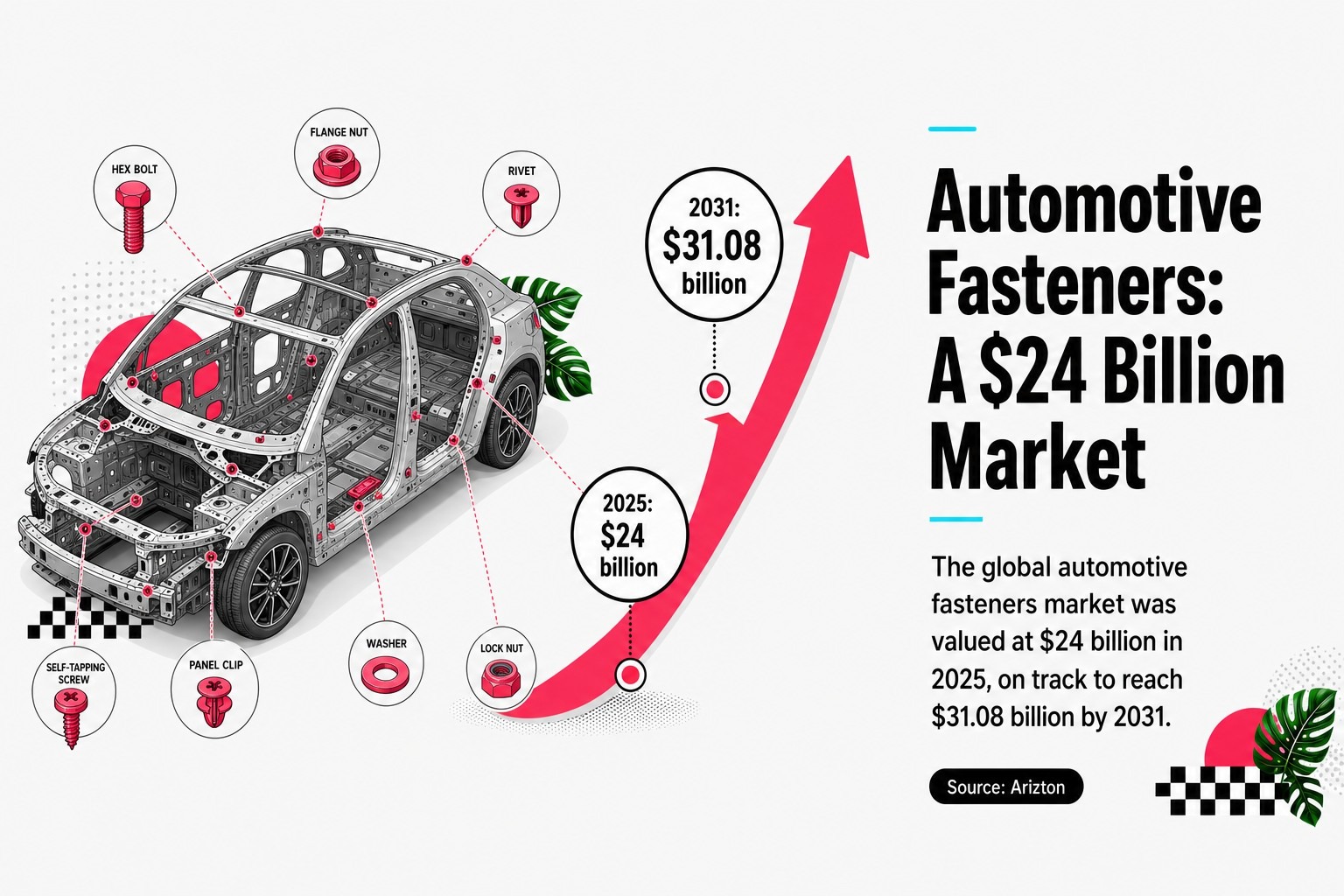
Automotive is the single biggest opportunity. According to Coherent Market Insights, automotive accounts for approximately 31.1% of the total industrial fasteners market. The global automotive fasteners market alone was valued at $24 billion in 2025, on track to reach $31.08 billion by 2031. That is a meaningful pool of demand, but it concentrates into a relatively small number of OEM and Tier 1 procurement teams. You do not need to reach everyone. You need to reach the right fifty accounts.
For a detailed breakdown of how to build the full pipeline architecture, the B2B lead generation pipeline strategies guide covers the structural mechanics in depth.
Most fastener manufacturers who struggle with sales pipeline have a lead quality problem, not a lead volume problem. Fifty unqualified contacts from a trade show list are worth less than five procurement engineers who downloaded your technical capability brief.
Define your ideal customer profile tightly. Name the verticals: automotive Tier 1, aerospace MRO, construction OEM, oil and gas equipment manufacturer. Name the buying trigger: new platform launch, supply chain diversification, current vendor quality failure. Build your messaging around those triggers and your conversion rate on actual qualified leads will climb.
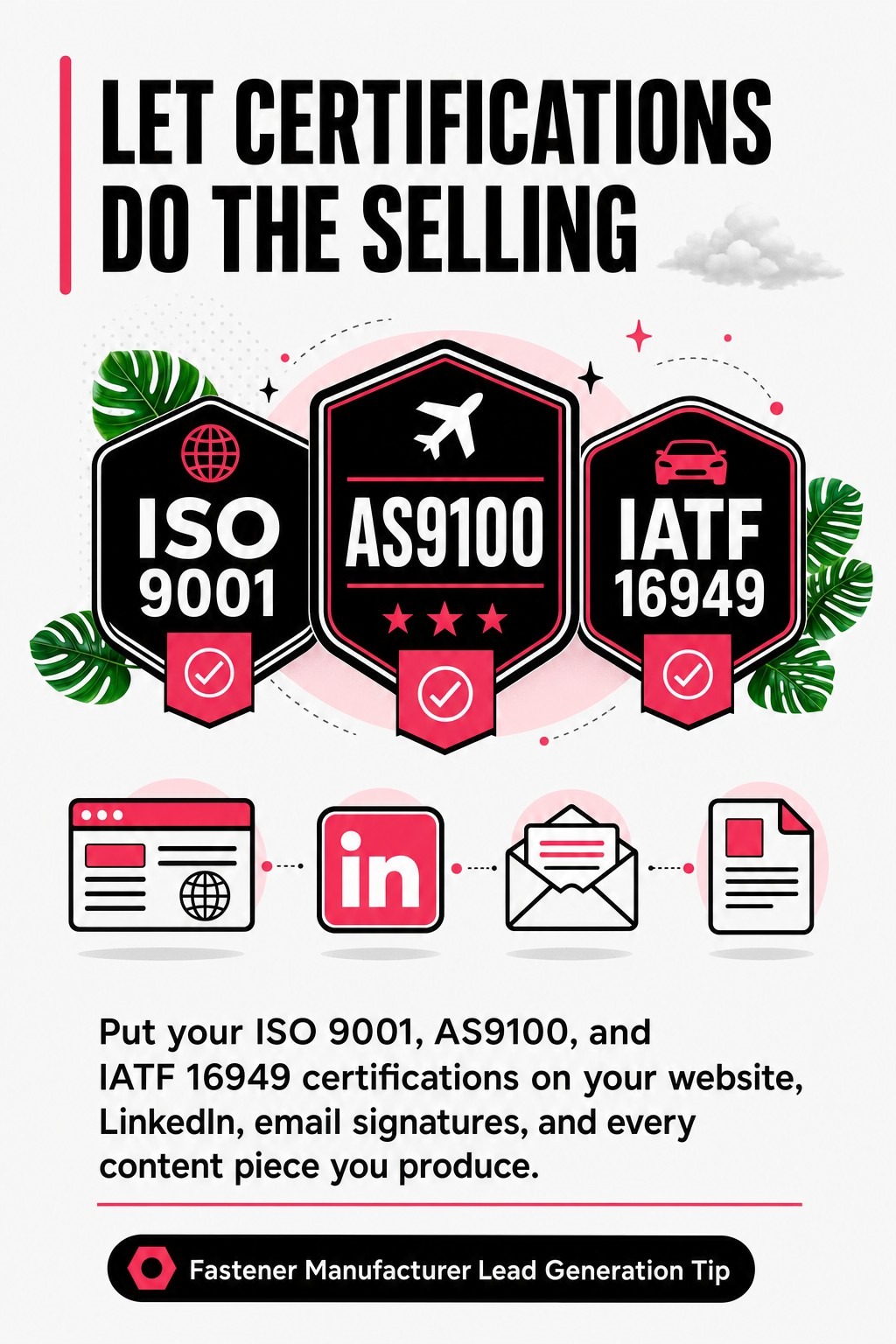
ISO 9001, AS9100, IATF 16949, these are not just quality badges. For procurement teams in aerospace and automotive, they are pre-qualification filters. A manufacturer without AS9100 certification does not make the shortlist for aerospace custom fasteners, full stop.
Your certifications belong on your website, in your LinkedIn content, in your email signatures, and in every piece of content you produce. They are not background information. They are lead generation tools that eliminate friction for buyers doing preliminary screening.
LinkedIn is the most direct channel for fastener manufacturers to reach OEM procurement engineers, supply chain managers, and engineering managers before they ever begin a formal vendor search.
The logic is straightforward. Procurement teams at automotive and aerospace OEMs are on LinkedIn. They are not on Instagram. They are not watching YouTube videos about fastener specs. They are reading industry content, following suppliers, and watching who their peers engage with. That is where your sales pipeline starts, even if it does not look like a pipeline yet.
LinkedIn for fastener manufacturers is not about broadcasting press releases. It is about consistent, specific technical content that signals to procurement teams that you know their problems. A post about titanium fastener tolerance challenges in aerospace assembly will get ignored by most of LinkedIn and noticed intensely by exactly the people you want.
Start with your company page. The description should lead with your target verticals and certifications, not your founding year. Procurement teams run searches. If your page says "ISO 9001 certified custom fasteners for automotive and aerospace OEMs," you show up when that engineer runs a supplier search. If it says "family-owned fastener manufacturer since 1987," you do not.
Then build individual profiles for your key salespeople and engineers. Technical credibility posts from a VP of Engineering carry more weight with procurement teams than company page posts. Buyers trust people more than logos.
Post three to four times per week. Mix content types: a technical insight, a certification update, a capability spotlight, a customer industry news comment. The goal is to appear in your target buyers' feeds consistently enough that when they start a vendor search, your name already feels familiar.
Email marketing for fastener manufacturers works best when it is segmented by vertical and tied directly to the buyer's stage in the sales funnel, not sent as generic newsletter blasts to everyone in the CRM.
Industrial buyers respond to relevant specificity. An email about corrosion-resistant fasteners for offshore oil and gas applications will get opened by procurement engineers in that sector. The same email sent to an automotive Tier 1 buyer does nothing for your conversion rate and trains them to ignore your future sends.
Build your email lists by vertical. Automotive. Aerospace. Construction. Oil and gas. Energy. Each segment gets different content based on the fastener challenges relevant to their applications, the certifications they require, and the procurement triggers common in their industry.
Custom fastener sales cycles can run six to eighteen months. A single email does nothing in a cycle that long. You need a sequence.
A basic lead nurturing sequence for a fastener manufacturer might run like this: an initial capability overview email, followed by a technical brief on your relevant certification (AS9100 for aerospace, IATF 16949 for automotive), followed by a case study or application story from the buyer's vertical, followed by a direct outreach email from a salesperson referencing the content they received. That sequence, run over six to eight weeks, moves a cold contact through awareness to consideration without requiring a sales call at each step.
The sales funnel for industrial buyers is not fast. Build your email marketing to match that reality, not fight it.
Content marketing for fastener manufacturers builds the kind of authority that puts you on OEM procurement shortlists before a buyer has even spoken to your competition.
Most fastener manufacturer websites are not doing SEO work. They have product pages with minimal copy, no technical content, and no reason for Google to rank them above a competitor for searches like "AS9100 custom fastener manufacturer aerospace" or "titanium fastener supplier automotive OEM." That is a missed opportunity, and it is a fixable one.
The B2B content marketing guide for manufacturers outlines exactly how to build this kind of content architecture. The short version: create content that answers the specific technical questions your buyers ask during their research phase. Not generic fastener content. Content about the tolerance challenges in EV battery assembly, or the certification requirements for aerospace-grade custom fasteners, or how to evaluate a fastener supplier's quality control process.
Industrial SEO is less competitive than consumer SEO, which means there is real opportunity for fastener manufacturers willing to publish consistent technical content. A well-optimized page targeting "custom stainless fasteners for offshore oil and gas" will face far less competition than almost any consumer product keyword.
Build pages around your target verticals and applications. Each vertical you serve should have a dedicated page: automotive fasteners, aerospace fasteners, construction fasteners, oil and gas fasteners. Each page should include your relevant certifications, your material capabilities, typical tolerance ranges, and lead times. That is exactly the information procurement teams search for.
For a more detailed approach to industrial SEO and product data for lead generation, there is a full breakdown of how to structure your product and capability pages for maximum search visibility.
Gated content, a technical whitepaper, an engineering guide, a material selection brief, does double duty. It provides value to buyers in their research phase and it gives you a qualified lead in exchange. A procurement engineer who downloads your "AS9100 Custom Fastener Specification Guide for Aerospace Applications" is not a cold contact. They are a warm lead who told you their vertical, their application, and their stage in the buying process.
That kind of qualified lead is worth ten cold email addresses. Build content that earns that exchange.
Marketing automation allows fastener manufacturers to maintain consistent, relevant contact with qualified leads across six to eighteen month sales cycles without requiring their sales team to manually track and follow up with every contact in the pipeline.
The U.S. screw, nut, and bolt manufacturing industry generated approximately $39.6 billion in revenue in 2025 according to IBISWorld. That market size reflects a large number of active procurement relationships, many of which were built and maintained through consistent, systematic follow-up over extended periods. Sales teams that rely on memory and spreadsheets to manage that kind of pipeline lose deals to competitors with better systems.
Tools like HubSpot or Salesforce can run automated email sequences triggered by specific buyer actions: a whitepaper download, a pricing page visit, a specific form completion. Each trigger delivers a relevant next piece of content rather than a generic follow-up. The buyer feels understood. The sales team gets a notification when a lead reaches a threshold score indicating sales-readiness.
Lead scoring assigns point values to buyer behaviors. A contact who downloaded your AS9100 capability guide, visited your aerospace fastener page three times, and opened four of your emails has a higher score than a contact who clicked one link six months ago. Your sales team should be spending time on the high-score contacts, not the cold list.
Set up scoring criteria specific to your sales funnel. Vertical fit (aerospace, automotive, oil and gas), engagement with technical content, certification page visits, and form completions all signal buying intent in ways that generic website traffic does not. This is how you separate qualified leads from noise.
The biggest pipeline leak in most fastener manufacturers is not a lack of leads. It is the gap between marketing-qualified leads (MQLs) and sales-qualified leads (SQLs), specifically the absence of an agreed definition for when a lead crosses from one to the other.
Marketing generates contact. Sales closes deals. But if sales dismisses MQLs as "not ready" and marketing never hears why, the system breaks down. Build a shared definition: an SQL for a fastener manufacturer might be a contact who fits a target vertical, has a current procurement need, has engaged with at least three pieces of technical content, and has a decision timeline within six months.
With that definition in place, marketing builds content and automation to move leads toward that threshold. Sales picks them up at the right moment instead of burning time on contacts that are six months away from being ready. That alignment is what turns your sales pipeline from a leaky pipe into something that actually builds. For the full tactical framework on digital marketing strategies for B2B manufacturers, including how to structure the MQL-to-SQL handoff, that guide covers it in practical detail.
A repeatable lead generation system for fastener manufacturers combines vertical-specific content, LinkedIn presence, segmented email marketing, and marketing automation into a pipeline that generates and nurtures qualified leads continuously, not just when the sales team has bandwidth to run outbound campaigns.
The compounding effect matters here. Content published today builds search authority over months. LinkedIn connections made this quarter become warm leads next year. Email sequences running in the background move contacts through the sales funnel while your sales team focuses on deals that are ready to close. None of these activities produce overnight results. All of them produce durable pipeline when maintained consistently.
The fastener market is growing. The broader global fasteners market is projected to reach $167.4 billion by 2035. That growth will create new procurement opportunities across automotive, aerospace, construction, oil and gas, and energy. The manufacturers who get onto the most shortlists will win the most of that growth. And shortlists are built through visibility, credibility, and consistent digital presence, not through cold calls on a Tuesday afternoon.
Start with one vertical. Build a targeted content piece for that sector. Set up a basic email nurture sequence. Optimize your LinkedIn company page for procurement search terms. Run that for ninety days and measure what moves. Then build from there. The full framework for this kind of systematic approach is covered in the complete guide to industrial manufacturing marketing, which is worth bookmarking as a reference as you build out each layer of your system.
The fastener manufacturers who grow their pipeline are not the ones with the best products. They are the ones whose products get found.