

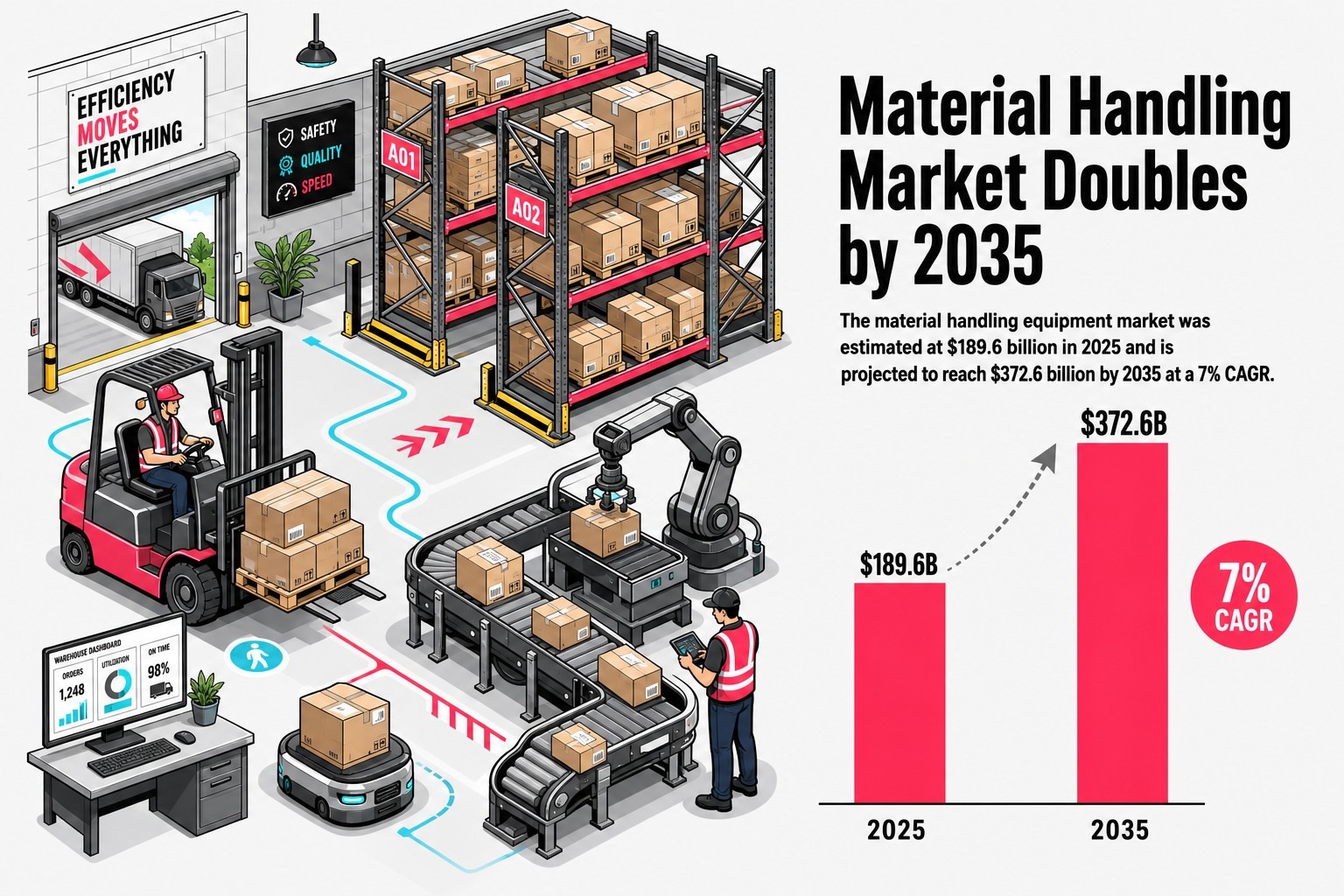
Material handling lead generation is the process of identifying, attracting, and converting decision-makers, specifically warehouse managers, logistics directors, operations managers, and procurement officers, into qualified sales conversations for companies selling forklifts, AGVs, conveyors, racking systems, robotics, and automation equipment. The material handling equipment market was estimated at $189.6 billion in 2025 and is projected to reach $372.6 billion by 2035 at a 7% CAGR, which means the buyers are out there, spending seriously. The challenge is getting in front of them before your competitors do.
I work with industrial and B2B companies every day on exactly this problem. And the single biggest mistake I see material handling companies make? Treating lead generation like a one-step event instead of a pipeline system. A cold email here, a trade show there, and then wondering why the sales pipeline stays empty. That's not a strategy. That's hoping.
Material handling lead generation is the structured process of building a repeatable flow of qualified leads, outbound prospecting sequences, and appointment setting activities that move potential buyers from first awareness to an RFQ or discovery call.
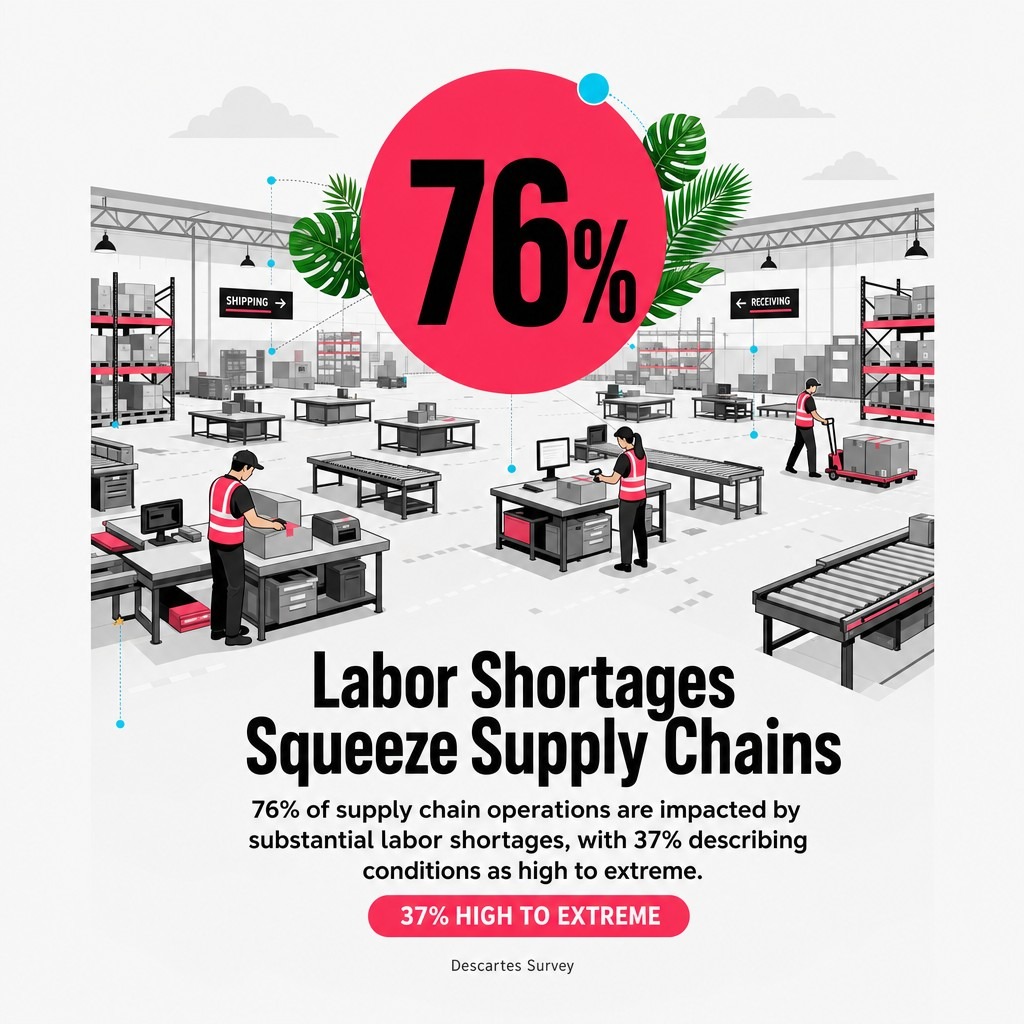
The automated material handling equipment segment alone is projected to grow from $33.39 billion in 2025 to $51.22 billion by 2030 at an 8.9% CAGR. That growth is driven by real operational pressure. According to a Descartes survey, 76% of supply chain operations are impacted by substantial labor shortages, with 37% describing conditions as high to extreme. Those operations need forklifts, conveyors, and automation. They need your solution. The question is whether you're reaching them with the right message at the right time.
For material handling companies, industrial lead generation is not a marketing luxury. It's a revenue function. Done right, it builds a sales pipeline full of companies actively evaluating capital equipment, not tire-kickers who downloaded a white paper once in 2022.
Check out our B2B lead generation strategies for building a stronger pipeline to see how the foundational principles apply across industrial sectors.
Material handling lead generation fails most often not because companies lack a product, but because they misread how buyers actually behave in this market.
Sales cycles in manufacturing and industrial equipment typically run 6 to 12 months for large enterprise deals, according to industry data on manufacturing lead generation. That's a long time to stay relevant. Most outbound prospecting efforts give up after two touchpoints. The deal goes to whoever stayed in the conversation longest, not necessarily the best product.
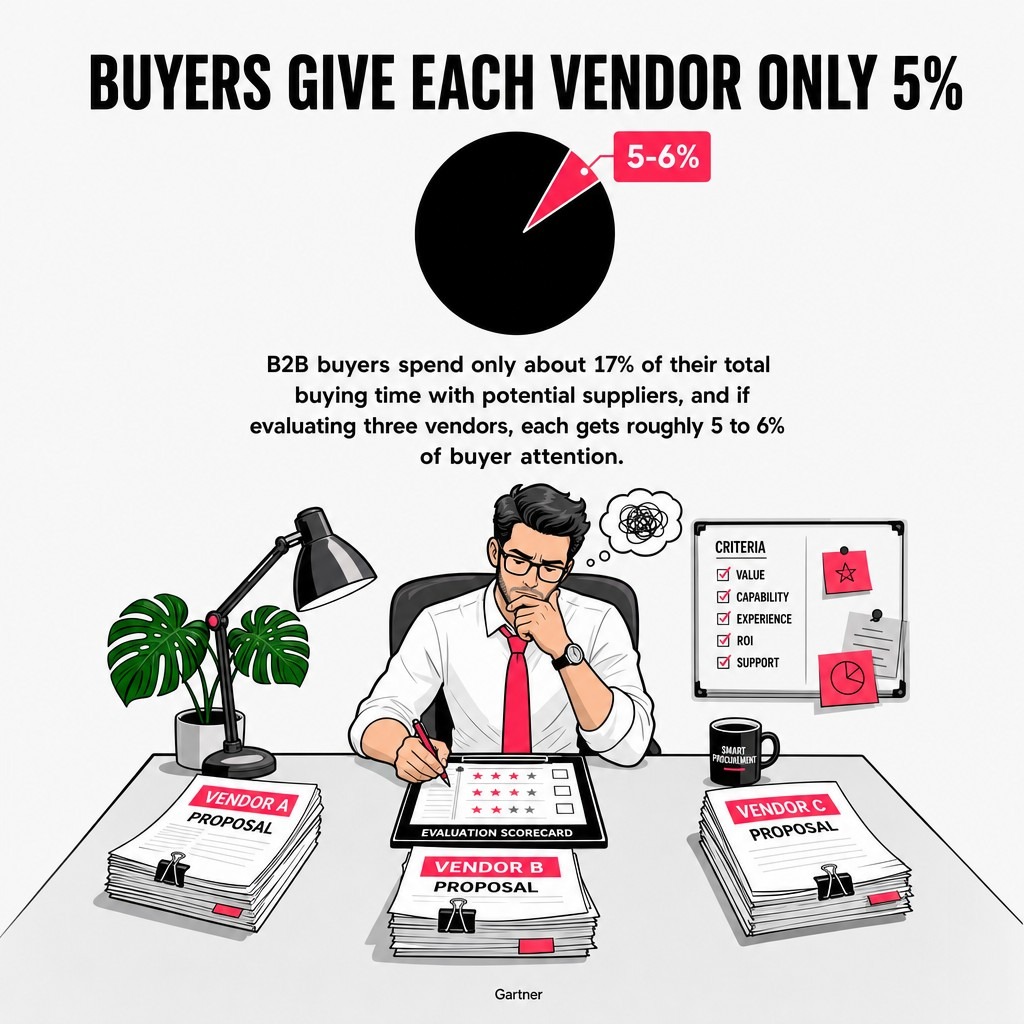
The buying committee problem makes this harder. According to Gartner, B2B buyers spend only about 17% of their total buying time with potential suppliers, and if evaluating three vendors, each gets roughly 5 to 6% of buyer attention. Five percent. You have a tiny window to make an impression on warehouse managers, logistics directors, and procurement officers all at once, often simultaneously, often without ever speaking to all of them directly.
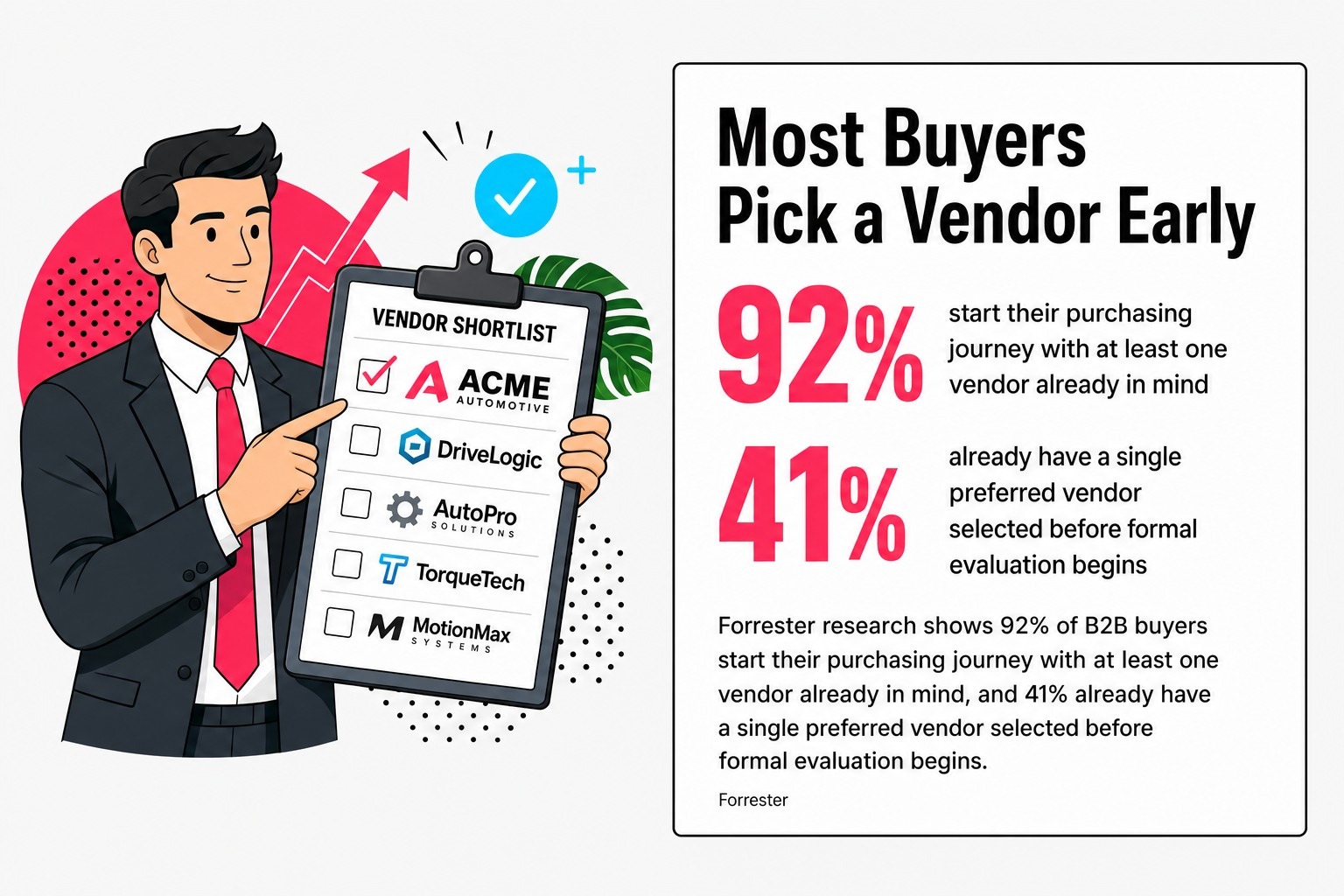
Then there's the vendor selection reality. Forrester research shows 92% of B2B buyers start their purchasing journey with at least one vendor already in mind, and 41% already have a single preferred vendor selected before formal evaluation begins. If you're not on that shortlist before the RFQ goes out, you're playing catch-up from day one. That's why material handling lead generation has to start well before a prospect is "in market."
Effective material handling lead generation requires targeting at least four distinct decision-maker roles, because no single person owns the buying decision for capital equipment in a warehouse or distribution environment.
The buying committee for forklifts, conveyors, AGVs, racking, and automation systems typically includes operations managers who feel the daily pain of throughput and labor gaps, warehouse managers who specify the equipment requirements, logistics directors who evaluate how a system fits the supply chain, and procurement officers who control vendor approval and contract terms. Miss any one of them and your RFQ stalls.
Account-based marketing, or ABM, is the right model here. Rather than broadcasting to a wide audience, ABM for material handling means building a specific target account list, identifying each stakeholder by role, and running personalized outreach sequences to each one. That approach produces qualified leads with real buying authority instead of website visitors who have no budget and no timeline.
The supply chain pressure context helps sharpen your targeting. The 2025 MHI and Deloitte report found that the top supply chain concerns are inflation at 38%, economic uncertainty at 37%, and workforce and talent shortages at 35%. Operations managers and warehouse managers dealing with those pressures are your most qualified leads. They have a problem that material handling equipment solves. Lead your outbound prospecting with that framing.
The most effective material handling lead generation programs combine outbound prospecting with inbound content to cover buyers at every stage of a long sales cycle.
Outbound is where most material handling companies underinvest. A structured outbound prospecting sequence, multi-touch across phone, email, and LinkedIn, targets warehouse managers and logistics directors by name, company, and specific operational challenge. The goal of each sequence is one thing: an appointment. Not a sale. Not an RFQ. An appointment.
Appointment setting in this industry requires persistence. Most qualified leads need seven to twelve touchpoints before agreeing to a conversation. Build sequences that earn attention by referencing industry-specific challenges, not generic "we'd love to connect" scripts. Reference labor shortages, throughput bottlenecks, or specific equipment categories like AGVs or conveyors that match the prospect's industry segment.
ABM for material handling means selecting target accounts based on firmographic data: company size, industry vertical (3PL, cold storage, ecommerce, pharma, manufacturing), geographic territory, and known technology gaps. Once accounts are selected, personalized outreach hits each decision-maker role with content relevant to their specific concern.
An operations manager gets a message about throughput efficiency. A procurement officer gets a message about total cost of ownership. Same company, different conversations. That's what separates ABM-driven industrial lead generation from batch-and-blast campaigns that produce unqualified leads no sales team wants to follow up on.
Our guide on reaching high-value buyers in heavy industrial sectors with paid search walks through the targeting logic that transfers directly to material handling companies.
Multi-channel outreach is not optional for material handling lead generation. It's the only approach that works given how little time buyers spend with any single vendor.
LinkedIn is the anchor channel. 89% of B2B marketers use LinkedIn for lead generation, with 62% confirming it produces quality leads. For material handling, LinkedIn allows targeting by job title (warehouse manager, logistics director), company size, and industry, which means your outbound prospecting reaches actual decision-makers rather than generic inboxes.
Phone and email run alongside LinkedIn in a coordinated sequence. Email sets context. Phone adds urgency and human connection. LinkedIn builds credibility and keeps you visible between touchpoints. Web retargeting catches prospects who visited your site but didn't convert, which matters when the average B2B website conversion rate for manufacturing and industrial companies is approximately 2.2%. That means 97 out of every 100 visitors leave without filling out a form. Retargeting keeps the conversation alive.
Trade events remain a valid channel, though the economics have shifted. ProMat 2025 set a record with 52,223 registered attendees and 1,160 exhibitors. More importantly, 80% of the top 100 retailers and 70% of the top 100 consumer goods companies send buying teams to make capital equipment purchasing decisions. That's a concentrated pool of qualified leads in one place. The mistake is treating the show floor as the entire strategy rather than one touchpoint in a longer multi-channel sequence.
Qualified leads in material handling share four characteristics: a defined operational problem, a budget tied to a CAPEX cycle, a timeline, and at least one decision-maker engaged in the conversation.
Most material handling companies mistake marketing-qualified leads for sales-qualified leads. An MQL downloaded a spec sheet. An SQL has a warehouse expansion planned for Q3 and wants to talk about conveyor capacity. Your sales pipeline should only count SQLs, because filling it with MQLs creates a false sense of pipeline health that collapses at forecast time.
Lead nurturing bridges the gap. A prospect who's nine months from a budget decision is not a dead lead. They're a future SQL. A lead nurturing sequence, email, LinkedIn, and the occasional phone check-in, keeps your company on their shortlist. Remember what the Forrester data showed: 41% of buyers have a preferred vendor selected before the formal process begins. Lead nurturing is how you become that vendor.
For a real-world example of what qualified industrial lead generation looks like in practice, our case study on 3x revenue growth for a B2B industrial distributor shows the specific levers that moved prospects through the pipeline to closed deals.
Material handling lead generation programs that produce measurable ROI share a consistent structure: a defined ideal customer profile, a multi-channel outbound sequence, appointment setting as the primary conversion goal, and a lead nurturing track for longer-cycle opportunities.
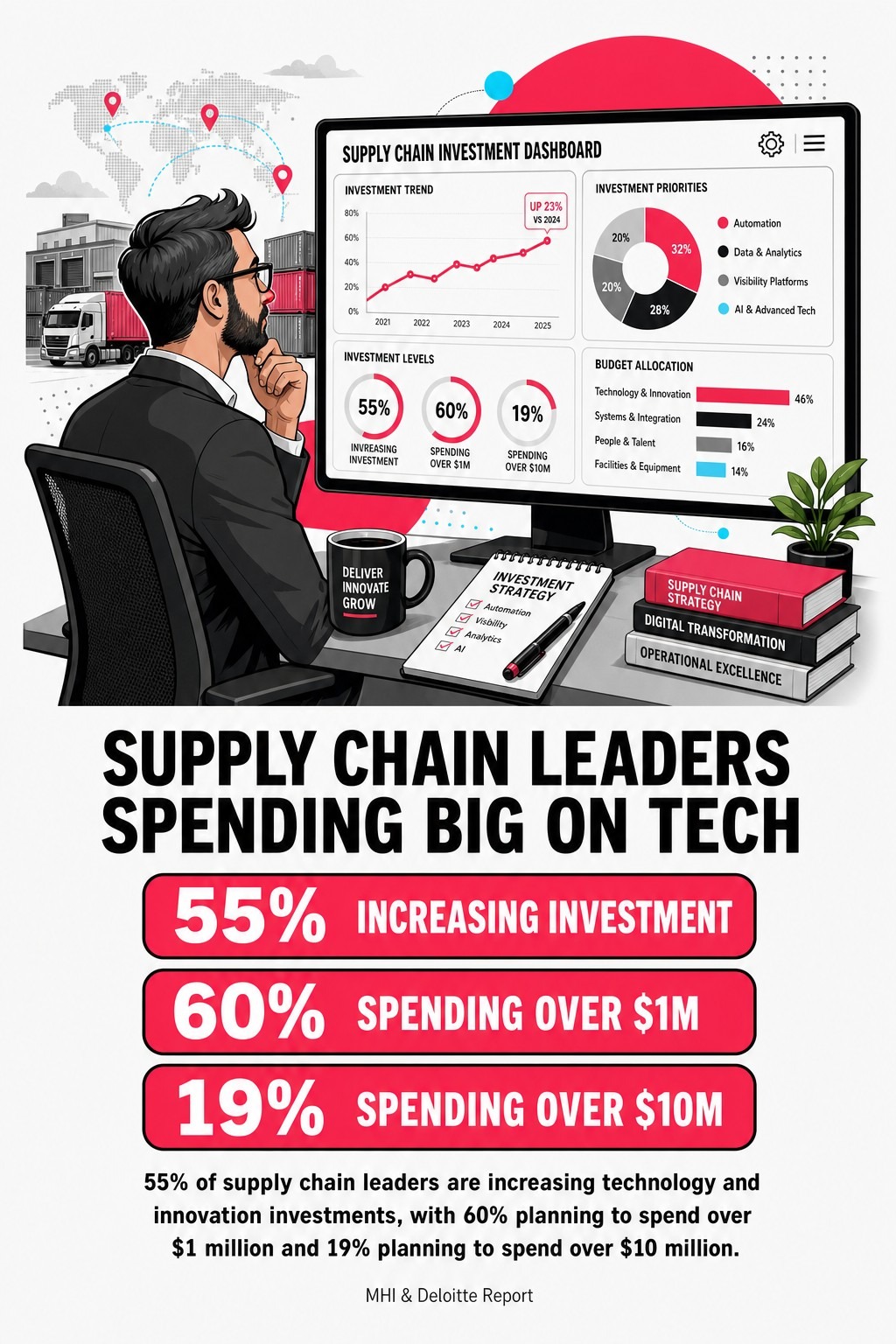
The spend levels in this market justify serious investment. 55% of supply chain leaders are increasing technology and innovation investments, with 60% planning to spend over $1 million and 19% planning to spend over $10 million. A single closed deal from a well-run material handling lead generation program can return the full cost of the program many times over. The math works. The question is whether your outbound prospecting and appointment setting processes are tight enough to close the gap between qualified leads and signed contracts.
Companies that also invest in their website's conversion performance see compounding returns. If you're driving traffic but not converting it, our breakdown of CRO tactics for equipment dealers to generate more RFQ leads covers exactly where the friction lives and how to fix it.
Outbound prospecting and appointment setting can produce qualified conversations within 60 to 90 days of launch. Closed revenue from those conversations typically follows the sales cycle length for the deal, which runs 6 to 12 months for large enterprise contracts. Plan your pipeline accordingly.
Dealers and manufacturers of forklifts, AGVs, conveyors, racking, robotics, and automation systems all benefit. So do 3PL providers, warehouse design firms, and systems integrators. Any company selling into warehousing, logistics, distribution, cold storage, ecommerce, pharma, or manufacturing has qualified buyers who need to be reached through structured outbound prospecting.
A qualified lead in material handling has a problem, a budget cycle, a timeline, and an engaged decision-maker. If any of those four are missing, it's a prospect to nurture, not a lead to hand to sales. Mis-labeling prospects as qualified leads is the fastest way to erode trust between marketing and your sales team.
ABM for material handling is almost always the better approach for companies selling equipment over $50,000. The buying committee is small, the deal values are high, and the sales cycle is long. Broad-based lead generation produces volume but not the quality of engagement that capital equipment sales require. Use ABM for your top 50 to 100 target accounts and use inbound channels to catch the rest.
Content supports every stage of the sales pipeline but doesn't replace outbound prospecting. Case studies, equipment comparison guides, and ROI calculators help decision-makers build the internal case for a purchase. They also give your outbound team a reason to follow up: "I wanted to share a case study on a cold storage operation that cut labor costs 30% with AGVs" beats "just checking in" every single time.
The full picture of digital marketing for industrial companies, including how content, paid search, and lead generation work together, is covered in our complete guide to marketing for manufacturing in the digital age.
Material handling lead generation is not complicated. It's just disciplined. Build your target account list, map the decision-makers, run a multi-channel outbound sequence, set appointments, and nurture the rest. The companies winning deals in this market aren't the ones with the biggest booth at ProMat. They're the ones who stayed in the conversation long enough to be on the shortlist when the budget opened. Start there.