
Industrial content marketing works because it meets B2B buyers exactly where they make decisions. 83% of B2B buyers substantially define their purchase requirements before speaking with sales representatives.

83% of B2B buyers define requirements before talking to sales—meet them with content.
That stat fundamentally changes how manufacturing companies should market.
Your prospects aren't picking up the phone to ask basic questions anymore. They're downloading white papers at 2 AM, watching product demos on their commute, and reading case studies during their lunch break. By the time they contact your sales team, they've already narrowed their vendor list.
I've spent years helping industrial companies adapt to this reality. The manufacturers who win are the ones creating content that educates, demonstrates expertise, and builds trust long before the first sales conversation happens.
This guide shows you exactly how to build an industrial content marketing strategy that generates qualified leads. You'll learn which content types work best for manufacturing audiences, how to create content for different buyer journey stages, and how to measure what actually drives revenue.
Industrial content marketing creates educational content that solves technical problems for B2B buyers in manufacturing sectors.
Unlike consumer marketing, industrial content targets engineers, procurement managers, and technical decision-makers. These people care about specifications, performance data, and implementation details. They don't respond to hype.
Your content needs to demonstrate technical competence while making complex information accessible. That's the balance that separates effective industrial content from generic marketing fluff.
The buying process has completely changed. 92% of industrial B2B buyers start their purchasing journey with at least one vendor already in their consideration set.
Your content determines whether you make that shortlist.
Traditional outbound methods can't compete with content marketing efficiency. Content marketing generates three times more prospects than outbound marketing at 62% less cost.
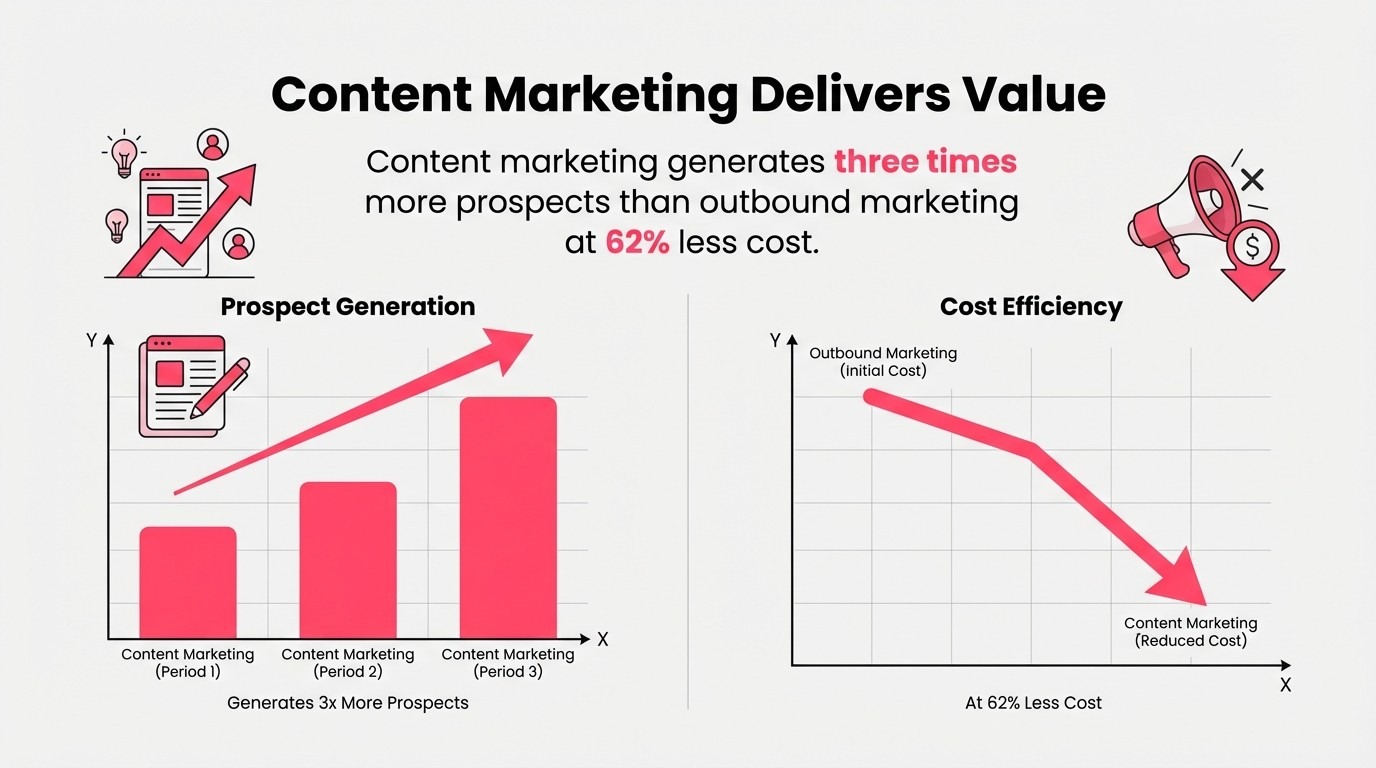
Content marketing: 3x more prospects at 62% lower cost than outbound.
Manufacturing buyers expect detailed technical information before they engage with sales. Content marketing delivers that information at scale, building trust while your sales team focuses on qualified opportunities.
Industrial buyers move through three distinct phases when researching solutions.
The awareness stage happens when they recognize a problem or opportunity. They're searching for educational content that helps them understand their situation. Blog posts, industry guides, and problem-focused articles work well here.
During consideration, buyers evaluate specific approaches and vendors. They need comparison content, case studies, and technical specifications. This is where white papers and detailed product information become critical.
The decision stage requires proof. Buyers want ROI calculators, implementation guides, and customer success stories that validate their choice.
Your content strategy needs assets for all three stages. Most industrial companies create too much awareness content and not enough decision-stage material.
The data on content marketing results speaks clearly. 97% of businesses report generating positive results from content marketing initiatives.
For manufacturing companies specifically, content marketing solves problems that traditional advertising can't touch.
Industrial buyers need to trust your technical competence before they'll take a meeting.
Publishing detailed technical content demonstrates expertise in ways that sales conversations can't match. When you publish a white paper explaining advanced materials science or a case study showing complex problem-solving, you're proving capability.
This authority compounds over time. Each piece of quality content adds to your reputation, making it easier to rank in search results and harder for competitors to dislodge you from buyer consideration sets.
Content marketing creates a lead generation system that works while you sleep.
A well-optimized blog post can attract qualified prospects for years after publication. Case studies convert visitors into leads. White papers capture contact information from buyers actively researching solutions.
The complete guide to B2B content marketing for manufacturers shows how this system creates predictable lead flow.
Unlike paid advertising, your content investment builds equity. That blog post you publish today generates value for months or years, not just while you're paying for ad clicks.
Industrial sales cycles often span months and involve multiple decision-makers.
Content keeps prospects engaged throughout this journey. Your technical blog posts educate engineers. Your ROI calculators help financial decision-makers build business cases. Your case studies give purchasing managers proof points they can share internally.
Good content does the work of explaining, educating, and persuading across an entire buying committee. That's impossible to achieve through sales conversations alone.
Different content formats serve different purposes in the industrial buyer journey. 91% of B2B industrial marketers utilize content strategies as a foundational element of their go-to-market approach.
The most successful manufacturing companies use a mix of content types strategically.
Blog posts attract organic search traffic and establish thought leadership.
Industrial blog content needs depth. Your audience wants detailed explanations, not surface-level overviews. Write about technical challenges, material selection criteria, process optimization, and industry trends.
SEO matters enormously for manufacturing blog posts. Most industrial buyers start their research on Google. Rank for the right long-tail keywords, and you'll capture prospects at the exact moment they're looking for solutions.
The guide to long-tail industrial keywords explains how to find search terms your competitors are missing.
Publish consistently. Weekly posting builds momentum and signals to search engines that your site offers fresh, valuable information. Mix educational content with problem-solving articles and industry commentary.
Case studies convert interest into action. Manufacturing segments show higher engagement with case studies compared to abstract whitepapers or theoretical guides.

Manufacturing audiences engage more with case studies than abstract white papers.
Industrial buyers want proof that your solution works in situations similar to theirs.
Structure your case studies around the problem-solution-results framework. Start by describing the client's specific challenge in technical detail. Explain your solution approach and implementation process. Then quantify the results with concrete metrics.
The best industrial case studies include technical specifications, implementation timelines, and measurable outcomes. Avoid vague statements about "improved efficiency." Specify that you reduced cycle time by 23% or increased throughput by 180 units per shift.
White papers position your company as a technical authority while capturing lead information.
These longer-form documents dive deep into industry challenges, emerging technologies, or complex decision frameworks. They require more investment than blog posts but generate higher-quality leads.
Gate your white papers behind a simple form. Buyers who download technical documentation are actively researching solutions and willing to exchange contact information for valuable insights.
Focus white papers on topics where you have genuine expertise. Write about challenges you've solved repeatedly, technologies you've mastered, or processes you've optimized across multiple implementations.
Video works exceptionally well for industrial content. 92% of marketers employing video content report that it represents a key component of their marketing strategy.
Manufacturing audiences need to see products in action, understand scale, and visualize implementation.
Product demonstration videos should follow a specific pattern. Process-focused product demonstrations consistently outperform outcome-focused demonstrations that skip to final results.
Show the setup process. Walk through each step of operation. Explain what's happening and why it matters. Industrial buyers want to understand how things work, not just see polished final results.
Create videos for different buyer journey stages. Introductory videos explain concepts and applications. Mid-funnel videos compare approaches and showcase capabilities. Late-stage videos provide detailed specifications and implementation guidance.
Webinars combine lead generation with relationship building.
Industrial audiences attend webinars to learn from experts and ask specific questions. This format works particularly well for complex topics that benefit from real-time explanation and Q&A.
Choose topics that address common challenges or emerging trends in your industry. Invite industry experts or customer speakers to add credibility and perspective.
Record every webinar and repurpose it into additional content. The recording becomes an on-demand asset. The transcript can be edited into blog posts. Key insights can be shared as social media content.
Strategy separates effective content programs from random blog posting.
You need a systematic approach that aligns content creation with business goals, buyer needs, and resource constraints.
Industrial content must speak to specific buyer personas.
Map out who influences and makes purchasing decisions at your target companies. Engineers evaluate technical fit. Plant managers care about operational impact. Financial decision-makers need ROI justification. Procurement focuses on risk mitigation and supplier reliability.
Each persona has different questions, concerns, and content preferences. Your content strategy needs to address all of them.
Create detailed persona profiles that include job titles, responsibilities, pain points, success metrics, and information sources they trust. Use these profiles to guide every content decision.
The best industrial content solves real problems.
Talk to your sales team about common objections and questions. Review support tickets for recurring issues. Interview customers about challenges they faced before finding your solution.
Build a master list of problems your content can address. Prioritize based on frequency, severity, and alignment with your solution capabilities.
Frame your content around these pain points. Don't write about your product features. Write about the problems those features solve and the business outcomes they enable.
SEO drives long-term content marketing success.
Industrial keyword research differs from consumer research. Search volumes are lower, but intent is higher. Someone searching for "automated welding systems for aluminum fabrication" is much more valuable than someone searching for "welding."
Focus on long-tail keywords that indicate specific needs. These terms have less competition and attract more qualified traffic. Use tools like Ahrefs or SEMrush to identify keywords your competitors rank for.

Ahrefs: research long-tail keywords and competitor rankings for industrial SEO.
Build content around keyword clusters. Create a detailed pillar page on a broad topic, then write supporting articles that target related long-tail keywords and link back to the pillar.
Define what success looks like before you start creating content.
Common industrial content marketing goals include increasing organic traffic, generating qualified leads, shortening sales cycles, and establishing thought leadership.
Make your goals specific and measurable. "Increase organic traffic" becomes "Generate 500 monthly organic visitors from target keywords by Q4." "Generate leads" becomes "Convert 50 white paper downloads per month."
Align content goals with broader business objectives. If your company is entering a new market segment, create content targeting that audience. If sales needs better qualification tools, develop content assets that help identify serious buyers.
Effective industrial content marketing requires different content types for each buyer journey stage.
Most manufacturing companies over-invest in awareness content and under-invest in decision-stage materials. Balance your content portfolio across the entire funnel.
Awareness content attracts buyers who recognize a problem but haven't defined a solution approach yet.
Create educational articles that explain industry challenges, emerging trends, and problem-solving frameworks. Use blog posts, introductory guides, and industry reports.
Focus on the buyer's problem, not your solution. An article titled "5 Signs Your Coating Process Is Costing You Money" works better than "Why Our Coating Equipment Is Better."
Optimize awareness content for search engines. These pieces need to rank for problem-focused keywords that prospects use early in their research.
Consideration content helps buyers evaluate different solution approaches and vendors.
This stage requires comparison guides, vendor selection checklists, and detailed capability demonstrations. White papers and webinars work particularly well here.
Be objective in your comparisons. Acknowledge different approaches and explain when each makes sense. Buyers are smart enough to see through one-sided content.
Include enough technical detail to demonstrate expertise without overwhelming prospects. Balance accessibility with depth.
Decision content validates the buyer's choice and facilitates internal approval.
Create ROI calculators, implementation guides, customer success stories, and detailed specifications. This content often gets shared with other stakeholders who weren't involved in earlier research.
Make it easy for buyers to justify your solution internally. Provide templates, business case frameworks, and cost-benefit analysis tools they can customize.
The case study of a B2B industrial distributor achieving 3x revenue growth shows how decision-stage content accelerates deal closure.
Execution quality determines whether your content strategy succeeds or fails.
These practices separate manufacturing companies that get results from those that waste resources creating content nobody reads.
Publishing consistently matters more than publishing frequently.
Set a sustainable content creation schedule. Weekly blog posts work well for most industrial companies, but biweekly is better than sporadic posting.
Quality trumps quantity every time. One thoroughly researched white paper generates more value than ten superficial blog posts. Your content represents your technical competence.
Develop editorial standards. Create templates for different content types. Build a review process that ensures technical accuracy and clarity.
Your engineers, technical specialists, and customer success managers have knowledge your competitors can't replicate.
Interview internal experts and turn their insights into content. Most technical professionals can't or won't write, but they can answer questions and review drafts.
Create a simple process for capturing expert knowledge. Send your subject matter experts a list of questions. Record a 30-minute conversation. Have a content writer turn that into a polished article.
Give credit to internal contributors. Bylines and recognition encourage ongoing participation and add credibility to your content.
SEO remains the most effective way to generate long-term leads from industrial content.
Target specific keywords in your content, but write for humans first. Use your primary keyword in the title, first paragraph, and a few subheadings. Include related terms naturally throughout.
Build internal links between related content pieces. When you publish a new blog post, link to relevant existing articles. This helps search engines understand your site structure and keeps visitors engaged longer.
Optimize technical elements. Write descriptive meta titles and descriptions. Use header tags properly. Compress images. Ensure fast page load speeds.
Creating content is only half the battle.
Social media promotion works differently for industrial companies than consumer brands. 75% of industrial B2B buyers make purchasing decisions through social media engagement.
Social engagement drives purchasing decisions for 75% of industrial B2B buyers.
LinkedIn is the primary social platform for B2B manufacturing. LinkedIn strategies for industrial companies incorporate 2 to 5 posts weekly, leading to 5.6 times greater follower growth compared to irregular posting patterns.
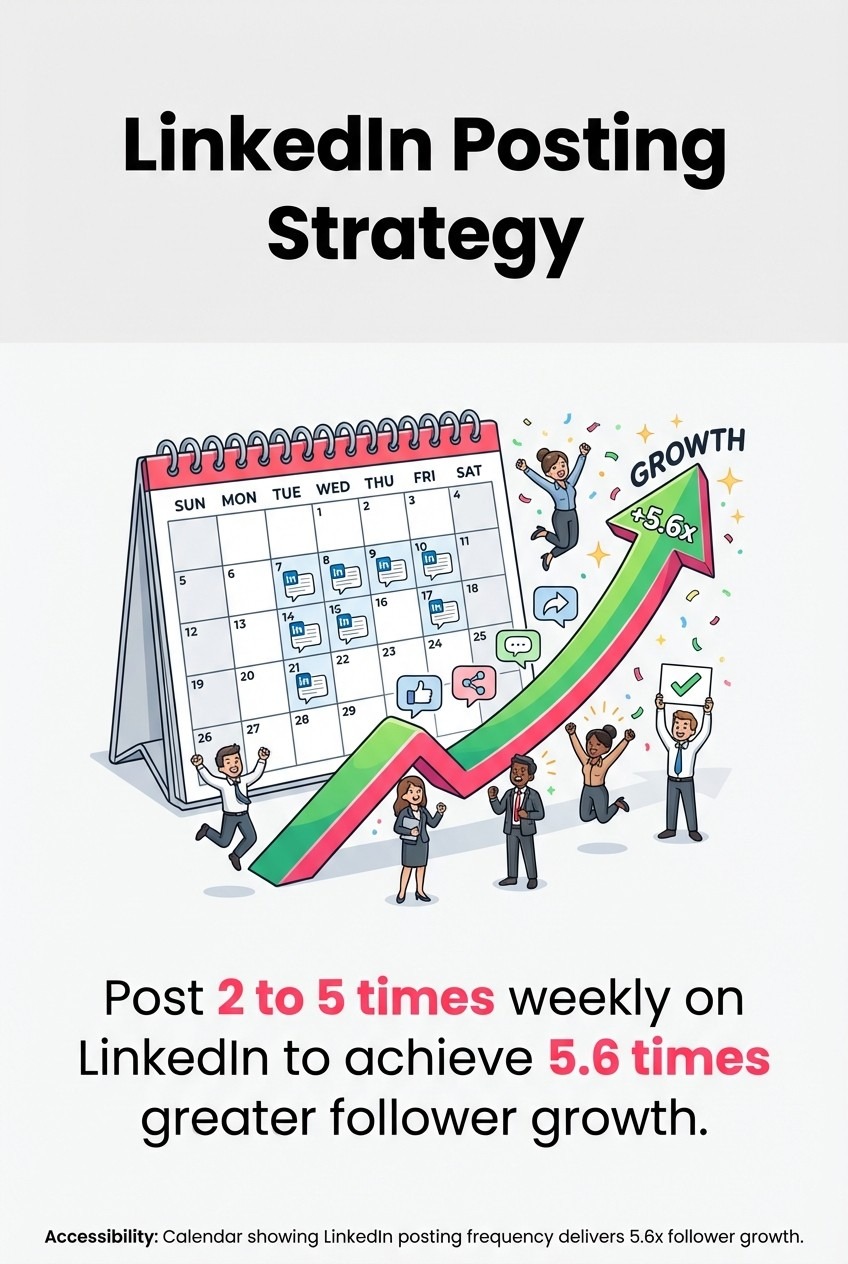
Post 2–5 times weekly on LinkedIn to grow followers 5.6x faster.
Share your content consistently. Post new articles immediately. Reshare evergreen content monthly or quarterly. Engage with comments and questions.
Email marketing remains highly effective for industrial audiences. Send regular newsletters featuring your latest content. Segment your list by buyer stage and persona to deliver relevant content.
Track metrics that connect to business outcomes, not vanity numbers.
Page views and social shares don't matter if your content isn't generating qualified leads and influencing purchase decisions.
Start with organic search traffic from target keywords. This indicates whether your SEO efforts are working and whether you're attracting the right audience.
Monitor lead generation metrics. Track form submissions, content downloads, webinar registrations, and contact requests. Calculate conversion rates for each content type.
Measure engagement quality. Look at time on page, scroll depth, and pages per session. Industrial buyers who spend five minutes reading a technical article are more qualified than visitors who bounce after 30 seconds.
Connect content to revenue. Use marketing automation tools like HubSpot or Salesforce to track which content pieces influenced closed deals.
HubSpot: attribute content to pipeline and closed-won deals.
Salesforce: connect marketing touchpoints to revenue outcomes.
Data should drive your content decisions.
Review your top-performing content monthly. Identify patterns in topics, formats, and keywords. Double down on what works.
Analyze which content generates the highest quality leads. If case studies consistently produce better leads than blog posts, invest more in case study production.
Look for content gaps. Review your analytics to find high-traffic pages with high bounce rates. These indicate topics where visitors need more information or better next steps.
Track keyword rankings over time. Use Google Analytics and Google Search Console to monitor which content pieces are gaining or losing visibility.
ROI justifies continued investment in content marketing.
Calculate your content creation costs, including staff time, freelancer fees, and tools. Divide this by the number of qualified leads generated to get your cost per lead.
Compare content marketing cost per lead to other channels. You'll typically find content marketing significantly more cost-effective than paid advertising or trade show participation for industrial companies.
Track long-term value. Content assets generate value over extended periods. A white paper published two years ago might still generate leads today.
Every manufacturing company faces obstacles when building a content program.
Recognizing these challenges helps you plan solutions before they derail your strategy.
Traditional manufacturing companies often struggle with content marketing adoption.
Sales teams worry about giving away expertise for free. Technical teams don't see content creation as their responsibility. Leadership questions the ROI of long-term content investment.
Address these concerns directly. Show sales how content generates qualified leads and shortens sales cycles. Make it easy for technical experts to contribute without becoming writers. Present data on content marketing effectiveness to leadership.
Start small and demonstrate results. A successful pilot program with measurable outcomes overcomes skepticism faster than theoretical arguments.
Industrial topics are inherently complex.
The challenge is explaining technical concepts clearly without oversimplifying or losing credibility. Your audience includes both technical and non-technical decision-makers.
Use the "explain it to an intelligent outsider" approach. Assume your reader is smart but unfamiliar with your specific technology. Define technical terms when first used. Use analogies carefully.
Layer your content. Start with accessible explanations, then provide technical details for readers who want them. Use expandable sections, sidebars, or linked resources for deep technical information.
Most industrial companies lack dedicated content marketing teams.
Be strategic about resource allocation. Focus on content types that generate the best results for your audience. Quality beats quantity.
Repurpose aggressively. Turn webinars into blog posts, white papers into email series, and case studies into social media content. One substantial content piece can feed your program for weeks.
Consider working with specialized industrial content agencies that understand technical topics. The industrial digital marketing guide covers resource planning strategies.
The industrial content marketing space continues evolving.
Stay ahead by understanding where your buyers are going and adapting your approach accordingly.
Static content is giving way to interactive experiences.
ROI calculators, product configurators, and assessment tools engage buyers while collecting valuable information about their needs and priorities.
Personalization technology allows you to show different content based on industry, company size, or previous interactions. A visitor from the automotive sector sees different case studies than someone from aerospace.
These capabilities require investment but significantly improve conversion rates and user experience.
Video consumption continues growing across all B2B audiences.
Industrial buyers increasingly expect video explanations of complex processes, virtual facility tours, and video case studies. This trend accelerated during the pandemic and shows no signs of reversing.
Invest in video production capabilities. Start simple with smartphone footage and basic editing. Improve production quality as you demonstrate ROI.
AI tools are transforming content production workflows.
Use AI for research, outline generation, and first drafts. But maintain human oversight for technical accuracy and strategic thinking. Industrial content requires expertise that AI can't replicate.
Marketing automation platforms help deliver the right content at the right time. Set up email sequences that nurture leads with relevant content based on their behavior and buyer stage.
Start with a focused pilot program rather than trying to do everything at once.
Choose one content type and one target audience. Create a small portfolio of high-quality content. Promote it consistently. Measure results. Refine your approach based on what you learn.
The data-driven guide to manufacturer marketing provides frameworks for building scalable programs.
Build your content library over time. Each piece adds to your authority and expands your search visibility. The compounding effect means your twelfth month of content marketing generates far better results than your first.
Stay consistent. Publishing one solid blog post weekly for a year beats publishing three posts per week for two months and then nothing.
Your industrial content marketing program will generate qualified leads, shorten sales cycles, and build market authority. The key is starting with strategy, maintaining quality, and measuring what matters.