
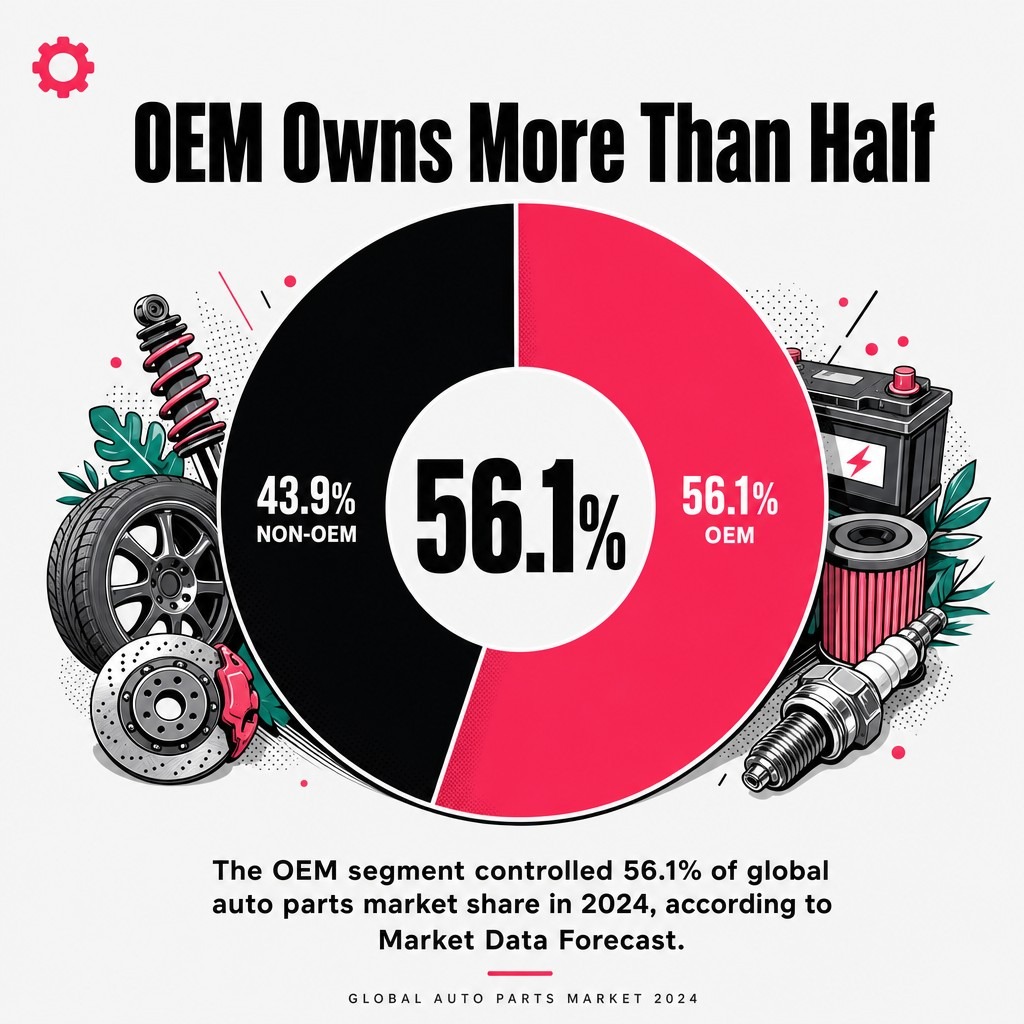
OEM parts marketing is the practice of positioning original equipment manufacturer parts in front of engineers, procurement teams, and repair shops through digital channels that match how these buyers actually research and purchase. The global auto parts market was valued at $577.21 billion in 2025, with the OEM segment controlling 56.1% of global market share in 2024, according to Market Data Forecast's auto parts market report. At the same time, Gartner's 2026 sales survey found that 67% of B2B buyers now prefer a rep-free experience. That combination tells you everything: enormous market, buyers who want to find you on their own terms.
I run an eCommerce PPC agency, and the pattern I keep seeing is OEM parts suppliers with genuinely superior products losing ground to aftermarket competitors who simply show up online more consistently. The quality advantage is real. The visibility advantage is not always there. That gap is fixable, and most of what fixes it costs less than a trade show booth.
OEM parts marketing targets a buyer who is not shopping for the cheapest option. Engineers and procurement professionals sourcing genuine parts need exact fit guarantees, manufacturer warranty compliance, and documented specifications. That changes everything about how you position and sell.
Aftermarket parts compete almost entirely on price. OEM parts marketing competes on certainty. A procurement manager choosing between a genuine part and an aftermarket alternative is not just comparing unit cost. They are comparing the risk of a failed installation, a voided warranty, or a non-conforming component in a regulated application. Your marketing needs to make that risk gap visible and explicit.
This is where most OEM auto parts digital marketing falls short. Supplier websites list part numbers and prices. They do not explain why exact fit matters for this specific application, or what happens when an aftermarket substitute does not meet OEM tolerances. That explanation is your strongest marketing asset, and most parts departments leave it completely unwritten.
For a deeper look at how OEM and aftermarket positioning differ strategically, the OEM vs aftermarket marketing comparison on this site breaks down the differentiation in detail.
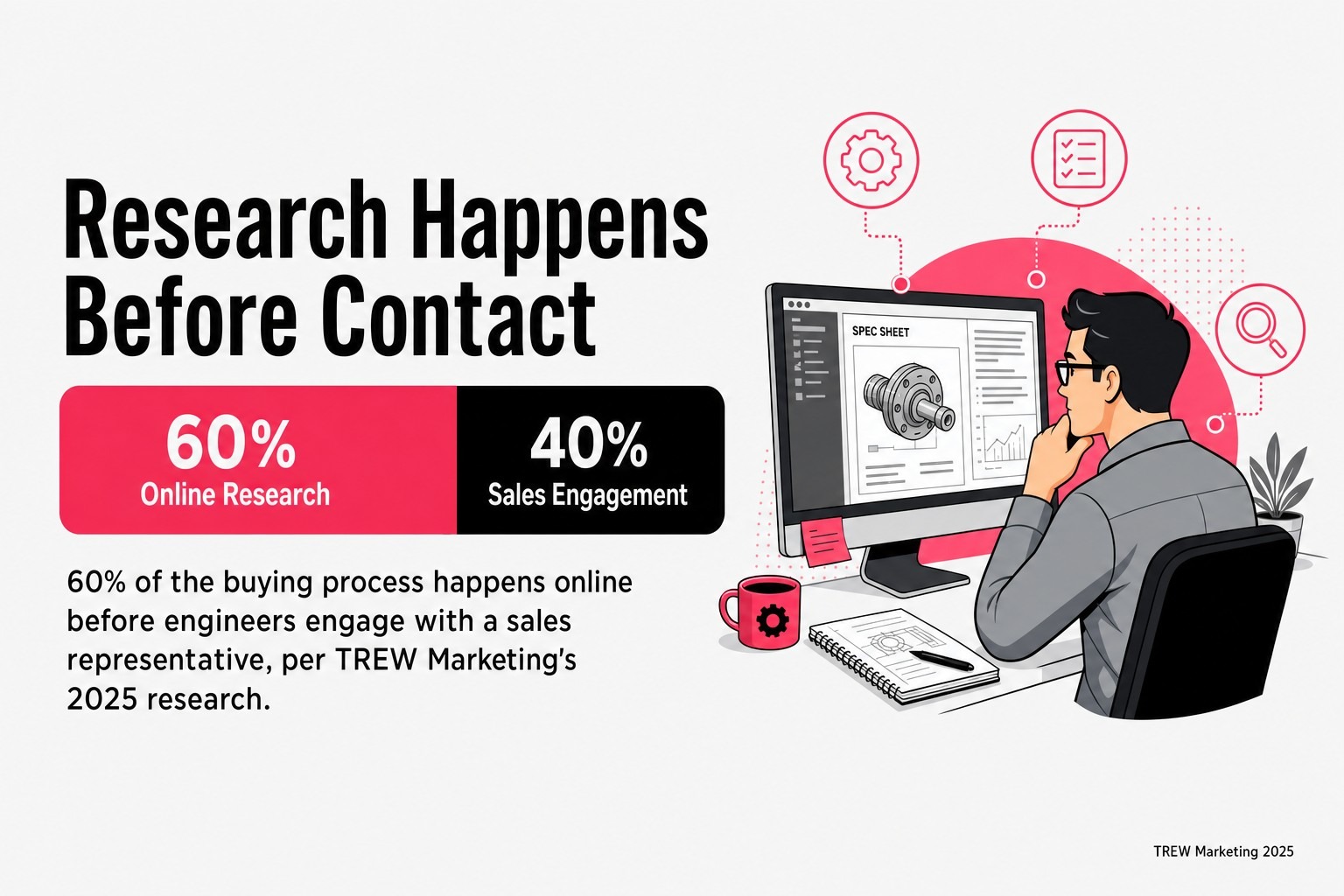
According to TREW Marketing's 2025 State of Marketing to Engineers research, 60% of the buying process happens online before engineers engage with a sales representative. That means by the time someone calls your parts department, the shortlist is usually already set.
The implication is uncomfortable for suppliers who rely heavily on relationship-based sales. Your digital presence is doing most of the qualifying work whether you have optimized it or not. If your website cannot answer a technical question at 9pm on a Tuesday, a competitor's website will.

6sense's 2025 Buyer Experience Report found that buyers are now contacting sellers earlier in the process, with first contact shifting from roughly 69% of the journey completed to 61%, about six to seven weeks sooner. Earlier contact sounds like good news. It is only good news if your content is strong enough that they found you in that earlier window.
Engineers need detailed specifications and performance data. Procurement teams want vendor reliability signals: certifications, lead times, and order history. Build content that serves both audiences, and you cover the two people most likely to influence the final purchase decision.
OEM parts marketing succeeds when digital channels work together rather than in isolation. SEO, PPC, eCommerce, email, and social media each serve a different part of the buying journey, and the suppliers who treat them as one coordinated system consistently outperform those running each channel separately.
SEO for OEM parts inventory pages starts with part-number-level specificity. Generic category pages rank for generic traffic. Engineers searching for a specific component type within a specific tolerance range are searching exact terms. Your product and category pages need to match that specificity.
Each OEM parts page should include the part number, compatible applications, fit specifications, and material or performance data. That content does dual work: it answers the technical questions engineers actually ask, and it gives search engines enough structured context to rank the page for long-tail queries that high-volume pages miss entirely.
Internal site architecture matters too. A parts department with thousands of SKUs needs logical category structures so both users and crawlers can find components without guessing. Clear URL hierarchies, descriptive meta titles, and schema markup for product data are baseline requirements for any serious OEM parts eCommerce presence.
Pay-per-click advertising for OEM parts operates on search intent that aftermarket competitors cannot easily intercept. When a procurement buyer searches for a specific genuine part by OEM part number, that query has almost no aftermarket competition. PPC campaigns targeting exact-match part numbers consistently deliver high-quality traffic at lower cost per click than broad category terms.
Google Shopping campaigns add another dimension. Properly structured OEM product feeds, with accurate titles, part numbers, and application data, pull genuine parts buyers who are already comparison shopping. For a detailed breakdown of how OEM product feeds drive equipment sales, the OEM product feeds and equipment sales growth guide covers feed structure in practical terms. And if you want the full PPC strategy playbook, the PPC guide for OEM parts suppliers goes deep on campaign structure and bidding.
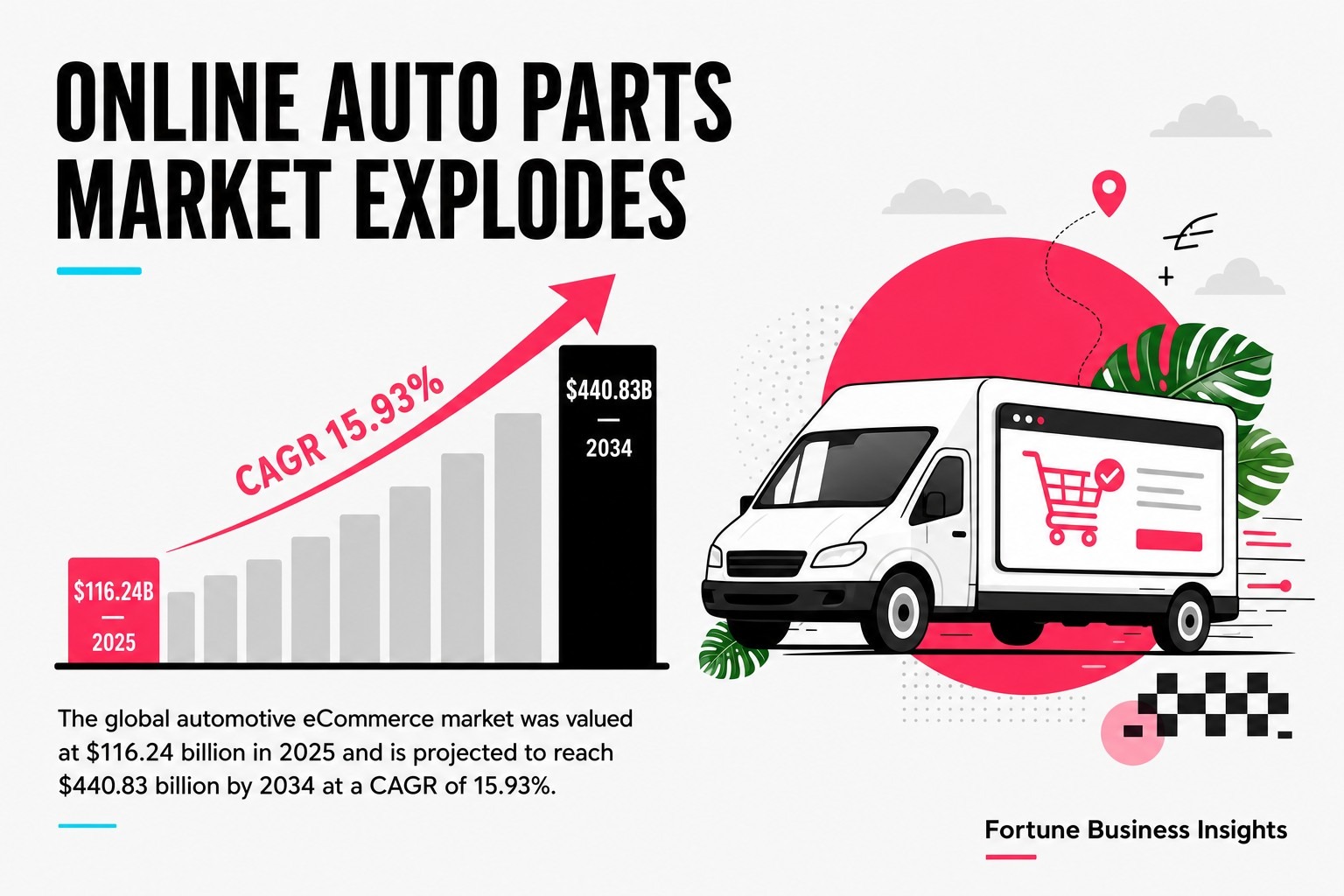
The global automotive eCommerce market was valued at $116.24 billion in 2025 and is projected to reach $440.83 billion by 2034 at a CAGR of 15.93%, according to Fortune Business Insights' automotive eCommerce market analysis. That is not a niche anymore. Online parts sales is the main channel for a growing share of workshop purchasing.
Roland Berger's Automotive Aftermarket Pulse 2025 found that more than 60% of workshops in mature markets now source significant volumes online. Repair shops are not waiting for a sales rep to stop by. They are ordering at midnight from whoever has the best-organized online catalog.
OEM parts suppliers have two practical eCommerce paths: a branded direct web store, or marketplace listings on platforms like eBay Motors or Amazon Automotive. Both have trade-offs.
LinkedIn is where engineers and procurement professionals actually spend their professional attention online. According to The Insight Collective's B2B tech buyer behavior research, 74% of B2B buyers use LinkedIn for work-related content, making it the dominant social platform among B2B buyers across the US and EMEA.

For OEM parts suppliers, LinkedIn works best as a content distribution channel rather than a direct sales platform. Technical articles, application notes, specification comparisons between genuine parts and aftermarket alternatives, and supplier reliability content all perform well with engineering and procurement audiences. Sponsored content targeting by job title and industry lets you put that content directly in front of the people making purchasing decisions.
Email marketing for parts departments serves a different purpose: retention and repeat purchase. Engineers and procurement teams who have already bought from you need a reason to come back before the next failure event. Catalog updates, new part availability, technical bulletins, and lead time notifications keep your parts department visible between purchase cycles.
The B2B content marketing guide for manufacturers covers how to structure content programs that serve both the LinkedIn and email channels without doubling your workload.
OEM parts marketing success is measurable at the channel level, the campaign level, and the SKU level. The question is which numbers actually tell you if the strategy is working, rather than just that traffic exists.
McKinsey's B2B Pulse 2024 research found that B2B buyers now use ten or more channels to interact with suppliers during the buying process, up from five channels in 2016. That means attribution is harder than it used to be. A buyer might find you through SEO, verify you on LinkedIn, download a spec sheet from your eCommerce site, and then submit a purchase order through your dealer portal. Single-channel attribution misses most of that journey.
Track these metrics across your OEM parts marketing programs:
Revenue per part number is the metric most suppliers do not track but should. It tells you which SKUs are driving your digital marketing ROI and which are dead weight in your catalog. Optimize around the parts that actually convert, and cut spend on pages that generate traffic without orders.
Want more auto parts content? Check out our auto parts marketing guide.
OEM parts marketing works when it matches the way engineers and procurement professionals actually buy: mostly online, across multiple channels, with a strong preference for self-service research before any conversation with a sales rep.
The market size is real. The shift to online parts sales is confirmed. And the buyers are already out there searching for genuine parts with exact specifications and fit guarantees. What most OEM suppliers are missing is not the product. It is the digital presence that makes the product findable at the exact moment the buyer is looking.
Start with your product pages. If they cannot answer a technical question from an engineer who has never spoken to your sales team, fix that first. Then build PPC campaigns around exact part numbers, structure your eCommerce catalog for search, and distribute technical content on LinkedIn where your procurement audience already spends their professional time.
The data-driven digital marketing guide for manufacturers is a strong next step if you want to build this into a full revenue growth system rather than a collection of separate tactics. Pick one channel, get it right, then stack the next one on top of it. That is how you build an OEM parts marketing program that actually compounds.