

Technical SEO for manufacturers determines whether procurement engineers find your product pages or your competitor's when they start a buying cycle. According to 6sense's 2024 B2B buyer experience report, 95% of the time the winning vendor is already on the buyer's Day One shortlist, which means if your site isn't indexed and visible before that shortlist forms, you're not in the running. Manufacturing SEO built on solid technical foundations, covering crawlability, site speed, structured data, and on-page optimization, is what gets you onto that list.

I work with manufacturers every day who build remarkable products but have websites that Google can barely read. Massive product catalogs buried five clicks deep. PDF spec sheets that no crawler will ever touch. Contact forms with eleven fields that nobody finishes. The technical problems aren't mysterious. They're just unaddressed. This post fixes that.
Technical SEO for manufacturers is the process of configuring a website's architecture, speed, crawlability, and structured data so search engines can find, read, and rank every product and category page without interference.
Most manufacturers think about SEO as writing blog posts or adding keywords to page titles. That's on-page SEO, and it matters. But if Google's crawler hits a wall before it even reaches those pages, none of that work pays off. Technical SEO is the foundation everything else sits on.
The scope covers four core areas: site architecture and internal linking, page speed and Core Web Vitals, mobile optimization, and structured data with schema markup. Each one affects how search engines index your content and how buyers find your products.
Manufacturing websites have specific structural problems other industries rarely face. Product catalogs with thousands of SKUs. Faceted navigation that generates duplicate URLs in the millions. Engineering PDFs sitting outside the crawlable site. Legacy CMS platforms that haven't seen a technical audit in years. These aren't edge cases. They're the norm. For a broader view of how SEO fits into the full manufacturing marketing picture, our complete manufacturing SEO guide covers the strategic layer in depth.
U.S. manufacturing and wholesale distribution sales reached $15.12 trillion in 2025, according to Digital Commerce 360's January 2026 B2B sales report, and a large share of that revenue starts with an online search.
That number sounds abstract until you realize what it means at the individual company level. Engineers and procurement managers doing product research aren't cold-calling vendors. They're typing part numbers and specifications into Google. If your product pages don't appear, that revenue goes somewhere else.
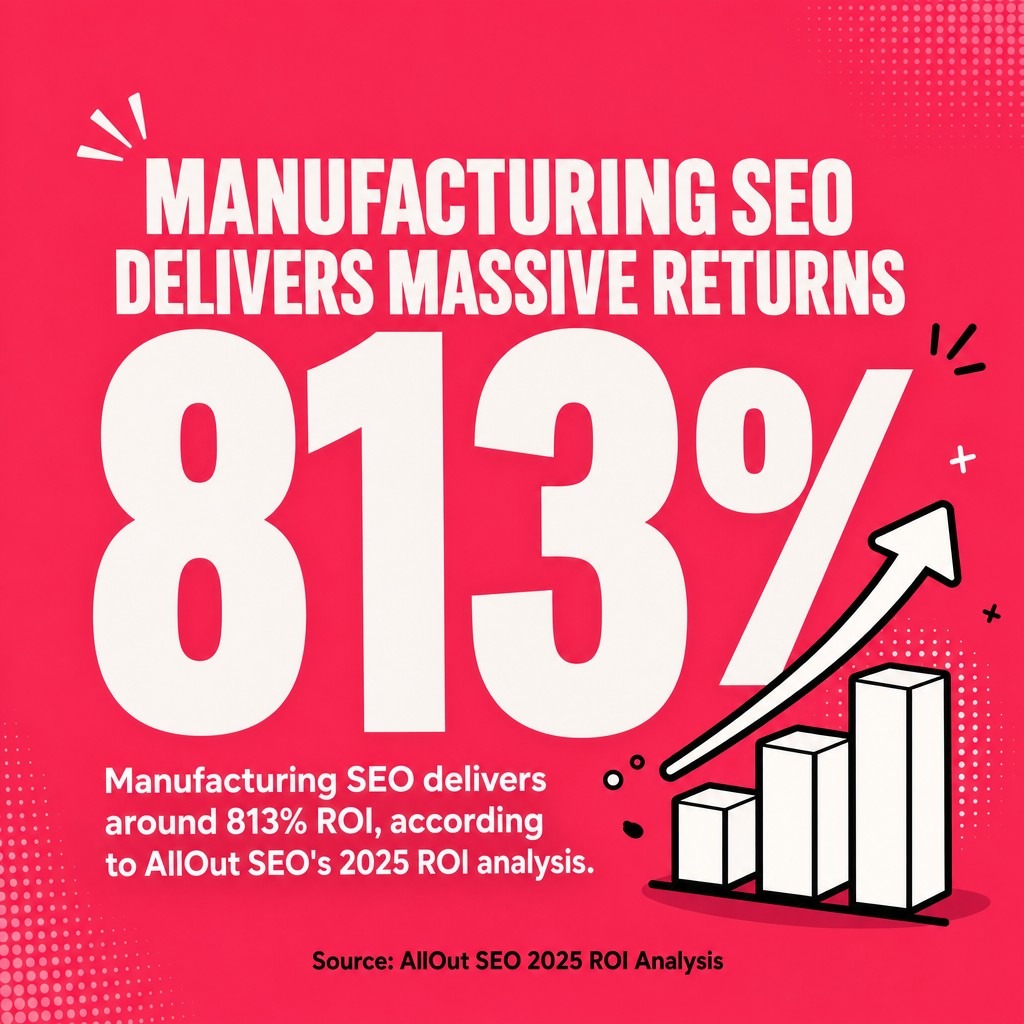
The ROI case for manufacturing SEO is concrete. AllOut SEO's 2025 ROI analysis estimates manufacturing SEO delivers around 813% ROI. That's not a typo. Paid channels rarely come close to that over time, because organic traffic compounds. A well-indexed product page keeps generating leads for years without a click cost attached to each one.
The B2B buying cycle makes this even more pointed. Brixon Group's research on the modern B2B buying journey shows that B2B buyers spend only 17% of their total buying time in direct contact with potential vendors. The other 83% is independent research, and most of that research happens online. Technical SEO is how you show up during that 83%.

If you want to see how this connects to the full B2B lead generation strategy for industrial companies, our step-by-step B2B SEO ranking guide for industrial companies walks through the process from keyword research to conversion.
Manufacturing websites waste between 30% and 40% of their crawl budget on low-value pages, according to Ranktracker's 2025 technical SEO statistics report, which means Google is spending half its time on your site crawling pages that should never be indexed.
Crawl budget is a finite resource. Google's crawler visits a site a set number of times per day based on server performance and the site's authority. When that budget gets eaten by paginated filter combinations, duplicate product URLs, and thin category pages, your important content gets crawled less often, or not at all.
Pages buried more than three clicks from the homepage tend to be crawled less often, according to SEO guidance from MarketingLTB. For manufacturers with deep product hierarchies, that can make important pages harder for search engines to find and index.
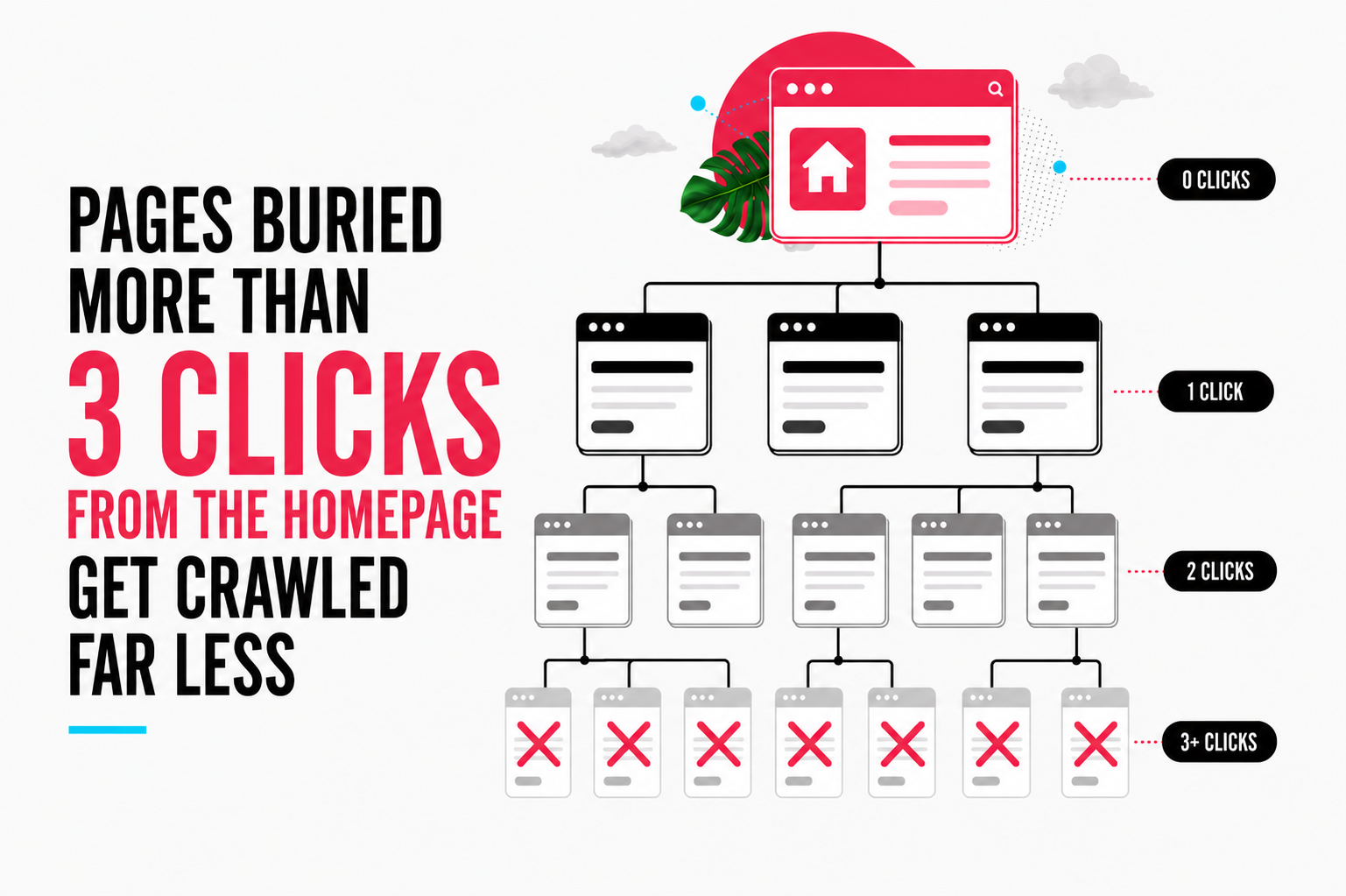
A product buried at Category > Subcategory > Sub-subcategory > Product is already at four levels. Add a paginated filter and you're at five. Add a variant URL and you're at six. Google may never reach it.
The fix is flatter architecture. Aim for every product page to be reachable within three clicks from the homepage. This means restructuring navigation, building strong internal linking from high-authority pages to deep product pages, and using XML sitemaps to signal priority directly to crawlers.
Internal links do double duty here. They distribute page authority across the site and they create crawler paths. Every time you add a new product line, audit how it connects to the rest of the site. An isolated section with no internal links pointing to it might as well not exist from Google's perspective.
Faceted navigation, the filter systems that let buyers sort by material, size, certification, and application, creates URL proliferation at scale. A product catalog with 500 base products and ten filter dimensions can generate hundreds of thousands of unique URLs. Most of them are duplicates with minor parameter variations.
Left unchecked, those URLs dilute your crawl budget and split page authority across near-identical pages. The solution involves a combination of canonical tags pointing to the primary product URL, noindex directives on parameter-generated pages, and robots.txt rules blocking crawlers from the filter parameter paths entirely.
This is one of the most common technical SEO failures I see on manufacturing sites. The product team builds a great filtering experience for users, the developer implements it without SEO guardrails, and suddenly the site has 200,000 URLs when it should have 2,000.
An XML sitemap tells Google which pages to prioritize. Most manufacturing sites either have an auto-generated sitemap that includes every URL (including the parameter garbage), or they don't have one at all.
A clean sitemap includes only the pages you want indexed: product pages, category pages, core service pages, and blog content. It excludes login pages, thank-you pages, internal search results, and any URL with a noindex tag. Submit it through Google Search Console and review it quarterly.
53% of users abandon a website if it takes more than 3 seconds to load, according to MarketingLTB's website speed statistics, and manufacturing websites with heavy product imagery and legacy CMS platforms routinely fail this threshold.
Speed is not a nice-to-have. It's a Google ranking signal and a direct conversion factor. A procurement manager pulling up your catalog on a mobile device at a job site will not wait for a six-second load time. They'll hit back and open your competitor's page instead.
Google's Core Web Vitals measure three specific aspects of page experience: Largest Contentful Paint (how fast the main content loads), Interaction to Next Paint (how quickly the page responds to input), and Cumulative Layout Shift (how stable the layout is as it loads).
As of July 2025, only 48% of mobile websites achieved good Core Web Vitals scores, according to the HTTP Archive's 2025 Web Almanac SEO report. That's a more useful number than it might look. It means roughly half your competitors are failing Google's page experience benchmark, and passing it is a real competitive edge.
For manufacturing sites specifically, the biggest LCP offenders are uncompressed product images and render-blocking JavaScript from legacy page builders. Fix image compression first. Convert large PNGs to WebP format, implement lazy loading for images below the fold, and remove any JavaScript that blocks the initial render.
Most manufacturing companies underinvest in hosting. A shared hosting plan that was fine for a five-page brochure site is not adequate for a 10,000-SKU product catalog with global distributor traffic.
Move to a managed hosting environment with server-side caching. Implement a content delivery network like Cloudflare to serve assets from edge locations closer to your buyers' geographic locations. These aren't developer luxuries. They're table-stakes for any site competing for organic traffic at scale.
Google officially completed its transition to mobile-first indexing in mid-2024, according to Digital Thrive AI's coverage of Google's mobile-first indexing completion, which means Google now uses the mobile version of your site as the primary basis for all rankings.
Many manufacturers built their sites for desktop-first experiences. Large data tables, wide product comparison grids, PDF downloads, and CAD file viewer integrations that require specific plugins are all common on manufacturing sites. Most of them break on mobile.
This matters even if your analytics show most visitors are on desktop. Google ranks based on the mobile version. If your mobile site has less content than your desktop version, or if the mobile experience is so poor that Google can't properly read it, your rankings suffer across all devices.
Run your key product pages through Google's PageSpeed Insights and review the mobile scores specifically. Look at whether product specifications render correctly on a small screen, whether navigation menus are usable with a thumb, and whether any content is hidden or truncated in the mobile view. For a detailed look at mobile optimization tactics for parts and product catalogs, our mobile optimization guide for parts websites covers the implementation in full.
Responsive design is the baseline. Beyond that, prioritize the content buyers actually need on mobile: product names, specifications, certifications, and a direct path to request a quote. Everything else is secondary.
On-page SEO for manufacturing websites requires aligning every title tag, header, and product description with the exact language procurement engineers and buyers use when searching for industrial components, materials, and equipment.
This is where keyword research for manufacturing companies gets specific. Buyers don't search for "fastening solutions." They search for "M8 stainless steel hex bolts DIN 933" or "ASME B16.5 Class 150 flanges carbon steel." The specificity is the point. Long-tail industrial search terms have lower search volume but dramatically higher purchase intent.
Every product page needs a unique title tag that includes the product's common name, its specification or standard, and the material or key attribute. A title like "Hydraulic Fittings | Products | Acme Manufacturing" wastes the most valuable SEO real estate on your site. "JIC 37-Degree Hydraulic Fittings, Stainless Steel, Sizes 1/8 to 2 Inch" tells Google and the buyer exactly what the page is about.
Meta descriptions don't directly affect rankings, but they affect click-through rates. For manufacturing pages, include the key specification, the available configurations, and a direct call to action like "request a quote" or "download spec sheet." That's what a buyer scanning ten search results wants to see.
Thin product pages, meaning pages with just a product name, a small image, and a price, perform poorly for manufacturing SEO. Buyers doing technical research need specifications, material grades, dimensional tolerances, compliance certifications, and application notes.
That depth also signals to Google that the page is authoritative. Write product descriptions that cover what the product is, what it's made of, what standards it meets, and what applications it serves. This isn't padding. It's the content buyers are searching for.
Internal linking within product pages matters too. Link from a product page to the relevant category, to related products, and to any technical articles or case studies that cover that product's applications. Those links help both users and crawlers move through your catalog efficiently.
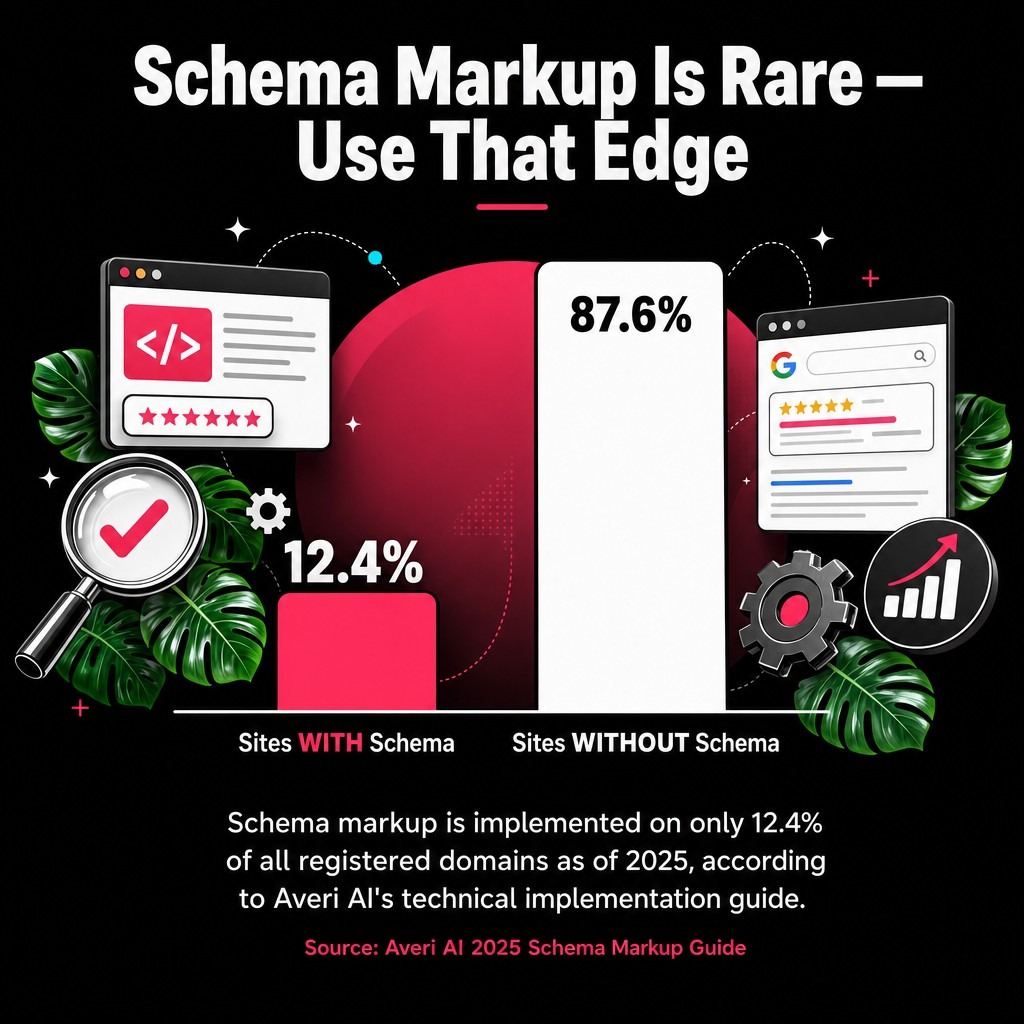
Schema markup is implemented on only 12.4% of all registered domains as of 2025, according to Averi AI's technical implementation guide for schema markup, which means adding structured data to your manufacturing site puts you ahead of the vast majority of competitors in search results.
Schema markup is a layer of structured data added to your HTML that helps search engines and AI systems understand exactly what your content describes. For manufacturers, the most valuable schema types are Product, Organization, FAQPage, and BreadcrumbList.
Product schema tells Google the exact name, description, SKU, material, and specifications of each item in your catalog. When implemented correctly, it can generate rich results in search that show specifications directly in the snippet, before a buyer even clicks through.
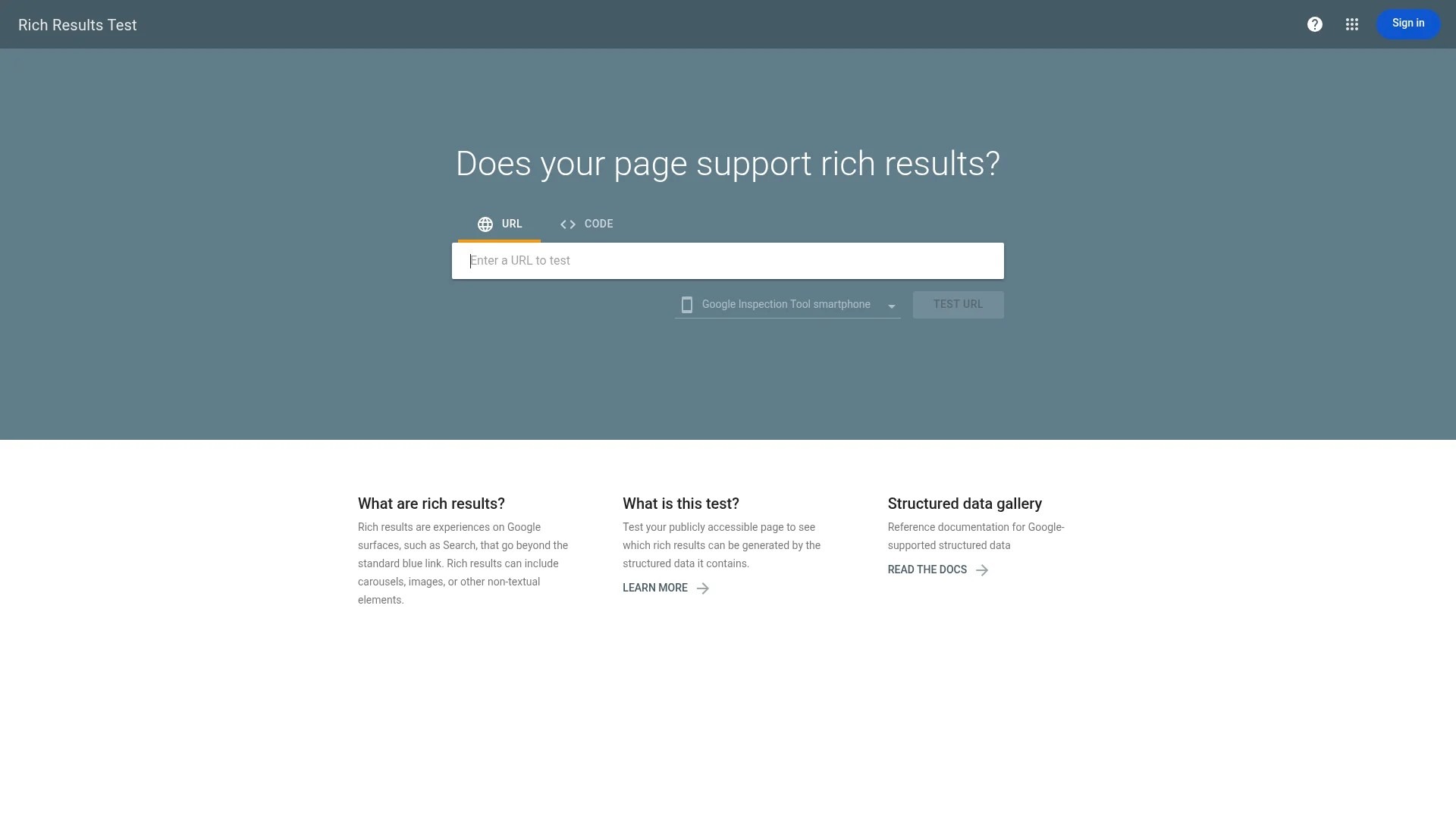
At minimum, implement name, description, sku, and brand properties on every product page. Add material, weight, and application-specific properties wherever your product data supports them. Validate all implementations using Google's Rich Results Test before deploying at scale.
Organization schema establishes your company's entity information: legal name, address, contact details, founding date, and industry. This data feeds directly into Google's knowledge graph and into AI systems like ChatGPT and Perplexity when they're generating answers about industrial suppliers.
BreadcrumbList schema communicates your site's navigation structure to search engines. For a deep product catalog, this is particularly important. It tells Google exactly how Category > Subcategory > Product fits together, which improves both crawlability and how your URLs display in search results.
AI search optimization for manufacturers is a real and growing concern. When a buyer asks ChatGPT or Google's AI Overviews "who makes HDPE pipe fittings in the Midwest," the answers pulled depend heavily on structured data, schema markup, and the consistency of your entity information across the web.
Generative engine optimization (GEO) for industrial companies starts with the same technical foundation as traditional SEO: clean structured data, schema markup, and consistent business information across directories. Manufacturers who implement schema markup now will have a significant structural advantage in AI-driven search results as that channel grows.
This is also where off-page signals matter. Backlinks from industry directories like ThomasNet, trade associations, and supplier databases reinforce your entity authority with both Google and AI systems. A manufacturer listed consistently across 20 industry directories with matching NAP data (name, address, phone) is easier for AI to trust than one with scattered, inconsistent citations.
The top technical SEO agencies for manufacturers in 2026 combine deep B2B industry knowledge with hands-on implementation capability across site architecture, on-page optimization, structured data, and lead generation strategy.
Choosing a manufacturing SEO agency is not the same as hiring a general digital marketing firm. Manufacturing sites have specific technical challenges, long sales cycles, and buyers who respond to specification-level detail rather than marketing copy. The agency you pick needs to understand both the technical SEO fundamentals and the way industrial buyers actually search.
The criteria that separate strong manufacturing SEO agencies from average ones come down to five factors: demonstrated experience with industrial or B2B clients, technical SEO depth (not just content production), transparent reporting tied to organic traffic and lead generation metrics, keyword research methodology that captures industrial search terms, and an understanding of the full B2B buyer journey.
Below is a reference table of the core evaluation criteria to use when comparing manufacturing SEO agencies:
When interviewing agencies, ask specifically how they handle crawl budget management on large product catalogs, whether they have experience with faceted navigation and canonical tags, and what their process is for implementing and validating schema markup. Vague answers to those questions are a signal to keep looking.
For manufacturers evaluating their full digital marketing mix alongside SEO, our digital marketing guide for manufacturers covers how technical SEO fits into broader revenue growth strategy.
Evaluating a technical SEO agency for a manufacturing business requires testing their knowledge of industrial buyer behavior, their technical implementation track record, and their ability to connect organic traffic to actual lead generation outcomes.
Most manufacturers get pitched by agencies that rank well for "SEO agency" but have never optimized a product catalog with 8,000 SKUs or written a title tag for an industrial filtration component. The pitch deck looks polished. The capability isn't there.
Ask every prospective manufacturing SEO agency these four questions before signing anything:
An agency that can answer those questions specifically, with process detail rather than marketing language, understands manufacturing SEO. An agency that pivots to talking about "content strategy" and "brand awareness" does not.
Demand monthly reporting that connects technical SEO work directly to organic traffic growth, keyword ranking improvements, and RFQ or lead volume. Vanity metrics like "impressions" and "domain authority score" tell you nothing about whether the agency's work is generating qualified B2B leads.
The metrics that matter for manufacturing SEO are: organic sessions to product and category pages, keyword rankings for your core industrial search terms, crawl coverage (what percentage of your catalog is indexed), Core Web Vitals pass rates, and organic-attributed contact form submissions or quote requests.
Set those benchmarks before the engagement starts. Review them monthly. If organic traffic to product pages isn't moving in the first 90 days, ask why. Good agencies have an answer. Average agencies change the subject.
The most common technical SEO mistakes on manufacturing websites are leaving PDFs unoptimized outside the crawlable site, ignoring mobile experience for desktop-heavy audiences, and building product catalogs without any structured data or schema markup in place.
I want to be direct about something. Most of these problems aren't complicated to fix once you know they exist. The gap isn't usually technical knowledge. It's that nobody has sat down with the site, run a proper crawl audit, and worked through the findings systematically. That's what a technical SEO audit does.
Run your site through Semrush or Ahrefs and pull a full crawl report. Sort the issues by severity. Start with anything that blocks indexation entirely: pages blocked in robots.txt that shouldn't be, noindex tags on product pages, broken internal links pointing to 404s. Those have immediate impact on search visibility.

Then work through page speed issues. Then duplicate content. Then structured data gaps. This is the sequence that produces measurable results fastest.
One more thing that consistently gets missed: local SEO for manufacturers. If you serve specific regional markets or operate from multiple facilities, your Google Business Profile and location-based keyword optimization matter. An industrial supplier in Ohio that ranks for "hydraulic fittings Cleveland" is capturing procurement managers who prefer regional vendors. Don't ignore it because you also have national reach.

A technical SEO foundation that generates B2B leads for manufacturers connects every element, crawlability, site speed, structured data, on-page optimization, and off-page authority, into a system where qualified buyers find your products before they've contacted anyone.
The sequence matters. Get the technical foundation right first. Clean up crawl issues, fix page speed, implement schema markup. Without those, on-page SEO work and content marketing investments produce a fraction of what they should. You're pouring water into a leaking bucket.
Once the foundation is solid, keyword research for manufacturing companies becomes the growth driver. Map your entire product catalog to the specific search queries buyers use. Use those terms in title tags, product descriptions, and category page headers. Build content that answers the technical questions buyers have during the research phase of their purchase cycle.
Off-page SEO through backlinks and industry directory presence then amplifies what you've built. Citations in ThomasNet, trade publication coverage, and supplier database listings build domain authority in a way that's highly relevant to your industrial buyer audience. These backlinks aren't just authority signals for Google. They're also the channels where buyers discover you before they even run a search.
The manufacturers who get this right don't just rank better. They stop being invisible to the 83% of the buying process that happens without any vendor contact. That's the real value of technical SEO done properly. It makes your site the resource buyers find and trust before they've ever picked up a phone. For manufacturers ready to build out the full strategy beyond the technical foundation, our SEO guide for capturing industrial buyers covers the demand generation side in detail.
Technical SEO for manufacturers is the process of optimizing a manufacturing website's architecture, page speed, crawlability, mobile experience, and structured data so search engines can find and rank product pages, and B2B buyers can find the manufacturer through organic search.
Most manufacturing companies see measurable improvements in crawl coverage and organic traffic within 60 to 90 days of completing a technical SEO audit and implementing the priority fixes. Full keyword ranking gains for competitive industrial terms typically take six to twelve months.
Start with Organization schema to establish your business entity, then implement Product schema on your highest-traffic product pages. Add BreadcrumbList schema across the catalog to communicate your site hierarchy. FAQPage schema on product and category pages can generate rich results for specification-related queries.
Block low-value URLs in robots.txt, add canonical tags on duplicate parameter-generated pages, reduce crawl depth so no product page is more than three clicks from the homepage, and submit a clean XML sitemap that includes only indexable pages. Address crawl budget issues before investing in content production.
B2B buyers complete most of their vendor evaluation independently through online research. If a manufacturing website isn't properly indexed and visible during that research phase, the manufacturer isn't considered. Technical SEO ensures product pages are findable and readable at the exact moment a buyer is searching.