.png)
Your product pages need to do three jobs at once. They need to rank when an engineer searches for "SAE J1939 compatible pressure sensor 0-500 psi." They need to convince a procurement officer that your specifications meet their requirements. And they need to make sense to ChatGPT when it synthesizes an answer for someone asking "which manufacturer makes the most reliable hydraulic fittings."
Most manufacturer websites fail at all three.
The problem isn't your products. It's that your product pages are optimized for nobody in particular. Generic descriptions that could apply to any manufacturer. Specs buried in PDFs. Part numbers treated as an afterthought instead of the foundation of your entire SEO strategy.
I've spent years helping manufacturers fix this exact problem at SCUBE Marketing. The manufacturers who get product page SEO right don't just rank better. They generate qualified leads from engineers who already know exactly what they need.
You're about to learn how to structure product pages that rank for the searches that actually matter. Part number optimization. Technical specification architecture. The specific on-page elements that convince both Google and procurement officers that you're the right supplier.
Part numbers represent the bottom of your funnel. When someone searches for a specific part number, they're not browsing. They're buying, cross-referencing, or validating a specification.
These searches convert at dramatically higher rates than generic product category terms. Someone searching "hydraulic fitting" is exploring options. Someone searching "Parker 6-6 FBZ-SS" knows exactly what they need and is checking if you stock it.
Manufacturer Part Numbers (MPNs) serve a dual purpose in SEO. They're unique identifiers that eliminate keyword competition, and they're precise match queries that signal high purchase intent.
Understanding search intent changes how you structure your content. Manufacturing procurement follows distinct phases: early-stage awareness searches, mid-stage specification research, and late-stage transactional searches.
Generic part category searches happen early. An engineer searches "stainless steel hydraulic fitting" when they're comparing options and validating design choices.
Specification-driven searches represent the middle stage. "3/8 NPT male hydraulic fitting 10000 psi" indicates they've narrowed requirements but haven't selected a manufacturer yet.
Exact part number searches are transactional. "Parker 6-6 FBZ-SS" or "your-brand-XYZ-500" means they're checking availability, comparing prices, or validating compatibility.
Most manufacturer websites treat part numbers as internal inventory codes. They appear in product titles, maybe in a specifications table, but they're not treated as keywords worth optimizing around.
The missed opportunity is massive. Every part number is a zero-competition keyword phrase where you should automatically rank first. But only if Google can find it, read it, and understand it's important.
Part numbers buried in images, locked in PDFs, or hidden behind JavaScript don't exist to search engines. Your competitors who put part numbers in H1 tags and body copy are capturing traffic that should be yours.
Engineers don't search for products the way consumers do. They search for specifications, compatibility requirements, and technical parameters that meet their design constraints.
Your product pages need to match that search behavior. Not with marketing copy about "industry-leading quality" but with searchable, scannable specification data that answers technical questions.
The structure matters as much as the content. Google needs to see specifications as structured data, not paragraph text. Engineers need to scan specs quickly without reading promotional content.
Start with an HTML table immediately below your product title and introductory paragraph. This table should contain your primary specifications in a format that's both human-readable and machine-parsable.
Include these core specification categories where applicable:
Each specification should use standard industry terminology. Don't say "very high pressure" when you mean "10,000 PSI max working pressure." Engineers search for numbers, not adjectives.
Every specification in your table is a potential keyword phrase. An engineer searching "hydraulic fitting SAE J1939 compatible" needs to see "SAE J1939" in your specifications, not buried in a downloadable datasheet.
Long-tail keywords collectively account for over 91% of all web searches and convert at 2.5 times the rate of head terms. In manufacturing, those long-tail searches are almost always specification combinations.
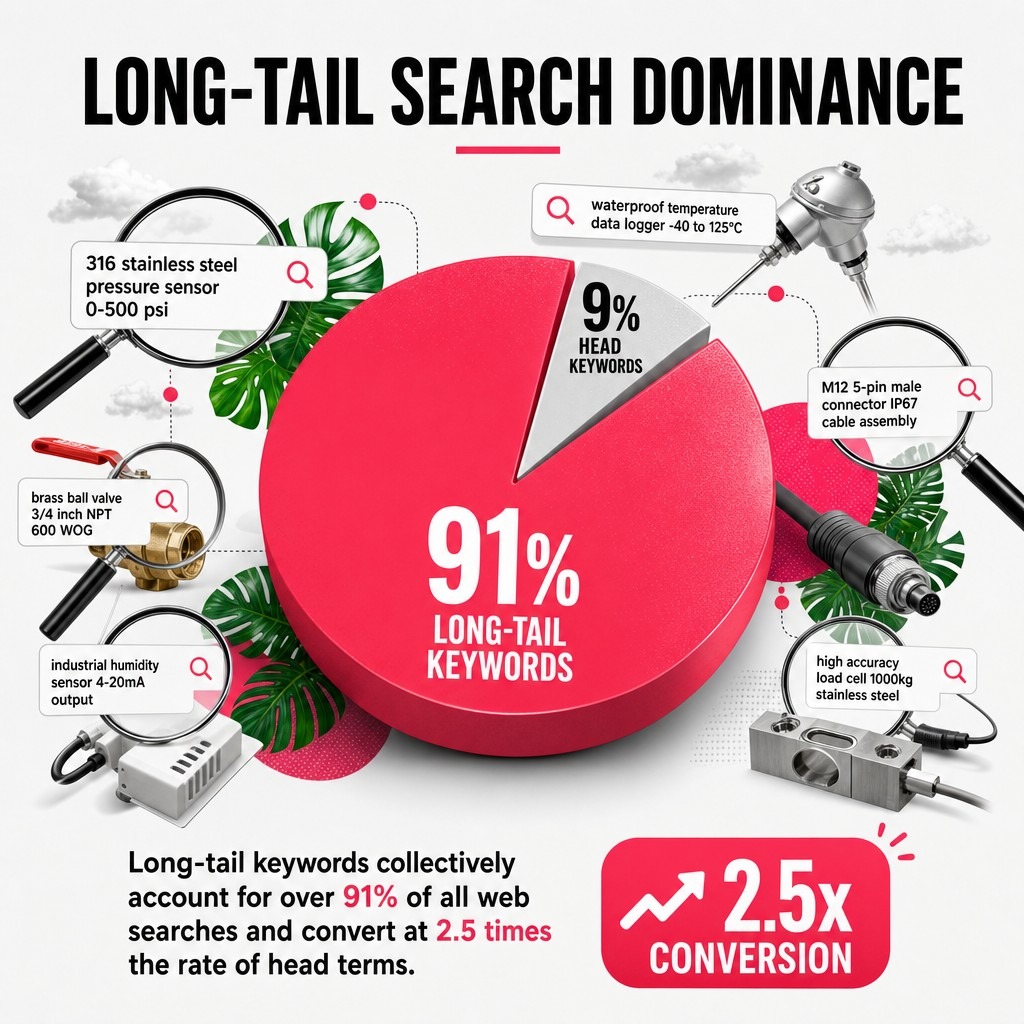
"Stainless steel pressure sensor" is a head term with high competition. "316 stainless steel pressure sensor 0-500 psi 1/4 NPT G1/4 output" is a long-tail specification search with near-zero competition and much higher conversion intent.
Your specification table needs to contain every searchable parameter. Pressure ranges. Thread types. Material grades. Output signals. Operating temperatures. Each one is a keyword that qualifies or disqualifies your product for a specific application.
Engineers evaluate dozens of products during specification research. They're not reading every word on your page. They're scanning for the three or four specifications that determine compatibility.
Use visual hierarchy to make critical specifications immediately visible:
The faster an engineer can confirm your product meets their requirements, the faster they move to the next evaluation stage. That's where your contact form or quote request comes in.
Product page optimization for manufacturers requires different priorities than consumer ecommerce. You're not optimizing for "best hydraulic fitting" or "top rated pressure sensor." You're optimizing for technical accuracy and specification matching.
The on-page elements that move the needle for manufacturer SEO are the ones that communicate technical authority and help search engines understand your product's specific use cases.
Your title tag formula should be: Primary Part Number | Key Specifications | Brand Name.
Example: "XYZ-500-SS | 316 Stainless Pressure Sensor 0-500 PSI | [Your Brand]"
This structure captures exact part number searches, specification combinations, and branded searches. The part number comes first because it's your most valuable keyword, and it's what appears in the browser tab when engineers are comparing multiple products across tabs.
Keep titles under 60 characters when possible. Google truncates longer titles in search results, and you want your most important specifications visible before the cutoff.
Your meta description isn't marketing copy. It's a technical summary that helps engineers decide whether to click.
Include: core specifications, key compatibility standards, and primary application. Skip promotional language entirely.
Bad: "Industry-leading pressure sensors designed for demanding applications with unmatched reliability."
Good: "316SS pressure sensor, 0-500 PSI range, 1/4 NPT connection, 4-20mA output. SAE J1939 compatible. Marine and industrial applications."
The second version tells an engineer exactly what they need to know. If those specifications match their requirements, they click. If not, they don't. That's the goal.
Your H1 should match or closely mirror your title tag. Use the part number and primary specifications.
Then use H2 and H3 tags to organize technical information:
This hierarchy helps both search engines and engineers navigate your content. Google understands topical organization. Engineers find technical details without scrolling through marketing content.
But length alone doesn't matter. Topical depth does. Your body content should answer the specific technical questions engineers ask during evaluation.
Include application guidance: "Ideal for high-pressure hydraulic systems in marine environments where corrosion resistance is critical. 316 stainless construction provides superior resistance to saltwater compared to 304 grade alternatives."
Add compatibility context: "Direct replacement for Parker 6-6 FBZ-SS and equivalent to Swagelok SS-600-1-4. Compatible with standard 3/8" hydraulic hose assemblies."
Explain technical advantages: "Electropolished internal finish reduces fluid turbulence and pressure drop compared to standard finishes. Important for applications requiring precise pressure regulation."
This content serves three purposes. It helps engineers evaluate fit for their application. It builds topical authority with search engines. And it ranks for the long-tail question queries engineers actually search.
The best manufacturer product pages balance machine-readable structured data with human-readable technical explanations. Search engines need structured information they can parse and display in rich results. Engineers need context and application guidance.
You need both, in formats that work for both audiences simultaneously.
Tables are your friend in manufacturing SEO. They present specifications in a scannable format for engineers while providing clearly labeled data pairs that search engines can extract and understand.
Structure your primary specifications table with these elements:
Each row is an opportunity to rank for a different specification combination. "316 stainless pressure sensor" targets material searches. "4-20mA output pressure sensor" targets signal type searches. "SAE J1939 pressure sensor" targets standard compliance searches.
After your specifications table, add an applications section that explains where and why engineers use this specific product. This is where you capture question-based searches and use-case queries.
Structure it as specific use cases rather than generic claims:
"Marine hydraulic systems: The 316SS construction resists saltwater corrosion better than 304-grade alternatives. Rated for continuous saltwater exposure in accordance with ASTM B117 salt spray testing."
"High-vibration environments: Integral strain relief and vibration-dampening collar prevent connection fatigue in mobile equipment and heavy machinery applications."
"Precision pressure regulation: Electropolished internal finish reduces pressure drop to less than 0.5 PSI at rated flow, critical for applications requiring consistent pressure delivery."
Each application paragraph targets a different search intent. Engineers searching "pressure sensor marine hydraulic" find the marine applications section. Engineers searching "low pressure drop sensor" find the precision regulation explanation.
One of the most valuable content types for manufacturing SEO is cross-reference information. Engineers frequently search "[competitor part number] equivalent" or "[competitor part number] cross reference."
If your part is compatible with or replaces a competitor's part, say so explicitly on the page. Create a dedicated compatibility section:
"Direct replacement for: Parker 6-6 FBZ-SS, Swagelok SS-600-1-4, Brennan 6801-06-06-SS"
Each competitor part number you list is a keyword phrase where you can rank. Engineers searching for those specific parts will find your product as an alternative.
This strategy is particularly effective for aftermarket manufacturers and component suppliers who offer compatible alternatives to OEM parts.
Schema markup is code you add to your product pages that explicitly tells search engines what each piece of information means. It's the difference between Google guessing that "0-500 PSI" is a pressure range versus knowing with certainty that it is.
For manufacturer product pages, Product schema is your starting point. But you'll want to extend it with properties specific to technical products.
Start with basic Product schema including these properties:
Then add technical properties that matter for industrial products:
The additionalProperty schema type lets you define custom name-value pairs for specifications that don't fit standard schema properties. This is where you encode pressure ratings, thread types, output signals, and other technical parameters.
Combine Product schema with Offer schema to communicate availability, lead times, and pricing information when appropriate:
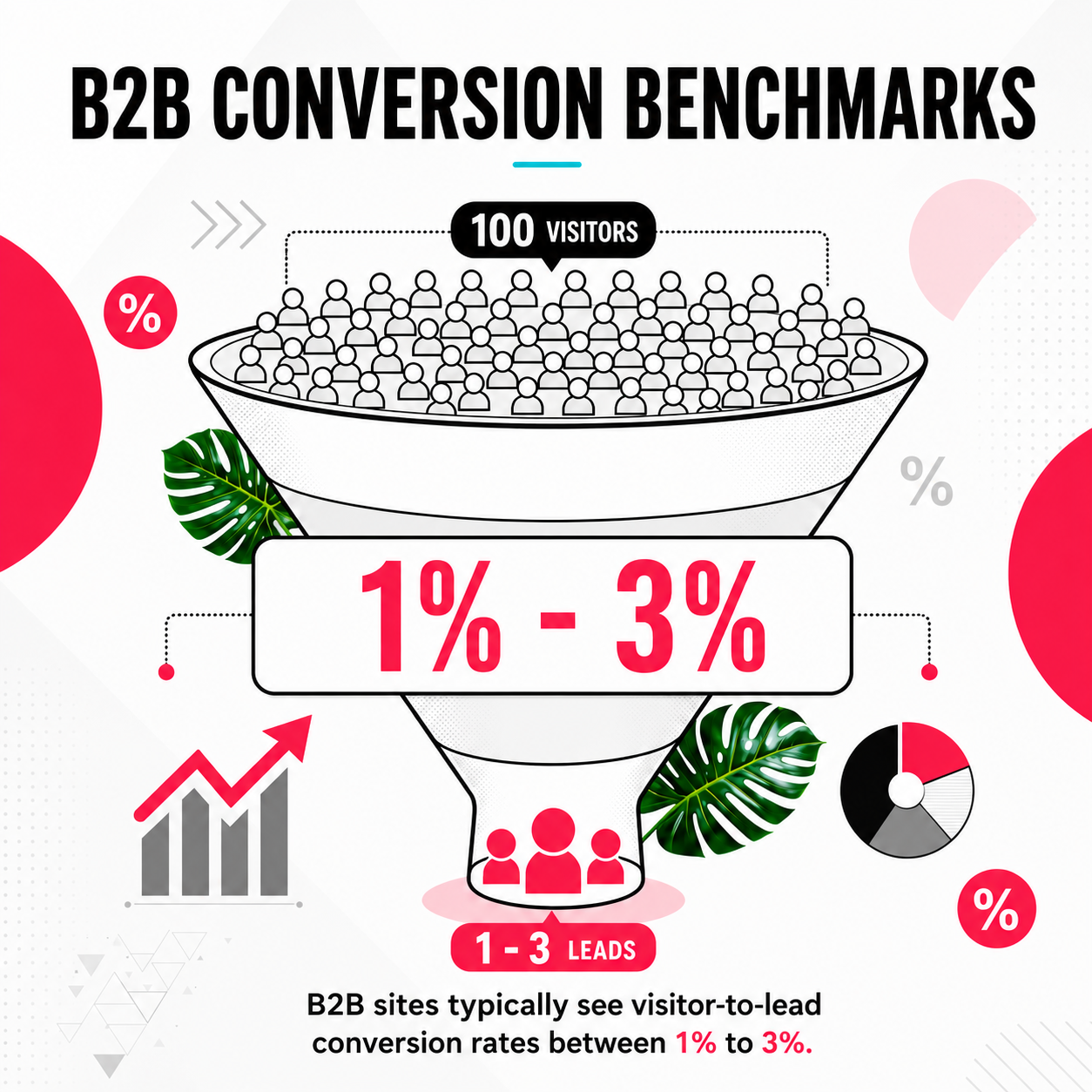
B2B ecommerce sites typically see visitor-to-lead conversion rates between 1-3%. Clear availability and pricing information moves engineers from research to contact faster.
Organization schema helps establish authority by explicitly defining your credentials:
This structured data reinforces expertise and trustworthiness, two critical E-E-A-T factors that affect rankings for technical and industrial queries.
On-page content optimization only works if Google can efficiently crawl, render, and index your product pages. Technical SEO issues kill rankings before content quality ever gets evaluated.
Manufacturers face specific technical challenges. Product catalogs with thousands of SKUs. Specification data generated from databases. Mobile experiences designed for desktop engineers.
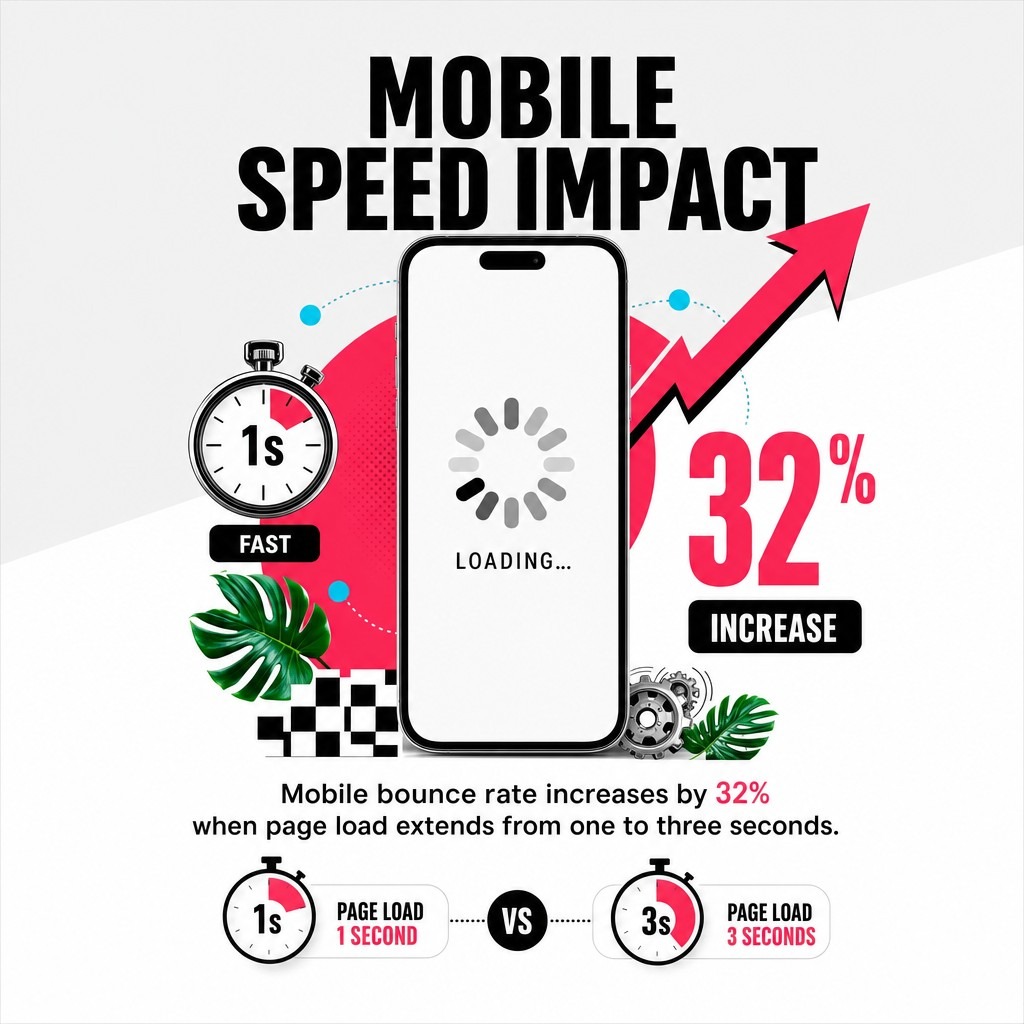
The problem is specifications. High-resolution technical drawings, detailed dimensional diagrams, and comprehensive specification sheets add page weight quickly.
Optimize without sacrificing technical detail:
Speed matters more on mobile. Engineers increasingly research specifications from tablets on the shop floor or smartphones during site visits. A slow mobile experience loses qualified leads.
Specification tables are notoriously difficult on mobile. Too many columns create horizontal scrolling. Too much detail becomes unreadable at small screen sizes.
Solutions that work for manufacturing product pages:
Use responsive table design that stacks vertically on mobile. Each specification becomes its own row with label and value side by side rather than forcing users to scroll horizontally.
Prioritize specifications by hiding less critical specs in expandable sections on mobile. Core specifications like part number, key dimensions, and pressure ratings stay visible. Secondary details like packaging weight or country of origin go in collapsible sections.
Make technical drawings pinch-to-zoom capable and high enough resolution to read dimension callouts when zoomed. Engineers need to verify dimensions on mobile.
Manufacturers with thousands of product variations face crawl budget constraints. Google won't crawl every page on every visit, so you need to prioritize which products get crawled most frequently.
Use XML sitemaps to signal priority:
Update sitemaps when you add new products or update existing product specifications. This signals to Google that content has changed and should be recrawled.
Use internal linking to reinforce product importance. Your highest-priority products should be linked from category pages, related product sections, and application guides. Products with more internal links get crawled more frequently.
Individual product pages rank for part numbers and specifications. But topical authority comes from comprehensive content covering every aspect of your product category.
Search engines reward websites that thoroughly cover a topic from multiple angles. One product page ranking for "316 stainless pressure sensor" is good. Ten product pages covering different pressure ranges plus application guides, comparison charts, and specification selection tools creates category-level authority.
Your category pages should do more than list products. They should provide overview content that establishes expertise in that entire product category.
Effective category page optimization includes specification comparison tables, application guidance, and selection criteria that help engineers narrow their search.
Example structure for a "Hydraulic Pressure Sensors" category page:
This content serves engineers researching options while building semantic relationships between related products. Search engines see comprehensive topic coverage, not just isolated product listings.
Application guides target the awareness and research phases of the buying process. Engineers who aren't searching for specific part numbers yet but are trying to solve design challenges or validate component selections.
These guides should connect application requirements to product specifications:
"Selecting Pressure Sensors for Marine Hydraulic Systems: Material compatibility with saltwater, pressure ranges for marine applications, environmental sealing requirements, and certification standards for maritime use."
Link from application guides to relevant products. This creates topical clustering where search engines see clear relationships between informational content and product pages.
Each application guide is also an opportunity to rank for longer-tail informational queries: "how to select pressure sensor for marine application" or "best material for saltwater pressure sensor."
Engineers searching for technical reference information present opportunities to demonstrate expertise while supporting product page rankings.
Effective technical resources for manufacturers include:
These resources earn links from industry forums, engineering communities, and educational institutions. In Backlinko’s analysis of 11.8 million Google search results, the #1 result had an average of 3.8x more backlinks than positions #2–#10, showing why practical technical assets can strengthen authority and organic visibility.


This changes product page optimization. It's no longer enough to rank in traditional search results. Your product pages need to be comprehensible and useful to AI systems synthesizing answers from multiple sources.
Generative Engine Optimization (GEO) extends traditional SEO for AI interpretation and synthesis.
AI systems excel at extracting structured information but struggle with marketing fluff and ambiguous descriptions. Your product pages need clear, explicit specification statements that AI can confidently cite.
Instead of: "Our pressure sensors deliver exceptional performance in demanding environments."
Write: "XYZ-500-SS pressure sensor operates from -40°F to 185°F with 0.25% full-scale accuracy. 316 stainless steel construction provides corrosion resistance in marine and chemical processing applications."
The second version gives AI systems concrete facts to extract and compare. When ChatGPT answers "which pressure sensor works in saltwater," it can confidently cite your 316 stainless construction and corrosion resistance.
Engineers frequently ask AI systems comparative questions: "Compare Parker 6-6 FBZ-SS to Swagelok SS-600-1-4" or "What's the difference between 304 and 316 stainless steel for pressure sensors?"
Structure product content to enable AI-powered comparison:
This table format helps AI extract specification comparisons accurately. The benefit column provides context that AI can use when explaining differences to engineers.
Format sections of your product pages as direct answers to common questions. Use the question as an H3 heading followed by a concise answer.
"Is this sensor suitable for saltwater applications?"
"Yes. The 316 stainless steel construction provides excellent corrosion resistance in saltwater and marine environments. Tested to ASTM B117 salt spray standard with no corrosion after 500 hours exposure."
This Q&A structure is exactly what AI systems look for when synthesizing answers. It's explicit, factual, and directly addresses common engineer questions.
Internal links distribute authority throughout your site and create semantic relationships between related content. For manufacturers, strategic internal linking can significantly improve product page rankings.
Your linking strategy should mirror how engineers actually research and evaluate products.
Category pages naturally link to individual products. But the structure matters.
Use descriptive anchor text that includes primary specifications: "316 stainless pressure sensor 0-500 PSI" rather than generic "View product" or "Learn more" links.
Link to your most important products first. Place high-priority products at the top of category listings where they accumulate more link authority and user attention.
For comprehensive category pages with dozens of products, use filters and sorting that keeps your priority products visible. "Most popular" or "recommended" sorting puts strategic products first.
Product pages should link to genuinely related products, not just random alternatives. The relationships should be based on how engineers actually cross-shop or combine products.
Useful related product relationships:
Each related product link should explain the relationship: "Higher pressure range alternative (0-1000 PSI)" or "Compatible mounting bracket for panel installation."
Strong internal linking from application guides to relevant products passes authority while serving user intent.
Engineers reading "Selecting Pressure Sensors for Marine Applications" should see contextual links to products that meet marine requirements. Link in the context of specific recommendations:
"For saltwater hydraulic systems, choose 316 stainless construction like the XYZ-500-SS for superior corrosion resistance compared to 304-grade alternatives."
This linking strategy serves three purposes. Engineers discover relevant products during research. Product pages gain authority from informational content. Search engines see semantic relationships between topics and products.
Manufacturer SEO success isn't measured by traffic alone. It's measured by qualified leads from engineers with genuine interest in your products.
The metrics that matter are different from consumer ecommerce.
Track rankings for three types of keywords separately:
Part number rankings: Your exact part numbers and cross-reference part numbers. You should rank #1 for every part number you manufacture. If you don't, your on-page optimization needs work.
Specification combination rankings: Multi-word queries combining specifications like "316 stainless pressure sensor 4-20mA." These indicate mid-funnel research traffic.
Application and category rankings: Broader terms like "pressure sensors for hydraulic systems" or "marine grade hydraulic fittings." These capture early research traffic.
The most valuable rankings are specification combinations. They represent engineers who've narrowed requirements but haven't selected a supplier yet.
Time on page and scroll depth matter more for technical products than bounce rate. Engineers reading specifications and reviewing technical drawings spend significant time on page even when they ultimately determine your product doesn't fit their requirements.
Track which specification sections get the most engagement. If engineers consistently scroll to dimensional drawings but rarely view certifications, it tells you what information drives decisions.
Downloads of technical documentation indicate serious evaluation. Engineers don't download datasheets or CAD files unless they're actively specifying your product.
Direct conversions on product pages are rare in manufacturing. Engineers research specifications long before they contact suppliers.
Track these conversion indicators instead:
Engineers typically visit manufacturer websites 5-8 times during the evaluation process. They're comparing specifications across multiple suppliers, validating compatibility, and building approval documentation.
Your product pages need to support that research cycle with comprehensive technical information that engineers can reference, download, and share with procurement teams.
Product page optimization for manufacturers is fundamentally different from consumer ecommerce SEO. You're not optimizing for impulse purchases or emotional buying decisions.
You're optimizing for engineers conducting technical evaluation. For procurement officers validating specifications against requirements. For AI systems synthesizing answers to complex comparison questions.
The manufacturers who win in search results understand this. They structure product pages around searchable specifications. They optimize for part numbers and technical parameter combinations. They create comprehensive technical content that establishes category authority.
Start with your highest-value products. The ones you want to rank for most. Apply these SEO best practices systematically to product listings.
Audit your current product pages against the elements covered in this guide. Are part numbers prominent and searchable? Are specifications in HTML tables rather than images? Is your schema markup explicit about technical properties?
The opportunity is significant. Most manufacturer websites still treat product pages as simple inventory listings. Technical specifications buried in PDFs. Part numbers invisible to search engines. Generic descriptions that could apply to any supplier.
Get product page SEO right, and you rank for the specific searches that indicate genuine purchase intent. Engineers find your products when they're actively specifying components. Procurement officers discover you when they're comparing suppliers.
That's the traffic that generates qualified leads and actual business. Not visits from people browsing generically, but engineers searching for exactly what you manufacture.