
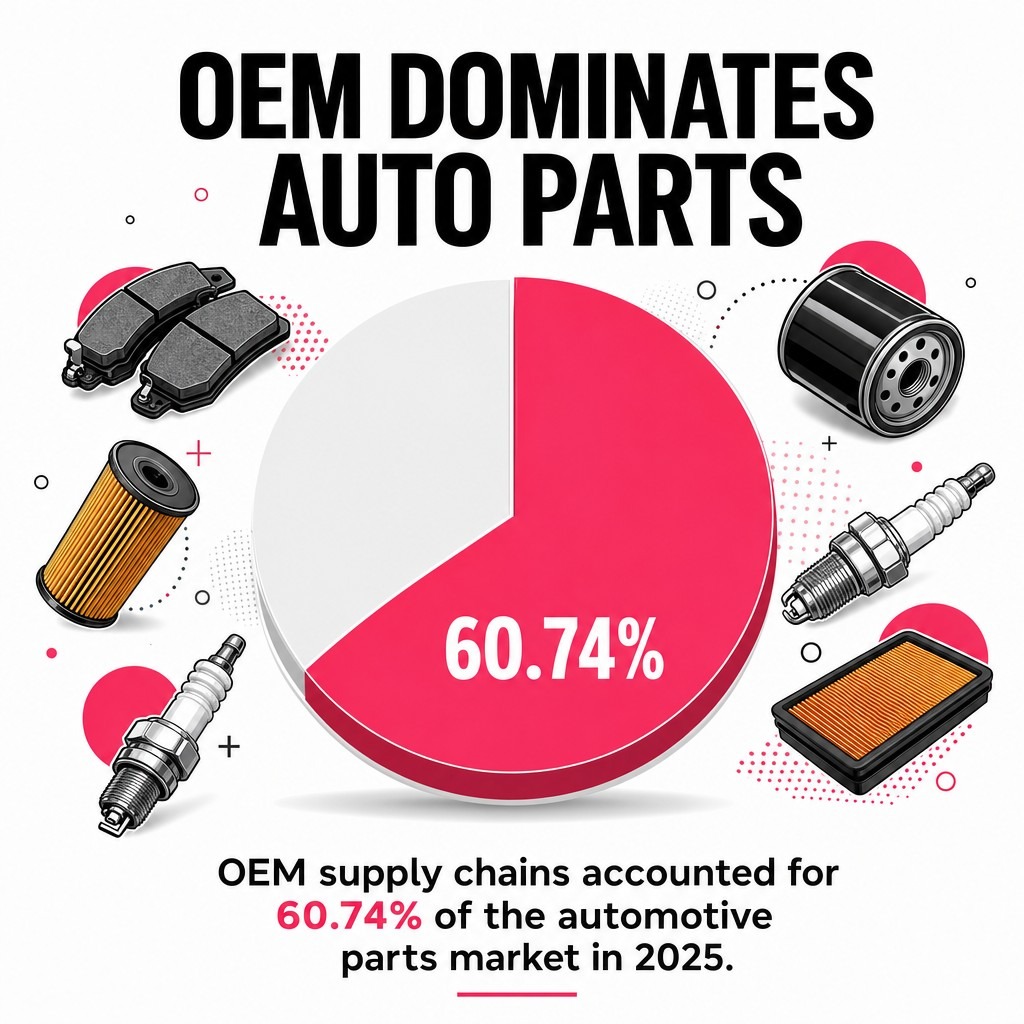
OEM supply chains accounted for 60.74% of the automotive parts market in 2025, making OEM parts SEO a critical revenue driver for retailers. Part number searches convert at exceptionally high rates because buyers know exactly what they need.
Your site architecture, structured data implementation using ACES/PIES standards, and technical SEO foundation determine whether you capture this high-intent traffic or lose it to competitors. OEM parts search optimization requires different tactics than aftermarket parts because buyers search by manufacturer part numbers, vehicle compatibility data, and precise fitment specifications.
I run a PPC agency, so I see the paid side of automotive parts every day. The conversion data tells a clear story. When someone types in a part number, they're ready to buy. But here's what surprises most retailers: organic traffic for part numbers converts almost as well as paid, and once you rank, there's no cost per click eating your margins.
The problem? Most OEM parts sites treat SEO like a generic ecommerce strategy. They optimize for broad terms like "brake pads" and wonder why their traffic doesn't convert. Meanwhile, the retailers winning this space have figured out the part number game. They've structured their sites to capture searchers who type "22204AA103" into Google, not shoppers who casually browse "Subaru parts."
I'll show you how to rank for part number searches, structure your catalog for OEM-specific queries, and implement the technical foundation that search engines need to understand your inventory. You'll learn the difference between OEM and aftermarket SEO strategy, why ACES and PIES data matters more than you think, and which on-page elements actually move the needle.
OEM parts retailers face a fundamentally different search environment than general ecommerce sites. Your buyers don't browse. They don't compare product features or read lifestyle content. They search by part number because their mechanic told them what to order, or they looked under their hood and found a worn component with a manufacturer code stamped on it.
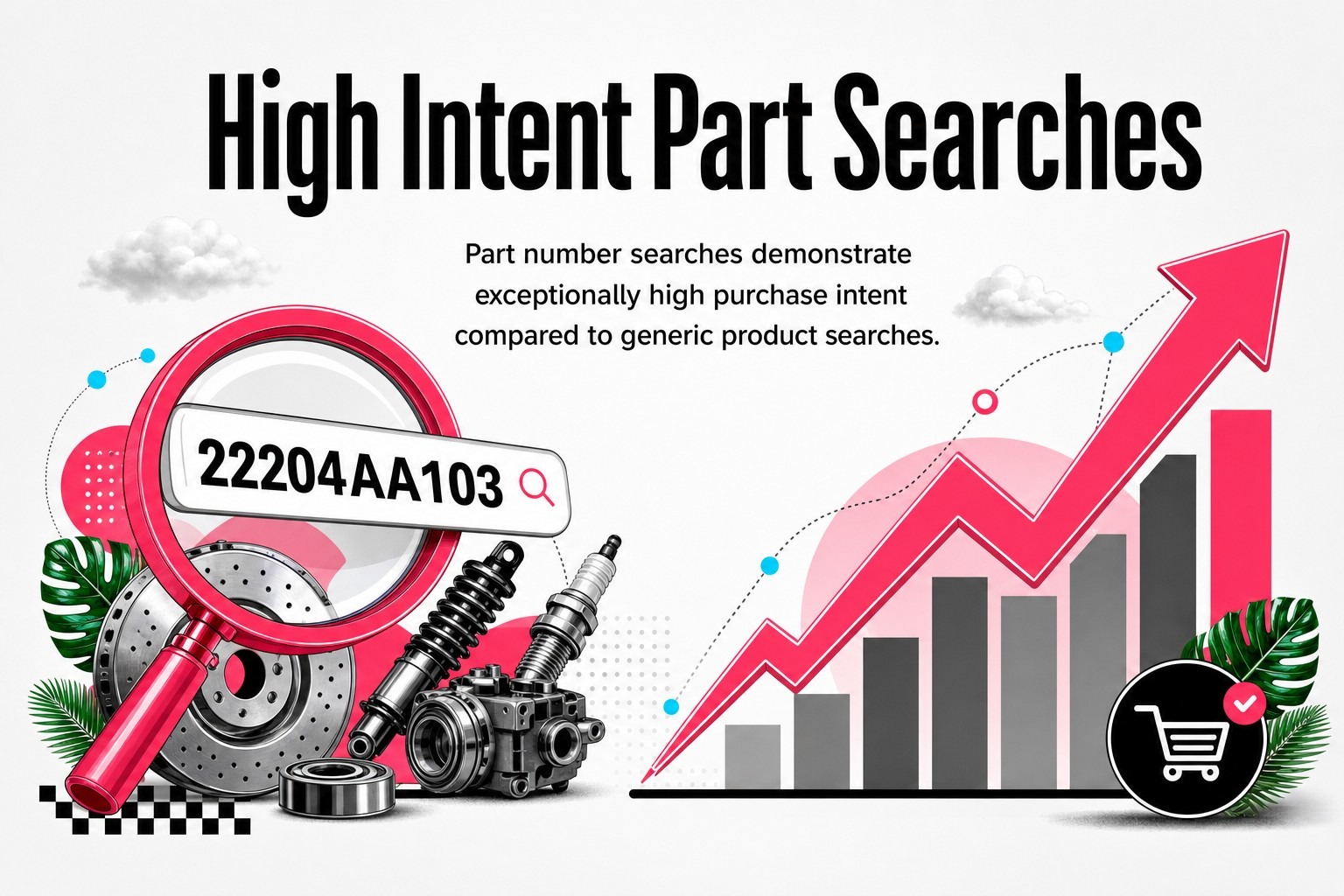
Part number searches demonstrate exceptionally high purchase intent compared to generic product searches. When someone types "AC Delco 41-993" into Google, they're not researching spark plug options. They need that exact part, and they're comparing prices and availability across retailers who stock it.
Standard ecommerce SEO focuses on informational content and buyer education. You'd typically create comparison guides, how-to articles, and lifestyle content to attract top-of-funnel traffic. That content has a place in OEM parts SEO, but it's not where you make money.
Your revenue comes from ranking for three search types: manufacturer part numbers, cross-reference numbers, and vehicle-specific fitment queries. Each requires different optimization tactics, and most retailers only nail one of the three.
Generic automotive parts retailers optimize for "brake pads for Toyota Camry." That's fine for aftermarket parts where buyers want options. But OEM buyers already know they need genuine Toyota part number 04465-06090. If your product page doesn't rank for that exact part number, you've lost the sale before they see your site.
The technical challenge is massive. You're optimizing for thousands or millions of individual part numbers, not dozens of product categories. Your site architecture needs to handle that scale while keeping pages crawlable and indexable.
Here's what that means practically: your category page for "Toyota Camry brake pads" might get decent traffic, but your product page for part number 04465-06090 converts at three times the rate. Scale that across your entire catalog, and part number optimization becomes your primary revenue driver.
Technical SEO determines whether search engines can even find your part numbers. I see retailers with 500,000 SKUs who wonder why only 5% of their pages appear in search results. The answer is always the same: poor site architecture, crawl budget waste, or indexing issues.
Your catalog size creates unique challenges. Google allocates crawl budget based on site authority and technical health. If your site structure forces crawlers to click through seven layers of category pages to reach a product, many parts never get indexed.
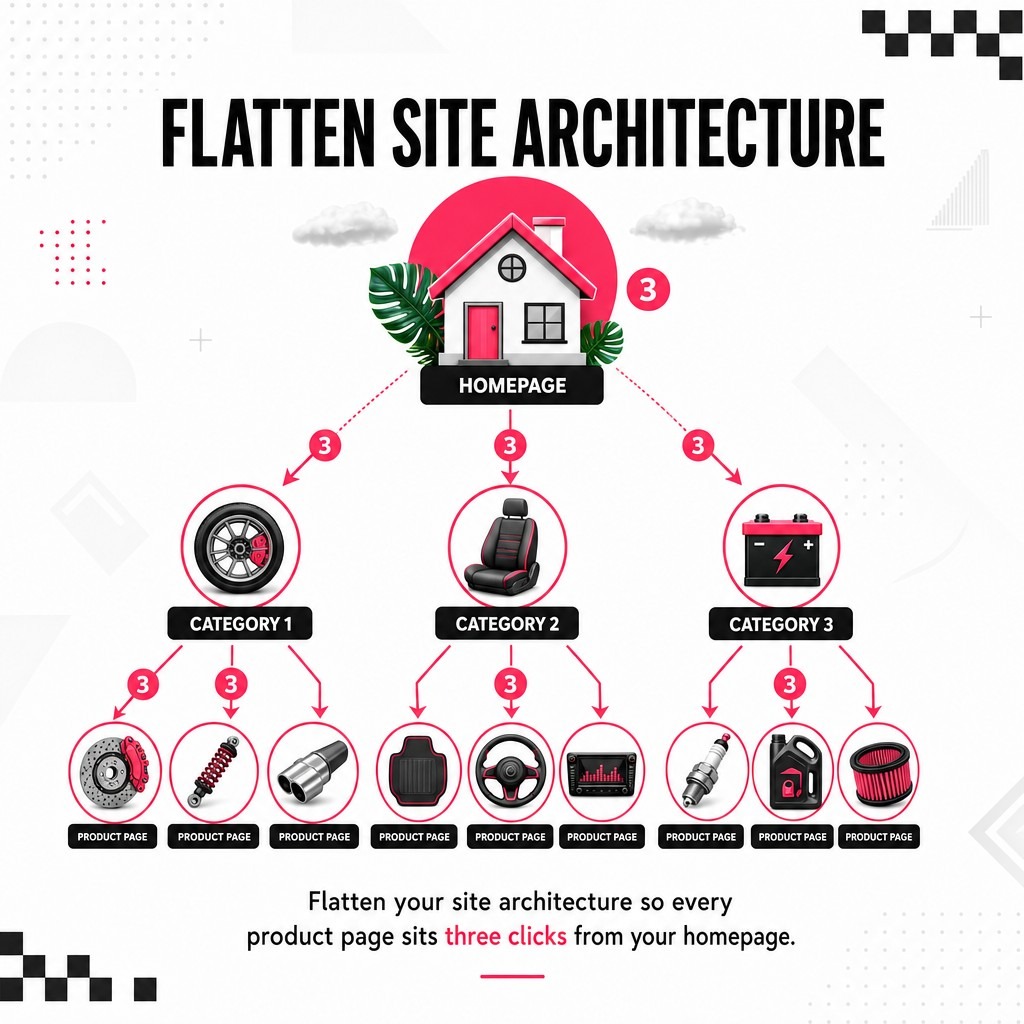
Flatten your site architecture so every product page sits three clicks from your homepage. Use category pages for broad vehicle applications, but link directly to high-volume part numbers from your navigation and internal linking structure.
Create dedicated landing pages for manufacturer part number patterns. If you stock 50 different AC Delco air filters, build a page targeting "AC Delco air filter part numbers" that links to each specific SKU. This creates entry points for part number searches while keeping your architecture scalable.
Implement proper canonicalization for duplicate content. OEM parts often have multiple valid part numbers (OEM number, superseded numbers, aftermarket equivalents). Canonical tags tell search engines which version to index while preserving the other numbers for internal search and user navigation.
Not every product page deserves indexation. If you stock a part with zero search volume and no cross-references, indexing it wastes crawl budget. Use robots.txt and noindex tags strategically to focus crawler attention on revenue-generating pages.
Monitor your index coverage in Google Search Console. Track which categories have indexation issues, and prioritize fixes based on revenue potential. A category with 10,000 SKUs and 2% indexed deserves immediate attention if those parts have search volume.
Build XML sitemaps organized by product category and update frequency. Your high-volume parts should sit in a sitemap that updates daily. Slow-moving inventory can update weekly. This signals to search engines which pages matter most.
Page speed matters more for part number searches than generic ecommerce. Your buyers are comparing prices across multiple tabs. Slow load times lose sales to faster competitors.
Optimize images aggressively. Product photos matter less for OEM parts than aftermarket since buyers need fitment data, not lifestyle shots. Use smaller file sizes, implement lazy loading, and serve images through a CDN.
Minimize JavaScript for critical rendering path. Part number, price, and availability must load instantly. Fancy product configurators and interactive features can load after the core content renders.
Your product page structure determines whether you rank for part number searches. Search engines need clear signals about which part numbers your page targets, and buyers need immediate confirmation they've found the right part.
Start with your title tag. Include the manufacturer part number first, followed by the part description and vehicle application. "22204AA103 - Subaru WRX Engine Air Filter - Genuine OEM" beats "Engine Air Filter for 2015-2021 Subaru WRX" for part number searches.
Place the part number prominently in your H1 tag and opening paragraph. Search engines weight content at the top of your page more heavily. If your part number first appears halfway down the page after marketing copy, you're wasting prime real estate.
Include all valid part number variations in your content: OEM number, superseded numbers, and common misspellings. Don't keyword stuff, but naturally mention these variations in fitment tables, cross-reference sections, and technical specifications.
Create a dedicated specifications section with structured data markup. List dimensions, weight, material, and manufacturer information. This content serves two purposes: it helps buyers verify fitment, and it provides text for search engines to understand your product.
For more detailed guidance on optimizing individual product pages, see our on-page SEO checklist for auto parts product and category pages.
Cross-reference data captures searches for alternative part numbers. If someone searches for an aftermarket equivalent to your OEM part, proper cross-reference tables help you rank for that query.
Format cross-references as HTML tables with clear headers. List the manufacturer, part number, and notes about compatibility. This structured format helps both users and search engines understand the relationships between parts.
Link between cross-referenced products bidirectionally. If part A cross-references to part B, both pages should link to each other. This internal linking reinforces the relationship for search engines and helps buyers find alternatives.
Include multiple product images showing different angles and the part number label clearly visible. Buyers need to verify they're ordering the correct part, and clear photos reduce return rates.
Add installation location photos when possible. A photo showing where the part mounts in the engine bay helps buyers confirm fitment better than a generic product shot on white background.
Optimize image file names with part numbers. "22204AA103-subaru-wrx-air-filter.jpg" signals relevance better than "IMG_4857.jpg." Include alt text with the part number and application for accessibility and SEO.
Vehicle fitment data separates successful OEM parts retailers from struggling ones. Your buyers search by year, make, and model almost as often as they search by part number. If your site can't answer "does this fit my 2018 Honda Accord?" immediately, you've lost the sale.
ACES (Automotive Catalog Exchange Standard) and PIES (Product Information Exchange Standard) data standards provide the structure for fitment information. ACES defines which vehicles a part fits, and PIES describes the part attributes.
Import ACES data into your product database and expose it on product pages in a scannable format. Create fitment tables that list every compatible year, make, model, and trim level.
Format fitment data as structured lists or tables, not paragraphs. Search engines can extract structured data more easily, and buyers can scan for their specific vehicle faster.
Use PIES data to populate your product attributes consistently across your entire catalog. Standardized attribute names improve internal search functionality and help search engines understand product relationships.
Build landing pages targeting year/make/model combinations for high-volume applications. A page optimized for "2015-2021 Subaru WRX parts" captures broader searches than individual product pages.
Structure these pages as curated product lists organized by system (engine parts, suspension parts, brake components). Link to individual part numbers from each category, creating strong internal linking between YMM pages and product pages.
Avoid thin content on YMM pages. Include vehicle specifications, common maintenance items, and genuine OEM part information specific to that application. This content depth helps you rank against general automotive information sites.
Implement a year/make/model selector in your site header that filters your entire catalog to compatible parts. This functionality improves conversion rates and generates internal signals about which parts fit which vehicles.
Store YMM selections in session data so the filtered view persists across page navigation. Buyers shouldn't need to re-enter their vehicle information on every page.
Add breadcrumb navigation showing the selected vehicle alongside category navigation. This helps buyers maintain context and provides additional structured data for search engines.
Schema markup tells search engines exactly what information appears on your pages. For OEM parts, proper schema implementation can generate rich results showing part numbers, compatibility, and pricing directly in search results.
Product schema is your baseline requirement. Include name, SKU, manufacturer, price, availability, and condition (new, remanufactured, used). This basic markup enables product rich snippets in search results.
Use the Vehicle schema type to mark up fitment information. Define the compatible vehicle using year, model, manufacturer, and variant properties. This structured format helps search engines understand which vehicles your part fits.
Implement the partNumber property explicitly within Product schema. Don't bury the part number in the description field. Search engines parse dedicated properties more reliably than text extraction.
Add the manufacturer property to specify the OEM brand. This helps differentiate genuine OEM parts from aftermarket equivalents in search results and increases trust signals for buyers searching specifically for factory parts.
Implement AggregateRating schema to display star ratings in search results. OEM parts don't generate as many reviews as consumer products, but ratings still provide trust signals that improve click-through rates.
Encourage buyers to leave reviews specifically mentioning fitment accuracy and part quality. Reviews containing phrases like "perfect fit for my 2019 Ford F-150" reinforce your fitment data and provide user-generated content for search engines.
Use the Review schema for individual reviews, including reviewer name, date, rating, and review text. This granular markup can generate review snippets that differentiate your listing from competitors.
Add Organization schema to your homepage defining your business as an automotive parts retailer. Include your logo, contact information, and social profiles. This establishes entity recognition in Google's knowledge graph.
Link your product pages to your Organization entity using the brand property. This connection helps search engines understand that your site is the authoritative source for your inventory.
Implement BreadcrumbList schema on all pages to define your site hierarchy. This structured navigation data helps search engines understand your catalog organization and can generate breadcrumb rich results.
Part number keyword research differs from traditional keyword research because most part numbers have zero search volume in standard keyword tools. You can't rely on Google Keyword Planner to tell you which OEM part numbers drive traffic.
Mine your internal site search data instead. Track which part numbers buyers search for on your site. High internal search volume indicates external search demand you're not capturing.
Analyze which part categories generate the most searches. Filters, brake pads, and wear items typically have higher search volume than structural components because they're replaced more frequently.
Look for seasonal patterns in part searches. AC components spike in summer, battery searches increase in winter, and tire-related parts peak during tire change seasons. Adjust your content calendar and promotional focus accordingly.
Track competitor rankings for part numbers you stock. If a competitor ranks for a part number you carry, you have an opportunity to compete for that traffic. Use tools like Ahrefs or SEMrush to identify these gaps.
Research aftermarket equivalent part numbers for your OEM inventory. These alternatives often have higher search volume than OEM numbers because more retailers stock them.
Create content targeting both OEM and aftermarket numbers on the same page. Position your genuine OEM part as the premium option while acknowledging the aftermarket alternatives exist. This captures both search queries.
Build comparison content for common OEM versus aftermarket decisions. "OEM vs Aftermarket Brake Pads for Honda Civic" targets buyers researching their options while guiding them toward your OEM inventory.
Beyond part numbers, buyers search descriptive phrases like "genuine Subaru WRX engine air filter." These long-tail queries have lower competition than generic terms and indicate OEM preference.
Incorporate phrases like "genuine," "OEM," "factory," and "original equipment" throughout your product content. These qualifiers attract buyers specifically seeking authentic manufacturer parts.
Create content comparing genuine OEM quality to aftermarket alternatives. This content ranks for research queries while reinforcing why buyers should choose OEM parts despite higher prices.
Our guide to keyword research strategies for high-performance auto parts provides additional tactics applicable to OEM parts catalogs.
Content marketing for OEM parts serves a different purpose than lifestyle ecommerce content. Your buyers don't need inspiration or education about why they need a water pump. They need technical information to verify they're ordering the correct part.
Focus your content strategy on three areas: installation guides, maintenance schedules, and part comparison resources. Each content type serves buyers at different stages while building topical authority for your site.
Create installation guides for parts requiring technical knowledge. Target searches like "how to replace [part name] on [vehicle]" which have commercial intent despite appearing informational.
Include the specific part numbers needed for each installation in your guides. Link directly to your product pages for those parts, creating a natural path from content to conversion.
Build maintenance schedule content organized by vehicle. "2015-2021 Subaru WRX Maintenance Schedule and OEM Parts List" targets owners researching upcoming service needs while presenting your inventory as the solution.
Develop comparison content for parts with multiple OEM options. Some vehicles have revised parts that supersede original equipment, and buyers need guidance on which version fits their production date.
Create detailed specification comparison tables showing differences between part revisions. Include dimensions, materials, and compatibility notes that help buyers select correctly.
Write content addressing common fitment questions. "Which brake pad set fits 2018 Honda Accord Sport vs Touring?" targets specific trim-level fitment confusion that blocks purchases.
Build authority content explaining the differences between genuine OEM parts and aftermarket alternatives. Address quality, warranty, and longevity concerns that influence buying decisions.
Position this content to rank for research queries while guiding buyers toward OEM purchases. Be honest about where aftermarket parts offer acceptable value, and emphasize where OEM quality matters most.
Include specific examples from your inventory showing price differences and value propositions. Transparency builds trust and helps buyers justify paying more for genuine parts.
To understand how buyers search for different types of automotive products, review our analysis of Google search types for auto parts and accessories.
Local SEO matters even for ecommerce-focused OEM parts retailers. Professional mechanics and repair shops search locally for parts suppliers offering same-day pickup or fast delivery.
Claim and optimize your Google Business Profile if you have a physical location. Professional buyers often filter search results by proximity, and a complete profile improves visibility for local commercial searches.
Professional mechanics search differently than retail buyers. They use trade terminology, search by shop location, and prioritize suppliers with commercial accounts and fast fulfillment.
Create content targeting professional buyer searches like "OEM parts supplier near [city]" and "wholesale OEM parts [location]." These queries indicate commercial intent worth capturing.
Add location-specific pages for each market you serve. Include inventory highlights, shipping times to that area, and any local pickup options available.
Complete every section of your Google Business Profile. Add your parts categories, service area, business hours, and attributes indicating whether you serve wholesale customers.
Upload photos of your facility, warehouse, and inventory. Professional buyers evaluate supplier credibility before establishing accounts, and comprehensive profiles signal legitimacy.
Encourage satisfied customers to leave Google reviews. Reviews improve your local pack rankings and provide social proof for businesses evaluating new suppliers.
Submit your business to automotive industry directories and trade associations. Citations from industry-specific directories carry more weight than generic business directories.
Ensure your NAP (Name, Address, Phone) information is consistent across all directories. Inconsistent listings confuse search engines and dilute your local SEO authority.
Target local business directories in markets where you have physical locations or offer same-day delivery. These niche directories often rank well for local searches and drive qualified traffic.
Standard ecommerce SEO metrics don't fully capture OEM parts SEO success. You need to track part-number-specific rankings, category-level visibility, and conversion rates by search type.
Set up custom reports in Google Analytics segmenting traffic by search type. Create segments for part number searches, YMM searches, and generic category searches to understand which queries drive revenue.
Track your ranking position for high-volume part numbers. Monitor top 50 positions even if you're not ranking on page one yet. Improvement from position 40 to position 15 indicates your optimization is working.
Measure indexed pages as a percentage of your total catalog. Growing your index coverage indicates improved crawlability and site architecture. Declining coverage signals technical issues requiring immediate attention.
Monitor organic click-through rate from search results. Low CTR despite good rankings suggests your title tags and meta descriptions need optimization. Test different formats emphasizing part availability or pricing.
Track competitor visibility for part numbers you both stock. Use rank tracking tools to monitor whether you're gaining or losing share of voice in search results.
Analyze which competitors rank consistently for part numbers across multiple categories. Study their site architecture, content strategy, and technical implementation to identify tactics worth adopting.
Monitor new competitors entering your market through SEO. Emerging players who suddenly rank for your target part numbers indicate new optimization tactics or content strategies worth investigating.
Calculate revenue per indexed page to identify your most valuable categories. Categories with high revenue per page deserve more optimization investment than low-performing sections.
Track average order value by traffic source. Organic part number searches typically generate higher AOV than generic category searches because buyers know exactly what they need.
Measure customer acquisition cost for organic traffic compared to paid channels. SEO requires upfront investment but generates ongoing returns without per-click costs, making it increasingly profitable over time.
Most OEM parts retailers make predictable SEO mistakes that kill their rankings. These errors stem from applying generic ecommerce tactics to automotive parts without understanding the unique search behavior.
Stop creating thin product pages with only part numbers and prices. Search engines need substantial content to rank pages. Add specifications, fitment data, installation notes, and cross-references to give each page ranking potential.
Many retailers create separate pages for each part variation with identical content except for the part number. This generates thousands of duplicate content issues that confuse search engines.
Consolidate variations onto single product pages using dropdowns or radio buttons for selection. Implement canonical tags pointing to the primary version if you must maintain separate URLs.
Differentiate content between similar parts by emphasizing the actual differences. Don't copy-paste descriptions and change only the part number.
Mobile buyers need different functionality than desktop users. Mechanics looking up part numbers on their phones can't navigate complex category structures or wait for slow-loading pages.
Optimize your mobile site for part number search first, category browsing second. Prominent search functionality and fast load times matter more than elaborate product galleries on mobile.
Test your checkout flow on mobile devices. Complex forms and slow page transitions kill conversion rates for buyers trying to order parts quickly between repair jobs.
Retailers focus on their stocked part numbers and ignore the dozens of alternative numbers buyers might search for. Every OEM part has superseded numbers, regional variations, and aftermarket equivalents worth targeting.
Build comprehensive cross-reference tables showing all alternative part numbers. Link between products that interchange or supersede each other to capture searches for any variation.
Research part number patterns in your niche. Some manufacturers use consistent numbering systems that let you predict related part numbers and create content targeting entire product families.
The top five SEO strategies are: publish content matching search intent, maintain strong technical SEO including fast mobile-friendly pages, optimize on-page elements like titles and structured data, earn authoritative backlinks, and improve user experience signals. For OEM parts retailers specifically, prioritize part number optimization, ACES/PIES data implementation, and vehicle fitment content.
Include the part number in your title tag first, add it to your H1 and opening paragraph, create cross-reference tables showing alternative part numbers, implement Product schema with the partNumber property, and build comprehensive specifications sections. Add all valid number variations naturally throughout your content.
Low indexation typically results from deep site architecture, crawl budget limitations, duplicate content issues, or thin product pages. Flatten your site structure so products sit within three clicks of your homepage, implement canonical tags for duplicate content, and add substantial unique content to each product page including specifications, fitment data, and installation information.
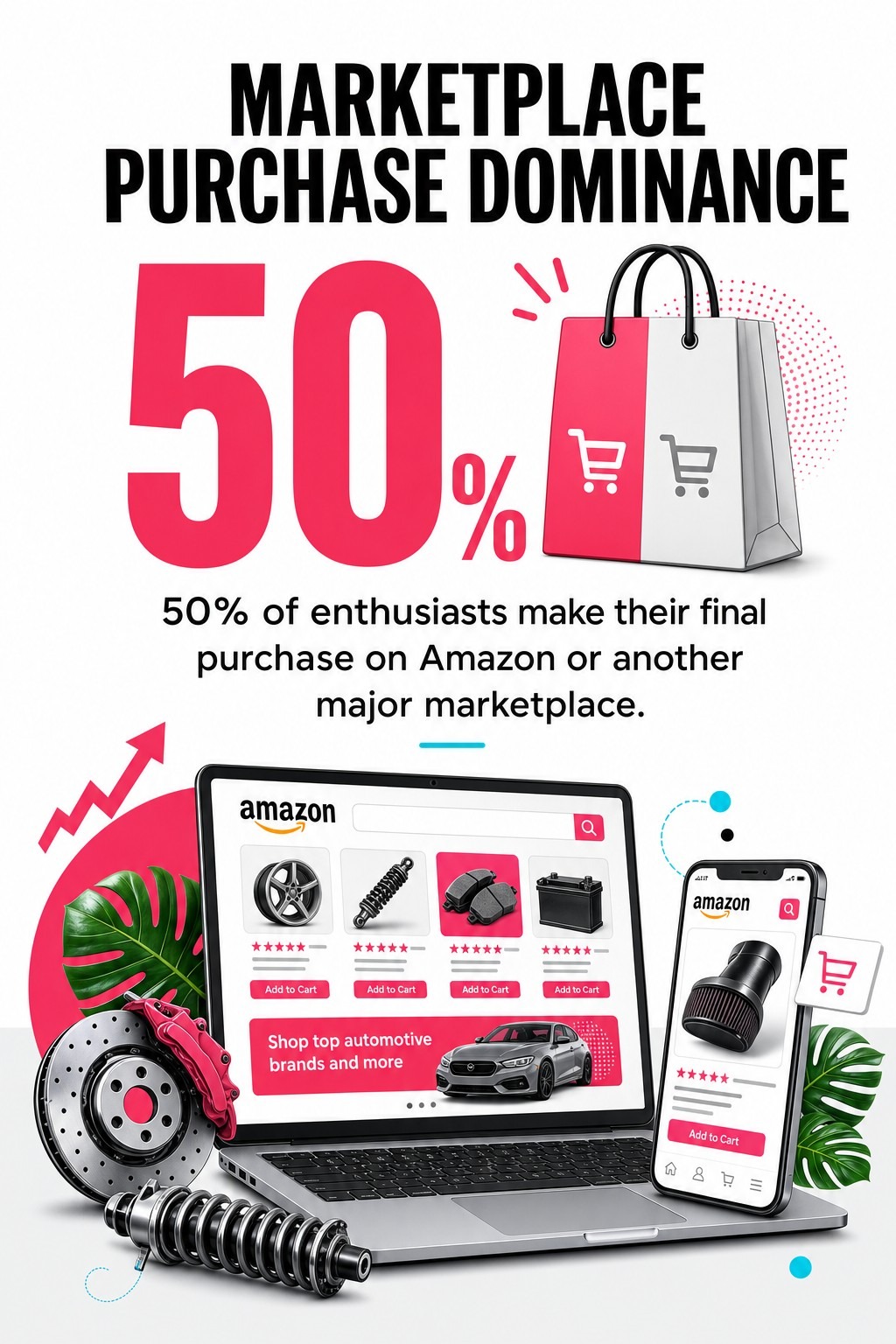
50% of enthusiasts make their final purchase on Amazon or another major marketplace, making marketplace competition a reality for OEM parts retailers. You can't out-muscle Amazon's domain authority, but you can outmaneuver them with better content and specialization.
Amazon's product pages prioritize pricing and fulfillment speed over detailed fitment information. Independent retailers win by providing comprehensive technical specifications, better customer service, and specialized knowledge.
Build topical authority in specific vehicle platforms or part categories. Becoming the go-to source for Subaru WRX OEM parts beats trying to compete across every vehicle make and model.
Create content depth Amazon can't match. Installation guides, maintenance schedules, and technical comparison articles establish expertise that generic marketplace listings lack.
Target professional buyers who value supplier relationships over lowest price. Mechanics and repair shops need reliable suppliers with expertise, not just cheap parts from anonymous sellers.
Rank for informational queries that precede purchase decisions. Buyers researching "which brake pads fit 2020 F-150" land on your content first, then purchase from you rather than continuing to Amazon.
Optimize for long-tail part-specific searches Amazon's generic product pages miss. "Genuine Toyota 04465-06090 brake pad set" targets buyers who specifically want OEM parts, not generic marketplace results.
Build email lists from content visitors and nurture them toward purchases. Amazon captures point-of-purchase traffic, but you can own the relationship before buyers enter purchase mode.
For a comprehensive understanding of OEM versus aftermarket marketing strategies, read our detailed guide on automotive OEM vs aftermarket marketing for auto parts.
Managing SEO for catalogs exceeding 100,000 SKUs requires automation and systematic approaches to content generation and optimization. Manual optimization doesn't scale at this level.
Develop template systems that generate unique content for each product by combining structured data fields. Pull part specifications, fitment data, and cross-references from your database to programmatically create differentiated product descriptions.
Faceted navigation lets buyers filter your catalog by vehicle, part type, manufacturer, and price. These filters create thousands of URL variations that can waste crawl budget if mishandled.
Implement canonical tags on filtered URLs pointing to the base category page. This consolidates ranking signals while maintaining user functionality.
Use URL parameters consistently and configure parameter handling in Google Search Console. Tell search engines which parameters change page content versus just filtering display.
Category pages with thousands of products need pagination or infinite scroll. Both patterns affect SEO differently and require specific implementation approaches.
If using pagination, implement rel="next" and rel="prev" tags to indicate page relationships. This helps search engines understand your series and consolidate ranking signals.
Alternatively, implement "load more" functionality that updates the URL as users expand results. This creates crawlable archives of your full category without generating separate paginated URLs.
Modern ecommerce platforms rely heavily on JavaScript for product filtering, cart functionality, and dynamic content. Search engines must execute JavaScript to see this content, which adds complexity.
Test your JavaScript rendering using Google's URL Inspection tool. Compare the rendered HTML to your source code to verify search engines see critical content like part numbers and specifications.
Implement server-side rendering or static generation for critical SEO content. Part numbers, fitment data, and product specifications should exist in HTML source code, not just JavaScript-generated DOM content.
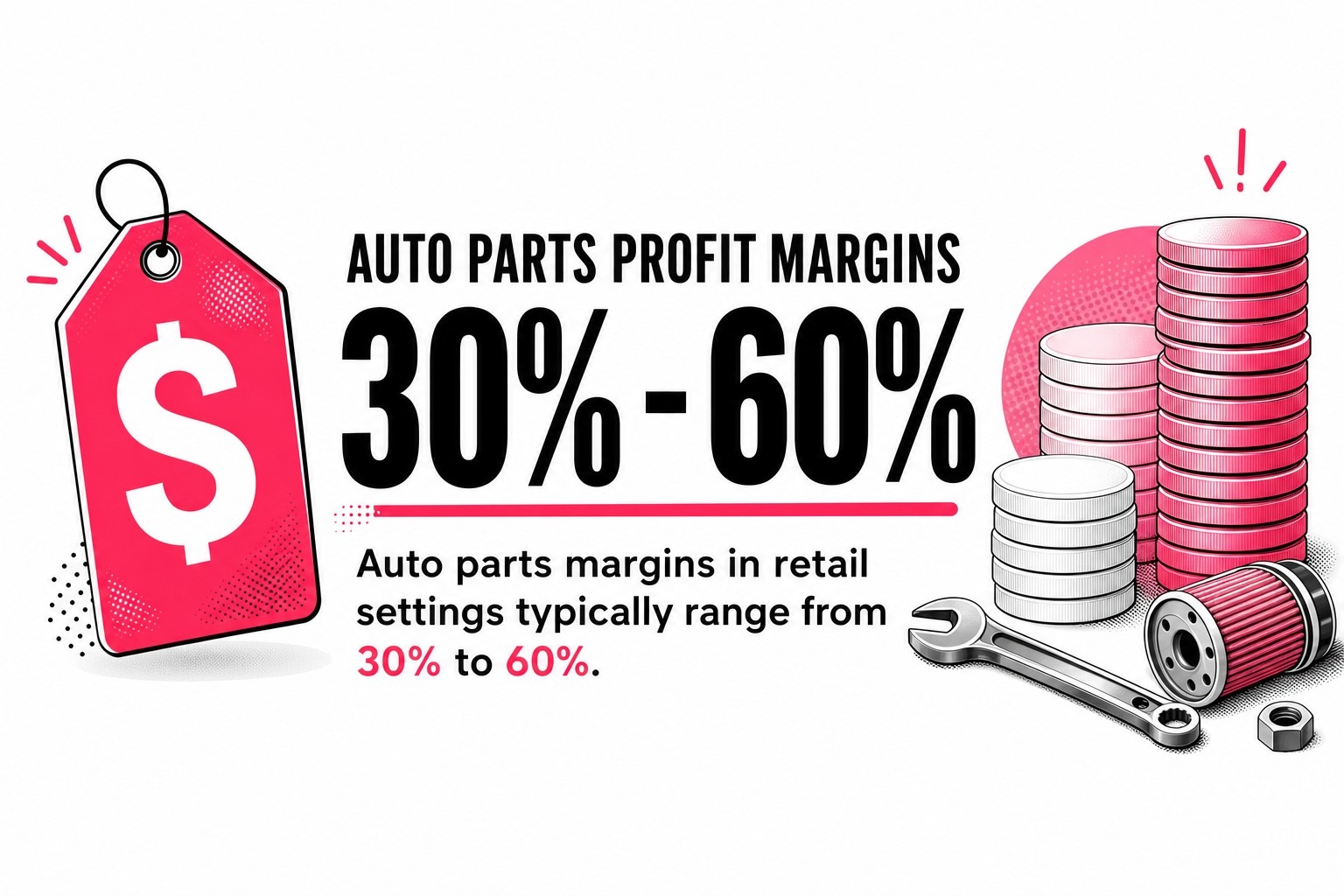
Auto parts margins in retail settings typically range from 30% to 60%, making SEO investment highly profitable compared to paid advertising. Once you rank organically, that traffic costs nothing per click while maintaining healthy margins.
Calculate your customer acquisition cost for organic traffic by dividing total SEO investment by new customers from organic search. Compare this to paid advertising CAC to justify continued SEO budget allocation.
Project long-term organic traffic value using conservative ranking improvement estimates. Even capturing 10% of search volume for your top 1,000 part numbers generates significant revenue at healthy margins.
Factor in customer lifetime value, not just first purchase value. Organic customers who find you through part number searches often return for future needs, increasing their lifetime value beyond initial acquisition cost.
Compare SEO costs to paid search costs over 24-36 months. Paid search requires ongoing spend, while SEO investments compound as your rankings improve and technical foundation strengthens.
Focus initial optimization efforts on categories with high search volume and strong margins. Brake components, filters, and common wear items typically offer the best SEO ROI because they're replaced frequently.
Analyze which part numbers have high search volume but low competition. These opportunities generate quick wins that demonstrate SEO value to stakeholders while building toward larger competitive battles.
Track revenue per indexed page by category to identify underperforming sections worth additional investment. Categories with low revenue per page despite good indexation need better content or targeting different keywords.
Part number SEO isn't sexy, but it's profitable. While competitors chase generic automotive keywords and broad category terms, you'll capture high-intent buyers typing exact part numbers into Google.
Start with your technical foundation. Fix site architecture issues limiting crawlability, implement proper canonical tags, and ensure your highest-value part numbers are indexable. These unglamorous fixes unlock everything else.
Then build your content systematically. Add cross-reference tables to your top 100 products. Create YMM landing pages for your three best-selling vehicle platforms. Write installation guides for parts that confuse buyers.
The retailers winning OEM parts SEO aren't doing anything complicated. They're executing basic optimization principles consistently across massive catalogs. They understand buyers search differently for parts than they do for consumer products, and they've structured their sites accordingly.
Pick five high-volume part numbers today. Check whether you rank in the top 50 results. If not, you have an immediate opportunity. Optimize those five pages using the tactics I've outlined. Track your rankings weekly. When you see improvement, expand to 50 part numbers, then 500.
OEM parts SEO is a volume game. You're optimizing for thousands of specific queries, not dozens. But each ranking improvement compounds because you're capturing ready-to-buy traffic at healthy margins.