
Auto parts SEO demands a fundamentally different approach than selling shoes or coffee beans online. Your customers search by year/make/model combinations, cryptic part numbers, and symptom-based queries that would confuse most ecommerce platforms.
Automotive SEO requires mastering three distinct search patterns. First, part number searches where someone types "AC Delco 41-110" expecting exact matches. Second, vehicle fitment queries like "brake pads for 2018 Honda Civic" where compatibility data determines relevance. Third, brand searches where shoppers hunt specific manufacturers across thousands of SKUs.
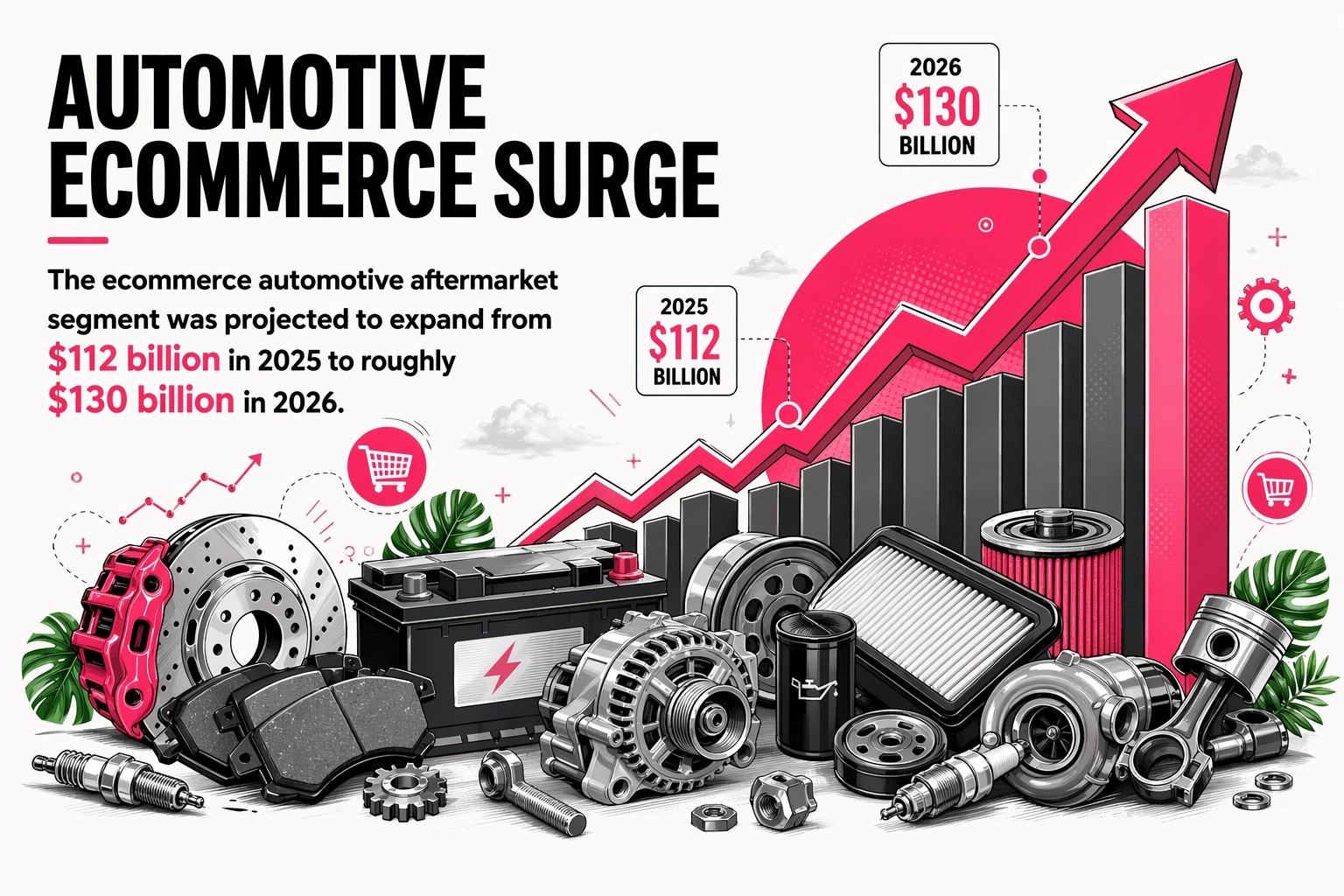
The stakes keep climbing. The ecommerce automotive aftermarket segment was projected to expand from $112 billion in 2025 to roughly $130 billion in 2026, and most of that growth flows through search engines and AI-powered product discovery.
I've spent years helping auto parts retailers navigate this complexity at Scube Marketing. The fundamental challenge isn't just ranking higher. It's ensuring your fitment data, part number crossovers, and product specifications speak the same language Google's algorithms and AI search tools understand.
This guide walks you through the proven strategies that separate thriving auto parts stores from those buried on page three. You'll learn how to optimize for vehicle compatibility searches, structure product data for AI search engines, and capture high-intent shoppers at every stage of their parts research journey.
Selling auto parts online isn't like selling t-shirts or kitchen gadgets. The search intent patterns are completely different.
Your average apparel retailer worries about sizing and color variations. Auto parts sellers manage fitment compatibility across decades of vehicle production, multiple trim levels, and regional specifications that change mid-model year.
S&P Global Mobility projects that US auto sales volumes will reach 15.9 million units in 2026. Each vehicle represents a unique fitment profile. Multiply that across 30 years of vehicle history and you're managing compatibility data that dwarfs most ecommerce catalogs.

Standard product attributes don't work for auto parts. You can't just add "fits most cars" to your product description and expect conversions.
Customers need precise year/make/model confirmation before they'll buy. They search "2015 Toyota Camry LE front brake rotors" because they've been burned by wrong parts before. Your SEO strategy must answer these specific queries with absolute certainty.
This requires structured fitment data tied to every product. ACES and PIES standards exist for this reason, but implementing them correctly determines whether you show up in vehicle-specific searches.
Part numbers create another SEO layer most retailers never encounter. A single brake pad might have five manufacturer part numbers, three OEM numbers, and dozens of crossover references.
Shoppers search any of these variations expecting to find the right product. Your product pages need to capture all relevant part numbers while avoiding duplicate content penalties.
Cross-reference data becomes SEO gold. When someone searches a discontinued Motorcraft part number, can your site surface the current replacement? That's the difference between a sale and a bounce.
Auto parts shoppers fall into distinct categories with different search behaviors. DIY mechanics search differently than professional technicians. Fleet managers have their own patterns.
DIY customers often start with symptom searches: "car making grinding noise when braking." They need educational content that guides them to the right part category before they're ready to buy.
Professional installers skip the education phase. They search exact part numbers or manufacturer specifications. Your product pages must serve both audiences without diluting either experience.
Auto parts search intent follows predictable patterns once you know what to look for. Shoppers move through distinct phases, and each phase requires different SEO optimization.
The research phase starts broad. Someone knows their transmission is slipping but doesn't know which parts they need. These informational searches drive blog traffic, how-to guides, and diagnostic content.
Next comes the identification phase. The shopper narrows down to specific parts but needs fitment confirmation. They're searching "transmission filter kit 2014 F-150" or similar year/make/model combinations.
Direct part number searches signal high purchase intent. Someone typing "AC Delco TP1015" knows exactly what they need. They're comparing prices or checking availability.
Your product pages must capture these searches with exact part number matches in titles, headers, and product specifications. Don't bury part numbers in image alt text or JavaScript-rendered content.
Include OEM numbers, manufacturer codes, and common crossover references in your product schema markup. This helps search engines match your products to various part number formats shoppers use.
Year/make/model searches represent the largest search volume for most auto parts categories. These queries follow consistent patterns: "brake pads 2018 Honda Civic" or "oil filter for 2020 Toyota Tacoma."
Category pages optimized for specific vehicle combinations outperform generic category pages. Creating dedicated landing pages for popular vehicle models captures this traffic effectively.
Your product pages need explicit fitment confirmation above the fold. Shoppers won't scroll through specifications hoping to find compatibility. Show fitment immediately with vehicle selector tools or clear compatibility tables.
Educational content captures early-stage shoppers. Someone searching "why is my check engine light on" needs diagnostic information before they're ready to buy parts.
These informational searches build authority and capture traffic that eventually converts. Blog posts linking to relevant product categories create natural conversion paths.
The key is matching content to search intent. Don't write generic fluff pieces. Create specific diagnostic guides that lead to your product inventory when shoppers identify their problem.
AI search transformed how customers discover auto parts. Google's AI Overviews now synthesize information from multiple sources, fundamentally changing which results get visibility.
Traditional SEO focused on ranking in the top ten organic results. Generative Engine Optimization (GEO) focuses on appearing in AI-generated summaries that increasingly dominate search results pages.
For auto parts retailers, this shift creates both challenges and opportunities. AI search tools excel at parsing fitment data and part specifications when you structure information correctly.
AI models understand structured data better than unstructured product descriptions. Schema markup becomes even more critical for AI search visibility.
When you implement proper automotive schema, AI tools can accurately extract fitment information, part numbers, and compatibility data. This helps your products appear in AI-generated search summaries.
Voice search queries increasingly use conversational language: "What brake pads fit a 2019 Subaru Outback?" AI search interprets these questions and surfaces products with clear, structured fitment data.
GEO requires content structured for AI comprehension. This means clear hierarchy, definitive answers, and structured data markup throughout your site.
Product descriptions should answer specific questions: What vehicles does this fit? What are the specifications? What related parts are required for installation? Format these answers as distinct sections AI tools can parse.
Include comparison tables showing your parts versus OEM specifications. AI search tools pull these structured comparisons into search results when shoppers research options.
Over 63% of web traffic currently comes from mobile devices, and mobile users rely heavily on AI-powered search assistants.

Mobile shoppers use voice search more frequently. They're often in auto parts stores or garages, searching hands-free while working on vehicles.
Your mobile experience must load quickly and present fitment information immediately. Slow load times or buried compatibility data kills conversions from AI-directed mobile traffic.
Fitment optimization separates successful auto parts SEO from wasted effort. You can have perfect technical SEO, but without accurate fitment data, you won't rank for vehicle-specific searches.
Start with clean, structured fitment databases. ACES (Aftermarket Catalog Exchange Standard) provides the industry framework for organizing this data.
Every product needs complete year/make/model/trim associations. Partial fitment data creates gaps where competitors capture your potential traffic.
ACES data defines what vehicles your parts fit. PIES (Product Information Exchange Standard) describes product attributes and specifications.
These standards aren't just for data feeds. They should structure how you organize product information on your website. Search engines reward consistent, standardized data formats.
Map your entire catalog to ACES categories and subcategories. This creates logical site architecture that both users and search engines can navigate efficiently.
Part numbers deserve dedicated optimization strategy. Many auto parts searches use manufacturer part numbers, OEM codes, or interchange numbers.
Include all relevant part number variations on product pages. Primary manufacturer numbers go in titles and H1 tags. Related OEM numbers and crossovers belong in product descriptions and schema markup.
Create a dedicated part number field in your product schema. This helps search engines understand which strings represent part numbers versus general product attributes.
Crossover references capture searches for competing brands or discontinued parts. When someone searches an old Motorcraft number, your Fram replacement should appear if it's compatible.
Build comprehensive crossover tables showing part number equivalencies. Format these as HTML tables search engines can crawl and index.
Link crossover tables to relevant product pages. This creates internal linking that strengthens part number search visibility across your catalog.
Vehicle selector widgets improve user experience and capture fitment-based searches. When implemented correctly, they also boost SEO performance.
Make sure your vehicle selector generates URL parameters search engines can crawl. JavaScript-only selectors that don't update URLs miss SEO opportunities.
Create static category pages for popular vehicle combinations. A dedicated "2018 Honda Civic Parts" category page with unique content outperforms purely dynamic filtered results.
Managing SEO for large catalogs with 50,000+ SKUs requires different tactics than small inventory stores. Scale introduces challenges most ecommerce sites never face.
Crawl budget becomes critical. Search engines allocate limited resources to crawling your site. With massive catalogs, you must prioritize which pages get crawled most frequently.
Your best-selling products and category pages deserve priority. Low-value pages like out-of-stock items or duplicate product variations waste crawl budget.
Logical category hierarchies help search engines understand your catalog organization. Auto parts naturally group by system (braking, engine, electrical) and vehicle application.
Create clear category paths: Homepage → Vehicle Make → Model → System → Part Type. This structure makes sense to users and creates natural internal linking patterns.
Limit category depth to four levels maximum. Deeper hierarchies dilute page authority and create confusing navigation paths.
Auto parts often have minimal differences between applications. Brake pads for left and right sides are functionally identical but require separate SKUs for fitment accuracy.
Use canonical tags to consolidate duplicate product variations. Point minor variants to a primary product page while maintaining individual URLs for shopping feeds and inventory management.
Write unique descriptions for genuinely different products. Template-generated descriptions create thin content that doesn't rank well or convert shoppers.
Clean URLs help both SEO and user experience. Include primary keywords and part categories in URL slugs.
Good URL structure: /brake-pads/ceramic-brake-pads/2018-honda-civic-brake-pads
Bad URL structure: /product?id=48291&cat=brakes&v=civic
Avoid session IDs and tracking parameters in URLs. These create duplicate content issues and waste crawl budget on meaningless URL variations.
Large catalogs often suffer from slow load times. High-resolution part images, complex filtering systems, and fitment selectors add page weight.
Core Web Vitals benchmarks can lead to organic traffic gains of up to 20% when properly optimized.

Implement lazy loading for product images below the fold. Load visible content first, then progressively load images as users scroll.
However, be careful with lazy loading implementation. Lazy loading can reduce conversions by 7% if improperly implemented, particularly when it delays critical fitment information.
Product page optimization balances search visibility with conversion optimization. You need pages that rank well and convince shoppers to buy once they arrive.
Start with titles that include part type, brand, and primary fitment. "ACDelco Gold 17D1367CH Ceramic Front Disc Brake Pad Set" captures more relevant searches than "Premium Brake Pads."
Your title formula should follow this pattern: Brand + Part Number + Part Type + Primary Vehicle Application when it fits naturally within character limits.
Every auto parts product page needs these critical elements above the fold:
Bury any of these elements and your conversion rate suffers. Shoppers won't hunt for basic information competitors show immediately.
Generic manufacturer descriptions don't differentiate your products or improve rankings. Write unique descriptions that answer specific shopper questions.
Include installation difficulty, required tools, and whether professional installation is recommended. DIY shoppers need this context before purchasing.
Mention related parts required for complete installation. Someone buying brake pads might need caliper grease and brake cleaner. Cross-selling these items helps customers and increases order value.
Technical specifications belong in structured format, not buried in paragraph text. Use tables or definition lists for easy scanning.
Include specifications search engines can parse. This data appears in product rich results and helps AI search tools understand your offerings.
Product reviews improve conversion rates and provide fresh, user-generated content that search engines value. Reviews also answer common questions other shoppers have.
Encourage detailed reviews that mention specific vehicles and installation experiences. "Fit my 2017 Silverado perfectly, easy installation" provides more value than "Great product."
Respond to negative reviews professionally. This shows potential customers you stand behind your products and care about customer experience.
Schema markup translates your product data into structured format search engines fully understand. For auto parts, this becomes even more critical due to fitment complexity.
Google prefers JSON-LD format over other schema markup formats, so implement your automotive schema using JSON-LD placed in page headers or footers.
Basic Product schema forms the foundation. Schema.org/Product markup properties include brand, model number, and SKU, which are essential for auto parts visibility.
Standard Product schema doesn't capture vehicle fitment data. You need additional properties showing year/make/model compatibility.
Use the vehicleIdentificationNumber property for VIN-specific parts. For broader fitment, implement custom properties or extensions that specify compatible vehicles.
Include part numbers in the mpn (manufacturer part number) property. Add SKU, brand, and model properties for complete product identification.
Review schema shows star ratings in search results, improving click-through rates significantly. Implement AggregateRating schema on products with sufficient review volume.
Include individual Review schema for detailed customer feedback. This provides additional context search engines can use when evaluating product relevance.
Keep review schema updated as new reviews arrive. Stale rating counts reduce credibility when shoppers see different numbers on your site versus search results.
BreadcrumbList schema shows your site hierarchy in search results. This helps shoppers understand where products fit within your catalog structure.
Implement breadcrumbs consistently across all product and category pages. The schema should match your visible breadcrumb navigation exactly.
Category pages benefit from Organization and ItemList schema. This helps search engines understand category relationships and product groupings within each category.
Use Google's Rich Results Test to verify your schema markup. This tool identifies errors preventing rich snippets from appearing in search results.
Monitor Google Search Console for schema-related errors. Address validation issues quickly to maintain rich result eligibility.
Test schema on product pages, category pages, and blog posts. Each content type may require different schema types for optimal search visibility.
Category pages drive significant organic traffic for auto parts sites. Well-optimized category pages rank for broad product searches while guiding shoppers to specific products.
Create distinct categories for each major part type: brake components, filters, ignition parts, suspension components. Avoid overly broad categories that dilute topical relevance.
Vehicle-specific category pages capture high-intent traffic. A "2018 Honda Civic Parts" category page targets shoppers who've already identified their vehicle and are browsing available parts.
Category pages need unique educational content beyond product listings. Explain the part category, common applications, and selection criteria shoppers should consider.
Include buying guides addressing frequently asked questions. "How do I choose the right oil filter?" content helps shoppers make informed decisions while improving SEO.
Add comparison tables showing different product tiers or brands. This provides value to shoppers while creating structured content search engines reward.
Filtering systems create URL variations for every filter combination. Left unchecked, this generates thousands of low-value pages consuming crawl budget.
Use robots.txt or meta robots tags to prevent indexing of filtered pages. Allow crawling but block indexing with noindex, follow tags on filter combination pages.
Create static category pages for valuable filter combinations. A "Ceramic Brake Pads" category page with unique content outperforms dynamically filtered results.
Category pages serve as internal linking hubs distributing authority to product pages. Prioritize linking to best-selling or highest-margin products.
Include contextual links within category descriptions. Link to related categories helping shoppers discover complementary parts.
For more detailed guidance on structuring auto parts keywords across categories, check out our keyword research strategies for high-performance auto parts.
Local SEO captures nearby customers searching "auto parts near me" or location-specific queries. Even pure-play online retailers benefit from local signals for regional distribution centers.
Google Business Profile optimization forms the foundation of local SEO. Complete every section: hours, services, product categories, and business description.
Post regular updates showing new inventory, promotions, or automotive tips. Active profiles rank higher in local search results than abandoned listings.
Multi-location retailers need dedicated pages for each store. Include unique content about local inventory, services, and staff expertise.
Avoid template-generated location pages with only address changes. These create thin content that doesn't rank well or serve customers effectively.
Embed Google Maps showing your location. Include driving directions and parking information helping customers find you easily.
Consistent NAP (name, address, phone) information across directories strengthens local rankings. Inconsistent information confuses search engines and weakens authority signals.
List your business in automotive-specific directories: auto parts supplier databases, industry associations, and manufacturer dealer locators.
Monitor and respond to reviews across all platforms. Review responses demonstrate engagement and can influence other customers' decisions.
Blog content addressing regional automotive concerns improves local relevance. Winter maintenance tips work well in northern climates. Salt corrosion prevention resonates with coastal areas.
Mention local landmarks or neighborhoods naturally in content. This creates geographic relevance without keyword stuffing location names.
Partner with local mechanics or car clubs for collaborative content. This builds local links and establishes community connections that boost local authority.
Educational content captures early-stage shoppers and builds topical authority. Someone researching "how to diagnose brake problems" isn't ready to buy, but they will be soon.
Focus content on common automotive problems matching parts you sell. Brake noise diagnosis leads to brake component sales. Engine performance issues connect to ignition and fuel system products.
Create content matching different expertise levels. DIY beginners need basic how-to guides. Experienced mechanics want technical specifications and installation tips.
Step-by-step repair guides attract search traffic and establish expertise. Include clear instructions, required tools, and difficulty ratings.
Link to relevant products within installation guides. When describing brake pad replacement, link to pads, rotors, and brake fluid you sell.
To better understand the different ways customers search for automotive solutions, see our analysis of Google search types for auto parts and accessories.
Video tutorials capture visual learners and rank in both YouTube and Google search. Installation videos answer "how to replace" queries better than text alone.
Embed relevant videos on product pages. Someone viewing brake pads appreciates installation videos showing the replacement process.
Optimize video titles, descriptions, and tags for automotive keywords. Include part numbers and vehicle applications in video metadata.
Automotive maintenance follows seasonal patterns. Winter preparation content peaks in fall. Summer road trip content gains traction in spring.
Plan content calendar around these cycles. Publish winter tire content in September, not December. AC maintenance guides should appear in March, not July.
Update and republish seasonal content yearly. Add current year to titles and refresh statistics for renewed search visibility.
Track metrics that matter for auto parts retail. Raw traffic numbers miss the point if visitors can't find compatible parts or bounce before converting.
Monitor organic traffic by product category. Identify which categories drive traffic versus which need optimization attention.
Track rankings for key part numbers and vehicle-specific searches. These high-intent keywords directly impact revenue.
The average conversion rate for Automotive Repair, Service & Parts in Google Ads is 14.67 percent, providing a benchmark for evaluating your organic performance.
Watch bounce rate on product pages. High bounces indicate fitment confusion, unclear information, or slow load times.
Measure time on site and pages per session. Auto parts shoppers often research multiple components for complete repairs. Engaged visitors indicate helpful content.
50% of aftermarket purchases are finalized on Amazon or another mega-marketplace, making SEO critical for capturing shoppers researching on Google before buying.

Your content and product data must answer questions marketplaces can't. Provide fitment guidance, installation support, and technical expertise larger platforms lack.
Position yourself as the expert resource, then capture conversions through superior knowledge and customer service.
Use Google Analytics to track organic traffic sources, user behavior, and conversion paths. Set up ecommerce tracking for complete revenue attribution.
Monitor Google Search Console for ranking changes, indexing issues, and search query data. This shows which part numbers and vehicle searches drive impressions.
Implement SEMrush or Ahrefs for competitor analysis and keyword research. Identify which part categories competitors rank for that you're missing.

Continuous Optimization Process
SEO isn't one-time setup. Algorithm updates, new vehicle models, and changing shopper behavior require ongoing optimization.
Review top-performing content quarterly. Update statistics, add new products, and refresh examples keeping content current.
Audit technical SEO twice yearly. Check for crawl errors, broken links, and schema validation issues that accumulate over time.
VIN-based product recommendations eliminate fitment guesswork. When customers enter their VIN, you can show exactly which parts fit their specific vehicle configuration.
VIN decoder tools are able to extract engine type and fuel efficiency, factory-installed options, and recall alerts, providing detailed vehicle specifications for precise fitment matching.
Integrate VIN lookup into product search and category pages. Shoppers who decode their VIN see personalized product selections increasing confidence and conversion rates.
VIN decoders require reliable data sources. License ACES-compliant databases or third-party VIN decoding services providing accurate vehicle specifications.
Store VIN data (with permission) for returning customers. Remembering a customer's vehicle enables one-click fitment verification on future visits.
Use VIN data to power email recommendations. Send maintenance reminders with links to compatible parts for customers' specific vehicles.
Remember vehicle selection across browsing sessions. If someone selected "2018 Honda Civic," show compatible parts sitewide until they change vehicles.
Highlight compatible products in search results and category listings. Visual indicators showing "Fits Your Vehicle" increase click-through and conversion.
Create "My Garage" features letting customers save multiple vehicles. Households with several cars appreciate managing different vehicle profiles.
Personalized content creates SEO challenges. Search engines crawl your default, non-personalized view while customers see customized results.
Ensure base product pages include complete fitment data search engines can crawl. Personalization should enhance, not replace, crawlable fitment information.
Generate static URLs for popular VIN-based queries. Create indexed pages for common vehicle configurations capturing search traffic for those specific applications.
Voice search adoption changes query patterns. Shoppers use natural language: "What brake pads do I need for a 2019 Subaru Outback?" instead of typed keywords.
Optimize for conversational queries by creating FAQ content answering common questions in natural language. Structure answers clearly so AI assistants can extract and voice them.
Featured snippets become more valuable for voice results. Position zero often provides the voice search answer, making snippet optimization critical.
Visual search tools let shoppers photograph parts and find matches. This works well for hard-to-identify components or when part numbers are worn.
Optimize product images for visual search. High-quality photos from multiple angles improve match accuracy in visual search systems.
Include detailed image alt text describing part appearance, not just function. This helps visual search algorithms understand what images depict.
AI chatbots guide customers through parts selection. These tools ask questions about vehicle symptoms and recommend appropriate parts.
The content feeding these AI systems must be accurate and comprehensive. Poor product data leads to wrong recommendations damaging customer trust.
For additional insights on optimizing complex product data feeds for better search visibility, explore our guide on optimizing product data feeds for automotive parts.
Search algorithms evolve constantly. Google's updates increasingly favor expertise, experience, and trustworthiness over pure keyword optimization.
Build authority through comprehensive content, accurate data, and positive customer experiences. These factors become more important as algorithms grow sophisticated.
Monitor industry changes and adapt quickly. Early adopters of new search features gain visibility advantages before competitors catch up.
The auto parts retailers who win aren't those with the biggest catalogs. They're the ones who understand how customers search, structure data search engines comprehend, and create experiences that serve both algorithmic requirements and human needs.