
Most manufacturers burn money on paid search because they treat it like consumer marketing. They target "manufacturing services" when buyers are searching "ISO 9001 certified precision machining Ohio."
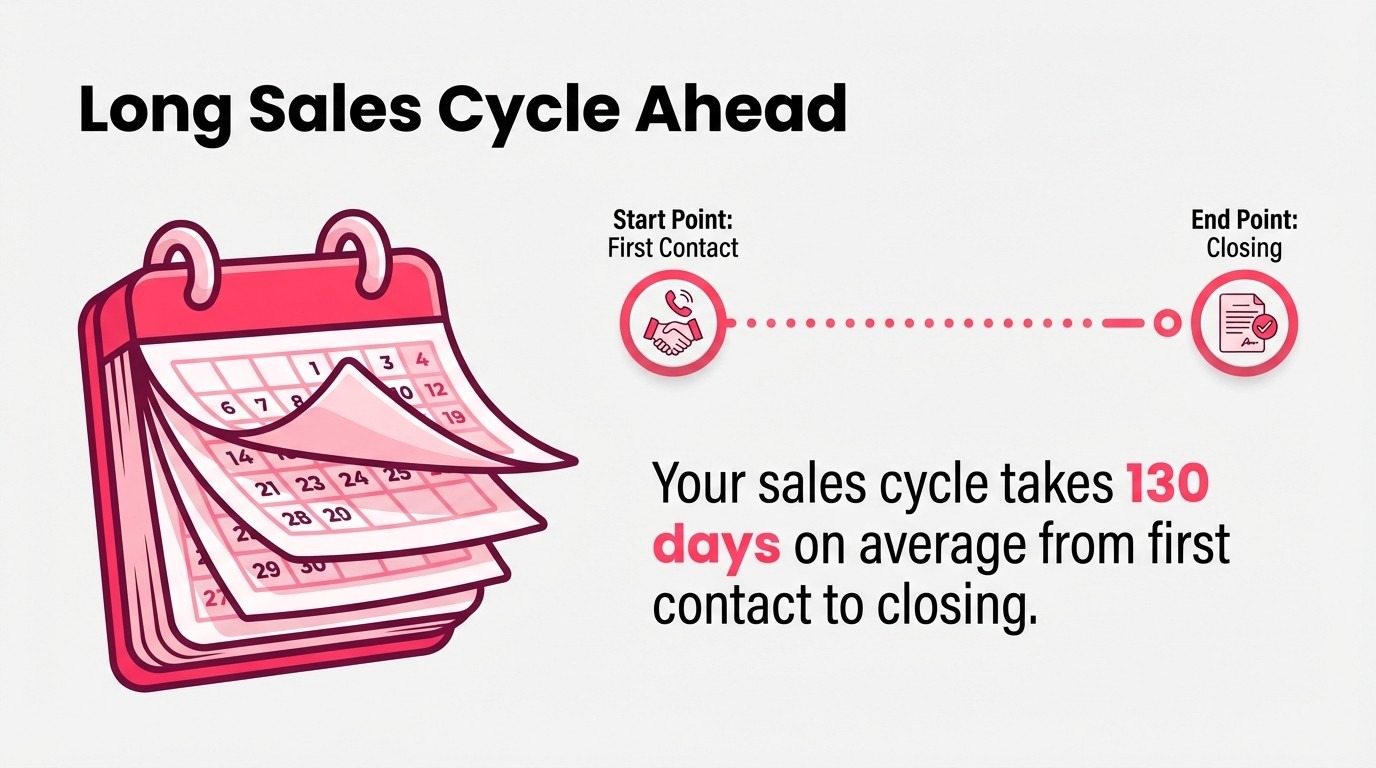
The math tells a brutal story. Manufacturing leads cost significantly more than the global average of $553. Your sales cycle takes 130 days on average from first contact to closing. Each click burns cash while your prospect is still mapping stakeholders.

I've managed paid search campaigns for manufacturers and industrial distributors for years at SCUBE Marketing. The difference between wasted spend and genuine pipeline isn't budget size. It's precision.
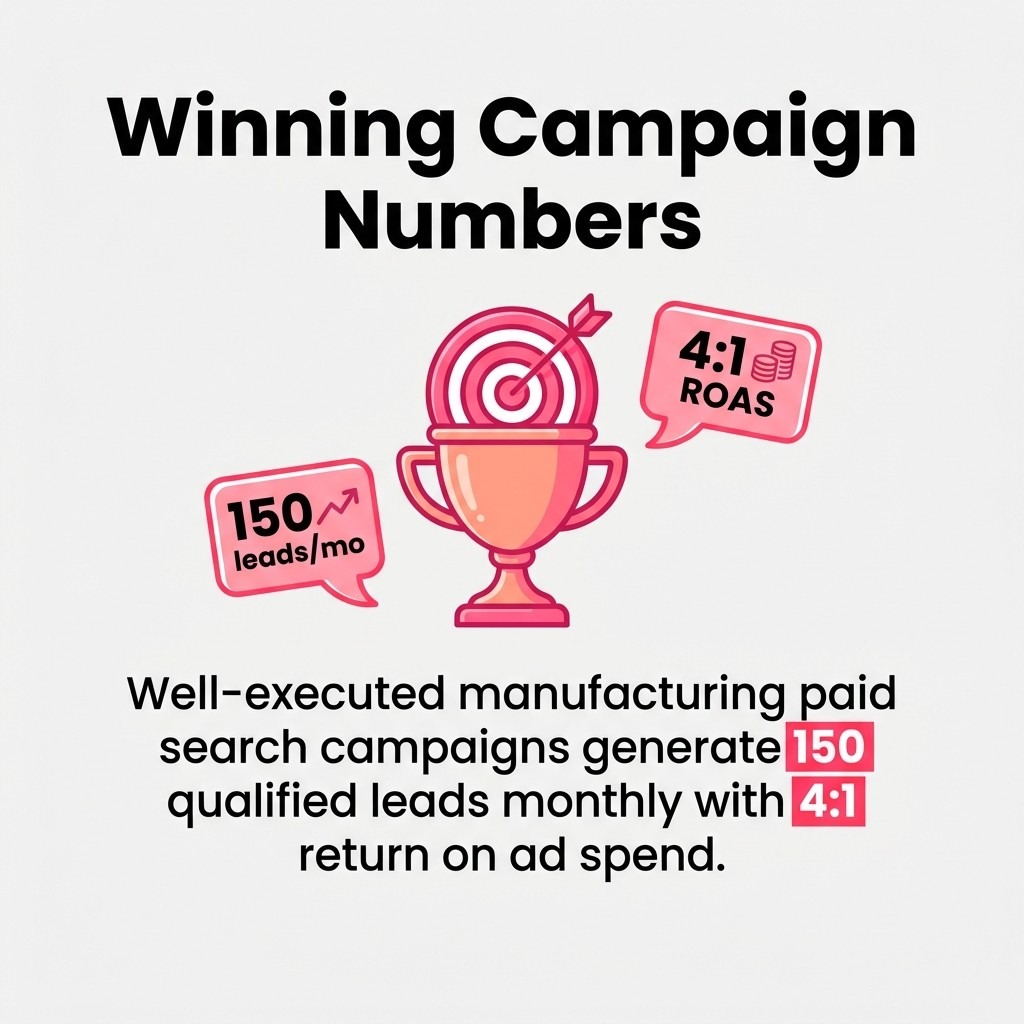
Well-executed manufacturing paid search campaigns generate 150 qualified leads monthly with 4:1 return on ad spend. But those numbers require accepting that manufacturing advertising works differently than selling shoes online.
You're about to learn the actual mechanics of turning Google Ads into purchase orders. No theory. Just the specific targeting, messaging, and tracking that separates profitable campaigns from expensive experiments.
The procurement manager searching at 11 PM isn't ready to buy. She's building a vendor shortlist for a project that won't start for six months.
Consumer marketing tactics assume purchase intent. Manufacturing advertising requires nurture architecture.
Your average sale takes four months to close. Multiple stakeholders weigh in. The engineer who found you isn't the purchasing agent who approves you.
Three different people click your ads during a typical sales cycle. The engineer searches technical specifications. The operations manager searches lead times and capacity. The CFO searches nothing but reads the proposal.
Most manufacturers run one generic campaign. "Precision machining services" targets everyone and convinces nobody.
Split your campaigns by buyer role. Create separate ad groups for engineers (technical specs, certifications, capabilities), operations managers (turnaround time, capacity, quality control), and procurement (pricing structure, vendor requirements, compliance).

Someone searching "CNC machining services" might need a quote tomorrow or research for next quarter. You can't tell from the keyword.
Layer in qualifiers. Target "CNC machining quote" separately from "CNC machining capabilities." The first signals urgency. The second signals research.
Your landing pages should match. Quote-intent searches go to a request form. Research-intent searches go to capabilities documentation.
National campaigns waste money unless you ship nationwide. A machine shop in Ohio competing for "metal fabrication" clicks in California burns budget on leads they'll never close.
Set radius targeting around your facility. Expand only to regions where you've actually won business. Track performance by location monthly.
For specialized capabilities with limited competition, you can cast wider. But watch your cost per qualified lead, not cost per click.
Purchase decisions in manufacturing happen in stages. Your paid search structure needs to mirror that reality.
Start by mapping your typical buyer journey. When do prospects first search? What changes as they move toward a decision?
Create three campaign tiers. Awareness campaigns target broad industry terms. Consideration campaigns target specific capabilities. Decision campaigns target brand and urgent needs.
Budget allocation should favor decision-stage campaigns. Those clicks cost more but convert faster. But don't ignore awareness. Six months from now, those researchers become requesters.
Use Google Analytics to track assisted conversions. The awareness click that doesn't convert today might contribute to the sale next quarter.
Every competitor targets "precision machining services." Fewer target "tight tolerance medical components manufacturer."
Mine your sales conversations for actual phrases. What do customers call what you make? Use their language, not your catalog descriptions.
Add negative keywords ruthlessly. "DIY machining" and "machining tutorial" waste budget. So does anything suggesting consumer intent.
Prioritize keywords with commercial signals. "Manufacturer," "supplier," "quote," "RFQ," "certified," and location modifiers indicate business buyers.
Your ad needs to answer the click question immediately. Not "quality machining services" but "ISO 9001 certified, 3-day quotes, 500+ aerospace parts shipped."
Specificity beats superlatives. "99.8% on-time delivery" outperforms "reliable service." Numbers prove. Adjectives claim.
Address the real objection. If you're more expensive, lead with "Premium materials, zero rejected parts." If you're slower, lead with "Complex geometries other shops reject."
Include your core differentiator in every headline. The engineer comparing five tabs needs to remember why yours matters.
Your ad sold the click. Your landing page needs to sell the form completion.
Most manufacturing landing pages fail because they're designed for consumer behavior. Industrial buyers need proof, not persuasion.
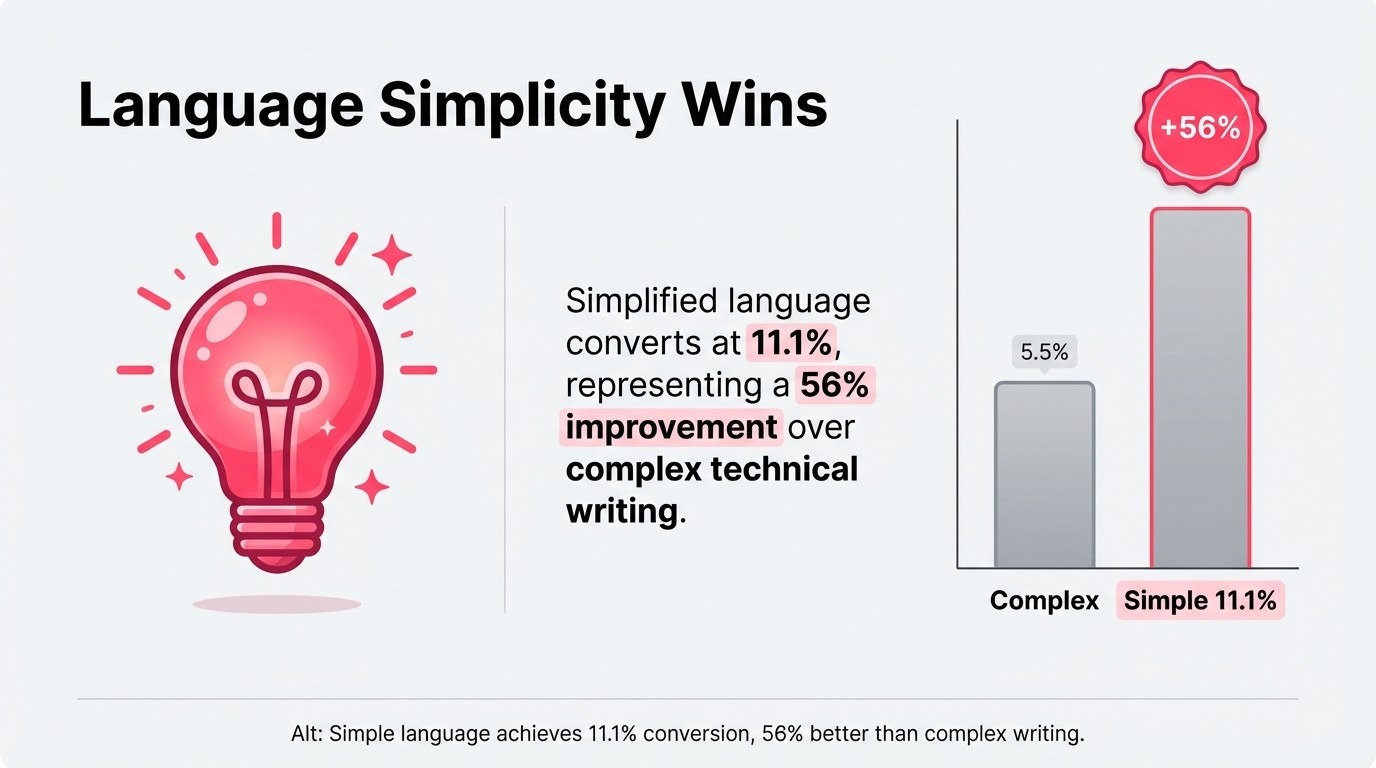
Simplified language converts at 11.1%, representing a 56% improvement over complex technical writing. But "simple" doesn't mean dumbed down. It means clear.
If your ad promises "aerospace-grade CNC machining," your landing page headline better say exactly that. Not "precision manufacturing solutions."
Every element should reinforce the ad promise. Show aerospace certifications above the fold. Display aerospace parts in your image gallery. Include aerospace client testimonials.
Message match isn't repetition. It's proof that the click wasn't wasted.
Certifications matter more than testimonials. ISO certifications, industry-specific compliance, facility photos showing actual equipment.
Be specific about capabilities. "5-axis CNC machining, tolerances to ±0.0005", materials include titanium, Inconel, stainless" beats "advanced machining capabilities."
Show delivery proof. "427 parts shipped last month, 99.2% on-time delivery, average 8-day turnaround" provides decision ammunition.
Client logos work if they're recognizable. Three Fortune 500 manufacturers beat twenty companies nobody knows. Social proof is crucial in the manufacturing industry to help with differentiation.
You need enough information to qualify the lead. You can't request so much that prospects abandon.
Essential fields: Company name, contact info, part description, quantity, timeline. Everything else can wait for the follow-up.
Explain why you're asking. "Material selection affects pricing" justifies the material field. "Production timeline determines scheduling" justifies the deadline field.
Offer immediate value. "Get detailed quote within 24 hours" or "Download our capability guide" gives them something for their information.
Engineers search on phones during off-hours. Your landing page needs to work on mobile without pinching and zooming.
Keep forms short. Six fields maximum on mobile. Use dropdown menus for multiple-choice answers.
Make phone numbers clickable. Some prospects prefer calling. Don't make them copy-paste to their dialer.
Test your page load speed. Slow mobile pages kill conversions regardless of content quality.
Broad targeting in manufacturing advertising is expensive guessing. Precise targeting is scientific hunting.
The goal isn't more clicks. It's more qualified conversations with buyers who have budget and timeline.
Set your primary radius around your facility. Then analyze where your best customers actually come from.
Create separate campaigns for proven regions. If you've closed ten deals in Michigan but only one in Texas, Michigan deserves higher bids and better budget.
Adjust for economic factors. Cities with strong manufacturing bases search more frequently and convert better than service-economy metros.
Consider excluding locations where shipping costs destroy your competitiveness. Better to focus budget where you can win.
B2B manufacturing searches don't follow 9-to-5 patterns. Engineers research late. Purchasing managers search early.
Run your initial campaigns 24/7 for two months. Export hourly performance data. Look for conversion patterns, not just click patterns.
You'll probably find research clicks evening and weekend, but form submissions concentrate during business hours. Adjust bids accordingly.
Don't shut off nights completely. Someone searching at midnight might be your best lead. Just bid lower when conversion probability drops.
Desktop users convert better for complex B2B purchases. But mobile users start the research.
Set mobile bids 20-30% lower initially. Track assisted conversions to see how many mobile clicks contribute to later desktop conversions.
If you offer instant quotes or simple RFQ forms, mobile can convert well. Complex configurators need desktop.
Tablet behavior often mirrors desktop more than mobile. Test treating tablets as desktop for bidding purposes.
Someone who visited your capabilities page but didn't request a quote is warm. Target them with specific offers.
Build remarketing lists by page type. Create separate audiences for quote page visitors, certification viewers, and case study readers.
Your remarketing ads should reference what they already know. "Saw our aerospace capabilities? Request a quote for your next project."
Set frequency caps. Seeing your ad twice weekly maintains presence. Seeing it five times daily triggers annoyance.
Manufacturing marketing budgets are tight. Companies stabilize marketing spend around 7.7% of revenue according to Gartner's 2025 CMO Spend Survey.
You can't outspend larger competitors. You can outthink them.
Calculate your average sale value. Determine acceptable cost per acquisition. Work backward to required lead volume and cost per lead.
If your average sale is $50,000 and you close 10% of qualified leads, you can afford $5,000 per closed deal. If you need ten leads monthly, budget $2,000-3,000 to start.
Average cost per click across industries is $5.26 in 2025. Industrial and commercial often runs higher due to commercial value, averaging around $5.70.
Start with modest daily budgets until you prove conversion rates. Better to run consistently at lower spend than blow the monthly budget in week one.
Manual CPC gives you control during testing. You learn what different keywords actually cost and which positions convert.
Once you have conversion data, switch to Target CPA or Maximize Conversions. Let Google's algorithm optimize bids based on your actual performance.
Avoid Maximize Clicks. It drives traffic, not results. Manufacturing advertising needs quality over quantity.
Review and adjust weekly initially, then monthly once performance stabilizes. Watch for seasonal patterns in your industry.
Allocate 50-60% to your highest-margin services. Put 20-30% toward volume services. Reserve 10-20% for testing new capabilities or markets.
Move budget toward what converts. If precision machining generates leads at $200 each while fabrication costs $400 per lead, shift budget accordingly.
But don't abandon slower performers immediately. Manufacturing sales cycles mean attribution lags performance by months.
The click that generates a sale happens months before the purchase order. Standard attribution breaks in manufacturing.
Set up proper tracking now. Waiting until you need the data means losing the data.
Track every meaningful action. Quote requests, yes. But also whitepaper downloads, capability guide views, certification page visits.
Assign value to micro-conversions based on historical close rates. If 30% of whitepaper downloaders eventually request quotes and 10% of those close, the download is worth 3% of your average sale value.
Use Google Analytics goals to track engagement depth. Time on site, pages per session, and return visits indicate genuine interest.
Import offline conversions back into Google Ads. When a lead becomes a customer, feed that data to your campaigns for better optimization.
The first click introduces you. The last click converts. Everything between nurtures.
75% of companies implementing multi-touch attribution see 14-36% cost per acquisition improvement.
Use data-driven attribution in Google Ads once you have sufficient conversion volume. It weights each touchpoint based on actual contribution to sales.
For smaller campaigns without enough data, use linear or time-decay models. Linear credits all touchpoints equally. Time-decay gives more credit to recent interactions.
Connect Google Ads to your CRM. Track leads from click through close.
Tag leads with campaign source. When that lead closes six months later, you know which campaign generated the revenue.
Use Salesforce or HubSpot to build complete customer journey reports. See which ad groups generate not just leads, but revenue.
Review this data quarterly. Monthly changes don't account for long sales cycles. Quarterly trends reveal what actually drives business.
Quality Score determines what you pay per click. Higher scores mean lower costs for the same position.
Improve relevance between keywords, ad copy, and landing pages. If the ad promises "titanium machining," the landing page should focus on titanium capabilities.
Boost click-through rate with specific, compelling ad copy. Generic ads get ignored. Specific value propositions get clicks.
Increase landing page experience through faster load times, mobile optimization, and clear calls to action.
Quality Score updates continuously. Monitor it monthly and fix any campaigns scoring below 5.
Basic campaigns work in uncrowded niches. Competitive markets require advanced tactics.
Bid on competitor brand names. Someone searching "Competitor Name machining" is actively considering alternatives.
Your ad should acknowledge the search. "Comparing machining suppliers? See how [Your Company] stacks up: faster quotes, tighter tolerances."
Defend your own brand terms. Competitors will bid on your name. Make sure you appear first with accurate information.
Brand defense campaigns should run 24/7 with high budgets. Losing your own name search is inexcusable.
Dynamic Search Ads automatically target searches based on your website content. Useful for manufacturers with extensive capabilities.
Feed Google your product catalog or services pages. It creates ads matching relevant searches you haven't manually targeted.
Review search term reports weekly. Add valuable queries as exact match keywords. Add irrelevant queries as negatives.
Don't let Dynamic Search Ads run without oversight. They'll burn budget on tangentially related searches if you're not careful.
By 2028, an estimated $750 billion in US revenue will funnel through AI-powered search.
Your content needs to answer questions AI can reference. Create detailed FAQs, specification guides, and comparison resources.
Structured data helps AI understand your capabilities. Implement schema markup for products, services, locations, and certifications.
Build authority through cited content. AI models prefer referencing authoritative sources. Become one through detailed technical resources.
Paid search generates leads. Sales closes them. The gap between those activities determines ROI.
Marketing thinks they delivered qualified leads. Sales thinks marketing sent garbage. This disconnect wastes both the ad spend and the sales effort.
For a deeper look at how manufacturers should align marketing and sales efforts, check out our comprehensive guide to manufacturing marketing strategies.
Define "qualified lead" before launching campaigns. Get sales and marketing in the same room.
Create a scoring system. Company size, industry, project timeline, budget indication. Agree on minimum scores before sales receives the lead.
Document lead handoff procedures. How fast should sales respond? What information do they need? Who handles which lead types?
Review rejected leads monthly. If sales consistently rejects "qualified" leads, your qualification criteria are wrong.
Someone requesting a quote expects a response within hours, not days. Speed matters more than perfect answers.
Set up automated acknowledgment emails. "We received your request and will respond within 24 hours" manages expectations.
Route urgent requests differently. If someone indicates "immediate need," that should trigger priority handling.
Track response times. Leaders who sit for three days before contact have already lost interest.
Sales knows which leads convert and why. Feed that intelligence back to marketing.
Weekly sales-marketing meetings during campaign launches. Monthly thereafter. Discuss lead quality, common objections, and closing patterns.
When sales closes a deal, document the customer journey. Which campaigns touched them? What convinced them? Use that data to refine targeting.
When leads don't close, understand why. Price? Timeline? Capabilities? Adjust messaging to filter out similar poor-fit prospects.
You can learn from your mistakes or from others' mistakes. The second option costs less.
Phrase match and broad match modifiers seem smart. They capture variations and misspellings.
They also capture completely irrelevant searches. "Metal fabrication" triggers on "metal fabrication art class" and "DIY metal fabrication."
Start with exact match. Add phrase match carefully. Review search terms weekly and add negatives constantly.
Broader targeting works once you've built substantial negative keyword lists. Not before.
Google shows you exactly what searches triggered your ads. Most advertisers never look.
Review search terms weekly for the first two months. Monthly after that. You'll find treasure and trash.
The treasure: high-intent searches you didn't think to target. Add them as exact match keywords.
The trash: irrelevant junk burning your budget. Add them as negative keywords immediately.
Your homepage serves multiple audiences with general information. Your paid search landing page should serve one audience with specific information.
Match landing pages to ad intent. Quote request ads go to quote forms. Capability ads go to detailed capability pages.
Don't make visitors hunt for what the ad promised. Every extra click loses conversions.
High click-through rates feel good. They don't pay bills.
Track cost per qualified lead, not cost per click. Track customer acquisition cost, not conversion rate.
A campaign generating 100 clicks at $3 each but zero sales loses to a campaign generating 10 clicks at $10 each with two sales.
See our case study on paid advertising for B2B distributors for real examples of how proper measurement transforms results.
You'll see leads next month. You'll see sales next quarter.
Budget for three to six months of spend before expecting positive ROI. Manufacturing sales don't close overnight.
Don't panic and kill campaigns after four weeks. You're burning money learning what works. That education pays off in month five.
Plan cash flow accordingly. If you need immediate revenue, paid search isn't the only answer.
Most manufacturers approach paid search backward. They launch campaigns, hope for results, then figure out tracking later.
Start with the close. Define what success looks like. Build tracking to measure it. Then create campaigns designed to deliver it.
Your first campaign won't be perfect. It shouldn't be. Perfect campaigns emerge from testing, refinement, and ruthless optimization.
Set up conversion tracking this week. Launch a modest test campaign next week. Review performance in two weeks. Adjust and expand what works. Kill what doesn't.
The manufacturers winning with paid search aren't spending more. They're spending smarter. They track everything, test constantly, and align marketing tightly with sales reality.
Your competition is probably doing this badly. They're targeting too broadly, measuring wrong metrics, and wondering why ads don't work.
You now know better. Start small. Track everything. Scale what converts. The manufacturing companies generating actual sales from paid search all started exactly where you are now.
For more detailed strategies on how manufacturers can maximize their digital marketing efforts, explore our complete guide to marketing for manufacturing in the digital age.