
Manufacturing marketing isn't about flashy campaigns or viral moments.
98% of industrial manufacturers generate sales-qualified leads through digital channels, but most still struggle to connect with decision-makers.
The real challenge? B2B manufacturing sales cycles average 130 days, involve multiple stakeholders, and require technical expertise that traditional marketing tactics simply don't address.
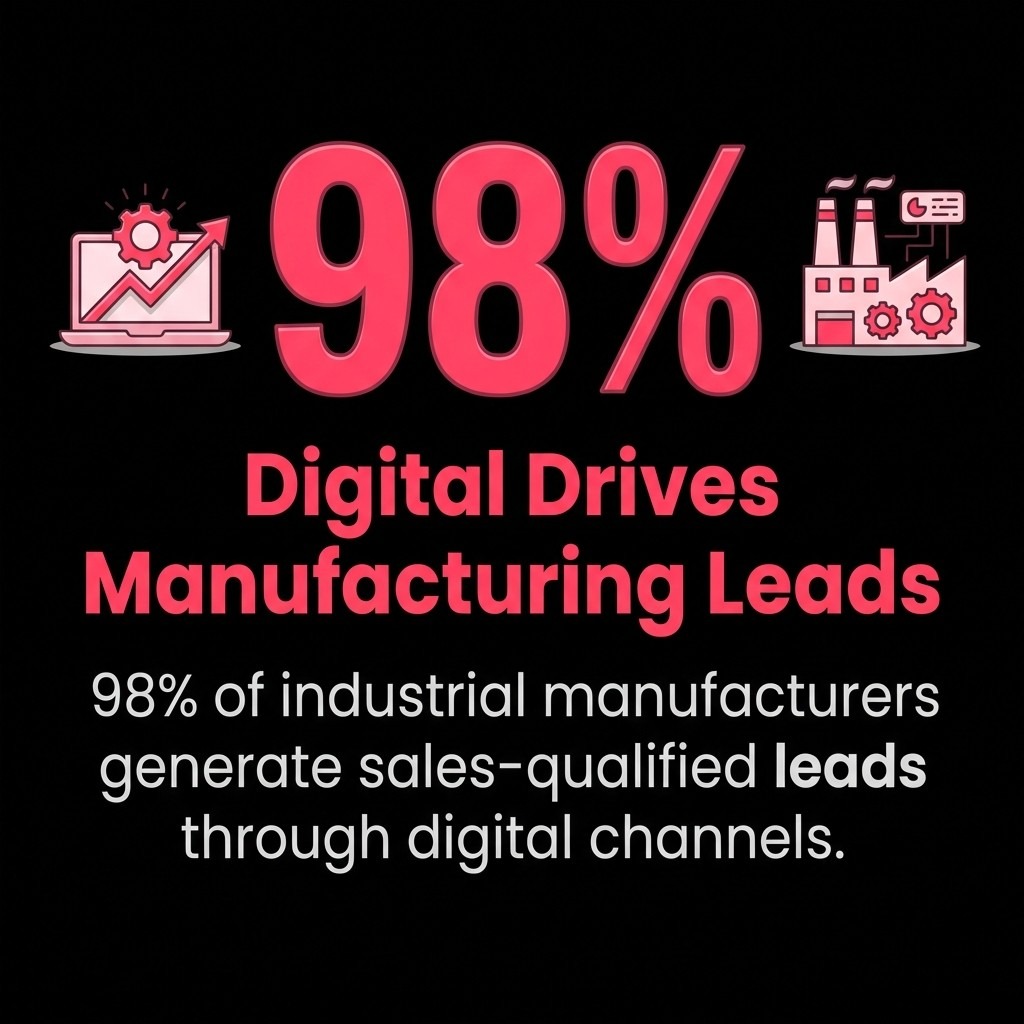
98% of industrial manufacturers generate SQLs through digital channels
I've spent years working with manufacturing companies on their digital marketing strategies. The patterns are clear.
Companies that succeed don't just throw money at ads. They build systematic approaches that align with how procurement teams actually research suppliers. They create content that answers technical questions before the first sales call. They optimize for search engines because engineers Google problems at 2 AM when production lines go down.
This guide covers eight proven marketing strategies specifically designed for manufacturing companies. Each section includes implementation steps, real-world applications, and metrics that matter. You'll learn how to generate qualified leads, shorten sales cycles, and build a marketing system that scales with your business.
No theory. No fluff. Just strategies that work when you're selling CNC machines, industrial components, or custom fabrication services.
Marketing for manufacturing companies operates in a completely different world than B2C marketing. You're not selling impulse purchases or emotional decisions.
You're selling to engineers who need technical specifications. Procurement managers who evaluate ROI models. Operations directors who worry about downtime. Finance teams who scrutinize capital expenditures.
Manufacturing has an average total sales cycle of 130 days. That's over four months from first contact to signed contract. During that time, potential customers research suppliers, compare alternatives, test samples, negotiate terms, and get approvals from multiple departments.
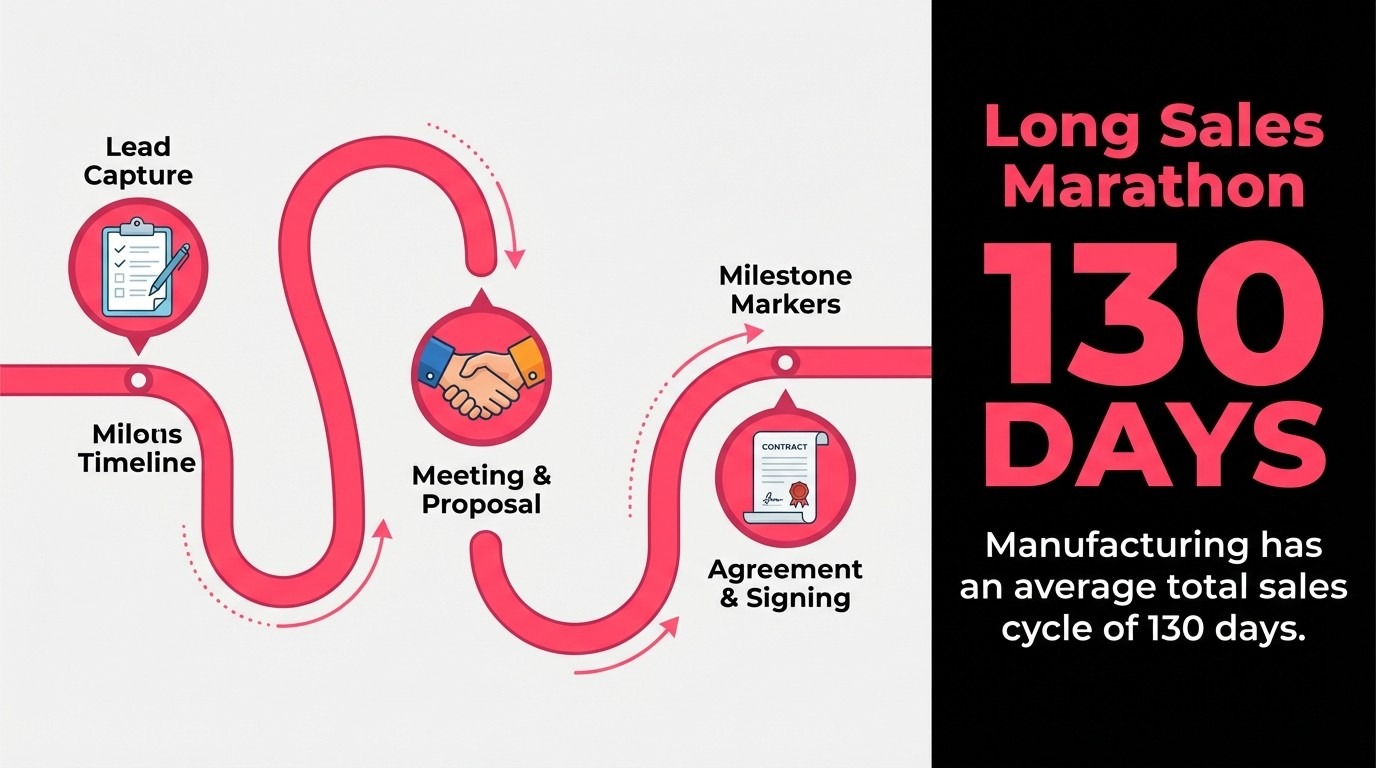
Average manufacturing sales cycle: 130 days (a marathon, not a sprint)
Traditional marketing treats this complexity like a sprint. Manufacturing marketing is a marathon.
B2B marketing in manufacturing faces unique challenges that consumer-focused strategies can't address. Your target audience isn't browsing social media looking for products. They're solving specific operational problems.
When a production manager needs a new hydraulic system, they don't click banner ads. They search for technical documentation. They read case studies about similar applications. They download CAD files and specification sheets.
The buying process involves multiple stakeholders with different priorities. Engineering wants performance specifications. Purchasing wants competitive pricing. Operations wants reliable delivery. Maintenance wants serviceability.
Your marketing needs to speak to all of them simultaneously.
64% of manufacturers struggle to prove ROI from their marketing efforts. The disconnect happens because companies apply consumer marketing playbooks to industrial sales.
They create generic content that doesn't answer technical questions. They optimize websites for brand awareness instead of lead generation. They measure vanity metrics like social media followers instead of qualified leads.
Manufacturing marketing requires patience and precision. You're building long-term relationships, not closing quick sales. The strategies that follow address these specific challenges with tactics designed for complex B2B sales cycles.
Content marketing isn't about blog posts for the sake of publishing. It's about positioning your company as the technical expert that solves specific problems.
85% of manufacturers use content marketing to build trust and generate leads. The companies that succeed create content that directly addresses the questions potential customers ask during their research phase.
When someone searches "how to reduce vibration in CNC machining," they're not browsing. They have a real problem right now. If your content provides the answer, you've just entered their consideration set.
Start with the questions your sales team hears repeatedly. What specifications do customers ask about? What objections come up during demos? What comparisons do they make between your products and alternatives?
Turn each question into detailed content:
The content needs depth. Surface-level explanations don't build credibility with engineers. Include calculations, tolerances, material properties, and performance data.
Publishing content on your website solves half the problem. Distribution ensures it reaches decision-makers during their research process.
Optimize every piece for search engine optimization. 69% of manufacturers utilize organic search traffic as their primary digital marketing channel. When engineers search for solutions, your content should appear in the first three results.
Share technical content on LinkedIn where procurement teams and operations managers actively research suppliers. Post in industry-specific forums and communities where your target audience asks questions.
Gate your most valuable content behind lead capture forms. Detailed specification guides, ROI calculators, and technical comparison charts are worth trading contact information for.
Track metrics that connect to actual business outcomes. Downloads of technical documents indicate research-stage interest. Time spent on specification pages shows serious evaluation. Return visits suggest active comparison shopping.
Connect content consumption to lead quality. Which white papers do customers download before requesting quotes? Which case studies appear in the browsing history of closed deals?
Use this data to refine your content strategy. Double down on topics that generate qualified leads. Update older content with new data and examples. Expand on subjects that consistently drive engagement.
For more insights on creating compelling content in specialized industries, check out our content marketing guide for technical B2B sectors.
SEO for manufacturing companies isn't about ranking for broad terms like "industrial equipment." You'll never outrank Amazon or Grainger for generic keywords.
The opportunity lies in long-tail technical queries. Specific searches like "stainless steel pressure vessel ASME Section VIII specifications" or "servo motor sizing calculation for conveyor systems."
SEO converts at 3 times the rate of pay-per-click advertising for manufacturers. The reason? Organic search results match user intent better than paid ads for technical research.
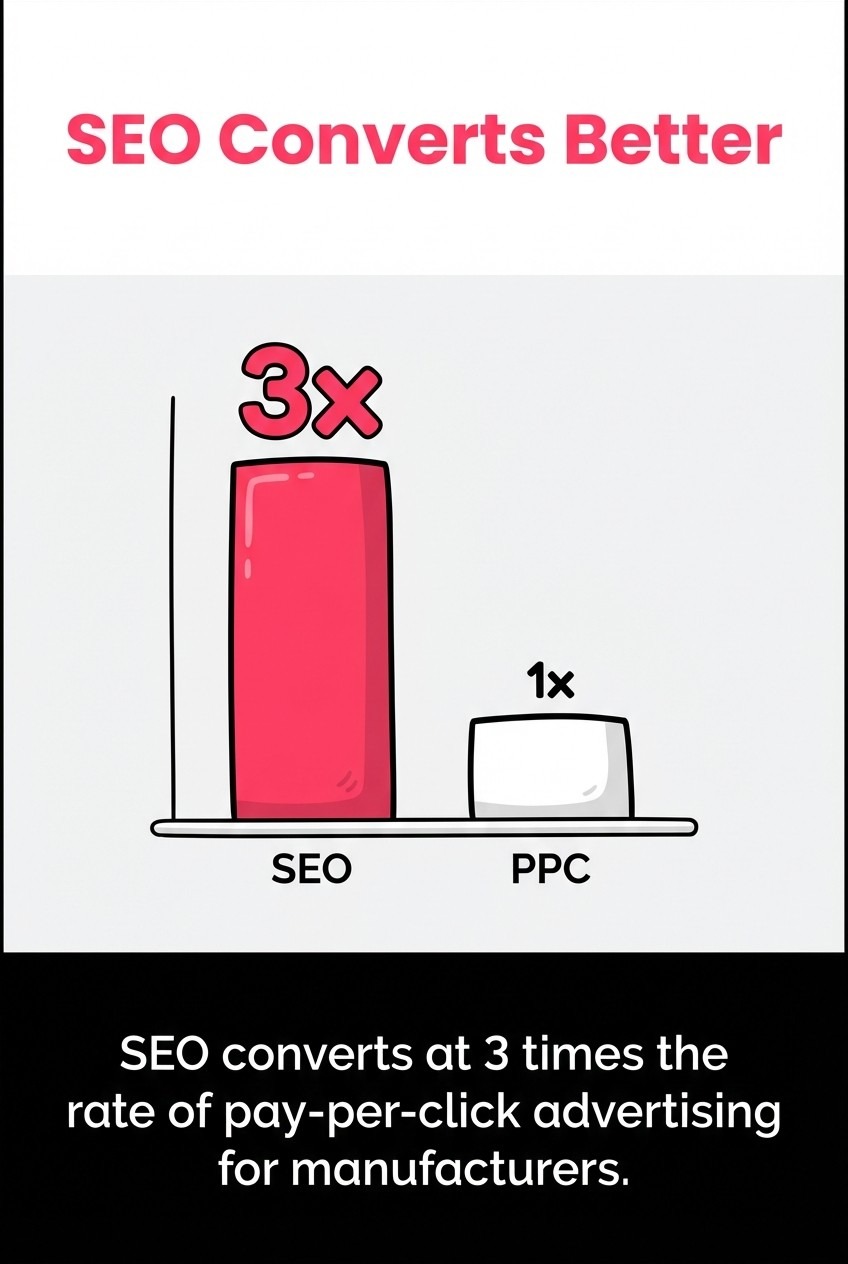
SEO converts at 3x the rate of PPC for manufacturers
Start with product specifications, part numbers, and industry standards. These terms have lower search volume but dramatically higher conversion rates.
Use tools like Google Keyword Planner to find variations engineers actually search. Look for questions beginning with "how to calculate," "what causes," "how to reduce," and "when to replace."
Analyze competitor websites to identify ranking gaps. What technical topics do they cover? Where are the content holes you can fill with superior information?
Create a spreadsheet mapping keywords to specific pages. Each product category needs optimized content targeting its unique technical vocabulary.
Structure your website around technical topics, not just products. Create dedicated pages for common applications, industry standards, and problem-solving guides.
Use descriptive headings that match search queries. Instead of "Our Products," write "Custom Hydraulic Cylinders for Mobile Equipment Applications."
Include technical specifications in structured formats. Tables with dimensions, capacities, and performance data make content scannable and help search engines understand your offerings.
Add schema markup for products, specifications, and reviews. This structured data helps search engines display rich results with ratings, prices, and availability.
Manufacturing companies earn links differently than consumer brands. Focus on industry associations, technical publications, and educational institutions.
Publish original research about industry trends. Survey customers about their challenges. Share the results as detailed reports that industry publications want to reference.
Contribute guest articles to trade magazines covering your sector. These backlinks from authoritative industry sources signal expertise to search engines.
Get listed in industry directories and supplier databases. These citations reinforce your category relevance and local presence.
Our B2B industrial distributor case study shows how strategic SEO drove measurable revenue growth through technical content optimization.
Not all leads deserve equal attention. Manufacturing sales often depend on landing a few major accounts rather than converting hundreds of small customers.
Account-based marketing flips traditional lead generation on its head. Instead of casting wide nets, you identify specific target companies and create personalized campaigns for key decision-makers at each account.
Companies using ABM report pipeline growth rates of up to 84%. The strategy works because it aligns marketing resources with sales priorities.
Start with your ideal customer profile. What industries use your products most successfully? What company sizes have budgets matching your pricing? What geographic regions do you serve best?
Work with your sales team to create a target account list. Include companies currently buying from competitors, organizations expanding operations, and businesses with specific problems your products solve.
Prioritize accounts by potential lifetime value. A single Fortune 500 manufacturer might represent more revenue than 100 small shops.
Research each target account thoroughly. Understand their operations, challenges, recent news, and key decision-makers. This intelligence informs personalized outreach.
Generic marketing messages don't work for account-based marketing. Every touchpoint should demonstrate you understand the target company's specific situation.
Create custom content addressing the target account's industry challenges. If you're pursuing automotive manufacturers, develop case studies showing results at similar automotive plants.
Use LinkedIn ads targeted specifically to decision-makers at your target accounts. Show them content that speaks directly to their operational challenges.
Send personalized direct mail with relevant technical resources. A custom-printed guide to "Improving OEE in Pharmaceutical Manufacturing" stands out more than generic sales brochures.
Marketing creates awareness and delivers educational content. Sales follows up with personalized outreach referencing the content prospects consumed.
Track account engagement across all touchpoints. When multiple contacts from a target company download your white papers, visit your website, and engage on LinkedIn, you've got a hot account.
Schedule regular account reviews between sales and marketing. Discuss what's working, which accounts show buying signals, and how to adjust campaigns based on feedback.
Social media marketing for manufacturing companies means LinkedIn. Period.
85% of marketers identify LinkedIn as their most effective social media channel for manufacturing marketing. More importantly, LinkedIn is 277% more effective for lead generation than Facebook and X combined.
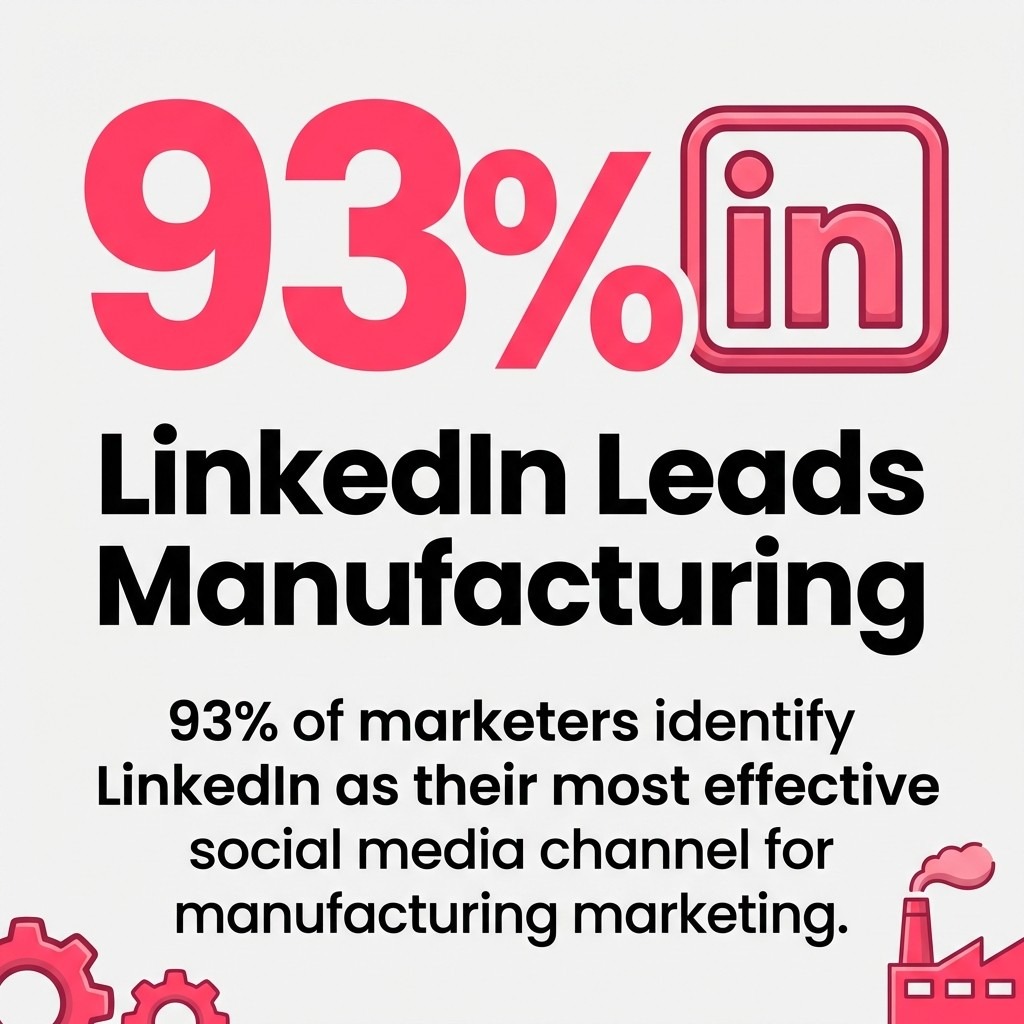
LinkedIn is the top social platform for manufacturing marketing (93% of marketers)
The platform works because decision-makers use it professionally. Engineers research suppliers during work hours. Procurement managers browse LinkedIn looking for vendor options. Operations directors follow companies before requesting quotes.
Your LinkedIn company page is often the first impression potential customers get. Make it count.
Complete every section with detailed information about capabilities, certifications, and industries served. Upload photos of your facility, equipment, and team. Add videos showing manufacturing processes and product applications.
Post consistently about technical topics relevant to your target audience. Share application tips, industry news, case studies, and behind-the-scenes content from your operations.
The goal isn't entertainment. It's demonstrating expertise and staying top-of-mind during long research cycles.
Company pages have limited organic reach. Personal profiles of employees and executives reach far more people.
Encourage engineers to share technical insights. Have quality managers post about certifications and standards. Let operations leaders discuss efficiency improvements and problem-solving.
This thought leadership builds credibility faster than corporate messaging. When a potential customer sees your metallurgist explaining heat treatment processes, that's authentic expertise.
Create a simple content calendar for employees to share. Provide them with post ideas, relevant articles, and company updates they can personalize and publish from their accounts.
LinkedIn's targeting capabilities let you reach exactly the right people. Filter by job title, company size, industry, and seniority level.
Create sponsored content promoting your best technical resources. Target ads to "VP of Operations" at "Manufacturing Companies" with "500-1000 employees" in "specific geographic regions."
Use lead generation forms directly within LinkedIn. These pre-filled forms reduce friction and capture contact information without forcing prospects to leave the platform.
Test different content offers to find what resonates. Technical guides might outperform product brochures. ROI calculators could generate more leads than case studies.
For additional strategies on understanding how your target audience behaves online, explore our guide on customer behavior insights for 2025.
Email marketing remains the most effective channel for nurturing manufacturing leads through extended sales cycles. The average email marketing ROI reaches $36 to $45 for every $1 spent.
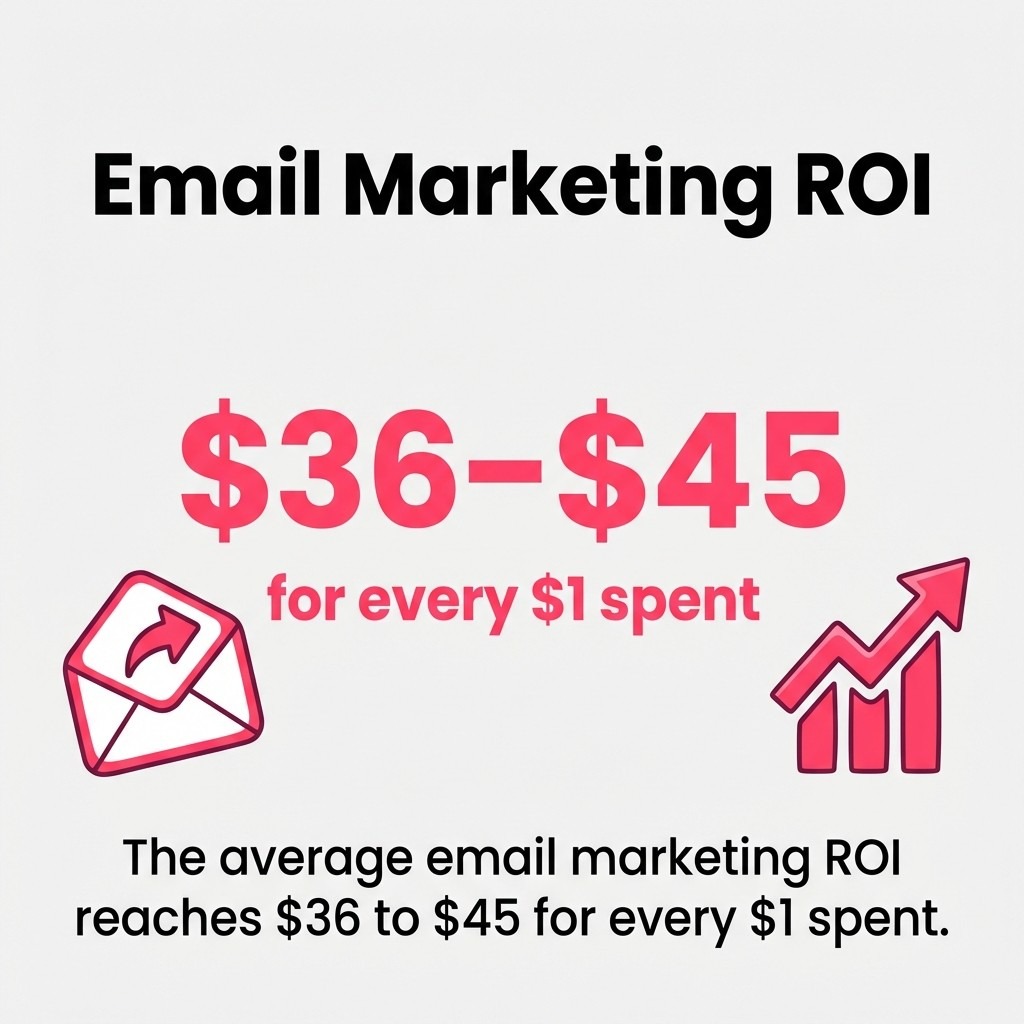
Email marketing ROI: $36–$45 per $1 spent
The key is patience and relevance. Your prospects aren't ready to buy today. They're researching options, building business cases, and navigating internal approval processes.
Email keeps you present throughout that journey without being pushy.
Generic email blasts don't work for manufacturing companies. You need segmentation based on where prospects are in their buying journey and what problems they're trying to solve.
Segment by industry served. Aerospace manufacturers have different concerns than food processing plants. Send industry-specific content that addresses unique challenges.
Segment by engagement level. Prospects who downloaded three white papers need different messaging than someone who visited your website once.
Segment by product interest. Someone researching CNC machines shouldn't receive emails about injection molding equipment.
Use progressive profiling to gather information over time. Each form submission or content download reveals more about the prospect's needs and timeline.
Build automated email sequences that deliver value at each stage of the buyer journey.
Start with awareness-stage content. Send educational resources about common industry challenges. Position problems before pitching solutions.
Move to consideration-stage content. Share comparison guides, specification sheets, and application examples. Help prospects evaluate options objectively.
Finish with decision-stage content. Provide case studies, ROI calculators, and implementation guides. Address final objections and make the buying decision easier.
Space emails appropriately for long sales cycles. Weekly emails might work for short sales cycles, but monthly touchpoints suit manufacturing better.
Track metrics beyond open rates and click-through rates. Connect email engagement to pipeline progression and closed deals.
Which email sequences generate the most qualified leads? Which subject lines get opened by your target accounts? What content keeps prospects engaged over multiple months?
Test different approaches systematically. Try technical content versus business case content. Compare industry-specific messaging against general manufacturing topics.
86% of manufacturing companies have adopted a CRM system. Integrate your email platform with your CRM to track the complete customer journey from first email to closed deal.
Trade shows remain critical for manufacturing companies, but they can't exist in isolation from your digital marketing strategy. 81% of trade show attendees have buying authority, making these events valuable for face-to-face relationship building.
The manufacturers who maximize ROI from trade shows integrate them into a larger digital marketing system. Pre-show marketing builds booth traffic. Post-show follow-up converts conversations into sales opportunities.
Start promoting your trade show presence 6-8 weeks before the event. Email your database announcing your booth location and what you'll be showcasing.
Create landing pages specifically for the event. Offer to schedule booth appointments or demos. Provide incentives like exclusive show-only pricing or product previews.
Use LinkedIn ads targeted to people attending the trade show. Platforms often create event-specific hashtags and groups. Engage in these channels before the show starts.
Prepare digital content to distribute at the booth. Load tablets with video demos, case studies, and specification sheets. Collect contact information digitally to eliminate manual data entry later.
The real work begins after the trade show ends. Most leads go cold because companies fail to follow up quickly and systematically.
Categorize leads by interest level immediately after the show. Hot prospects get personal calls within 48 hours. Warm leads enter targeted email nurture sequences. Cold contacts get added to general marketing automation.
Send personalized follow-up emails referencing specific conversations from the booth. Include the resources you promised, plus additional relevant content based on their interests.
Create post-show content recapping your presence. Share photos, videos, and key announcements on LinkedIn and your website. This extends the event's reach beyond attendees.
Track trade show leads separately in your CRM. Tag them with the event name so you can measure long-term conversion rates and revenue attribution.
Calculate cost per lead including booth space, travel, materials, and staff time. Compare this to other lead generation channels to evaluate effectiveness.
Monitor how trade show leads progress through your sales pipeline compared to digital leads. They often convert faster because of the face-to-face interaction, but take longer to close due to the complex sales cycle.
For practical guidance on evaluating different marketing channels for your business, see our article on choosing the best traffic sources for your business.
Marketing automation lets small marketing teams execute sophisticated campaigns that would otherwise require dozens of people. For manufacturing companies with limited marketing resources, automation multiplies impact.
The technology handles repetitive tasks like email sequences, lead scoring, and CRM updates. This frees your team to focus on strategy, content creation, and high-value prospect interactions.
Not all website visitors and content downloads represent equal opportunities. Lead scoring assigns point values to specific behaviors, helping sales teams focus on the most promising prospects.
Award points for high-intent actions. Visiting your pricing page scores higher than reading a blog post. Downloading a technical specification sheet indicates more interest than a general industry guide.
Add demographic scoring based on fit. Contacts from target industries, appropriate job titles, and ideal company sizes receive bonus points.
Set thresholds that trigger sales alerts. When a lead reaches 100 points, notify your sales team automatically. These hot leads deserve immediate attention while interest is high.
Create workflows that move prospects through your marketing funnel automatically based on their behavior.
When someone downloads a white paper, automatically add them to a relevant nurture sequence. If they visit your website multiple times in one week, trigger an alert to sales.
Build branching logic based on engagement. If prospects open and click your emails, send more detailed technical content. If they don't engage, shift them to a slower-paced sequence.
Automate internal processes too. When sales marks a lead as "qualified," automatically create a CRM opportunity and notify the account manager.
Marketing automation enables personalization without manual customization for each prospect. Use dynamic content that changes based on recipient attributes.
Email subject lines can reference the recipient's industry. Body content can highlight relevant case studies from similar companies. Call-to-action buttons can link to industry-specific landing pages.
Website personalization shows different content to return visitors. Someone who previously downloaded a guide about reducing machine downtime might see related case studies on their next visit.
In mature B2B operations, 30 to 60% of the sales pipeline is attributed to marketing. Automation makes this level of contribution possible by systematically nurturing prospects over long sales cycles.
Your website is the hub of all digital marketing activity. Content marketing drives traffic to it. SEO makes it discoverable. Email campaigns link back to it. Trade show leads visit it to research your company.
If your website doesn't convert visitors into leads, every other marketing effort suffers.
Engineers and procurement managers visit manufacturing websites with specific goals. They need technical information quickly without navigating through marketing fluff.
Structure navigation around products, industries served, and applications. Make it easy to find exactly what they're looking for.
Feature search prominently. Technical buyers often know the specific product or specification they need. Let them search for part numbers, industry standards, or technical terms.
Make contact information obvious on every page. Include phone numbers, email addresses, and contact forms in headers and footers. Remove barriers to conversation.
Provide multiple ways to engage based on readiness level. Offer downloadable resources for early-stage researchers. Display "Request a Quote" buttons for prospects ready to buy. Include "Schedule a Demo" options for those in between.
Every campaign should direct traffic to dedicated landing pages, not your homepage. These focused pages eliminate distractions and guide visitors toward one specific action.
Match landing page messaging to the ad or email that brought visitors there. If your LinkedIn ad promises "5 Ways to Reduce CNC Machine Downtime," the landing page headline should reference that same benefit.
Keep forms short initially. Ask only for essential information like name, email, and company. Use progressive profiling to gather additional details over time.
Include social proof on landing pages. Display customer logos, testimonials, and certifications that build credibility with first-time visitors.
Make specifications, CAD files, and technical documents easy to find and download. Create a resource library organized by product category, industry, and file type.
Optimize PDFs for search engines. Name files descriptively and include metadata. This makes technical documents discoverable through Google search.
Provide comparison tools that let prospects evaluate options side-by-side. Interactive configurators help buyers specify exactly what they need before requesting quotes.
For detailed strategies on optimizing your conversion funnel from visitor to lead, check out our guide on conversion rate optimization from analytics to action.
Marketing measurement separates effective strategies from wasted budget. But manufacturing companies face unique challenges in attribution due to long sales cycles and multiple touchpoints.
The solution isn't perfect attribution. It's tracking the right metrics at each stage of the funnel and understanding how they connect to business outcomes.
Start by measuring whether your target audience is discovering your company. Track organic search traffic from relevant technical keywords. Monitor social media engagement from decision-makers at target accounts.
Measure website traffic growth overall, but segment by source. Are you attracting visitors from the right industries? Do they match your ideal customer profile?
Track brand search volume. As awareness grows, more people should search for your company name directly.
Conversion rate from visitor to lead shows whether your content resonates. The average cost per lead for the manufacturing industry is $170. Track your actual cost and work to beat this benchmark.
Monitor lead quality through sales feedback. What percentage of marketing-generated leads are actually qualified? Which sources produce leads that convert to opportunities?
Track content engagement metrics. Which white papers get downloaded most? What pages do converting leads visit before requesting quotes?
Connect marketing activities to closed revenue. Tag every lead with source information and track it through your sales pipeline.
Calculate marketing-influenced revenue, not just marketing-sourced revenue. Most deals involve multiple touchpoints. Give marketing credit when it plays a role, even if sales made first contact.
Track metrics like pipeline velocity. Are marketing-qualified leads moving through the sales process faster than cold outbound prospects?
Measure customer lifetime value by acquisition source. Do leads from content marketing become better long-term customers than trade show leads?
For more guidance on tracking what actually matters for lead generation, read our article on Google Analytics for lead generation measurement.
Strategy without execution means nothing. These eight approaches work, but only if you implement them systematically.
Start with your biggest opportunity. If you're getting zero organic search traffic, prioritize SEO and content marketing. If you have traffic but no conversions, focus on website optimization and lead nurturing.
Don't try to execute everything simultaneously. Pick 2-3 strategies, implement them well, measure results, then expand.
You need tools that work together seamlessly. At minimum, invest in a solid CRM system, marketing automation platform, and analytics tools.
Popular options for manufacturing companies include Salesforce or HubSpot for CRM and marketing automation. Both integrate well with other tools and scale as your needs grow.
Use Google Analytics for website tracking and Google Search Console for SEO monitoring. These free tools provide essential data about how prospects find and interact with your website.
Consider specialized tools for specific needs. SEMrush or Ahrefs help with keyword research and competitor analysis. Drift or Intercom enable website chat for real-time engagement.
Break your strategy into quarterly objectives with specific deliverables.
Month 1: Foundation building. Set up analytics properly. Audit existing content. Define your ideal customer profile and target accounts. Establish baseline metrics.
Month 2: Content creation and optimization. Publish technical content targeting your priority keywords. Optimize key website pages for conversion. Launch your first email nurture sequence.
Month 3: Promotion and distribution. Start LinkedIn engagement. Launch your first ABM campaign. Test different content offers to see what generates qualified leads.
Review results at the end of 90 days. What worked? What didn't? Where should you double down? What should you cut?
Manufacturing leadership often views marketing as an expense, not an investment. Your job is proving otherwise with data.
Start small with pilot programs that demonstrate ROI. If you can show that $5,000 in content marketing generated three qualified leads worth $500,000 in potential revenue, budget conversations get easier.
Connect marketing metrics to business outcomes leadership cares about. Don't report on social media followers. Report on sales pipeline generated, cost per qualified lead, and revenue influenced by marketing.
Video marketing produces a 93% ROI for manufacturing companies. Use data like this to justify specific investments in new channels or tactics.
The manufacturing marketing approach we use at Scube Marketing emphasizes measurable results tied to business growth. That's how you build long-term support for marketing initiatives.
Manufacturing marketing works differently than other industries. Success requires patience, technical depth, and systematic execution. But the companies that get it right generate consistent qualified leads, shorten sales cycles, and build predictable revenue growth.
Pick your starting point. Execute consistently. Measure relentlessly. Adjust based on data.
That's marketing that actually works for manufacturing companies.