
The auto parts market hit $5.8 billion in online sales in 2026, and most of that traffic came from paid search campaigns.
But here's what matters more: auto parts retailers enjoy an average cost per click of just $3.90, almost 40% cheaper than the all-industry average. That gap represents opportunity, but only if you know how to structure campaigns that speak the language automotive shoppers actually use.
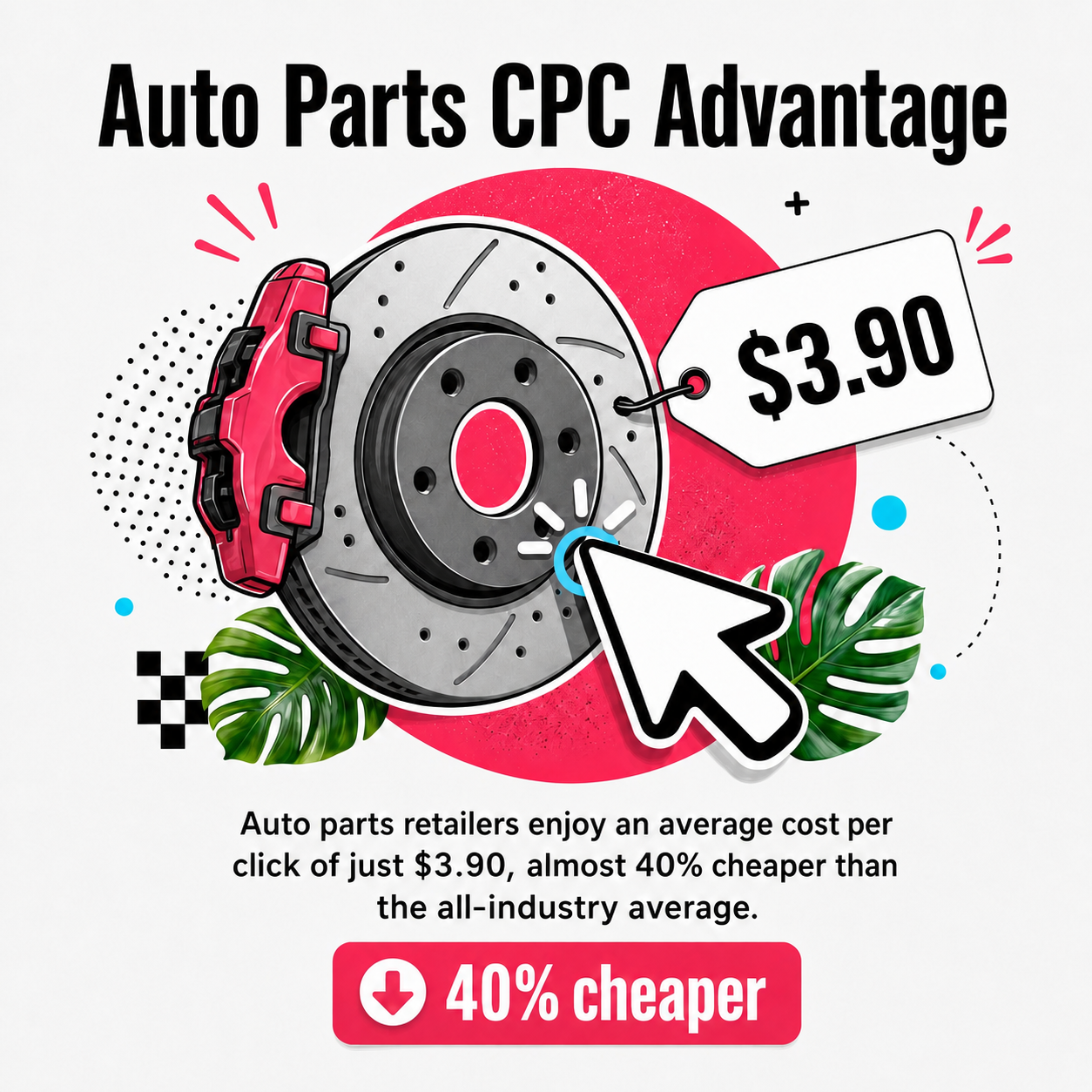
Auto Parts CPC Advantage
I've run paid search campaigns for auto parts retailers for years at Scube Marketing. The difference between a campaign that bleeds budget and one that prints money comes down to understanding something most PPC agencies miss: automotive shoppers don't search like normal ecommerce customers.
They search by symptom first, then by part number. They filter by year, make, and model before they even look at price. They need fitment data more than they need product reviews.
This guide shows you how to build paid search campaigns that win clicks from high-intent shoppers. You'll learn the exact keyword structures that work for auto parts, how to organize product data for Google Shopping campaigns, and which platforms actually deliver ROI in the aftermarket space. By the end, you'll have a framework for turning search traffic into customers who come back every time their vehicle needs another part.
Most ecommerce PPC follows a simple pattern. You bid on product names, optimize for conversion rate, and hope your margins hold up.
Auto parts break that model completely.
Your customers search in three distinct ways, and each requires a different campaign structure.
First, they search by symptom: "why is my brake pedal soft" or "rattling noise when turning."
These searches bring people who don't know what part they need yet.
Second, they search by vehicle specification: "2018 Honda Civic brake pads" or "alternator for Toyota Tacoma." These shoppers know the part but need fitment confirmation.
Third, they search by exact part number: "AC Delco 41-110" or "Bosch 0986424089."
Generic ecommerce campaigns treat all searches the same. Automotive PPC needs separate campaign structures for each search type, with different landing pages and different bidding strategies.
The automotive aftermarket market will grow from $457.08 billion in 2026 to $604.57 billion by 2034. That growth comes from independent retailers who figured out how to compete with the OEM dealers. But independent shops face a challenge: 57% of consumers globally prefer buying replacement parts from the independent aftermarket, yet 83% of repair shops report customers now choosing entry-level or low-cost parts.


That price pressure makes your cost per click matter even more. You can't afford to waste budget on generic keywords that bring tire-kickers.

Understanding how automotive shoppers search changes everything about campaign structure. Each pattern represents a different stage in the buying journey, and each converts at wildly different rates.
When someone searches "car pulls to the left when braking," they're not ready to buy. They're diagnosing. These searches have lower immediate conversion rates, but they build trust with shoppers who will buy once they identify the problem.
Smart retailers create informational landing pages that diagnose the issue, then recommend the specific part that solves it. You're not bidding on high-volume generic terms. You're targeting long-tail diagnostic queries that bring motivated shoppers with actual vehicle problems.
The key is matching symptom searches to the correct part category, then using that initial click to capture the vehicle fitment data you'll need for retargeting.
Searches like "brake rotors for 2015 Ford F-150" signal buying intent. The shopper knows what they need. They're comparing options, checking fitment, and looking for the best price-to-quality ratio.
These searches convert at higher rates because the research phase is complete. Your job is confirming fitment compatibility and differentiating on factors beyond price: shipping speed, warranty terms, installation difficulty, brand reputation.
Vehicle-specific campaigns should use dynamic keyword insertion that mirrors the exact year/make/model combination the shopper searched for. This increases relevance scores and click-through rates without requiring thousands of individual keyword entries.
When someone searches an exact part number, they're ready to buy. They've already done their research. They know exactly what they need. They're comparing prices and availability across retailers.
Part number campaigns require the highest bids because competition is fierce and margins are thin. But these clicks convert at the highest rate, sometimes above 20%. The entire battle comes down to having the part in stock, displaying clear pricing, and offering faster shipping than competitors.
You win these searches by having clean product data that includes manufacturer part numbers, OEM equivalents, and interchange numbers. More on that in a minute.
Most auto parts retailers dump everything into one campaign and wonder why performance is inconsistent. The solution is creating separate campaign structures for each search pattern.
Set up dedicated campaigns for diagnostic queries with lower bids and longer conversion windows. These campaigns feed your retargeting audiences more than they generate immediate sales.
Target broad match keywords around common vehicle problems: brake noise, engine hesitation, fluid leaks, electrical issues. Send traffic to content pages that diagnose the problem and recommend solutions, not directly to product pages.
Measure these campaigns on engagement metrics and remarketing list growth, not immediate ROAS. The value comes later, when those shoppers move to the purchase phase.
Google Shopping campaigns work exceptionally well for auto parts because they display product images, pricing, and availability upfront. Shoppers can verify fitment before clicking, which improves your conversion rate.
Performance Max campaigns pull from across Google's properties including Search, Shopping, Display, and YouTube. But for auto parts, I've found standard Shopping campaigns with tight product group segmentation outperform Performance Max in most cases.
The reason: Shopping campaigns give you control over bid adjustments based on product categories, brands, and margins. Performance Max optimizes for volume, not necessarily for the product mix that maintains profitability.
Structure your Shopping campaigns by vehicle fitment when possible. Create separate product groups for different makes, models, or part categories. This allows you to bid more aggressively on high-margin categories while protecting budget on commodity parts.
Exact match campaigns targeting specific part numbers require the most aggressive bids because you're competing directly on product availability and price.
Use exact match keywords for high-value part numbers and phrase match for part number variations. Include manufacturer part numbers, OEM numbers, and common interchange equivalents.
These campaigns should send traffic directly to product pages with clear inventory status, competitive pricing, and prominent shipping information. Every additional click between the search and the add-to-cart button costs you conversions.
Your campaign structure doesn't matter if your product data is a mess. Auto parts require more complex data management than almost any other ecommerce category because fitment data must include make, model, year, part numbers, and installation instructions.
ACES (Aftermarket Catalog Exchange Standard) defines vehicle fitment. PIES (Product Information Exchange Standard) defines product attributes. Together, they create the structured data framework that makes auto parts searchable and filterable.
If your product feed doesn't follow these standards, you're losing clicks to competitors who do. Google Shopping pulls fitment information from your feed to display compatibility in search results. Missing or incorrect fitment data means your products won't show for relevant searches.
Most auto parts suppliers provide ACES/PIES data in their product catalogs. The challenge is maintaining that data across your ecommerce platform and keeping it synced with your advertising feeds.
Google Shopping displays your product title as the primary element in search results. Auto parts titles need to balance three requirements: keyword relevance, fitment clarity, and character limits.
The format that works best: [Brand] [Part Type] for [Year] [Make] [Model] - [Key Specification].
Example: "Bosch QuietCast Brake Pads for 2018-2022 Honda Accord - Ceramic Front Set."
This structure includes the brand name shoppers trust, the part type they're searching for, the exact vehicle fitment, and the key product specification that differentiates from competitors. It works for both broad searches and specific queries.
Auto parts retailers typically sell on multiple platforms: their own website, Google Merchant Center, Amazon (which maintains significant hold on global aftermarket ecommerce sales), and eBay. Each platform requires slightly different feed formats.
The solution is maintaining a single source of truth for your product data, then using feed management software to translate that data into platform-specific formats. This prevents the nightmare of updating fitment information in five different places every time a supplier changes a specification.
Feed management also allows you to customize product titles, descriptions, and categorization for each platform's algorithm without manually editing thousands of products.
Most auto parts retailers start with obvious keywords: "brake pads," "oil filter," "spark plugs." Those keywords are expensive and rarely profitable because you're bidding against every other parts retailer.
The opportunity lives in the long-tail variations that indicate specific vehicle applications and buying intent.
Instead of bidding on "brake pads," target "brake pads for 2019 Toyota Camry" or "front brake pads 2015-2020 Ford F-150." These longer keywords have lower search volume but higher conversion rates and cheaper CPCs.
The math works in your favor: if generic "brake pads" costs $8 per click with a 2% conversion rate, you're paying $400 per sale. If "brake pads for 2019 Toyota Camry" costs $3 per click with a 15% conversion rate, you're paying $20 per sale.
You don't need to manually create every possible year/make/model combination. Use keyword insertion templates in Google Ads that dynamically match the searcher's query. Just make sure your landing page can display the correct fitment information for whatever vehicle they searched.
Keywords like "grinding noise when braking" or "car vibrates at highway speed" bring shoppers who need help diagnosing their problem. These searches have informational intent initially, but they represent future buyers.
Create content landing pages that explain the symptom, identify likely causes, and recommend specific parts. Include fitment tools that let shoppers enter their vehicle information to see compatible products.
These campaigns work best with lower bids, longer conversion tracking windows, and measurement focused on assisted conversions rather than last-click attribution.
If you sell aftermarket alternatives to OEM parts, bid on the OEM part numbers. If you stock multiple brands, bid on competitor part numbers.
A shopper searching "ACDelco 41-110 spark plug" might be open to a compatible NGK or Bosch alternative if you clearly display the cross-reference and offer a better price or faster shipping.
These campaigns require careful negative keyword management to avoid clicks from people only interested in the exact brand, but they capture shoppers willing to consider alternatives based on value.
Auto parts ecommerce conversion rates average 12.61%, significantly higher than most product categories. That high baseline comes from the nature of auto parts: if your car is broken, you need the part. You're not browsing for fun.

Auto parts ecommerce averages a 12.61% conversion rate—well above typical retail categories.
But converting that click still requires landing pages optimized for the specific questions auto parts shoppers ask.
The single most important element on an auto parts landing page is immediate fitment verification. Shoppers need to confirm the part fits their specific vehicle before they'll consider anything else.
The best implementation puts a vehicle selector at the top of every product page: dropdown menus for year, make, model, and sometimes engine or trim level. Once selected, the page confirms compatibility and adjusts the product display to show only compatible parts.
Clear product specifications and compatibility information address the core questions automotive shoppers ask. Without this, even the best ad campaigns struggle to convert.
Auto parts shoppers need more technical detail than typical ecommerce customers. They want to know exact specifications, installation requirements, warranty terms, and whether the part includes necessary hardware.
Organize this information in scannable sections rather than dense paragraphs. Use tabs or accordions to display detailed specs, fitment notes, installation tips, and reviews without overwhelming the page.
Include multiple product images showing different angles, key features, and scale references. Video content showing installation or comparing the part to OEM alternatives significantly improves conversion rates.
Auto parts purchases are often urgent. A car sitting in the driveway can't wait two weeks for shipping.
Display real-time inventory status prominently. Show estimated delivery dates based on the shopper's location. Highlight expedited shipping options if available.
For high-value parts or less common applications, consider offering phone support directly from the product page. Some shoppers want to confirm compatibility with a human before they commit to a purchase.
Campaign structure matters, but the individual settings within each campaign determine whether your budget gets spent efficiently or wasted on irrelevant clicks.
If you only ship domestically, don't waste budget on international clicks. If certain parts are available for local pickup, create separate campaigns targeting shoppers within driving distance of your location.
For parts with weight-based shipping costs that make long-distance shipping unprofitable, use location bid adjustments to reduce bids for distant shoppers while maintaining aggressive bids for nearby customers.
This is especially important for bulky items like body panels, exhaust systems, or wheels where shipping costs significantly impact profitability.
Auto parts shoppers frequently search on mobile devices while standing in auto parts stores, sitting in parking lots, or working in garages. But mobile conversion rates often lag desktop because checkout processes aren't optimized for small screens.
Use device performance data to adjust mobile bids based on actual conversion rates. If mobile clicks convert at half the rate of desktop, reduce mobile bids by 40-50% to maintain target cost per acquisition.
Better yet, optimize your mobile checkout flow to close that conversion gap. Offer digital wallets, saved vehicle profiles, and one-click purchasing for repeat customers.
Auto parts shopping follows predictable daily and weekly patterns. Weekend warriors do automotive work on Saturday and Sunday. Professional mechanics order parts early in the week. DIY shoppers research in the evening after work.
Analyze your conversion data by day and hour, then adjust bids to spend more during high-converting time periods. This concentrates budget when your audience is most active and most likely to purchase.
Google pushes Performance Max hard, but standard Shopping campaigns often deliver better results for auto parts retailers who understand their margin structure and want control over product-level bidding.
Standard Shopping campaigns give you granular control over product groups. You can segment by brand, category, margin level, or any attribute in your product feed. This allows strategic bid management that protects profitability.
For example, you might bid aggressively on high-margin synthetic oil filters while bidding conservatively on low-margin economy filters. Performance Max doesn't allow this level of control. It optimizes for volume, which often means pushing budget toward lower-priced items that generate clicks but not profit.
Shopping campaigns also provide clearer performance data. You can see exactly which products, brands, or categories drive results. Performance Max reporting is limited by design.
If you have strong product data, clear margin requirements, and want to actively manage campaign performance, stick with Shopping campaigns.
Performance Max works better for retailers with limited time for campaign management or those testing new product categories where historical data doesn't exist.
It also performs well for broad awareness campaigns where you want maximum reach across Google properties without managing individual placements. If you're launching a new brand or trying to build market presence for a category you don't currently dominate, Performance Max's automated expansion can help.
But watch your margins closely. The algorithm doesn't care about profitability. It cares about conversions.
Most auto parts retailers focus exclusively on Google Ads and ignore Microsoft Advertising (formerly Bing Ads). That's a mistake that leaves money on the table.

Microsoft's search network reaches a different demographic than Google. The audience skews slightly older, more affluent, and more likely to own vehicles outside warranty periods. Exactly the demographic that needs aftermarket parts.
Competition is lower on Microsoft Advertising, which means cheaper CPCs for the same keywords. I've seen auto parts campaigns achieve 30-40% lower cost per click on Microsoft compared to Google for identical search terms.
The platform also offers import functionality that copies your Google Ads campaigns directly, so setup requires minimal additional work. You're essentially getting incremental traffic at lower CPCs with almost no extra effort.
Start with a small budget test on Microsoft Advertising. Mirror your best-performing Google Shopping and Search campaigns. Measure incremental cost per acquisition. Most retailers find it becomes 15-25% of their total paid search budget within a few months.
Return on ad spend matters, but focusing exclusively on ROAS misses important signals about campaign health and customer value in the auto parts business.
Auto parts are inherently repeat-purchase products. The customer who buys oil filters this month will need air filters next month and brake pads next year. Measuring only first-purchase ROAS undervalues campaigns that attract customers with high lifetime value.
Track second purchase rates, average time between purchases, and total customer value over 12 months. This reveals which campaigns and keywords attract one-time bargain hunters versus customers who become loyal repeat buyers.
Adjust your bidding strategy accordingly. You might accept lower first-purchase ROAS for keywords that bring customers with high repurchase rates.
Auto parts research often spans multiple sessions and devices. A shopper might research on mobile during lunch, check reviews on desktop in the evening, then complete the purchase on mobile the next day after their mechanic confirms the diagnosis.
Last-click attribution credits only the final touchpoint, which systematically undervalues informational campaigns and early-stage keywords. Switch to data-driven attribution or at minimum position-based attribution that credits multiple touchpoints in the conversion path.
This typically reveals that your informational campaigns and symptom-based keywords contribute more value than last-click reporting suggests.
Not all auto parts categories perform equally in paid search. Filters, brake components, and routine maintenance parts typically have strong search volume and healthy margins. Specialty electrical components or body panels might have terrible ROAS despite high average order values.
Analyze performance by product category monthly. Double down on categories that work. Reduce budget or switch to organic strategies for categories where paid search doesn't generate profitable returns.
After managing hundreds of automotive campaigns, I see the same mistakes repeatedly. Most are easy to fix once you know what to look for.
If you sell parts for domestic vehicles, add foreign makes as negative keywords. If you only stock parts for passenger vehicles, exclude commercial truck searches. If you don't carry performance or racing parts, exclude those modifiers.
This seems obvious, but most campaigns leak budget to irrelevant searches because negative keyword lists aren't comprehensive or regularly updated.
Build negative keyword lists at the campaign level for vehicle types you don't serve. Update them monthly as search query reports reveal new irrelevant patterns.
Every click should land on the most relevant page possible. Part number searches should go to product pages. Vehicle-specific searches should go to filtered category pages showing only compatible parts. Symptom searches should go to diagnostic content.
Sending traffic to generic pages increases bounce rates and tanks conversion rates. The extra work of creating proper landing page structures pays back immediately in improved performance.
You can't bid the same on high-margin specialty parts and commodity items competing with Amazon pricing. Create separate campaigns or product groups based on margin thresholds.
Similarly, don't waste clicks on out-of-stock items. Use automated rules to pause products when inventory hits zero. Nothing frustrates shoppers more than clicking an ad only to find the product unavailable.
Auto parts paid search works differently than typical ecommerce PPC. Success comes from understanding the unique search patterns of automotive shoppers, organizing campaigns around vehicle fitment and search intent, and optimizing product data for the complex matching requirements of parts compatibility.
Start with campaign structures that separate symptom searches, vehicle-specific queries, and part number lookups. Each requires different landing pages, bid strategies, and conversion tracking.
Invest in product data quality. ACES and PIES standards aren't optional extras. They're the foundation that makes your products discoverable and verifiable across all paid search platforms.
Test Microsoft Advertising alongside Google. The audience demographics and lower competition often deliver better unit economics for auto parts retailers.
Measure beyond first-purchase ROAS. Customer lifetime value matters more in categories where repeat purchases are inherent to product usage. Track second purchase rates and long-term customer value by acquisition source.
The aftermarket is growing, but the winners will be retailers who understand that auto parts shoppers search by vehicle compatibility first and price second. Build campaigns that answer the fitment question immediately, and you'll win the click before price even enters the conversation.
For more detailed strategies on automotive PPC, check out our guides on search ads for auto parts, PPC campaigns for aftermarket auto parts, and keyword research strategies for high-performance auto parts.