
Parts distributors waste money chasing the wrong words. You optimize for "industrial bearings," but your buyers search "bearing replacement schedule heavy equipment." That gap costs you qualified traffic daily.
MRO keyword strategy works backward from how procurement teams actually search. Research shows 84% of manufacturing buyers start their supplier search online. They're not browsing, they're solving problems. Your keywords need to match their specific maintenance scenarios, not generic product categories.

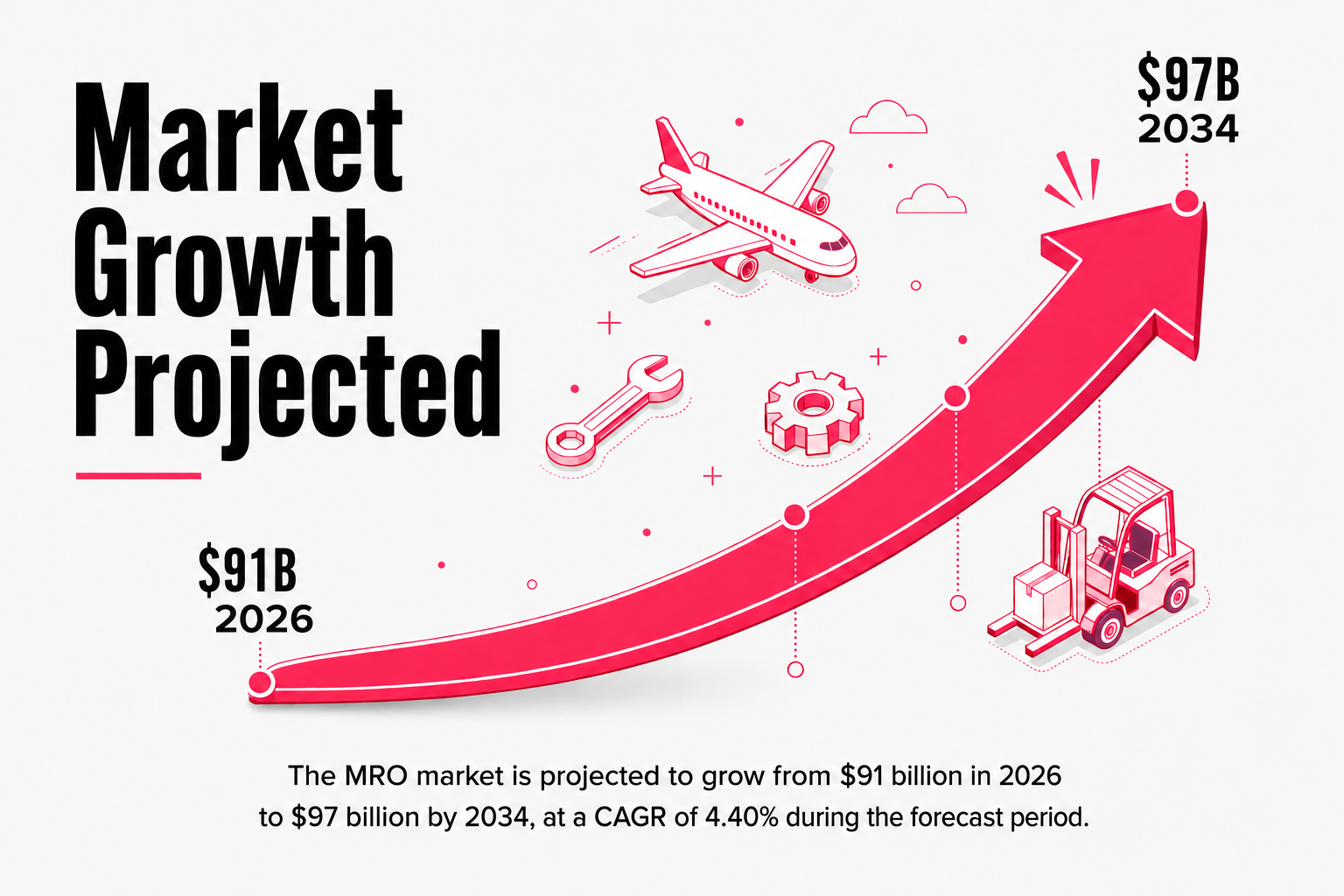
The global MRO distribution market shows serious growth potential. Industry projections estimate the market will expand from roughly $91 billion in 2025 to about $97 billion by 2026, with compound annual growth around 4.4%. That growth attracts competition, making smart keyword targeting essential.
Most MRO distributors stack their service pages with manufacturer names and part numbers. That captures bottom-funnel searches but misses the research phase entirely. Buyers spend weeks evaluating specifications, compatibility, and application requirements before they ever search for a specific SKU.
This guide shows you how to build keyword clusters around parts, materials, and applications. You'll learn which terms drive qualified leads, how to structure location-specific content, and why technical specifications matter more than search volume in MRO.
Industrial buyers don't search like consumers. They use technical language, include specifications in queries, and evaluate multiple suppliers simultaneously.
The purchase cycle matters more than traffic volume. SEO-generated leads in B2B manufacturing close at about 14.6%—nearly ten times higher than paid advertising in many industrial sectors. That conversion rate comes from attracting buyers who already understand their requirements.

MRO searches cluster around three distinct intents: specification research, application guidance, and vendor comparison. Generic product terms generate traffic but rarely convert. A search for "hydraulic pump" could mean anything. A search for "hydraulic pump 3000 PSI continuous duty food grade" signals purchase intent.
Search volume metrics mislead in specialized markets. Tools like Semrush and Ahrefs show low monthly volumes for technical terms. That data reflects broad averages, not your specific buyer behavior. Long-tail keywords attract relatively low search volumes but face lower competition and produce higher-quality traffic.
Maintenance teams search with datasheets in hand. They enter exact specifications because substitute parts cause downtime and safety issues.
Your keyword strategy needs specification modifiers: dimensions, tolerances, material grades, temperature ratings, pressure limits, certifications. Each modifier creates a distinct search pattern.
Consider bearing keywords. "Ball bearing" gets volume but no conversions. "ABEC-7 ceramic ball bearing 608 size" reaches a buyer ready to purchase. The technical detail filters out casual researchers.
Downtime costs force local sourcing. When equipment fails, procurement teams add location modifiers to every search.
"Hydraulic hose repair" generates different results than "hydraulic hose repair Chicago O'Hare." The second search indicates immediate need and geographic urgency.
Local SEO matters more in MRO than most B2B sectors. Service capabilities, delivery speed, and emergency availability influence purchase decisions as much as price. Your keyword strategy should target city names, airport codes, industrial parks, and regional distribution points.
Start with your existing sales data, not keyword tools. Review your top 50 products by revenue and identify the questions buyers ask during the sales process.

Those questions become keyword clusters. If customers regularly ask about corrosion resistance, temperature ranges, or compatibility with specific equipment manufacturers, those concerns appear in search queries too.
Export your product catalog to a spreadsheet. Add columns for: material composition, application type, industry served, compatible equipment brands, technical certifications, and common failure modes.
Organize keywords by funnel stage and search intent. MRO buyers move through distinct research phases, each with different search patterns.
Early-stage searches focus on problem diagnosis: "why does hydraulic pump overheat," "bearing noise troubleshooting," "conveyor belt tracking issues." These informational queries reach maintenance teams identifying problems.
Mid-stage searches evaluate solutions: "pump rebuild vs replacement cost," "bearing material comparison," "belt tracking adjustment procedure." Buyers understand their problem and research fix options.
Late-stage searches include specifications: "Grundfos CR 5-2 replacement parts," "SKF 6205 bearing stainless steel," "Habasit M1030 conveyor belt." These queries signal immediate purchase intent.
Your product manuals contain exact phrases buyers search. Maintenance technicians copy terminology from equipment documentation into search boxes.
Review installation guides, maintenance schedules, and troubleshooting sections. Highlight phrases that describe: common failure points, replacement intervals, compatibility requirements, adjustment procedures, and safety warnings.
Those phrases become long-tail keywords. "Replace pump shaft seal every 2000 hours" appears in manuals and in searches. Someone searching that specific phrase has equipment documentation open and needs parts now.
MRO keywords split into distinct categories based on how buyers search and what drives urgency. Each category needs different content approaches.
Emergency keywords include urgency signals: "same day," "24 hour," "emergency," "rush delivery," "in stock near." These modifiers indicate equipment downtime and willingness to pay premium prices.
Scheduled maintenance keywords focus on specifications and compatibility. Buyers research during planned shutdowns when they have time to compare options and negotiate pricing.
Different industries use different terminology for identical parts. Aviation MRO uses "AOG" (Aircraft on Ground). Manufacturing uses "critical spares." Food processing emphasizes "FDA approved" and "food grade."
Your keyword strategy needs industry-specific variants. A stainless steel fitting serves multiple markets, but search terms vary: "sanitary fitting tri-clamp" for food processing, "corrosion resistant fitting marine grade" for maritime applications, "high purity fitting semiconductor" for cleanrooms.
The long-tail industrial keyword approach applies directly to MRO markets. Specificity beats volume when buyers have exact requirements and limited supplier options.
Material keywords segment buyers by application requirements. Each material grade creates distinct search patterns with different competition levels.
Standard steel bearings face high competition. Ceramic bearings, stainless steel food-grade bearings, and high-temperature bearings each represent smaller, more qualified audiences.
Add specification layers to every product category: pressure ratings, temperature ranges, size dimensions, voltage requirements, flow rates, load capacities. These modifiers reduce competition while increasing relevance.
Geographic targeting matters more in MRO than almost any other B2B sector. Equipment failures create location-dependent urgency that transforms search behavior.
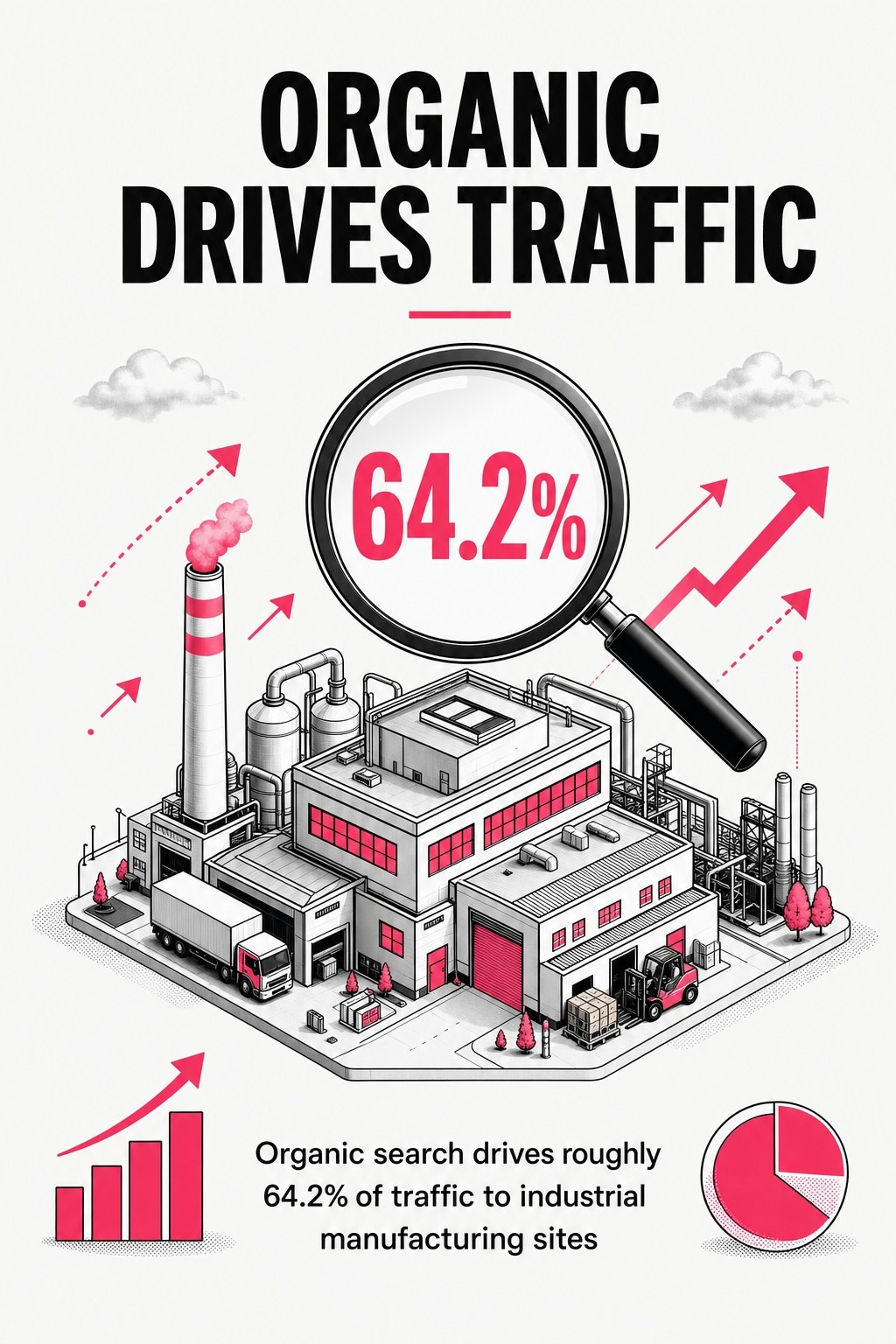
Organic search drives roughly 64.2% of traffic to industrial manufacturing sites. A significant portion includes location modifiers because maintenance teams prioritize delivery speed over minor price differences.
Build location pages around distribution points, not just headquarters. If you stock inventory in multiple cities or can deliver same-day to specific regions, create dedicated landing pages for each service area.
Aviation MRO relies heavily on airport proximity. Create pages targeting specific airports where you can deliver rapidly: "LAX aircraft parts distributor," "O'Hare emergency hydraulic supply," "DFW AOG support."
Industrial parks concentrate multiple potential customers in small geographic areas. Manufacturing facilities, warehouses, and distribution centers cluster together, creating micro-markets worth targeting individually.
Research industrial parks in your service areas. Build content around: "[Industrial Park Name] maintenance supplies," "[Business Park] emergency parts delivery," "[Manufacturing District] inventory support."
Each warehouse, branch office, or service center needs its own Google Business Profile. Don't use a single profile for multiple locations—Google penalizes that approach.
Optimize each profile with location-specific services. If your Chicago location stocks bearings but your Phoenix location doesn't, only mention bearings in the Chicago profile.
Post regularly to profiles with inventory updates, delivery area expansions, and emergency service availability. These signals help Google understand your actual capabilities at each location.
Service pages need to match how buyers actually search while providing the technical detail they need to make decisions.
Most MRO sites create one page per product category. That structure works for navigation but fails for search visibility. You need pages that match complete search queries, not simplified category names.
Instead of a single "bearings" page, create pages for: "food grade stainless steel bearings," "high temperature ceramic bearings," "corrosion resistant marine bearings," "precision ABEC-7 bearings."
Industrial buyers need specifications, compatibility information, and application guidance on every product page. Missing any of these elements forces them to contact competitors.
Include complete specification tables: dimensions, tolerances, materials, ratings, certifications. This data appears in searches and answers buyer questions without requiring phone calls.
Add compatibility sections listing equipment brands and models. When buyers search "[equipment brand] replacement parts," your compatibility documentation helps you rank.
Provide application notes explaining when to use each product variant. Temperature ranges, pressure requirements, and environmental conditions help buyers self-qualify.
Showing pricing separates serious buyers from researchers. Some distributors hide pricing behind forms, but that approach loses qualified leads to competitors.
Consider partial pricing disclosure: volume discounts, price ranges, or "starting at" prices. This information qualifies leads while maintaining room for negotiation on large orders.
Emergency parts deserve different treatment than commodity items. Rush delivery and same-day service command premium pricing—state that clearly to filter price-sensitive researchers from urgent buyers.
Technical content builds authority and captures early-stage searches. Buyers spend weeks researching before contacting suppliers.
Your content strategy should target problem-solving searches, not product promotions. Answer the questions maintenance teams ask during equipment failures and planned maintenance.
Focus on troubleshooting guides, maintenance schedules, compatibility charts, and application comparisons. These assets attract buyers months before purchase decisions while establishing your technical expertise.
Create maintenance schedule guides for equipment your parts support. "Grundfos pump maintenance schedule" attracts facility managers planning preventive maintenance programs.
Include recommended replacement intervals, inspection procedures, and common failure indicators. Link directly to relevant replacement parts within the content.
This content generates repeat traffic as buyers reference your guides during each maintenance cycle. The educational value builds trust that influences supplier selection.
Equipment failures trigger immediate research. Troubleshooting content captures buyers at their most receptive moment—when they need solutions fast.
Write diagnostic guides that help identify failure causes: "hydraulic pump overheating causes," "bearing noise diagnosis guide," "conveyor tracking problems solutions."
Structure content around symptoms rather than products. Buyers search problems, not solutions. Once you help diagnose the issue, recommend appropriate parts.
The B2B SEO approach for industrial companies emphasizes this problem-solution content structure because it matches actual buyer behavior.
Site structure impacts how well Google understands your product relationships and service capabilities. Poor organization confuses search engines and buries your best content.
Use hierarchical URLs that reflect product relationships: domain.com/bearings/ball-bearings/ceramic-ball-bearings/. This structure helps Google understand category relationships and prioritize pages appropriately.
Implement schema markup for products, local businesses, and technical specifications. Structured data helps Google display rich results that increase click-through rates.
Product catalogs with thousands of SKUs create performance challenges. Large specification tables, multiple product images, and PDF datasheets slow page loading.
Use lazy loading for images below the fold. Compress technical drawings and specification sheets without losing readability. Consider hosting large PDF files on content delivery networks.
Test site speed on mobile devices, not just desktop. Maintenance technicians search on phones while standing next to broken equipment. Slow mobile pages lose urgent buyers.
Product schema helps Google understand specifications, pricing, availability, and compatibility. This structured data enables rich snippets that dominate search results.
Include key product attributes in schema: brand, model number, material, dimensions, ratings, certifications. Map these fields to your product database for automated implementation.
Local business schema becomes essential for multi-location distributors. Mark up each location with service areas, inventory specializations, and emergency availability.
MRO backlink opportunities differ from typical B2B link building. Industry associations, equipment manufacturers, and technical forums provide relevant authority.
Manufacturer partnerships create natural link opportunities. Request inclusion in authorized distributor directories and dealer locators. These links signal relevance to Google while driving direct referral traffic.
Industry associations often maintain supplier directories. Join relevant trade organizations and ensure your profile includes links to technical resources, not just your homepage.
Comprehensive technical guides attract links from equipment forums, maintenance blogs, and industry publications. Create definitive resources that others reference.
Compatibility charts, torque specifications, maintenance schedules, and troubleshooting flowcharts all generate organic backlinks. Engineers and technicians bookmark and share genuinely useful reference materials.
Update resources annually and promote new editions. Regular updates give industry sites reason to link again and help content maintain rankings.
Document successful applications and challenging repairs. These stories attract links from industry publications while demonstrating technical expertise.
Focus on problem-solving narratives: unusual compatibility requirements, emergency repairs, custom solutions. Specific details make case studies linkable and shareable.
Submit case studies to industry publications and equipment manufacturer blogs. Many accept contributed content that includes attribution links.
Traditional SEO metrics mislead in specialized B2B markets. Ranking position matters less than qualified lead volume and customer acquisition cost.
Track keyword rankings, but prioritize bottom-funnel terms over informational queries. A ranking for "pump maintenance guide" matters less than ranking for "Grundfos CR 5-2 parts."
Industry data shows the average conversion rate for Automotive – Repair, Service & Parts in Google Ads reaches around 14.67%. Organic traffic from well-targeted keywords often converts even higher because buyers self-qualify through content.
An increase from 100 to 500 monthly visitors means nothing if leads don't close. Monitor lead-to-customer conversion rates by keyword category.
Technical specification searches typically convert best. Application research queries generate longer sales cycles but larger average orders. Emergency part searches produce quick sales at premium margins.
Tag leads by keyword category in your CRM. This tracking reveals which search terms drive profitable customers, not just form submissions.
Connect content performance to actual revenue. Service pages, troubleshooting guides, and compatibility charts each play different roles in the buyer journey.
Use assisted conversion tracking in Google Analytics to identify content that influences purchases without generating direct conversions. Troubleshooting content often assists sales that close through direct contact.
Calculate customer acquisition cost by content category. Emergency part content may generate fewer leads but close faster with higher margins. Scheduled maintenance content produces steady recurring revenue.
MRO keyword strategy works when you stop chasing volume and start matching buyer behavior. Technical specifications, location modifiers, and application context matter more than generic product terms.
Start with your sales data. Identify questions buyers ask and problems they solve. Turn those patterns into keyword clusters that target each stage of the research and purchase process.
Build content around technical value, not marketing messages. Maintenance teams need specifications, compatibility data, and troubleshooting guidance. Provide that information and your authority builds naturally.
Test your current top-performing product pages. Add specification modifiers, location variants, and application contexts. Track which combinations generate qualified leads and expand those patterns across your catalog.
Your next step: Review your five highest-revenue products. Create specification-rich landing pages for each major variant. Target the complete search phrases buyers actually use, not simplified category names.