
Most manufacturing marketers waste 60% of their budget on content nobody converts on. I've watched it happen dozens of times: perfect technical specs, flawless production quality, zero qualified leads.
The problem isn't your product or your content quality. It's that industrial buyers don't behave like they used to.
84% of manufacturing industry professionals now use search engines to find equipment, components, and services before they ever talk to a sales rep. They're researching your competitors at 2 AM. They're comparing your certifications on mobile devices. They're making shortlist decisions without you even knowing they exist.
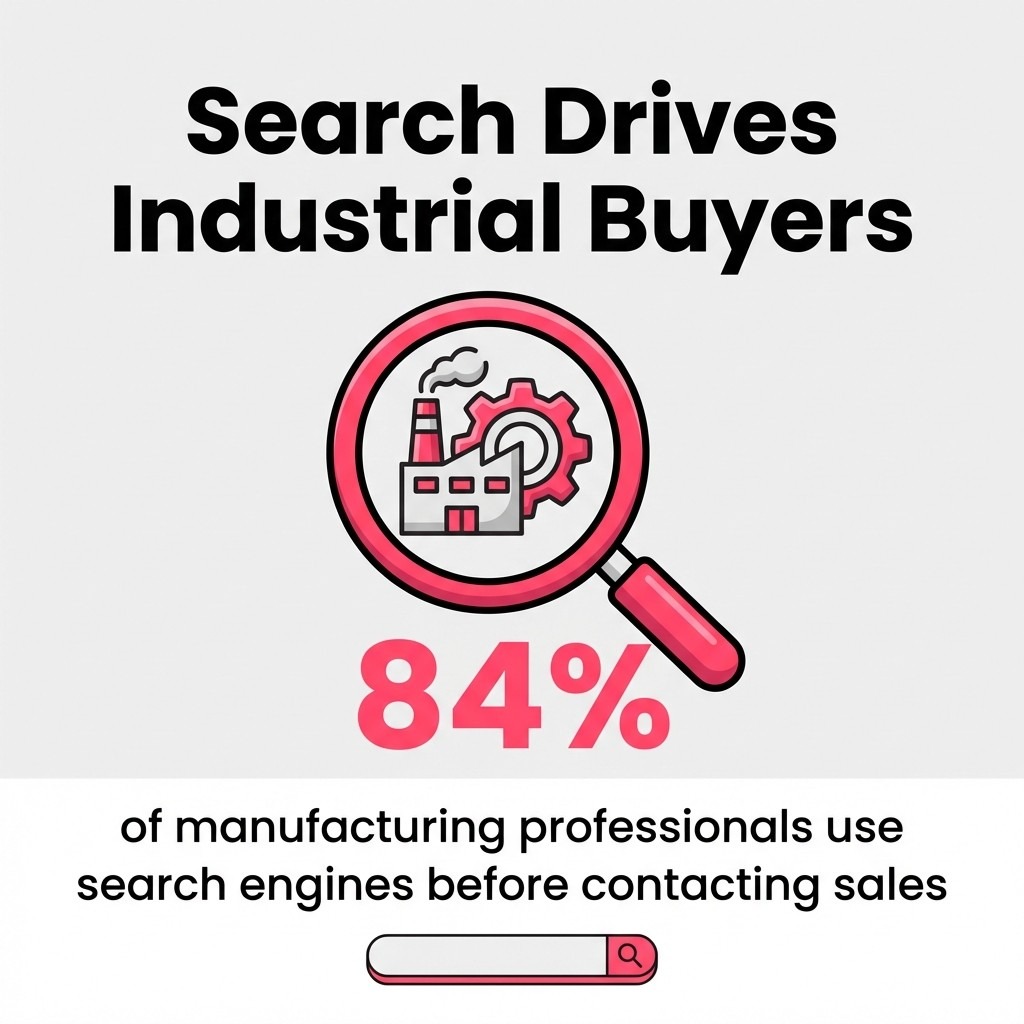
Search now drives industrial discovery: 84% of manufacturing professionals use search engines before contacting sales. Source: Corporate Visions
Traditional marketing can’t reach buyers who’ve already done 67% of their buyer’s journey digitally before speaking with sales. You need a systematic approach to digital marketing that actually generates qualified leads, not just traffic and impressions.
I'm going to walk you through exactly how to build and execute a digital marketing strategy for manufacturing companies. You'll learn which tactics actually drive leads, how to allocate your budget for maximum ROI, and how to avoid the mistakes that tank most industrial marketing campaigns. By the end, you'll have a clear roadmap from initial strategy through daily execution.
The industrial buying process changed fundamentally over the past five years. Buyers no longer wait for trade show meetings or sales calls to start their research.
The numbers tell the story. 98% of industrial manufacturers generate sales-qualified leads through digital marketing. This isn't experimental anymore. It's the primary lead source for nearly every successful manufacturer.
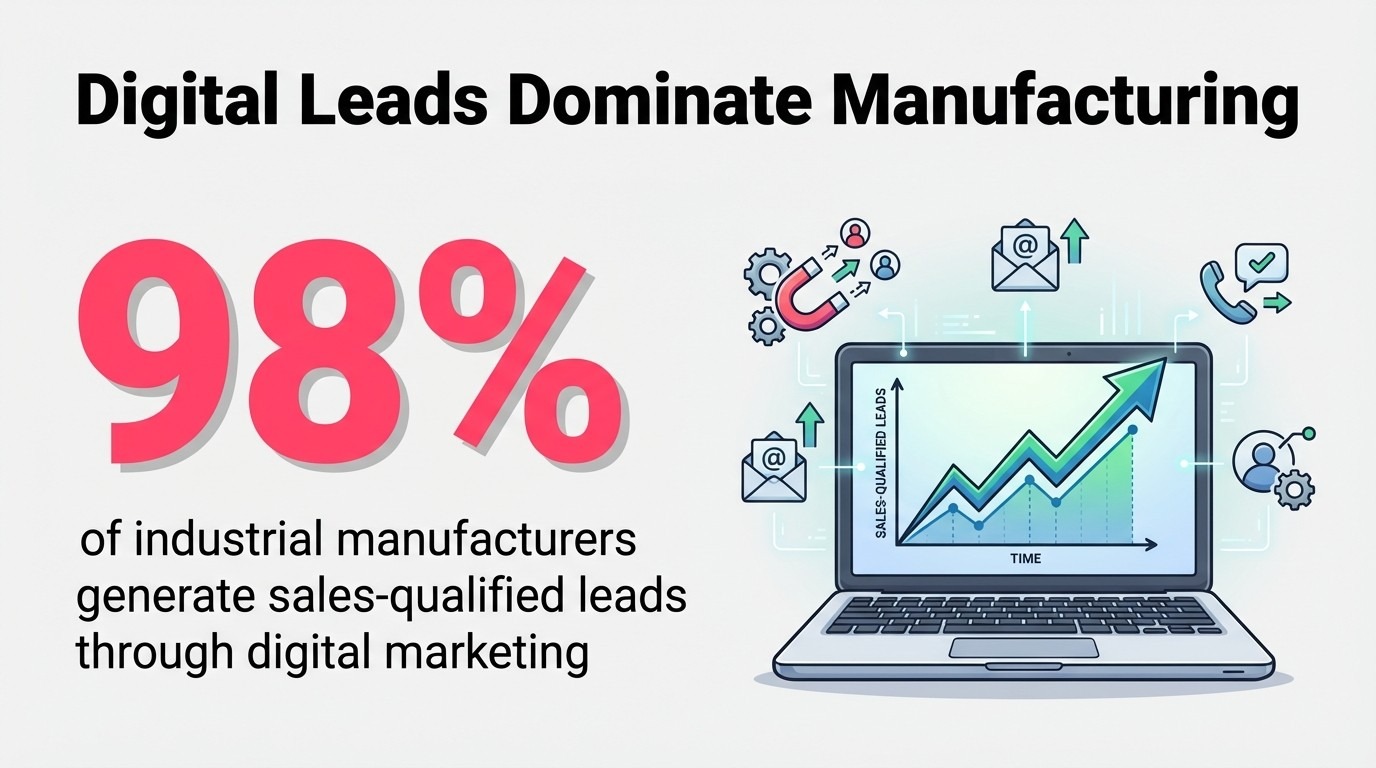
Digital channels produce SQOs: 98% of industrial manufacturers generate sales-qualified leads via digital marketing. Source: Lead Forensics
But here's what makes this shift particularly challenging for manufacturers: the average manufacturing sales cycle extends to 130 days from initial contact through closing. Your digital marketing needs to nurture prospects for four months or longer.
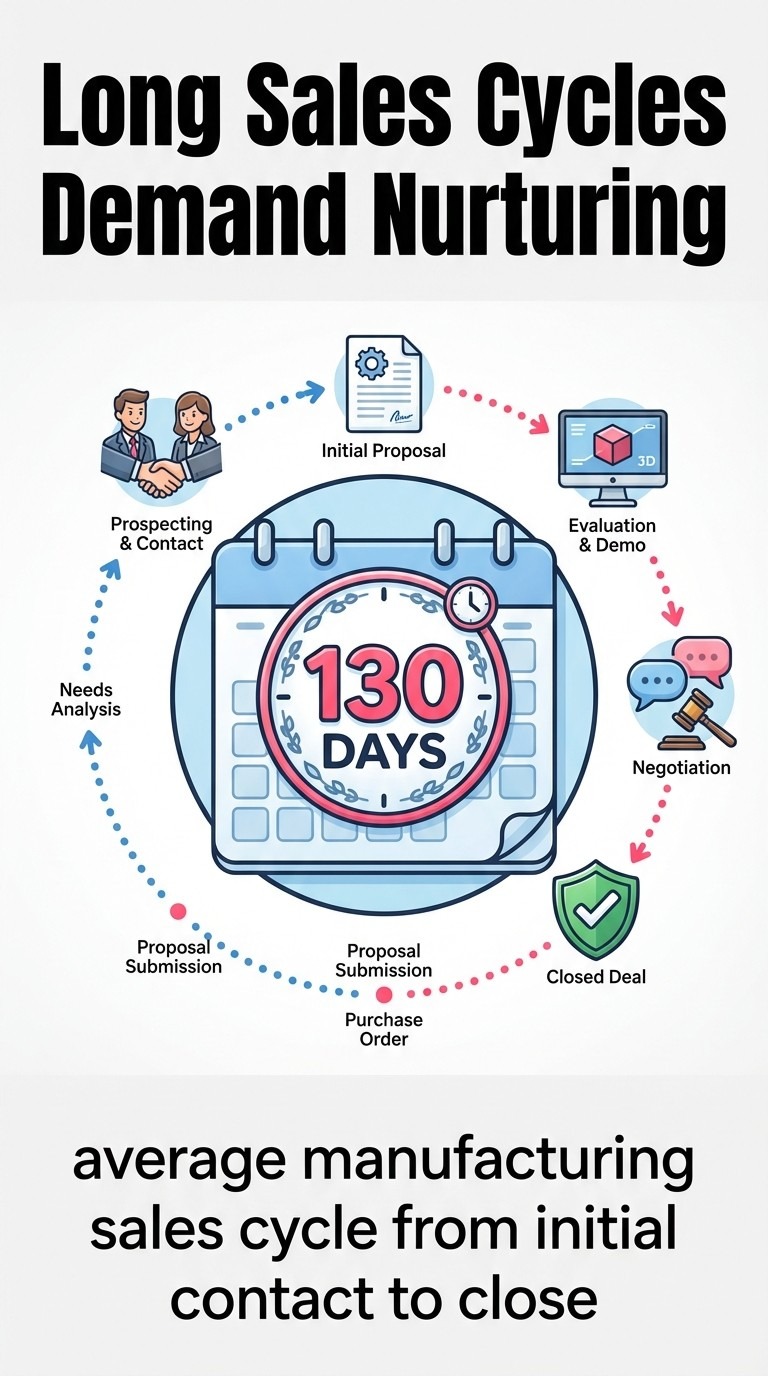
Long sales cycles: manufacturing averages 130 days from first touch to close—plan to nurture. Source: Focus Digital
Traditional outbound methods struggle with this timeline. Cold calls interrupt buyers mid-research. Trade show contacts go cold after three weeks. Print advertising can't adapt to changing buyer questions.
Digital marketing solves these problems by meeting buyers where they already are: search engines, LinkedIn, YouTube, industry forums. When someone searches "precision CNC machining services Ohio" at midnight, your content can be there. When an engineer compares material specifications on mobile, your technical resources can answer their questions.
The digital transformation market in manufacturing reached $439.56 billion in 2026 and continues growing at 2.59% annually. Manufacturers investing in digital capabilities are pulling ahead while traditional competitors scramble to catch up.
The Financial Case for Digital Marketing Investment
ROI concerns often block digital marketing initiatives at manufacturing companies. Leadership wants proof that digital channels will outperform established methods.
The evidence is compelling. Email marketing generates $36 to $40 per $1 spent, making it one of the highest-ROI tactics available to manufacturers. Even better, SEO campaigns deliver 748% ROI with approximately a nine-month breakeven period.
Compare those returns to traditional advertising. A full-page trade magazine ad costs $8,000 to $15,000 with no guaranteed leads. A booth at a major industry trade show runs $25,000 to $100,000 before travel and materials. Digital tactics cost less and track better.
The compound advantage matters too. Your trade show presence disappears after three days. Your SEO work continues generating leads 24 months later. Content you create today can nurture prospects in 2028.
Industrial buyers complete extensive research before they ever fill out a contact form. They visit your website four to seven times. They download technical specifications. They watch product videos. They read case studies from your existing customers.
They also research your competitors simultaneously. If your digital presence looks weak compared to three other suppliers, you're eliminated without knowing you were considered. Buyers shortlist vendors based on online credibility long before they request quotes.
This creates both a problem and an opportunity. The problem: you can't influence buyers you don't know about. The opportunity: digital marketing lets you educate and persuade buyers throughout their entire research process.
Buyer behavior in manufacturing has fundamentally shifted. The people researching and specifying your products approach purchasing differently than they did five years ago.
Younger engineers and procurement specialists grew up with Google. They expect to find detailed technical information online immediately. If your website makes them call for basic specifications, they move to a competitor with better resources.
Decision-makers now involve more stakeholders in purchasing decisions. Engineering evaluates technical fit. Procurement compares pricing. Operations considers delivery and support. Quality reviews certifications. Your digital content needs to address all these roles simultaneously.
The research phase also happens earlier and more thoroughly. Buyers consume an average of 13 pieces of content before they engage with sales. They want whitepapers, comparison guides, video demonstrations, and customer testimonials. They're building expertise about your category while evaluating multiple suppliers.
The buyer's journey in manufacturing follows a predictable pattern. Understanding each stage helps you create content that moves prospects toward purchase.
Awareness Stage: Buyers recognize a problem or opportunity. An engineer realizes current tooling creates too much waste. A production manager identifies a bottleneck that needs new equipment. They start researching solutions with broad searches and educational content.
Consideration Stage: Buyers compare different approaches. Should they upgrade existing equipment or switch to a new system? What technologies solve their problem most efficiently? They consume comparison content, technical specifications, and case studies showing different solutions.
Decision Stage: Buyers evaluate specific vendors and products. They need detailed specifications, pricing information, implementation timelines, and proof from similar customers. They're ready for sales conversations but want most questions answered first.
Most manufacturers only create content for the decision stage. They have product datasheets and pricing but nothing for awareness or consideration. This means they miss buyers for 80 percent of the research journey.
Multiple people influence manufacturing purchases. Each role needs different information to move forward.
Your digital marketing needs to serve all these audiences. An engineer finding your technical content should easily share pricing information with procurement. An executive reading a case study should find supporting specifications for their engineering team.
Strategy comes before tactics. Most manufacturers jump straight to "we need a new website" or "let's start posting on LinkedIn" without defining what success actually means.
Start with clear business objectives. Do you need to generate more leads? Enter new markets? Launch a new product line? Reduce customer acquisition costs? Your digital marketing strategy should directly support specific business goals.
Then define what you want digital marketing to accomplish. How many qualified leads per month would satisfy your sales team? What industries or company sizes represent your ideal customers? Which geographic regions matter most?
Get specific about measurement. "Increase brand awareness" means nothing. "Generate 50 qualified leads per month from precision machining customers in the automotive sector" gives you something to build toward and track.
Generic "manufacturing decision-makers" targeting wastes budget on irrelevant traffic. You need detailed buyer personas based on your actual customers.
Start by analyzing your best current customers. What industries do they serve? What size are their operations? What problems were they trying to solve? Who was involved in the purchase decision?
Interview recent customers about their buying process. What terms did they search? What content helped them understand your capabilities? What questions did they have before contacting sales? What almost prevented them from choosing you?
Build 3-5 detailed buyer personas that represent different customer types. Include job titles, responsibilities, goals, challenges, and information needs. Give each persona a name and backstory so your team thinks about them as real people.
Map content to each persona's journey. What does "Engineering Eric" need during awareness versus decision? What concerns does "Procurement Paula" have that your competitors address better?
Digital marketing metrics for manufacturers divide into vanity metrics that feel good and performance metrics that matter. Track the latter.
Vanity metrics include website visits, social media followers, and page views. These numbers can increase without affecting revenue. A million visitors means nothing if none convert to leads.
Performance metrics connect to revenue. Track qualified leads generated, lead-to-customer conversion rate, customer acquisition cost, and revenue influenced by digital channels. These numbers directly relate to business outcomes.
Set benchmarks based on your sales capacity. If your team can only handle 30 qualified conversations per month, generating 100 leads creates problems. Scale your digital marketing to feed sales at a sustainable pace.
Most manufacturers ask "what should we spend on digital marketing?" Wrong question. Ask "what investment will generate our target number of qualified leads at an acceptable cost?"
Work backward from lead goals. If you need 50 qualified leads per month and your lead-to-close rate is 20 percent, you'll acquire 10 new customers monthly. If the average deal value is $50,000, that's $500,000 in monthly revenue. A 10 percent cost of customer acquisition means you can invest $50,000 monthly in digital marketing.
Split that budget across tactics based on expected performance and your current capabilities. A typical B2B manufacturing budget might look like this:
Adjust based on your situation. New companies need more paid advertising for immediate leads. Established brands with strong domain authority should invest more heavily in content and SEO.
Now that you understand strategy, let's examine the specific tactics that consistently generate qualified leads for manufacturers. Each plays a distinct role in reaching and converting industrial buyers.
Not every manufacturer needs every tactic. Your specific situation determines priorities. A startup needs different tactics than a 50-year-old manufacturer entering digital channels. A company selling commodity fasteners approaches digital differently than one selling custom automation systems.
Focus on tactics that align with how your specific buyers research and purchase. If your customers spend significant time on LinkedIn, prioritize that channel. If they search Google extensively before engaging vendors, emphasize SEO and content marketing.
Start with foundation tactics that drive long-term results. These require more upfront investment but compound over time. Then layer in activation tactics that generate immediate leads while foundation tactics mature.
Foundation tactics include your website, SEO, and content marketing. These take 6-12 months to show significant results but continue generating leads for years. Think of them as building the infrastructure that supports everything else.
Activation tactics include paid advertising, email marketing, and social media. These produce faster results and can be scaled up or down based on lead needs. They work best when pointing to strong foundation elements.
Most successful manufacturers run both types simultaneously. Foundation tactics reduce long-term customer acquisition costs. Activation tactics maintain steady lead flow during the 6-12 months foundation tactics need to mature.
SEO remains the highest-ROI digital marketing tactic for manufacturers willing to invest properly. Remember: SEO campaigns deliver 748% ROI with approximately nine months to break even.
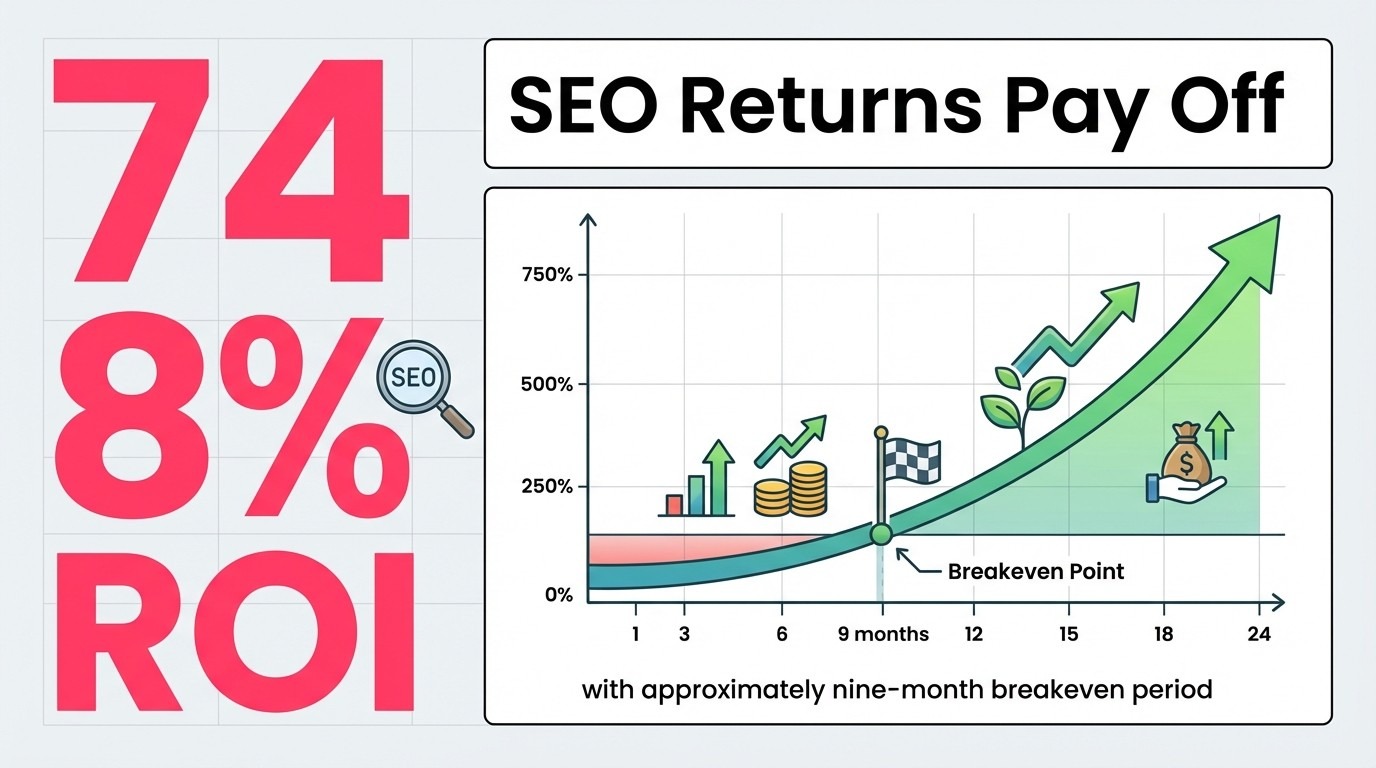
SEO pays compounding returns: 748% ROI with ~9-month breakeven for manufacturers. Source: ALM Corp
Industrial buyers start with search engines. They type "precision sheet metal fabrication medical devices" or "hydraulic cylinder repair services Minnesota" into Google. If you don't appear on page one for relevant searches, these buyers never discover you.
But SEO for manufacturers differs from consumer SEO. You're not chasing massive search volumes. You need high-intent keywords that indicate buyer readiness, even if monthly search volume is only 50-100 searches. "Custom injection molding automotive parts" with 70 monthly searches generates more qualified leads than "injection molding" with 10,000 searches that include students, job seekers, and tire kickers.
Start with technical basics that help search engines understand and trust your website. Google can't rank content it can't properly crawl, index, and interpret.
Your website needs fast load times, mobile optimization, and secure HTTPS connections. Test your site speed using Google PageSpeed Insights. Scores below 70 hurt rankings. Fix image compression, enable caching, and minimize JavaScript that blocks rendering.
Implement proper XML sitemaps and robots.txt files. Use schema markup to help search engines understand your manufacturing capabilities, locations, and product specifications. Rich snippets from schema markup improve click-through rates even when rankings stay constant.
Create clear site architecture that mirrors how buyers think about your capabilities. Group related products and services logically. Use descriptive URLs like /precision-cnc-machining/aerospace-components/ instead of /products/category-7/item-142/.
Fix broken links and redirect old URLs properly. Industrial buyers bookmark specification pages and share them with colleagues. Broken links create terrible user experiences and waste the SEO value you've built.
Most manufacturers target wrong keywords. They optimize for what they call their products instead of what buyers actually search.
Start with your sales team. What questions do prospects ask during early conversations? What problems bring buyers to you? What alternatives do they consider? These conversations reveal the language buyers actually use.
Use Google Keyword Planner and Ahrefs to research search volume and competition for relevant terms. Focus on keywords with clear commercial intent: "buy," "supplier," "manufacturer," "custom," "services," "quote."
Prioritize long-tail keywords that indicate specific needs. "Metal fabrication" is too broad and competitive. "Custom stainless steel fabrication food processing equipment" targets buyers looking for exactly what you offer.
Map keywords to buyer journey stages. Awareness keywords like "what is CNC machining" attract early researchers. Decision keywords like "precision CNC machine shop ISO 9001 Michigan" attract buyers ready to request quotes.
Creating content that ranks requires balancing search engine requirements with human needs. Write for humans first, optimize for search engines second.
Start with page titles and meta descriptions that include target keywords and compel clicks. "Precision CNC Machining Services" is boring. "Precision CNC Machining for Aerospace & Medical | AS9100 Certified | Ohio" tells buyers exactly what you offer and why you're qualified.
Structure content with clear H1, H2, and H3 headings that include related keywords naturally. Use short paragraphs and bullet points for scannability. Add relevant images with descriptive alt text.
Answer questions thoroughly. If someone searches "how to select a contract manufacturer," give them a comprehensive guide covering capabilities, certifications, communication, quality systems, and capacity. Don't give them 300 words and a contact form.
Link internally between related pages. Your page about CNC machining should link to pages about specific materials, industries you serve, and relevant case studies. This helps search engines understand your site structure and keeps visitors engaged longer.
Backlinks from authoritative websites signal to Google that your content is trustworthy and valuable. Quality matters far more than quantity. One link from an industry association beats 100 links from random directories.
Earn links by creating resources other sites want to reference. Publish original research, comprehensive guides, or technical resources that solve common problems. When industry blogs and forums link to your content, your domain authority improves.
Look for opportunities with industry associations, trade publications, and complementary suppliers. Write guest articles for manufacturing blogs. Participate in industry forums and answer questions with links to relevant resources on your site.
Check competitor backlinks using Ahrefs or Moz Link Explorer. If three competitors have links from the same industry directory, you probably should too. Reach out and request inclusion.
Avoid black-hat link building tactics. Buying links, participating in link schemes, or using automated link-building tools will get you penalized. Focus on earning legitimate links through valuable content.
Content marketing works particularly well for manufacturers because industrial buyers need extensive education before purchase. They're comparing technologies, evaluating capabilities, and building business cases for capital equipment purchases.
But here's the challenge: 66% of manufacturers say their content isn't converting effectively. They create content that educates without persuading. Or they create sales content that turns off buyers still in research mode.
Effective content marketing balances education with persuasion. You teach buyers how to evaluate solutions while demonstrating why your approach works best. You answer their questions while positioning your capabilities as the obvious choice.
Different content types serve different purposes throughout the buyer's journey. Use each type strategically.
Blog posts attract search traffic and demonstrate expertise. Write about problems your buyers face, how to evaluate solutions, and best practices in your industry. Aim for 1,500-2,500 words that thoroughly answer questions. Publish consistently, at least 2-4 times monthly.
Technical guides and whitepapers provide in-depth information for serious buyers. Create comprehensive resources about selecting equipment, comparing technologies, or implementing solutions. Gate this content behind forms to capture lead information.
Case studies prove you can deliver results for companies like your prospects. Document specific customer challenges, your solution approach, and measurable results. Include details about customer industry, application, and why they chose you over alternatives.
Product comparison guides help buyers evaluate different approaches. Don't just promote your solution. Honestly compare technologies, approaches, or product categories. Buyers trust content that acknowledges trade-offs and helps them make informed decisions.
Video content has become essential. 93% of businesses now use video as a marketing tool because it works. Create facility tours, product demonstrations, technical explainer videos, and customer testimonials.
The gap between content that educates and content that converts comes down to strategic calls-to-action and lead capture.
Every piece of content needs a clear next step. Someone reading about selecting a contract manufacturer should be invited to download your capabilities brochure, view your quality certifications, or schedule a facility tour. Don't just end with "contact us for more information."
Use progressive disclosure to capture leads at different readiness levels. Someone early in research might download a general guide for an email address. Someone further along might provide company details and project requirements for a detailed quote or consultation.
Place content upgrades throughout blog posts. If you're writing about precision machining tolerances, offer a downloadable tolerance chart or specification guide. If you're explaining material selection, provide a comparison matrix. These targeted offers convert better than generic newsletter signups.
Include proof points throughout content. Mention relevant certifications, customer names (with permission), and specific results you've delivered. Buyers want to know you have experience with their specific challenges.
Creating great content accomplishes nothing if nobody sees it. You need systematic distribution across multiple channels.
Share every piece of content on LinkedIn, highlighting different angles for different audience segments. Engineers care about technical details. Executives want ROI information. Tailor your promotion to what each audience values.
Email your content to existing contacts and leads. Segment by industry, role, or stage in buyer journey. A procurement manager needs different content than an engineer, even at the same company.
Repurpose content across formats. Turn a blog post into a LinkedIn article, a video script, and an infographic. A comprehensive whitepaper can be broken into 5-6 individual blog posts. A case study can become a video testimonial and a one-page PDF.
Use paid promotion to amplify high-value content. Boost LinkedIn posts to targeted audiences. Run Google Ads to technical guides and whitepapers. Invest $500-1,000 per month promoting your best content to reach buyers who haven't found you organically yet.
Manufacturing sales cycles average 130 days. Your digital marketing needs to nurture leads for months before they're ready for serious sales conversations. Email marketing and marketing automation handle this nurturing systematically.
Email remains incredibly effective despite everyone claiming it's dead. Remember: email marketing generates $36 to $40 per $1 spent. No other channel comes close to that ROI for B2B manufacturers.
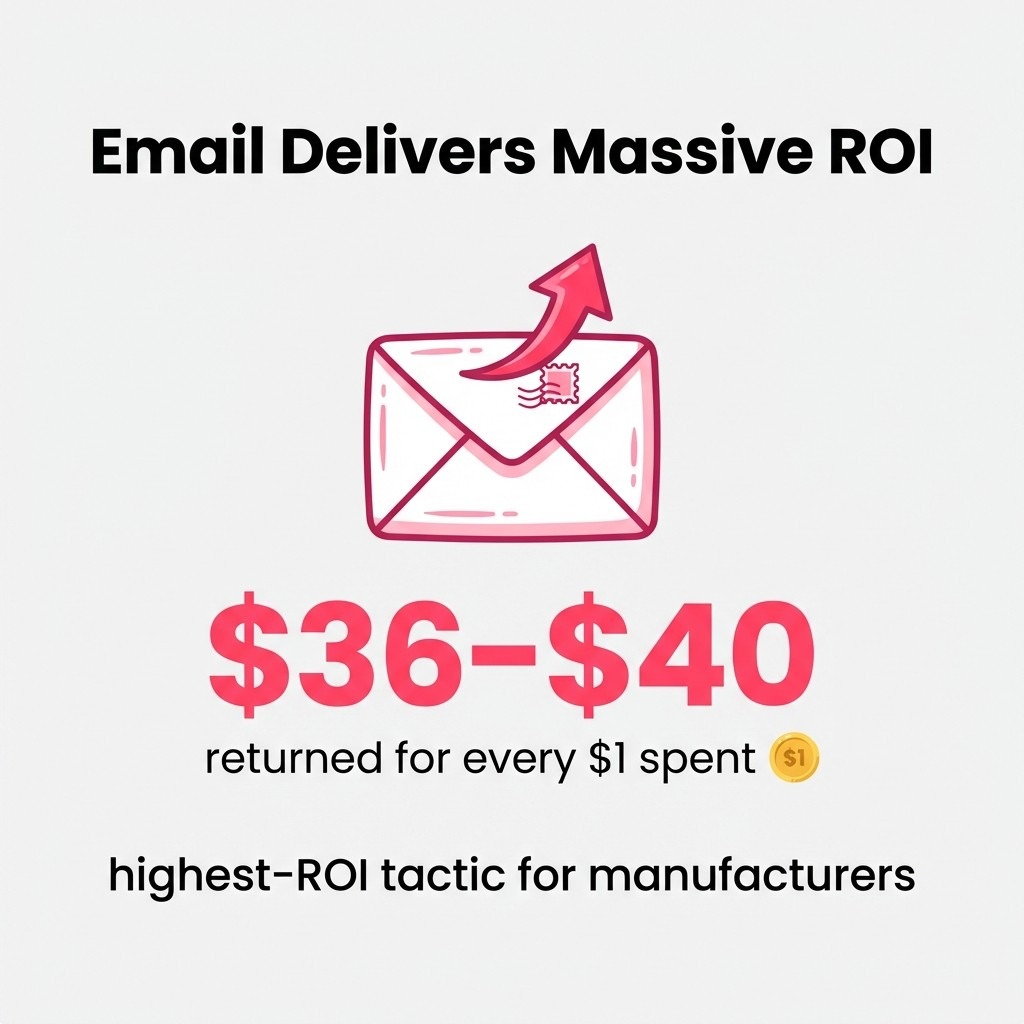
Email ROI remains unmatched: $36–$40 returned for every $1 spent. Source: Martal Group
But random newsletter blasts won't cut it. You need strategic email sequences that educate buyers, address objections, and move them toward purchase decisions. Marketing automation platforms like HubSpot, Marketo, or Pardot make this scalable.
You need a list of qualified contacts before email marketing can work. But buying lists wastes money and damages deliverability. Build your list organically through valuable content offers.
Create gated content that requires email signup: technical guides, specification sheets, CAD libraries, comparison tools, ROI calculators. Make the value exchange obvious. "Get our 47-page precision machining guide" works better than "subscribe to our newsletter."
Add email signup opportunities throughout your website. Exit-intent popups, slide-in boxes, and content upgrades all capture visitors before they leave. Test different offers to see what resonates with your audience.
Capture emails at trade shows and events, but follow up immediately. The person who scanned their badge at your booth will forget you within 48 hours. Send a personalized email within 24 hours referencing your conversation and offering relevant resources.
Strategic email sequences educate buyers over weeks or months. Each email delivers value while gently moving recipients toward conversion.
Start with a welcome sequence for new subscribers. Email 1 delivers the content they requested. Email 2 (3-5 days later) shares related resources. Email 3 (one week later) introduces your company and capabilities. Email 4 (one week later) includes customer proof and social proof. Email 5 (one week later) offers a clear next step like requesting a quote or scheduling a consultation.
Create educational drip campaigns around specific topics or buyer personas. An engineer researching CNC machining gets different content than a procurement manager comparing suppliers. Segment your sequences based on the interests people express through content downloads and website behavior.
Use behavior-based triggers to send timely emails. Someone who downloads a product spec sheet should receive related case studies three days later. Someone who visits your pricing page five times is probably close to decision and needs different messaging than a first-time visitor.
Re-engagement campaigns target leads who went quiet. After 60-90 days of inactivity, send a "we haven't heard from you" email offering fresh content or asking about their project status. Some buyers need longer research periods and appreciate the check-in.
Marketing automation platforms track prospect behavior and score leads based on engagement and fit. This helps you identify sales-ready leads and avoid wasting sales time on tire-kickers.
Set up lead scoring based on demographic fit and behavior. Award points for company size, industry, job title, and location. Add more points for high-intent behaviors like downloading pricing guides, visiting product pages multiple times, or watching demo videos.
Define your lead threshold with sales. Maybe 100 points triggers a sales notification. Maybe leads need both a minimum score and a specific action like requesting a quote. Test and refine your scoring model based on which leads actually convert to customers.
Integrate your marketing automation with your CRM so sales sees complete prospect history. When a lead reaches a threshold, sales should know every piece of content they consumed, which pages they visited, and what problems they're trying to solve. This context dramatically improves first conversations.
Use automation for sales alerts too. When a key prospect visits your pricing page, sales should know within minutes. When a long-quiet lead suddenly engages with three emails in one day, they're probably reactivating their project. Timely sales outreach based on behavior data converts significantly better than arbitrary follow-ups.
Social media serves different purposes for manufacturers than consumer brands. You're not building mass followings or going viral. You're establishing authority, engaging with industry communities, and staying visible throughout long buyer journeys.
Focus your efforts on platforms where industrial buyers actually spend time. LinkedIn dominates for B2B manufacturing. YouTube works well for product demonstrations and technical content. Facebook can be effective for local manufacturers targeting regional customers.
Forget Instagram, TikTok, and Pinterest unless you have specific consumer-facing products. Spreading yourself thin across irrelevant platforms wastes resources without generating qualified leads.
LinkedIn delivers the best ROI of any social platform for B2B manufacturers. Buyers research suppliers on LinkedIn. They follow companies in their industry. They consume content from thought leaders and potential vendors.
Your company LinkedIn page needs optimization first. Complete every field. Include detailed descriptions of your capabilities. Showcase your specializations, certifications, and customer industries. Post updates 3-5 times per week minimum.
Employee advocacy amplifies reach dramatically. Your engineers, salespeople, and leadership have far more reach than your company page. Encourage them to share company content, write their own posts about technical topics, and engage with industry discussions.
Share content that demonstrates expertise without being overtly promotional. Post about industry trends, technical tips, manufacturing challenges and solutions, and customer success stories. Mix educational content with company updates in roughly 80/20 ratio.
Engage actively with your target audience. Comment thoughtfully on posts from prospects, customers, and industry influencers. Join relevant LinkedIn groups and contribute to discussions. Answer questions in your areas of expertise. This visibility builds familiarity and trust.
Use LinkedIn Ads to target specific companies and job titles. Account-based marketing on LinkedIn works exceptionally well for manufacturers. 76 percent of marketers achieve higher ROI with Account-Based Marketing than any other approach. Target your ideal prospects with sponsored content, message ads, and dynamic ads.
Video content demand continues growing. Engineers and buyers want to see equipment in action, understand how products work, and watch manufacturing processes. YouTube serves this need perfectly.
Create a systematic YouTube content strategy. Film facility tours showing your capabilities. Record product demonstrations highlighting key features. Produce technical education videos explaining concepts in your field. Document customer applications (with permission) showing real-world results.
Optimize videos for search. Use descriptive titles with relevant keywords. Write detailed descriptions including specifications, applications, and links to your website. Add cards and end screens pointing to related videos and landing pages.
Don't obsess over production quality. Industrial buyers care more about content than polish. A smartphone video clearly showing how a machine works beats a $10,000 production that looks pretty but lacks substance. Authenticity and technical clarity matter most.
Embed YouTube videos throughout your website. Add product demonstration videos to product pages. Include explainer videos in blog posts. Place customer testimonial videos on your homepage. Videos increase time on site and improve conversion rates.
Facebook works primarily for manufacturers serving regional markets or consumer-adjacent products. If you're targeting procurement managers at Fortune 500 companies, skip Facebook. If you're a job shop serving local manufacturers, Facebook can drive awareness and leads.
Use Facebook to showcase your team, culture, and community involvement. Share employee spotlights, behind-the-scenes content, and local partnerships. This humanizes your business and builds connections with local buyers.
Join and participate in industry Facebook groups. Many trade associations and professional communities maintain active Facebook groups. Share expertise, answer questions, and build relationships. Just don't spam with sales pitches.
Run targeted Facebook Ads to local businesses. Facebook's geographic and interest targeting can reach relevant decision-makers in your region. Promote content offers, facility tours, or special capabilities to companies in specific industries and locations.
Paid advertising generates manufacturing leads while you build organic presence through SEO and content marketing. It's particularly valuable for new manufacturers, companies entering new markets, or businesses launching new products.
The key is targeting high-intent searches and audiences. Broad awareness campaigns waste budget in B2B manufacturing. You need to reach buyers actively researching solutions or companies that match your ideal customer profile.
Google Ads puts you in front of buyers searching for exactly what you offer. When someone searches "custom injection molding medical devices California," your ad can appear above organic results.
Start with search campaigns targeting high-intent keywords. Focus on terms with commercial intent: "manufacturer," "supplier," "custom," "services," "quote." Avoid informational terms early researchers use. You want clicks from buyers ready to evaluate vendors.
Use exact match and phrase match keywords for better control. Broad match wastes budget on irrelevant searches. Build detailed negative keyword lists to exclude job seekers, students, and non-target searches.
Create compelling ad copy that differentiates your capabilities. "CNC Machining Services" doesn't stand out. "Precision CNC Machining | AS9100 & ISO 13485 | 5-Day Turnaround" tells buyers exactly why they should click your ad instead of competitors'.
Send traffic to dedicated landing pages, not your homepage. A buyer searching "contract manufacturing medical devices" should land on a page specifically about medical device manufacturing, your relevant certifications, case studies, and a clear quote request form.
Start with small budgets and expand what works. Test different keywords, ad copy, and landing pages. Track which campaigns generate qualified leads, not just clicks. Pause underperforming campaigns quickly and invest more in winners.
LinkedIn Ads excel at targeted account-based marketing. You can advertise specifically to decision-makers at companies you want as customers.
Build target account lists based on industry, company size, location, and growth signals. Upload these lists to LinkedIn Campaign Manager. Create sponsored content and message ads specifically for these target accounts.
Layer job title targeting on top of company targeting. You might target engineering managers, procurement directors, and operations VPs at your target accounts. Each role needs different messaging emphasizing what they care about most.
Use LinkedIn's matched audiences to retarget website visitors. Someone who visited your website should see your ads on LinkedIn for the next 30-90 days. This multi-touch approach keeps you visible throughout long buying cycles.
Test different ad formats. Sponsored content appears in feeds and tends to drive engagement. Message ads land directly in LinkedIn inboxes with higher intent signals. Dynamic ads personalize to each viewer. Experiment to find what generates qualified leads most cost-effectively.
Most buyers won't convert on their first visit. Retargeting keeps your company visible as prospects research, compare, and make decisions over months.
Install retargeting pixels from Google, LinkedIn, and Facebook on your website. Build audiences based on page visits, time on site, and specific actions. Someone who viewed product pages for 10 minutes is more qualified than someone who bounced from your homepage.
Create retargeting campaigns with sequenced messaging. Week 1: show general brand awareness ads. Week 2-3: promote relevant content like guides or webinars. Week 4-6: highlight capabilities and customer proof. Week 7+: focus on calls-to-action like quote requests.
Exclude converted leads from retargeting campaigns. Once someone becomes a qualified lead or customer, stop showing them ads for initial contact. Shift them to customer nurturing programs instead.
Your website is the hub of all digital marketing activities. Every tactic ultimately drives prospects to your website, where they evaluate your capabilities and decide whether to contact you.
Most manufacturer websites fail at conversion. They look professional but don't guide visitors toward becoming leads. Beautiful design means nothing if qualified prospects can't find what they need or understand why they should contact you.
Start with clear, capability-focused navigation. Organize by what buyers need, not by your internal structure. Group services by industry, application, or material rather than by department or equipment type.
Your homepage needs to immediately communicate who you serve and what problems you solve. "We are a precision machining company" tells visitors nothing useful. "Precision CNC Machining for Medical Devices & Aerospace Components | AS9100 Certified" tells buyers exactly whether you can help them.
Include prominent calls-to-action throughout your site. "Request a Quote," "Download Capabilities Brochure," "Schedule Facility Tour" should appear on every page. Make these buttons stand out visually and place them above the fold.
Create detailed service pages that answer buyer questions. Don't just list capabilities. Explain your process, typical applications, materials you work with, quality systems, lead times, and what makes your approach different. Give buyers the information they need to shortlist you.
Showcase social proof prominently. Display customer logos, certifications, and specific results you've delivered. Include customer testimonials with names, companies, and photos when possible. Video testimonials are even more powerful.
Make contact information obvious. Phone numbers, email addresses, and location should appear in your header or footer on every page. Add a contact form to multiple pages, not just a dedicated contact page. Reduce friction for buyers ready to reach out.
Engineers and procurement managers research suppliers on mobile devices more than you'd expect. Your website must work perfectly on smartphones and tablets.
Test your mobile experience thoroughly. Can visitors easily navigate between pages? Do forms work well on small screens? Are technical specifications readable without pinching and zooming? Do videos and images load quickly?
Simplify mobile forms by removing non-essential fields. A quote request form that requires 15 fields on desktop should ask for 5-6 fields on mobile. You can gather additional information later in the sales process.
Use click-to-call buttons on mobile. When someone viewing your site on their phone wants to contact you, one tap should start a call. Don't make them copy and paste phone numbers.
Ensure fast mobile load times. Compress images aggressively. Minimize code. Use accelerated mobile pages (AMP) for blog content. Google ranks fast-loading mobile sites higher than slow competitors.
Small improvements to conversion rates compound dramatically. Moving from 1 percent to 2 percent conversion doubles lead generation from the same traffic volume.
Test different headlines on key pages. Your homepage, service pages, and landing pages should clearly communicate value propositions. Try multiple variations to see what resonates with your audience.
Simplify forms by removing unnecessary fields. Every field you add decreases conversion rates. Ask only for information you absolutely need for initial qualification. You can gather details later.
Add live chat to your website. Many buyers prefer chat over phone calls or forms. Tools like Drift, Intercom, or HubSpot Chat let visitors ask questions immediately. Route qualified chats to sales in real-time.
Use exit-intent popups strategically. When someone is about to leave your site, offer a valuable resource in exchange for their email. Don't make these annoying or use them on every page. Test what works without hurting user experience.
Improve page load speed obsessively. Every second of delay costs conversions. Use tools like Google PageSpeed Insights to identify performance bottlenecks and fix them systematically.
Digital marketing only works when you measure results and optimize based on data. Too many manufacturers launch tactics without tracking what actually generates qualified leads and revenue.
Set up proper analytics infrastructure first. You can't optimize what you don't measure. Then establish regular reporting rhythms to review performance and make data-driven decisions.
Track metrics that connect to revenue, not vanity metrics that look impressive without affecting the bottom line. Focus on these key performance indicators:
Break down performance by traffic source. Which channels generate the most qualified leads? Which have the lowest cost per lead? Which drive leads that convert to customers at the highest rates? Invest more in winners and fix or cut losers.
Analyze performance by buyer persona and industry. Do certain customer types convert better through specific channels? Does content about particular applications drive more engagement? Use these insights to refine targeting and content strategy.
Track assisted conversions, not just last-click attribution. Manufacturing buyers touch multiple channels over months before converting. Someone might discover you through organic search, return via LinkedIn, download a whitepaper, and finally request a quote after clicking a retargeting ad. Give credit throughout the journey.
Install Google Analytics 4 properly with enhanced measurement turned on. Set up conversion tracking for key actions: form submissions, quote requests, content downloads, phone calls from website.
Use UTM parameters consistently for all campaigns. Tag every email, social post, and paid ad with source, medium, and campaign parameters. This lets you track exactly which efforts drive results.
Implement call tracking to measure phone leads. Tools like CallRail assign unique numbers to different campaigns so you know which marketing efforts generate calls. Industrial buyers often prefer calling over forms, so tracking phone conversions is critical.
Connect your marketing platforms to your CRM. Marketing automation tools like HubSpot should sync with your sales CRM so you can track leads all the way through to closed revenue. This complete view shows which marketing investments actually drive sales.
Digital marketing performance improves through systematic testing and optimization. Don't set campaigns and forget them. Review performance weekly and implement improvements monthly.
Test one variable at a time so you know what causes changes. If you simultaneously change ad copy, landing pages, and targeting, you won't know which change improved performance. Test methodically and give each test enough time to generate meaningful data.
Start with high-impact optimization opportunities. Improving your lowest-performing campaigns often delivers bigger returns than micro-optimizing campaigns that already work well. Fix broken things before perfecting good things.
Build a testing roadmap with prioritized hypotheses. "Visitors from LinkedIn might convert better with video testimonials on landing pages" becomes a testable hypothesis. Prioritize tests based on potential impact and ease of implementation.
Document everything you learn. Create a shared log of tests run, results, and insights gained. This organizational knowledge compounds over time and prevents repeating failed experiments.
Strategy without execution accomplishes nothing. You need systematic processes to launch, manage, and optimize your digital marketing efforts consistently.
The biggest challenge most manufacturers face is capacity. Your marketing team is small. Resources are limited. You need approaches that deliver results without requiring unrealistic time and budget investments.
You have three options for building digital marketing capability: in-house team, external agency, or hybrid approach. Each has trade-offs.
In-house teams provide deep product knowledge and company understanding. They're available for immediate needs and long-term relationship building. But hiring specialists for SEO, paid advertising, content creation, and automation requires significant investment. A full manufacturing marketing team costs $300,000-500,000 annually in salaries and tools.
External agencies bring specialized expertise and proven processes. They've solved problems for multiple manufacturers and know what works. But they lack your specific technical knowledge and may serve competing companies. Retainers typically run $5,000-15,000 monthly for comprehensive services.
Hybrid approaches combine internal and external resources. You might hire an in-house content manager who understands your products while outsourcing technical SEO and paid advertising to specialists. This often delivers the best results for manufacturers with limited budgets.
Start with clear role definitions regardless of approach. Who owns strategy? Who creates content? Who manages campaigns? Who analyzes performance? Confusion about ownership leads to important tasks falling through cracks.
Consistent content creation requires planning and systems. Sporadic blog posts and random social media updates won't deliver results. You need a systematic content calendar.
Plan content monthly or quarterly based on buyer journey stages, key topics, and campaign priorities. Map out blog posts, videos, whitepapers, case studies, and social content. Assign creation responsibilities and deadlines.
Build repeatable content processes. Create templates for different content types. Develop checklists for content creation, review, and publication. Use project management tools like Asana or Trello to track content through production.
Batch similar content creation tasks. Write multiple blog posts in one session. Record several videos in one day. This focused approach produces more content faster than context-switching between different tasks.
Repurpose content aggressively. One customer interview can become a case study, video testimonial, blog post, series of social posts, and email campaign. Extract maximum value from every content investment.
The right tools multiply your team's effectiveness. But too many tools create complexity without adding value. Start with essentials and add tools as specific needs emerge.
Website platform: Use WordPress with a B2B-focused theme or HubSpot CMS for integration with marketing automation. Both provide flexibility for manufacturers.
Marketing automation and CRM: HubSpot offers integrated tools for manufacturing at reasonable cost. Salesforce with Pardot works for larger operations. ActiveCampaign provides affordable automation for smaller manufacturers.
SEO tools: Ahrefs or SEMrush for keyword research, competitor analysis, and backlink tracking. Google Search Console is free and essential.
Analytics: Google Analytics 4 for website analytics. CallRail for call tracking. Hotjar for user behavior analysis.
Content creation: Canva for graphics. Loom for quick videos. Otter.ai for transcription. Grammarly for writing quality.
Invest in proper integration between tools. Your website form submissions should automatically create leads in your CRM. Email engagement should trigger scoring updates. Sales activities should inform marketing data. Connected systems multiply effectiveness.
Digital marketing budgets range dramatically based on company size, goals, and competition. A small job shop might invest $3,000-5,000 monthly. A mid-size manufacturer targeting national markets might budget $15,000-30,000 monthly. Large manufacturers competing for Fortune 500 customers often invest $50,000-100,000+ monthly.
Allocate budget based on strategy, not arbitrary percentages. If you need immediate leads while building organic presence, invest more in paid advertising initially. If you have time to build, emphasize content and SEO. Adjust allocation quarterly based on what's working.
Track spending by campaign and channel. Know exactly how much you're investing in SEO, content marketing, paid ads, email marketing, and social media. This visibility lets you optimize allocation toward highest-ROI activities.
Build budget flexibility for testing new tactics. Reserve 10-15 percent of budget for experiments. Try new ad platforms, content formats, or technologies. Some will fail, but successful experiments become core tactics.
Start implementing your digital marketing strategy today. Pick one foundation tactic and one activation tactic from everything we've covered. Maybe that's launching a blog and starting Google Ads. Maybe it's improving your website and beginning email marketing.
What matters is starting with measurable goals and systematic execution. Manufacturing companies that wait for perfect conditions never begin. Those that start small, measure results, and optimize continuously build sustainable competitive advantages.
Your industrial buyers are already online researching suppliers. The question isn't whether to invest in digital marketing. It's whether you'll reach them before your competitors do.