
Microsoft Advertising, the platform most people still call Bing Ads, runs on a search engine that Statcounter credits with 5.29% of worldwide search in September 2026. Small slice. Even so, Microsoft's search advertising revenue grew by $1.3 billion, or 9%, in its 2026 fiscal year. If you came looking for Bing Ads statistics to settle a budget debate, those two numbers frame it. The global share is the least useful number for a large-catalog store.
Zoom in on the US and the story changes. Statcounter puts Bing at 9.91% of US search across all devices in September 2026. Statcounter's June 2026 data has Bing at 11.64% of US desktop search. Your buyers might be purchasing agents, plant maintenance teams or engine builders checking fitment at a desk. If so, that desktop figure should drive your Microsoft budget.
Ten figures cover most of a 2026 budget conversation about Microsoft Advertising, and half of them come from Microsoft itself. That split matters when you put them in front of a CFO. The table lists each figure with its source, its date and what it means for a catalog store.
Bing's search share depends heavily on the device, ranging from 2.3% on US mobile to 14.62% on worldwide desktop in Statcounter's 2026 data. The table below compares Bing and Google across five slices of that data.
The useful read is about your own device mix. A store that earns most of its revenue on desktop has a bigger Microsoft opportunity than the global headline suggests. A store that sells mostly on phones has a smaller one, because US mobile search is almost entirely Google's.
Before anyone argues about Bing's share in a meeting, pull last quarter's device split from your analytics. That one report tells you which row of this table describes your business.
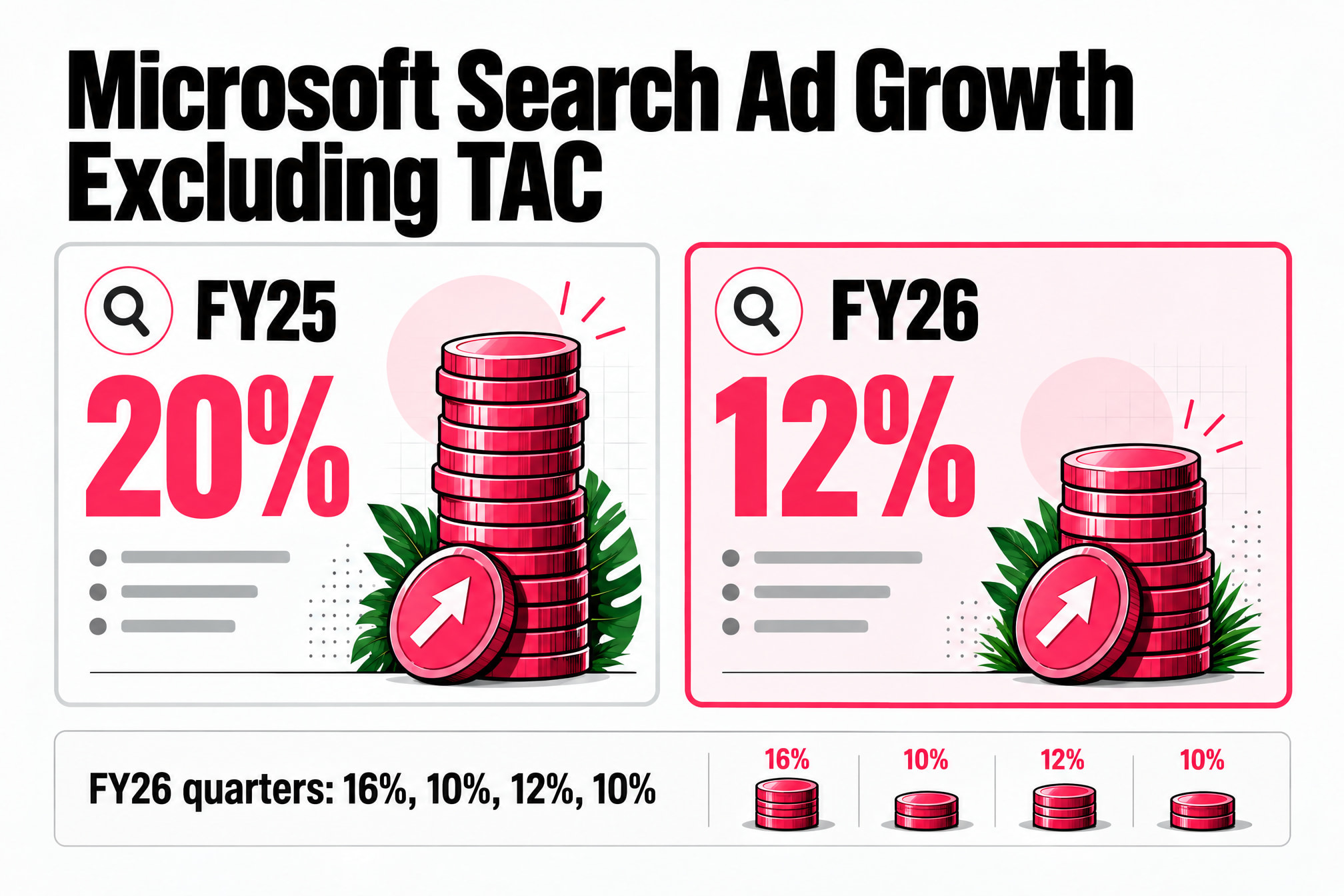
Microsoft's search advertising revenue excluding traffic acquisition costs grew 12% in FY26, down from 20% in FY25. Traffic acquisition costs, or TAC, are what Microsoft pays partner publishers to distribute its search ads. Stripping them out shows the growth in what Microsoft keeps.
Slower growth still means a larger auction each year, and rising revenue per search usually shows up as higher click costs for advertisers.
Microsoft's fiscal year runs July through June, so FY26 covers July 2025 to June 2026. Microsoft's quarterly metrics show ex-TAC growth of 16% in Q1, 10% in Q2, 12% in Q3 and 10% in Q4. In its Q4 earnings release, Microsoft put that last figure at 9% in constant currency.
For scale, Microsoft's search and news advertising revenue reached $3,697 million in Q1 FY26, up 15% from $3,225 million a year earlier. That line includes TAC and news ads, so it won't match the ex-TAC growth rates above.
Microsoft credits its FY26 ex-TAC growth to higher search volume, higher revenue per search and third-party partnerships. Higher revenue per search is the driver I'd watch. Each query is earning Microsoft more ad money, and in an auction that money comes from advertisers. I'd plan for Microsoft click costs to drift up rather than stay frozen at whatever you paid last year.
Microsoft's claim that its ads reach more than 1 billion people across 187 markets is a network-wide, self-reported figure, not a count of Bing searchers. It spans Bing, Edge, LinkedIn, Outlook, Copilot, MSN, Windows and Xbox.

Reach counts people who could see an ad anywhere; search budgets depend on people actively looking for a product at that moment.
That billion includes someone checking Outlook between meetings and someone mid-match on Xbox. Neither is typing "7-pin trailer wiring harness" into a search box at that moment. Search is demand capture, and most of the billion isn't searching when Microsoft counts them.
Reach also says nothing about age, income or job title. Your own Microsoft Advertising audience reports beat any headline number here, because they describe the people who reached your store. For search budgeting, the share figures above are the better base. Save the billion for conversations about placements across MSN, Outlook and Edge, where breadth is the point.
The 2026 WordStream/LocaliQ search benchmarks mix Google and Microsoft campaigns, so they work as a search-wide yardstick rather than a Bing price list. WordStream and LocaliQ analyzed more than 13,000 US Google and Microsoft Ads campaigns from April 2025 to March 2026.
WordStream's data puts the average CTR at 6.64% and the average CPC at $5.42. Search Engine Journal reports the 2026 benchmark conversion rate at 8.18%, up from 7.52% the year before. Digital Applied puts average cost per lead at $66.69, down from $70.11 in the 2025 edition.
Higher conversion rates and cheaper leads year over year are good news for search as a whole. But the limits matter. The figures blend two platforms, they vary a lot by industry, and cost per lead is a lead-gen metric. A large-catalog store lives on revenue, ROAS and gross profit per click.
Set your Microsoft CTR beside your own Google CTR and the 2026 Google Ads click-through rate benchmarks, not against a number that already includes both platforms. Then judge Microsoft on margin, not on clicks.
Copilot is where Microsoft Advertising is changing fastest in 2026, with higher ad CTR, shorter journeys, in-chat checkout and a fast-growing shopping catalog. Every figure in this section comes from Microsoft itself. Copilot is Microsoft's conversational AI assistant, and it can now show ads inside a conversation and handle shopping and checkout.
Microsoft Advertising reported 73% higher click-through rates for ads in Copilot than in traditional search, based on its August 2025 data. Microsoft's investor materials add that customer journeys including Copilot ads were 33% shorter than traditional search journeys, measured from November 2024 to May 2025.
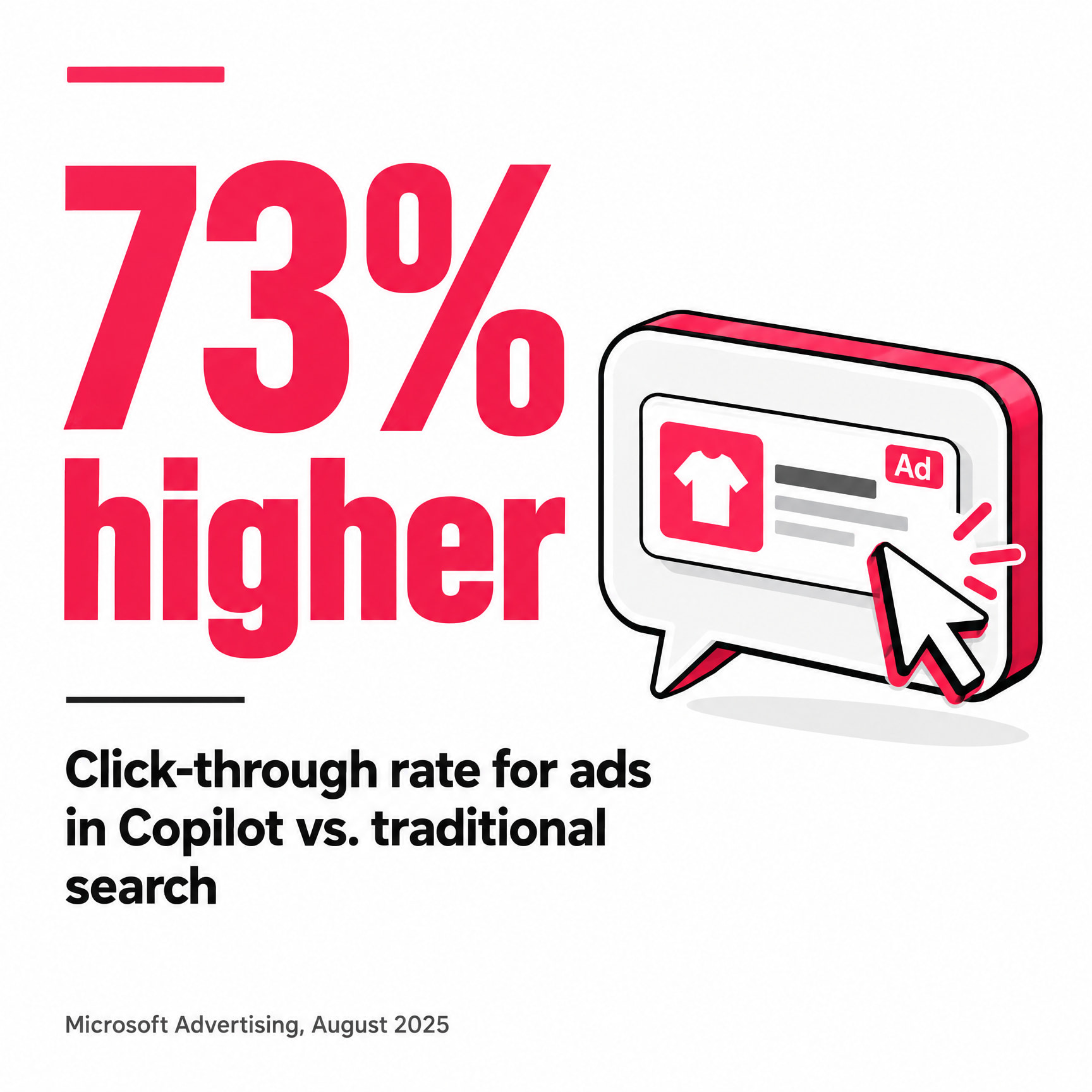
This is a vendor-reported figure, so treat it as a hypothesis and verify it with quick-back rates in your own test campaigns.
Both numbers come from the company selling the placement, and neither compares Bing with Google. I'd treat them as a reason to test, not a forecast. If you do test, watch quick backs, where a shopper clicks an ad and bounces straight back to the previous page. A high CTR with lots of quick backs means people are browsing, not buying.
Microsoft announced Copilot Checkout on January 8, 2026, letting shoppers buy inside Copilot without being redirected to a store's site. Checkout began rolling out in the US on Copilot.com with PayPal, Shopify and Stripe.
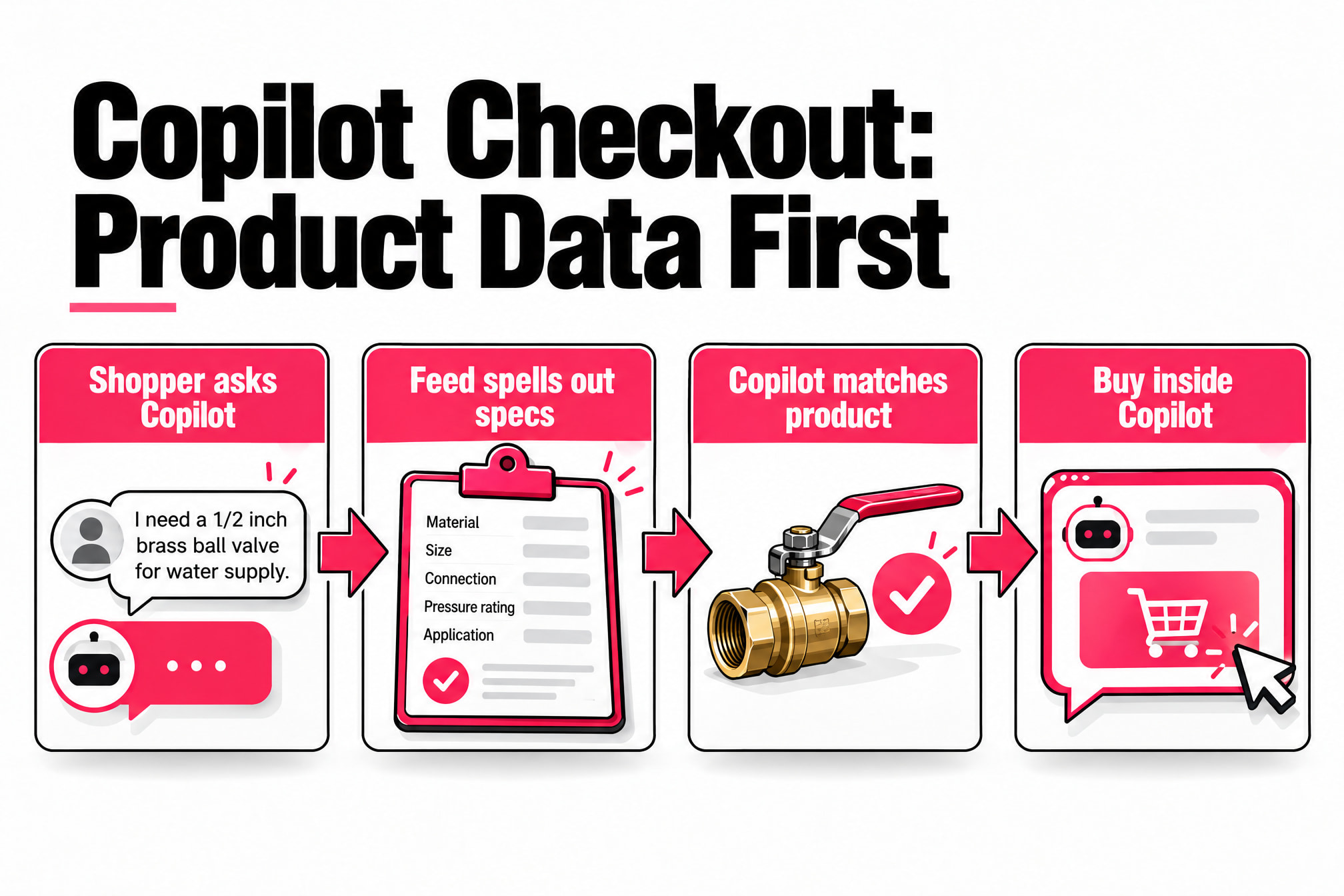
Assistants can only recommend what a feed describes, so missing attributes quietly remove products from conversational shopping results.
Microsoft is also expanding Copilot's shopping catalog data to more than 500,000 merchants. In Microsoft's April 2026 internal data, the top 100,000 Shopify merchants in the US and Canada saw about 90% relative growth in impression share within Copilot Shopping. That figure covers big Shopify stores only. Read it as a direction, not a promise for stores on other platforms.
For spec-driven catalogs, the lesson is product data. When a buyer asks Copilot for a 3/4-inch lead-free brass ball valve, the assistant can only match what your feed spells out. Clean titles, complete attributes, fitment data and a sensible feed structure decide whether you show up. Data feed management is one of the services we offer at SCUBE, and for most large-catalog stores it's where I'd put the first hours of Microsoft work.
Public 2026 data supports a fair Microsoft-versus-Google comparison on search share and device mix, and very little else. The table shows which comparisons hold up and where to get the rest.
Statcounter measures both engines the same way, which is why the share comparison stands. Microsoft publishes its own search ad growth, but nothing here gives Google's on the same basis. And the 2026 cost benchmarks blend both platforms. A "Bing is cheaper than Google" line in a client deck needs a named source, and none of the sources in this roundup provides one.
Your own account data closes most of the gaps. Run the same product groups on both platforms for a quarter, then read the results next to the platform-level figures in our 2026 Google Shopping statistics roundup.
The 2026 numbers favor a desktop-first, feed-driven Microsoft budget sized on your own data, not a carbon copy of your Google account. Copying Google campaigns over and walking away is the PPC version of guessing fitment. Sometimes the part fits. Plenty of times it comes back. This checklist turns the stats into decisions.
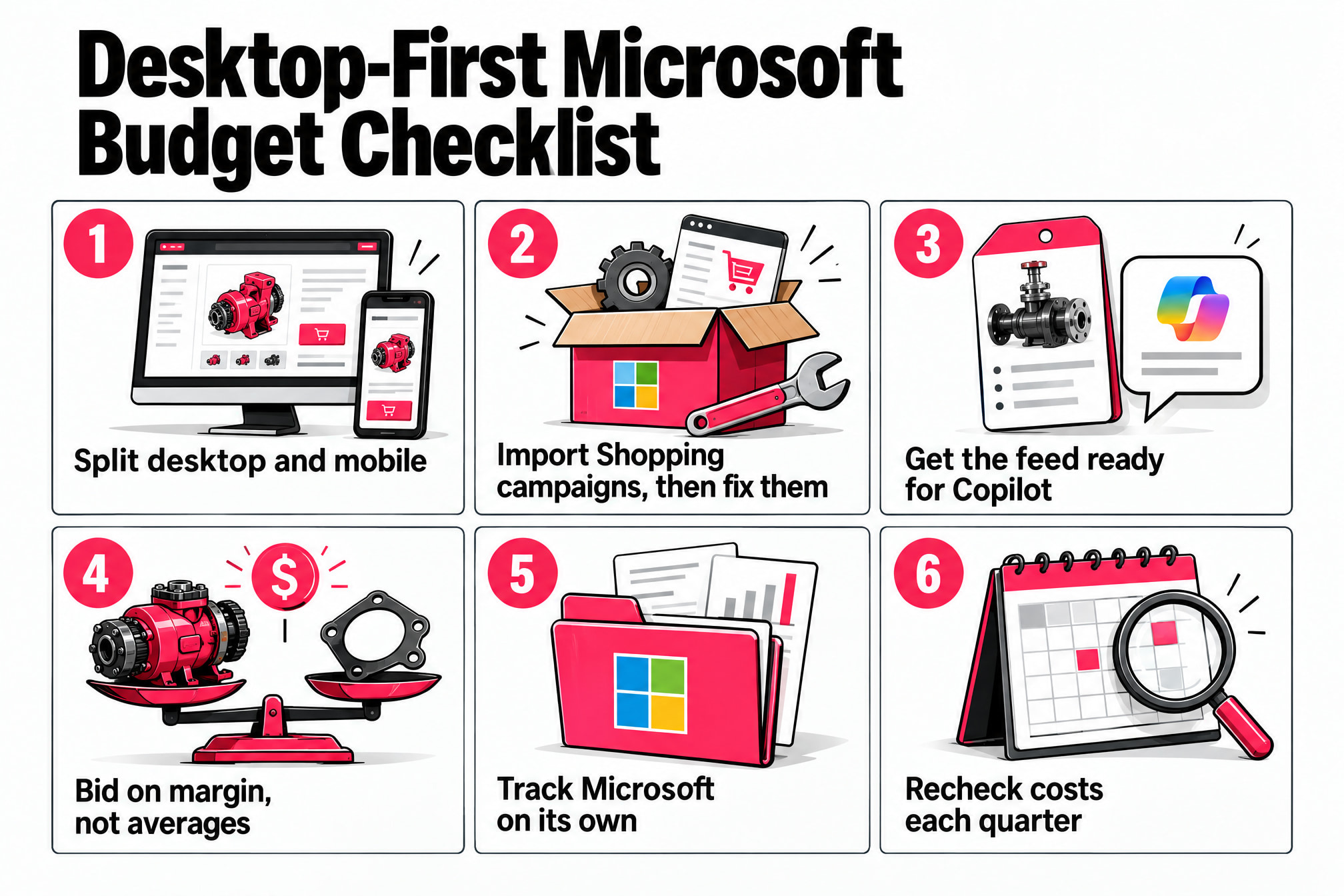
Working through these in order keeps a new Microsoft account from inheriting Google settings that were never tuned for its audience.
Before you commit a dollar, run one quick sizing test. Pull last quarter's US desktop revenue from Google Shopping and multiply it by 18.83%, Bing's share of US desktop search in Statcounter's September 2026 data. Treat the result as a rough starting estimate of what Microsoft Shopping could add, not a forecast. Set a first test budget your margins can carry at that level, and let a quarter of real data tell you whether to scale it.
If you'd like help turning that estimate into a Microsoft Shopping Game Plan, the SCUBE team runs Bing Ads and Shopping for large-catalog stores and would be glad to build it with you.