

Heavy equipment industry statistics for 2026 start with a global construction equipment market worth $167B to $171.98B in 2025, depending on whether you ask GM Insights or Fortune Business Insights. Both firms expect that market to grow by more than 6% a year into the mid-2030s.
That's the headline. The trend underneath it is bumpier. Off-Highway Research counted global construction equipment unit sales down 2% in 2024. In March 2025, Off-Highway Research forecast another 2% slide for that year. Over the same stretch, Caterpillar's services business, which includes aftermarket parts, brought in $24B in 2025. Caterpillar has now set a $30B target for 2030.
New construction and the parts that keep it running are moving at different speeds. That gap matters if you sell parts online. I run an ecommerce PPC agency that works with distributors and retailers in heavy equipment, industrial and MRO. From where I sit, the steadier money in this industry is in parts, service, rental fleets and online resale. Those are channels a large-catalog team can win.
Heavy equipment market estimates span $167B to $388.22B because each research firm draws the boundary of the market in a different place. GM Insights and Fortune Business Insights both measure construction equipment. Fortune also publishes a broader heavy construction equipment estimate. Research and Markets measures construction machinery, which is a wider net still. Frost & Sullivan folds farm and mining machines into an off-highway total.
Market sizing in this industry comes with more attachments than a skid steer. Averaging these figures is like averaging the bucket on a mini excavator with the bucket on a mining shovel and calling the result typical.
The table below lines up each estimate with what it measures, so you can see where the gaps come from.
If you need one number for a slide, use a construction equipment figure and name the firm and the year. GM Insights has the lowest of the major global estimates, which makes it the conservative pick. Fortune Business Insights' heavy construction equipment figure fits only when you mean that wider category, and your slide should say so.
One more trap. KHL's Yellow Table total is the summed sales of the 50 biggest makers, not a market size. It's a great gauge of OEM health and a poor stand-in for total demand.
Dollar growth in construction equipment doesn't mean more machines on job sites. Units are still working down from their peak. Construction Briefing reports that global sales hit a record 1.36 million units in 2021.
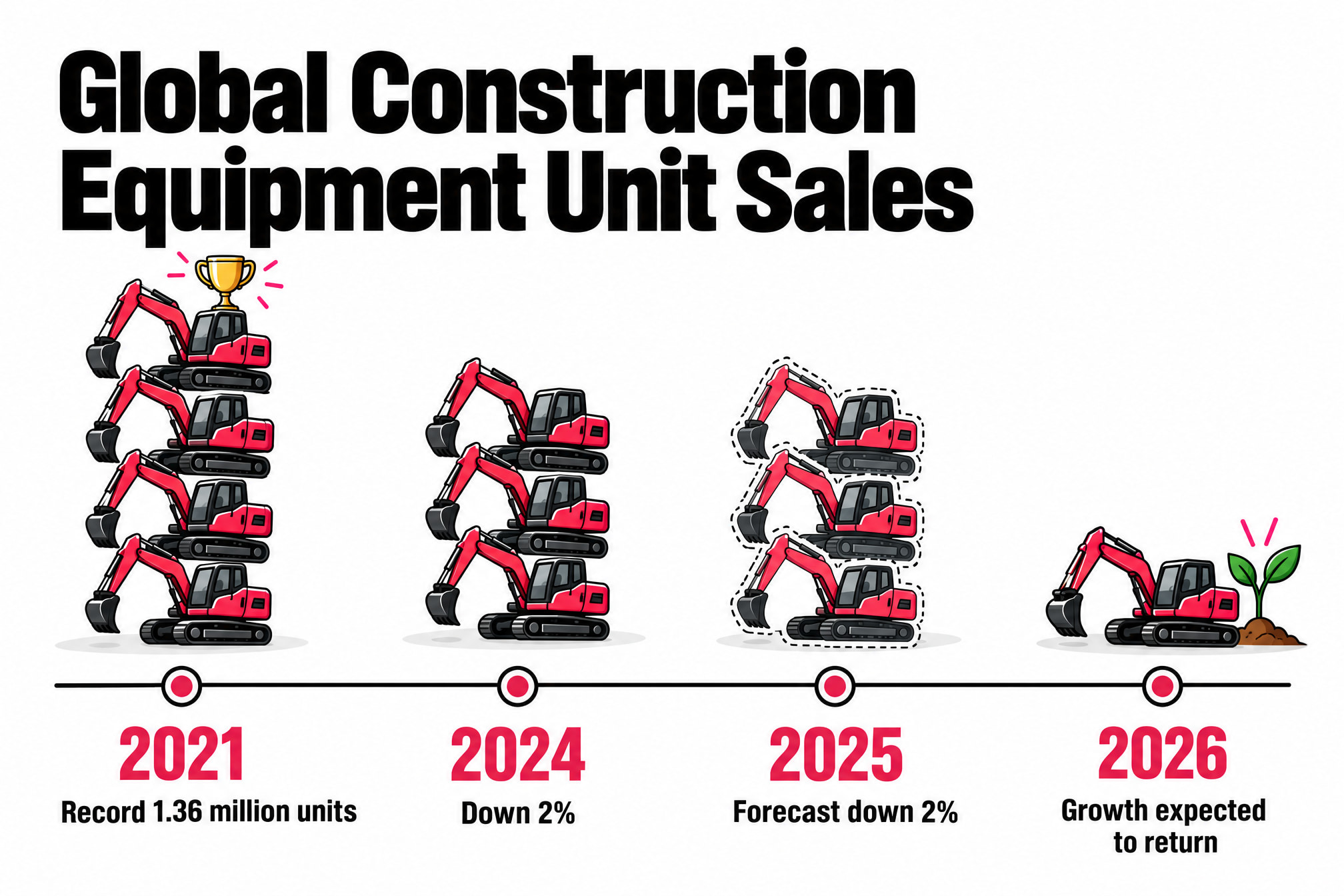
Machines sold in the 2021 peak year are now mid-life, the age when wear parts and hydraulic repairs become routine purchases.
The slide since then has been gradual. Off-Highway Research counted a 2% drop in global unit sales in 2024. In March 2025, it forecast another 2% decline for 2025 and expected growth to return from 2026.
Now set that against dollars. KHL's Yellow Table shows the 50 largest makers posted record combined sales in 2025. That was a year when units were expected to shrink. Fewer machines, more dollars. My read is that higher prices per machine, a tilt toward bigger machines, or both explain the gap.
For the longer view, Interact Analysis forecasts the global off-highway vehicle market at 7.8 million units by 2030. That count includes farm and material handling machines, so keep it away from the construction-only peak figure.
For a parts catalog, the 2021 peak keeps paying. Every machine sold that year still needs filters, undercarriage, hydraulic components and wear parts for as long as it runs. A soft year for new iron doesn't erase the installed base you sell into.
One machine type accounts for more than half of construction equipment value. Mordor Intelligence puts the excavator share of the global market at 51.24% in 2025. That's more than every other machine type combined.
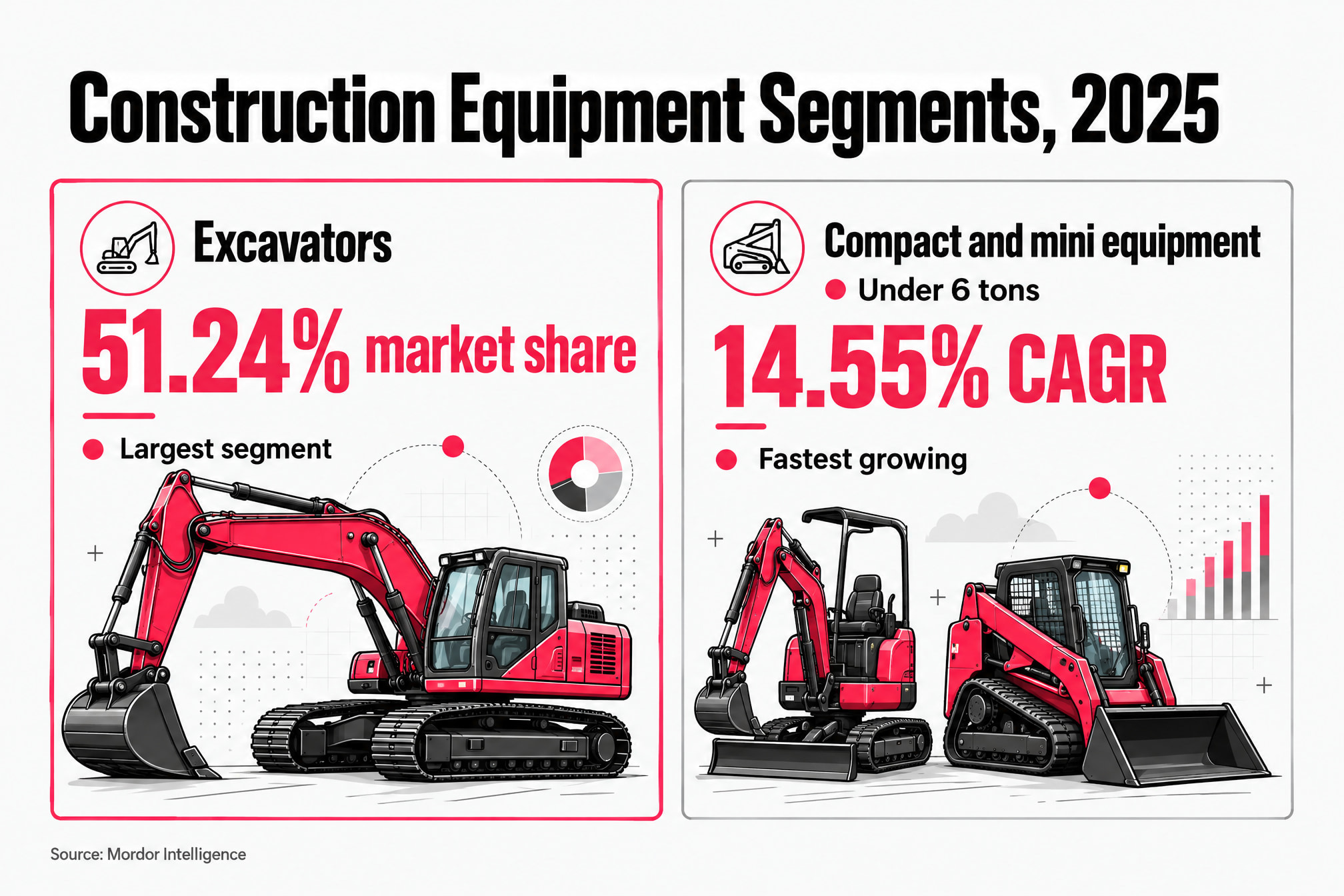
Size and growth point to different budget priorities: excavator parts protect volume today, compact fitment pages capture tomorrow's demand.
Zoom out to earthmoving machinery as a whole and the share climbs. Mordor Intelligence's January 2026 figures put earthmoving at over 59% of the construction equipment market.
The fastest-growing slice is a smaller one. Mordor Intelligence forecasts compact and mini equipment under 6 tons to grow at a 14.55% CAGR.
Those numbers make a solid first draft of your SKU segmentation. If excavator parts share a Shopping campaign with everything else, your budget ignores where the machines are. I'd split excavator and compact equipment parts into their own campaigns or product groups. Then I'd label them by machine class in the feed and give them first claim on budget tests.
Compact machines bring a fitment wrinkle. Brands, models and serial ranges overlap. It's worth testing whether your compact buyers search by model before part number. If they do, clean fitment data and model-level landing pages will serve them better than broad category pages.
The 50 largest construction equipment makers sold a record $246.6B combined in 2025, up 3.8%, according to KHL's 2026 Yellow Table. The biggest shake-up was XCMG climbing into the top 10 at No. 3. Komatsu, Volvo CE and Hitachi are other well-known construction equipment brands.
The Yellow Table totals for the last three years show how quickly the top line bounced back.
Caterpillar stayed No. 1 in the 2026 Yellow Table with $37.5B in construction equipment sales, or 15.2% of the top-50 total. At company level, Caterpillar's total sales and revenues reached $67.589B in 2025, up 4% from $64.809B. Caterpillar's profit fell to $8.884B from $10.792B over the same period.
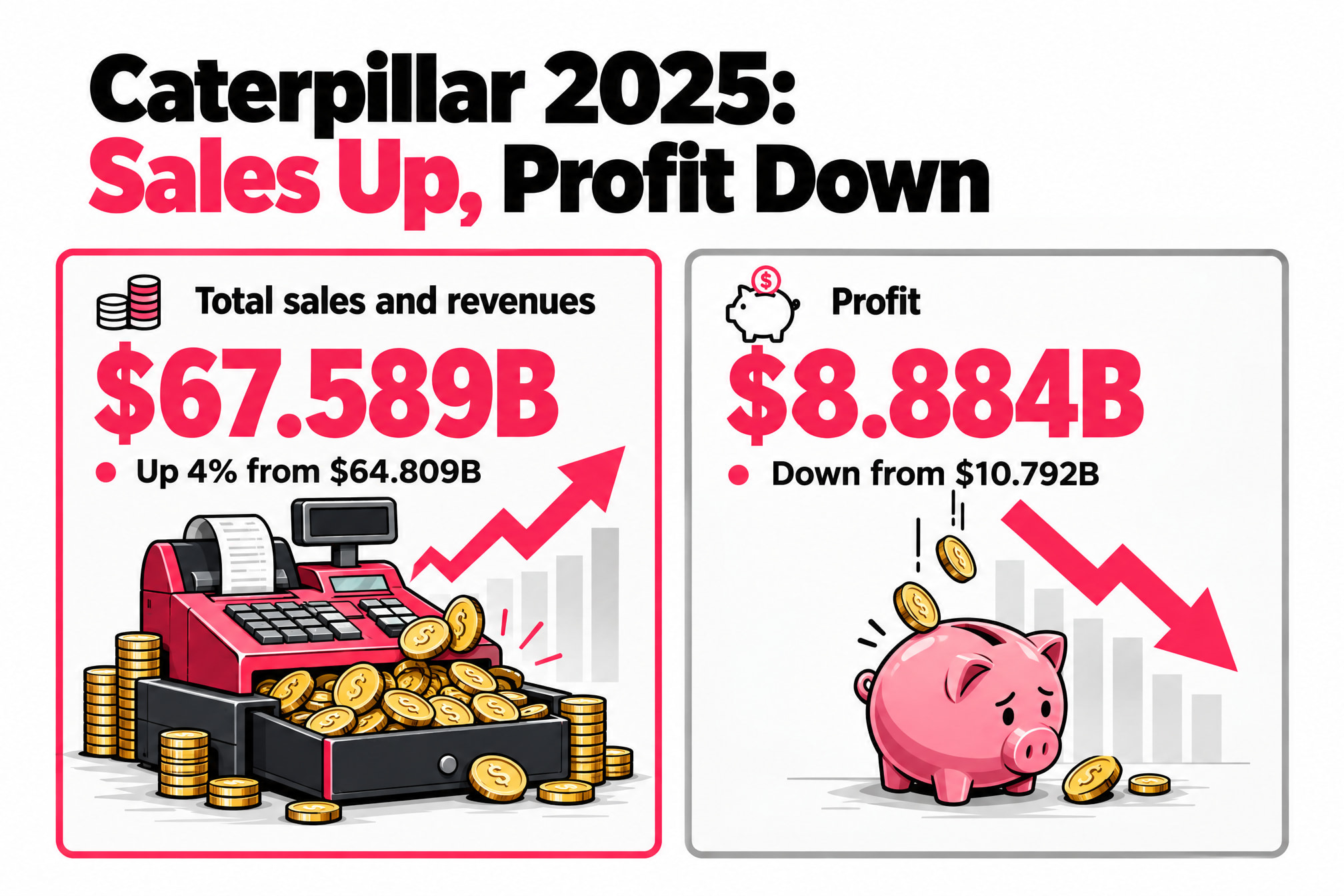
Figures come from Caterpillar's 2025 annual report filed with the SEC, covering the whole company rather than construction equipment alone.
Sales up and profit down is worth remembering the next time someone quotes revenue growth as proof the industry is healthy. Revenue tells you demand held. It doesn't tell you anyone kept more of it.
Interested in more content related to heavy equipment? We have our full guide to heavy equipment & construction parts marketing and ecommerce
John Deere's Construction & Forestry segment had a rough fiscal 2025. Deere reported net sales down 12% to $11.382B, with operating margin down to 9.0% from 15.5%.
The fourth quarter told a different story. Deere's Construction & Forestry sales rose 27% to $3.382B in Q4, an early sign of recovery. Deere's fiscal year doesn't match the calendar year, so don't line its annual numbers up against Caterpillar's as if they cover the same months.
North America holds more than a quarter of the heavy construction equipment market and swung harder than any other major region in 2025. Fortune Business Insights gives North America a 28% share of that market.
In October 2025, Off-Highway Research expected North American construction equipment sales to fall 11% for the year. It called that the steepest drop of any major market.
A double-digit drop in new machine sales hits dealer lots first. It says far less about the installed base your parts catalog serves.
For U.S. parts sellers, that means reading your own data before reacting to industry headlines. Pull search query and Shopping reports by state and by machine family. If demand for excavator undercarriage or hydraulic parts is flat or up, a weak year for new equipment is no reason to trim budget.
The construction equipment aftermarket kept growing while new unit sales slipped. Research and Markets sized it at $28.53B in 2025. Research and Markets projected $30.44B for 2026, a 6.7% increase.
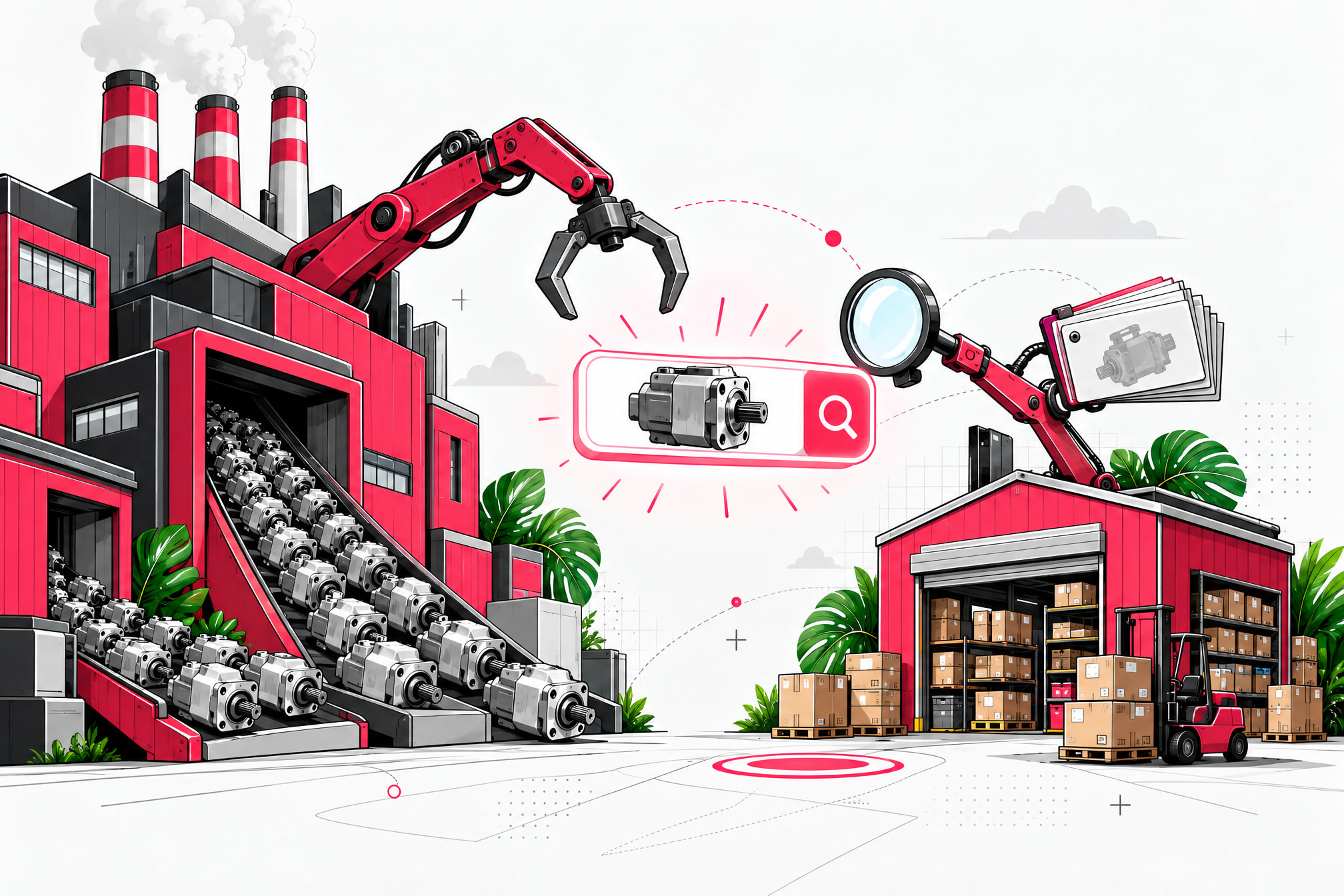
When the machine's maker sells parts online, independent sellers win the search on cross-brand coverage and fitment detail rather than brand budget.
Caterpillar's numbers make the same point from the OEM side. Caterpillar's services revenue, which includes aftermarket parts, grew 4% to $24B in 2024, measured against what the company called an "aspirational" $28B target. Caterpillar's services revenue came in at $24B again in 2025, and the company has since raised its target to $30B by 2030.
Put those side by side and the research figure looks small. One OEM's services line, which covers more than parts, comes to $24B. One research firm sizes the entire construction equipment aftermarket at $28.53B. The two use different definitions. Still, if you're building a parts business case, treat the research figure as a narrow slice rather than a ceiling.
The line that should get your attention is in Caterpillar's segment highlights. The company says its 2025 services revenue was driven partly by "enhancements to our eCommerce platforms." For independent sellers and distributors, that means the company that built the machine now competes for the same part-number search you do.
You won't outspend an OEM on brand. You can compete on catalog depth across brands, faster fitment answers and cross-references that help a buyer confirm a non-OEM part fits. Clean fitment data, OEM numbers in titles and a feed structure built around how mechanics search are the foundation of heavy equipment parts marketing and ecommerce.
Full disclosure, data feed management is one of the services we sell at SCUBE Marketing, so I'm biased toward product data. Even so, a parts listing with weak fitment data loses the click before your bid strategy gets a say.
Rental now supplies the majority of U.S. construction equipment use. The American Rental Association (ARA) reports record rental penetration of about 59.5% in 2025. ARA's figures also show U.S. construction, industrial and general tool rental revenue reached $80.6B in 2025, up 3.3%.
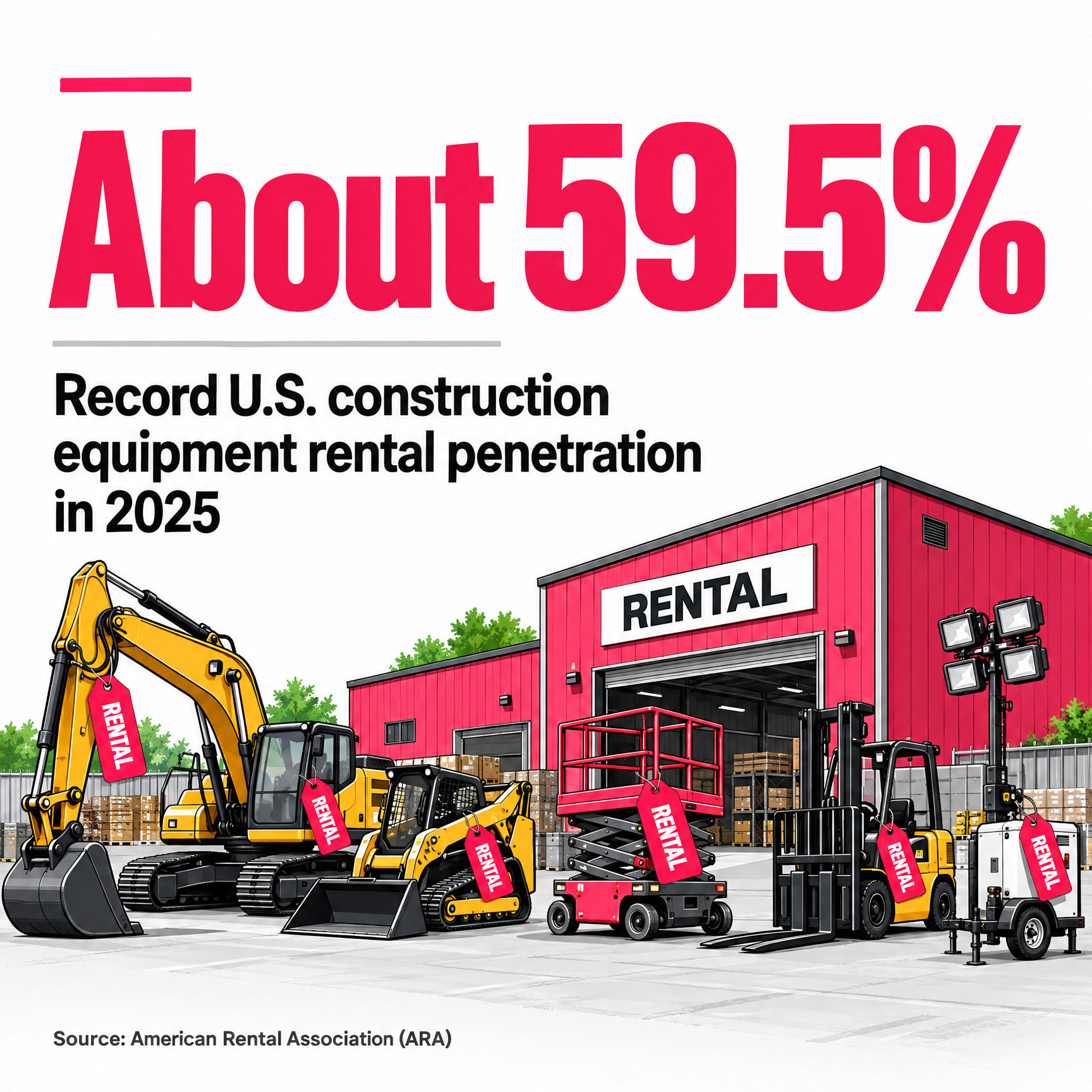
Rental penetration measures the share of equipment use supplied by rental fleets, making fleet managers the majority buyer for many parts.
Forecasts for 2026 moved up during the year. ARA's November 2025 forecast projected 2.3% growth in 2026, to $82.3B. Later ARA updates raised the 2026 forecast to $83.5B.
A rental fleet is a large, repeat, spec-driven buyer. It services many machines from many brands, buys the same part numbers again and again, and loses money every day a machine sits in the yard waiting on a part.
That changes what your site needs. Account pricing, quick order by part number, saved fleet lists and clear stock status matter more to this buyer than a pretty category page. Winning fleet managers and service departments is closer to paid search for high-value construction equipment buyers than to a consumer retail campaign.
Used heavy equipment trades at serious volume through auctions and online marketplaces. RB Global reported $16.2B of gross transaction value (GTV) in 2025, up 2% from $15.9B. GTV is the total value of everything sold through its channels. RB Global's total includes IAA's automotive salvage business and both auction and online sales, so it isn't a pure heavy equipment number.
The construction piece moved faster late in the year. RB Global's Q4 2025 GTV was $4.3B, up 4% year over year. RB Global's commercial construction and transportation GTV rose 9% to $1.5B in the quarter, helped by the J.M. Wood acquisition.
Every used machine that sells comes with a new owner who needs parts. My read is that many of these buyers start shopping without an established dealer relationship, which makes them search-first customers. Selling truck and heavy equipment parts online is built around this type of buyer, someone with a model number, a problem and no favorite supplier yet.
Tariffs and interest rates matter most right now because the construction equipment industry is cyclical and sensitive to both. Caterpillar put a number on the tariff side. In its 2025 annual filing, Caterpillar said it expected tariffs to cost about $2.6B in 2026. That's a big bite next to the profit it reported for 2025.
The wider off-highway market was already soft. Frost & Sullivan estimates global off-highway equipment revenue, which spans construction, mining and agriculture, fell 2.9% to $322.6B in 2025. Frost & Sullivan expected about 3.0% growth in 2026.
Interest rates hit the buy side. Heavy machines are usually financed, so every rate move changes a contractor's buy-or-rent math. Higher financing costs make the rental alternative easier to justify.
For parts sellers, tariffs show up as landed-cost changes on imported SKUs. If your bids still chase revenue while your costs move, you can win more orders and keep less gross profit. A margin-based bid strategy fixes that by feeding cost or gross profit data into your campaigns, so bids follow profit per SKU. It belongs at the center of any PPC plan for heavy equipment sellers.
None of this cancels the long-range forecasts. GM Insights and Fortune Business Insights still project growth into the mid-2030s. The near term is just rougher terrain than a single CAGR suggests.
The global construction equipment market was $167B in 2025 according to GM Insights. Fortune values the broader heavy construction equipment market at $251.19B in 2026.
GM Insights forecasts a 6.1% CAGR to $289.5B by 2035. Fortune Business Insights projects a 6.8% CAGR to $310.24B by 2034.
Caterpillar ranked No. 1 in the 2026 Yellow Table with $37.5B in construction equipment sales, 15.2% of top-50 sales.
Excavators made up 51.24% of the global construction equipment market in 2025, according to Mordor Intelligence.
U.S. rental penetration reached a record of about 59.5% in 2025, with rental revenue of $80.6B, according to ARA.
Research and Markets put the global construction equipment aftermarket at $28.53B in 2025 and projected $30.44B for 2026.
This table gives each headline stat with its source, its definition and its data year, ready to paste into a report.
If only three numbers make your next budget deck, use the $30.44B aftermarket projection, the roughly 59.5% U.S. rental penetration and Caterpillar's $30B services target. They point at parts, fleets and online channels, the ground a large-catalog team can actually take.
If you'd like help turning those numbers into a parts plan, SCUBE Marketing runs Google Shopping and Bing Shopping, data feed management and PPC for large-catalog sellers. Get in touch.