

A national distributor of fueling equipment partnered with SCUBE to increase online revenue through paid search. The business operated in a complex B2B market where ecommerce transactions often represented the start of longer, higher-value offline relationships.
The engagement was structured as a collaboration. DeanHouston led platform optimization and user experience design to address the distributor’s market constraints, while SCUBE was responsible for paid search execution once the foundation was in place.
SCUBE designed and managed a Google Ads program focused on consistent demand capture rather than short-term volume. Over time, the paid media system generated more than $200,000 in online revenue and supported the acquisition of large, high-value accounts that extended beyond ecommerce transactions.
Search marketing in industrial B2B categories introduces a different set of constraints than consumer ecommerce.
Demand is narrower. Sales cycles are longer. Online purchases often represent only part of a broader commercial relationship. Standard B2C approaches tend to overemphasize volume while underestimating downstream value.
Before paid media could scale effectively, the ecommerce platform and user experience needed to reflect how buyers evaluated and purchased technical equipment. Without that foundation, search traffic would create activity without meaningful business impact.
SCUBE entered the engagement after the platform and UX work led by DeanHouston established clarity around buyer needs and market dynamics. The focus shifted to ensuring that paid search execution reinforced that structure rather than working against it.
Clear KPIs were established based on business objectives, with an emphasis on profitable acquisition and long-term account value rather than surface-level platform metrics.
Google Shopping and Search campaigns were segmented by buyer journey stage to separate high-intent demand from exploratory behavior. Keyword and query management reduced wasted spend and ensured that visibility aligned with relevance in a technically complex category.
Offers, value propositions, and ad angles were developed to reflect how industrial buyers evaluated suppliers rather than relying on consumer-style messaging.
Audience, offer, and ad testing was used selectively to refine structure and improve performance incrementally. The objective was continuous improvement, not aggressive short-term optimization.
ROAS helped prevent waste, but decisions were guided by how the system behaved as volume increased.
After 12 months of consistent execution and incremental optimization:
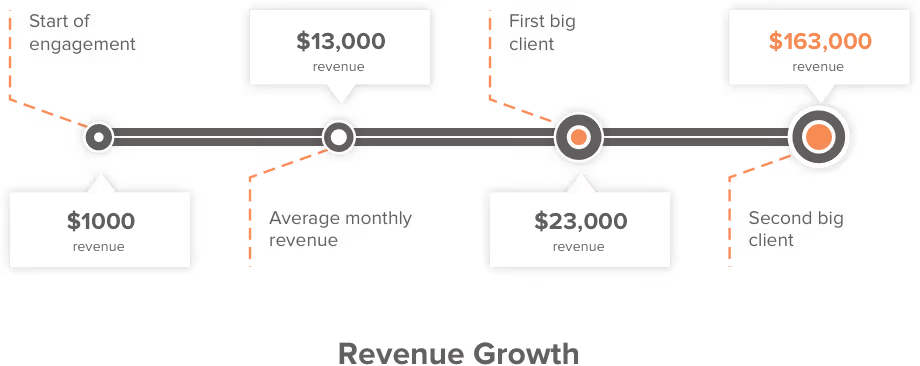
While ecommerce revenue was meaningful on its own, the larger impact came from the quality of accounts entering the business through search.
“Successful search marketing in complex B2B markets is no easy task. SCUBE’s ability to understand the nuances of complicated channel and product dynamics and know when to step away from common B2C/D2C approaches was instrumental in the current and continued success of this campaign. At DH+ we pride ourselves on our ability to see past convention and into what really works for our technical products clients - and we’re proud to have a partner that approaches industrial search the same way.”
Colton Stombaugh
Director of Digital Marketing, DeanHouston
The result was not just incremental ecommerce revenue. It was a paid search foundation that supported long-term account growth in a market where precision matters.
The SCUBE Game Plan is a focused review of how complex, spec-driven catalogs behave inside paid channels. It’s designed to surface what’s contributing to performance, what’s masking underlying issues, and where structure is quietly working against you. If there’s a fit, we walk through the findings in a ~60 minute conversation, looking at:
The goal is a clearer picture of how the system is behaving, so decisions stop relying on averages or assumptions.

.avif)