
Your equipment sits idle while competitors fill their rental schedules. The problem isn't your inventory or prices. It's visibility.
One idle day on a $1,500 weekly rental is more expensive than 50 qualified clicks. Every click that brings you a booking helps recover idle days—and every idle day costs more than a month of good PPC management.
The heavy equipment rental industry revenue is anticipated to climb at a CAGR of 2.8% to reach $55.5 billion in 2025, including a gain of 1.4% in 2025 alone (IBISWorld).
Most equipment rental companies wait months for organic search results to materialize. Meanwhile, contractors search "excavator rental near me" at 6 AM and book within hours. And they can’t afford to be waiting, as it’s estimated that 21% of construction companies plan to rent equipment less frequently in the upcoming 12 months, and transition toward ownership (EquipmentWatch). But there is still strong demand, with 72% of contractors renting equipment in the past 12 months, which was on par with 2024 (EquipmentWatch).
I've spent years managing PPC campaigns for businesses that need immediate results. Equipment rentals are uniquely suited for paid search because rental decisions happen fast. A contractor doesn't comparison shop for weeks. They need a skid steer by Thursday.
This guide shows you how to build PPC campaigns that capture high-intent searches, target the right geographic areas, and convert clicks into confirmed bookings. You'll learn budget strategies that prevent overspending, keyword approaches that attract ready-to-rent customers, and landing page tactics that close deals.
By the end, you'll understand how to make PPC your most predictable booking channel. No waiting for SEO rankings to climb. Just immediate visibility when customers are actively searching.
Organic search takes months. Your competitors book customers today.
Think about your typical customer journey. A general contractor wins a project bid on Monday. They need specific equipment by Wednesday. They're not reading blog posts or comparing 15 different rental companies.
They type "bobcat rental [city name]" into Google. They click the first three results. They call or book online within 30 minutes.
That's your window. Miss it, and they're already scheduling with someone else.
SEO builds long-term brand trust and organic traffic. It's valuable for establishing authority over time. But it doesn't solve this week's empty rental calendar.
PPC puts you at the top of search results instantly. Launch a campaign Monday morning, and you're visible for relevant searches by Monday afternoon.
This speed matters for seasonal rushes, weather-dependent demand spikes, and competitive markets where aggregators dominate organic results.
Large rental aggregators own many organic search results. They have massive SEO budgets and established domain authority.
PPC levels the playing field. Your local equipment rental company can appear above these national players for geographic-specific searches. You're not outspending them on SEO. You're outbidding them for relevant paid placements.
Google doesn’t reward budget size; it rewards ad relevance. A well-built local ad can outrank a national aggregator 100% of the time for your service area.
This direct competition becomes possible because Google rewards ad relevance and landing page quality, not just budget size.
Equipment rentals often involve urgent needs. Construction delays, equipment failures, and project timeline changes create immediate demand.
These high-intent, time-sensitive searches convert at premium rates. PPC can quickly generate bookings, especially for last-minute or high-demand periods.
Your campaign catches these valuable opportunities that SEO can't address fast enough.
Now that you understand why PPC matters, let's build a campaign that actually generates bookings.
Most equipment rental companies make the same mistake: they copy their website structure into Google Ads. That's backward. Your campaign structure should match how customers search, not how you organized your services menu.
Start with Google Ads. It captures active search intent when people need equipment now.
Facebook and Instagram work for awareness. Google works for conversions. When someone searches "mini excavator rental," they're ready to book. When someone scrolls Facebook, they're killing time.
Focus your initial budget where intent is highest.
Create separate campaigns for different equipment categories. One campaign for excavators, another for aerial lifts, another for concrete equipment.
This separation allows you to allocate budget based on what actually drives revenue. If excavator rentals generate 40% of your income, they should get more than 10% of your ad spend.
Within each campaign, build ad groups around specific equipment types. Don't lump "excavators" together. Separate mini excavators, standard excavators, and long-reach excavators.
Each type attracts different customers with different project needs and budgets.
Install conversion tracking before launching ads. Track form submissions, phone calls, and online bookings separately.
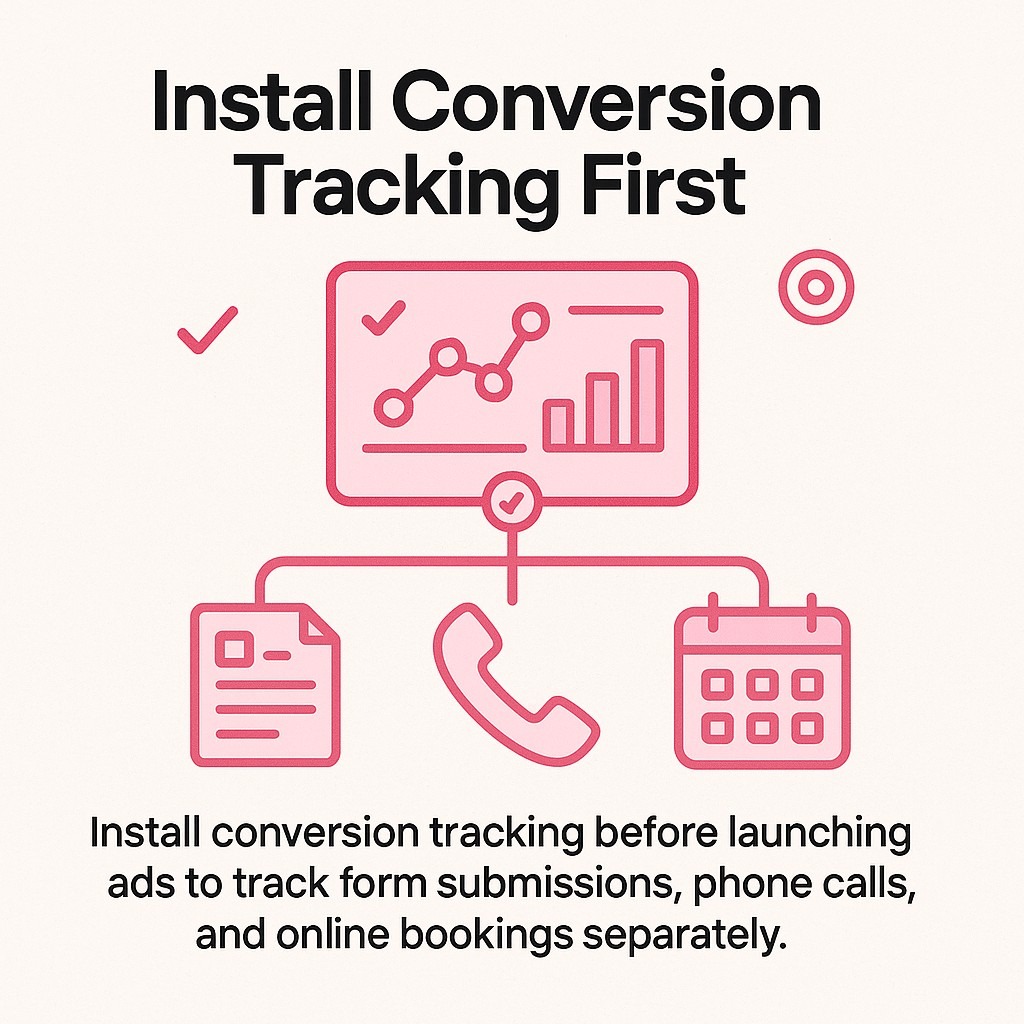
Install conversion tracking first to measure form fills, phone calls, and online bookings separately—before you spend a dollar on ads.
Set up location targeting for your service area. No point showing ads to people 200 miles away if you don't deliver that far.
Enable ad extensions: location extensions, call extensions, callout extensions, and sitelink extensions. These increase your ad's visual footprint and provide more ways for customers to contact you.
In a local service PPC test (HexaClicks, 2024), a regional rental business achieved a 39% click-through rate and $2.36 CPC in its first week by running highly localized ads with strong ad extensions.
Link your Google Business Profile. This connection improves local visibility and trust signals.
The foundation of successful PPC lies in targeting the right keywords. Not the most popular keywords. The most profitable ones.
Equipment rental keywords fall into distinct intent categories. Understanding these categories determines which searches convert and which waste budget.
These phrases signal ready-to-rent intent:
Notice the specificity. People using these terms know exactly what they need. They're comparing options or ready to book.
Prioritize these keywords in your campaigns. They convert at higher rates than broad research terms.
Generic terms cost more and convert less. "Excavator rental" attracts everyone, including people just browsing prices for future projects.
"20-ton excavator rental for foundation work" attracts a contractor with a specific project starting soon. The search volume is lower, but the conversion rate is higher.
Build keyword lists around:
These long-tail variations cost less per click and attract more qualified leads. Smaller search volume, bigger payoff. It’s not about traffic, it’s about intent.
Using negative keywords to filter out irrelevant traffic protects your budget from clicks that never convert. Cutting clicks is often the fastest way to improve ROI. Every irrelevant search term you block is budget saved for a booking that matters.
Add these negative keywords to every campaign:
Review search term reports weekly. Identify irrelevant queries triggering your ads. Add them as negatives immediately.
This ongoing refinement improves campaign efficiency more than any other tactic.
Equipment rentals are inherently local. Your delivery radius defines your serviceable market.
Geographic targeting determines whether your ads reach potential customers or waste money showing to people you can't serve.
Start by mapping your realistic delivery zones. Factor in delivery costs, time, and equipment transportation logistics.
A 50-mile radius sounds reasonable until you calculate the cost of delivering a 30-ton excavator 48 miles each way. Suddenly, closer customers become more profitable.
Set up radius targeting around your physical location. Adjust based on equipment type. Smaller tools support wider delivery. Heavy equipment requires tighter geographic focus.
Urban and suburban customers behave differently. City contractors often need smaller equipment for tight job sites. Suburban and rural projects allow larger equipment.
Create separate campaigns for urban and suburban zones. Adjust equipment offerings and ad messaging accordingly.
This segmentation lets you bid more aggressively in high-value areas while maintaining presence in lower-margin zones.
If you operate in a market with aggressive competitors, consider geo-targeting their locations. Run ads to people searching near competitor addresses.
This tactic works particularly well when you offer better availability, faster delivery, or more competitive rates.
For more advanced geographic PPC strategies, check out our guide on geo-targeting PPC campaigns with advanced strategies.
Your ad copy makes the difference between clicks that convert and budget that disappears.
Equipment rental ads need to communicate three things instantly: what you rent, where you serve, and why someone should choose you.
Lead with the specific equipment and location in your first headline. "Mini Excavator Rental - Dallas" beats "Professional Equipment Rentals."
Your second headline should address availability or key differentiator. "Same-Day Delivery Available" or "24/7 Emergency Rentals."
The third headline can highlight pricing, experience, or service quality. "Competitive Daily Rates" or "30+ Years Serving Contractors."
This structure matches search intent. People searching for specific equipment want immediate confirmation you have it.
Use the first description line to expand on your headline promise. Mention your inventory depth, condition standards, or delivery capabilities.
The second description should include a clear call-to-action and booking convenience. "Book Online in 5 Minutes" or "Call Now for Instant Quote."
Avoid generic claims like "best quality" or "trusted provider." These don't differentiate you. Instead, mention specific advantages: "GPS-Equipped Fleet" or "Certified Operator Training Included."
Location extensions show your address and distance from the searcher. This builds trust and confirms you serve their area.
Call extensions let mobile users tap to call immediately. Most equipment rentals start with a phone conversation about project specifics.
Callout extensions highlight key benefits: "Free Delivery Over $500," "Weekend Rates Available," "Equipment Always Inspected."
Sitelink extensions direct users to specific equipment categories or services. Link to your excavator page, aerial lift page, and contact page.
These extensions don't cost extra. They just increase your ad's size and click-through rate.
Ad clicks mean nothing if your landing page doesn't convert. The page someone lands on determines whether they book or bounce.
Most equipment rental companies send all traffic to their homepage. That's a mistake. Your homepage tries to serve everyone. Your landing page should serve one specific search intent.
If your ad promises "Mini Excavator Rental - Same Day Delivery," your landing page headline should say "Mini Excavator Rentals - Same Day Delivery Available."
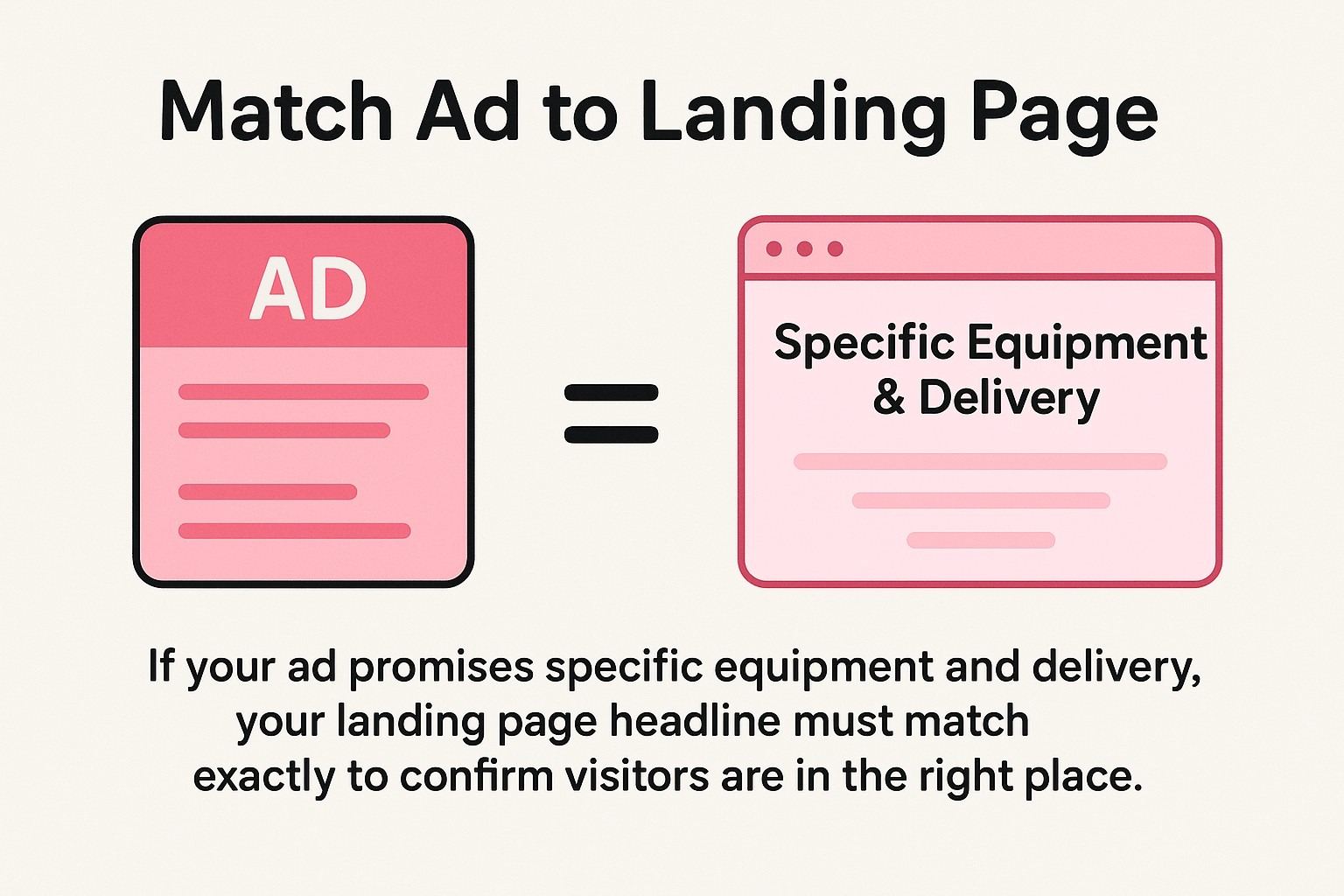
Match your ad promise to the landing page headline and offer to confirm visitors are in the right place and reduce bounce.
This continuity confirms to visitors they're in the right place. Breaking this connection creates doubt and increases bounce rates.
Match the equipment type, location, and key benefit from your ad to your landing page headline.
Show the specific equipment prominently. High-quality photos of the actual machines you rent, not stock photos.
Ask your techs to snap units on job sites instead of using catalog imagery. Real, local photos often lift click-through rates dramatically and build instant trust with contractors who can spot stock images a mile away.
List technical specifications that contractors need: dimensions, capacity, weight, reach, power requirements.
Display clear pricing information. Even if you need to show "starting at" rates, giving a price range reduces friction.
Include an instant quote form above the fold. Collect only essential information: equipment type, rental duration, delivery location, contact details.
Add social proof elements: customer testimonials, years in business, number of projects served, certifications.
Your landing page must load in under 3 seconds on mobile. Compress images. Minimize code. Use mobile-responsive design.
Make phone numbers tap-to-call. Make forms simple with minimal fields. Enable autofill for address and contact information.
Test your booking flow on actual mobile devices. If it's awkward for you, it's losing you bookings.
Setting the right budget and bid strategy prevents overspending while maximizing booking opportunities.
Calculate backward from your revenue goals. If you need 10 additional bookings per month and your average booking value is $1,500, that's $15,000 in additional revenue.
If you're willing to spend 20% of revenue on customer acquisition, your monthly PPC budget is $3,000.
Divide that budget across your campaigns based on historical performance. New campaigns need testing budget. Proven campaigns deserve more allocation.
Start conservative. You can always increase budget when you identify winning campaigns. Cutting budget after overspending feels worse than gradual scaling.
Manual CPC bidding gives you complete control. Set maximum bids for each keyword based on its value.
This approach works best when you're learning which keywords convert. You can quickly adjust bids based on performance.
Once you have conversion data, consider Enhanced CPC. Google automatically adjusts your bids up or down based on conversion likelihood.
For campaigns with strong conversion history, Target CPA bidding optimizes for cost per acquisition. You tell Google your target cost per booking, and it manages bids accordingly.
Avoid fully automated strategies until you have at least 30 conversions per month. Automation needs data to work effectively.
For deeper insights on budget optimization, review our article on managing advertising budgets effectively.
Not all bookings have equal value. A weekend rental generates less revenue than a month-long rental.
Set up conversion values that reflect actual booking revenue. This lets you bid more aggressively for high-value conversions.
Target ROAS (return on ad spend) bidding optimizes for revenue, not just conversion volume. You might get fewer total bookings but higher-value ones.
This strategy works particularly well when you have diverse equipment with varying profit margins.
Learn more about value-based bidding and how to use it to maximize campaign ROI.
Not all customers have the same needs. Contractors, homeowners, property managers, and event planners rent equipment for different reasons.
Commercial customers prioritize reliability, availability, and delivery speed. They rent regularly and care about establishing vendor relationships.
Residential customers prioritize price, ease of use, and included support. They rent occasionally and need more guidance.
Create separate ad groups for each audience. Use different ad copy emphasizing different benefits.
For commercial: "24/7 Support for Contractors" and "Priority Equipment Reservation."
For residential: "Easy-to-Use Equipment" and "Instruction and Safety Training Included."
Different projects need different equipment approaches. Foundation work needs different excavators than landscaping projects.
Build ad groups around common project types in your market: residential construction, commercial building, road work, landscaping, events.
Tailor your messaging to address specific project pain points. Show you understand their challenges and have the right equipment solutions.
Early-stage searchers use broad research terms: "excavator rental cost" or "what size excavator do I need."
Mid-stage searchers compare options: "excavator rental companies near me" or "best equipment rental rates."
Late-stage searchers are ready to book: "rent excavator today" or "same day equipment rental."
Create different campaigns for each stage with appropriate bidding strategies. Bid aggressively on late-stage terms. Bid conservatively on early-stage research.
You can't improve what you don't measure. PPC requires constant monitoring and optimization.
Click-through rate shows how compelling your ads are. Low CTR means your ads don't match search intent or aren't differentiated enough.
Conversion rate reveals landing page effectiveness. High clicks with low conversions indicate landing page problems, not keyword issues.
Cost per acquisition tells you what each booking costs. Compare this to your average booking value to determine profitability.
Impression share shows how often your ads appear for relevant searches. Low impression share means you're missing opportunities, either due to budget constraints or low bids.
Quality Score impacts both ad position and cost per click. Higher quality scores mean lower costs and better positions.
Install Google Ads conversion tracking on your booking confirmation page. This tracks completed reservations.
Set up phone call tracking to measure calls generated by ads. Many equipment rentals start with phone conversations about project specifics. You can have perfect keywords and still lose if nobody answers the phone. Missed calls cost more than bad clicks.
Track form submissions separately from bookings. Some leads require follow-up before converting to confirmed reservations.
Assign appropriate conversion values based on average booking revenue for each equipment category.
For comprehensive tracking strategies, see our guide on PPC reporting tools for getting the best insights.
Review search term reports every Monday. Identify new negative keywords and opportunities for new positive keywords.
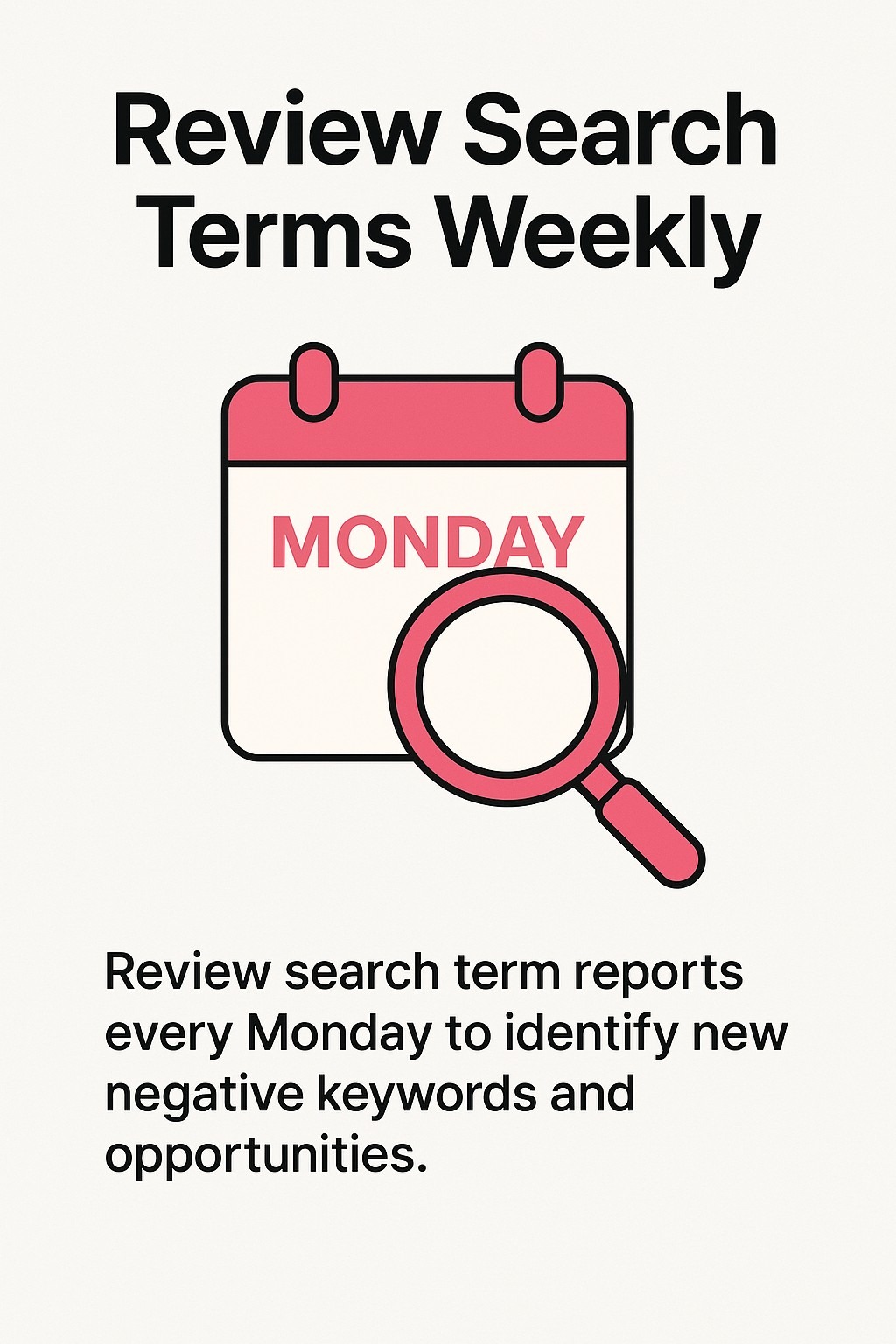
Review search term reports every Monday to add negatives, find new keywords, and keep spend focused on high-intent queries.
Analyze performance by device. Mobile and desktop often perform differently. Adjust bids accordingly.
Check ad position and impression share. If you're consistently in position 1, try lowering bids slightly to reduce costs while maintaining volume.
Review conversion rates by landing page. Test variations of underperforming pages.
This weekly routine takes 30 minutes and prevents small problems from becoming expensive ones.
Once your basic campaigns perform well, these advanced tactics can capture additional market share.
Most people don't book on their first visit. They compare multiple rental companies before deciding.
Set up remarketing campaigns that show ads to people who visited your site but didn't book. Use these ads to highlight your differentiators: faster delivery, better rates, newer equipment.
Create separate remarketing lists based on which equipment pages people viewed. Show excavator ads to excavator browsers, aerial lift ads to lift browsers.
This targeting precision increases relevance and conversion rates.
Explore more about advanced remarketing services and how brands can maximize repeat business.
Bid on competitor brand names when appropriate in your market. If someone searches "CompetitorName equipment rental," show an ad highlighting your advantages.
This tactic works best when you offer genuine advantages: better availability, lower rates, wider service area.
Don't use competitor names in your ad copy. That violates trademark policies. But you can bid on their terms and show relevant ads.
Construction activity fluctuates seasonally. Adjust budgets and bids to match demand cycles.
Increase bids during peak construction season when demand and booking values are highest. Reduce spending during slow winter months in cold climates.
Prepare seasonal campaigns in advance. Launch snow removal equipment ads before the first forecast. Start landscaping equipment campaigns as spring approaches.
This proactive approach captures demand early when competition is lower and costs are cheaper.
Dynamic Search Ads automatically generate ad headlines based on your website content. They help capture long-tail searches you might not have keywords for.
Set up DSA campaigns targeting your equipment category pages. Google matches searches to relevant pages and creates ads dynamically.
Monitor these campaigns closely. Add high-performing search terms to your regular keyword campaigns. Add irrelevant terms as negatives.
DSA campaigns work as a discovery tool, revealing valuable keywords you wouldn't have thought to target manually.
PPC works best as part of a broader digital marketing approach, not as an isolated tactic.
Use PPC data to inform SEO strategy. Keywords with high conversion rates in PPC are worth targeting organically.
SEO builds long-term traffic that reduces PPC dependency over time. PPC provides immediate visibility while SEO gains traction.
Run PPC campaigns for competitive terms where organic rankings are difficult. Focus SEO efforts on less competitive long-tail terms.
This combined approach maximizes total visibility and reduces overall customer acquisition costs.
Capture email addresses from PPC-generated bookings. Build a list of past customers.
Send seasonal reminder emails when their previous rental projects typically occur. "You rented a power washer last spring. Need it again this year?"
Offer repeat customer discounts to encourage direct bookings that don't require ongoing PPC spend.
Create equipment guides, project tutorials, and comparison articles. Link to these from your PPC landing pages.
Educational content builds trust with cautious buyers. It positions you as an expert, not just an equipment provider.
This content also improves organic search visibility, reducing long-term PPC dependency.
Avoid these frequent errors that waste budget and limit results.
Your homepage serves multiple purposes. PPC landing pages should serve one purpose: converting a specific search intent.
Create dedicated landing pages for each major equipment category. Match the specificity of your ads. Your homepage’s job is to tell your story. Your landing page’s job is to make the phone ring.
Broad match keywords trigger ads for unexpected searches. Many waste money on irrelevant clicks.
Review search terms weekly. This single action improves efficiency more than any other optimization.
Markets change. Competitors adjust strategies. Seasonal demand fluctuates.
Static campaigns lose effectiveness over time. Regular optimization keeps performance strong.
For a comprehensive list of pitfalls to avoid, read our article on 11 common mistakes PPC managers make and how to avoid them.
If you don't track phone calls, you're missing half your conversion data. Use call tracking numbers on landing pages.
This data shows which keywords and ads generate phone inquiries, not just online bookings.
Different keywords have different values. "Excavator rental emergency" is worth more than "excavator rental cost estimate."
Adjust bids based on intent, not just search volume. High-intent keywords deserve higher bids even with lower volume.
Maintain detailed inventory records and schedule regular maintenance to keep equipment rental-ready. Use specialized rental management software to track availability, reservations, and returns efficiently. Implement asset tracking technologies like GPS or barcodes for high-value items to reduce losses.
Build a professional website with online booking capabilities and optimize for search engines. Leverage targeted digital advertising like PPC campaigns to reach contractors and businesses when they're actively searching. Engage on social media, gather customer reviews, and network with local businesses to increase visibility.
You'll see clicks and traffic immediately after launching campaigns. Meaningful conversion data typically emerges within 2-4 weeks. Full optimization and consistent results usually develop after 60-90 days of active management and refinement.
PPC gives equipment rental companies what SEO can't: immediate visibility when customers are actively searching.
Start with one well-structured campaign targeting your highest-value equipment category. Set a conservative budget. Track everything. Optimize weekly based on actual performance data.
The companies winning in equipment rentals aren't necessarily the ones with the biggest fleets. They're the ones customers find first when searching.
Your equipment is ready. Your team is ready. Now make sure your visibility matches your capabilities.
For additional insights on data-driven campaign management, check out our article on data-driven real-time bidding strategies and learn about the four key reasons you should use PPC advertising.