
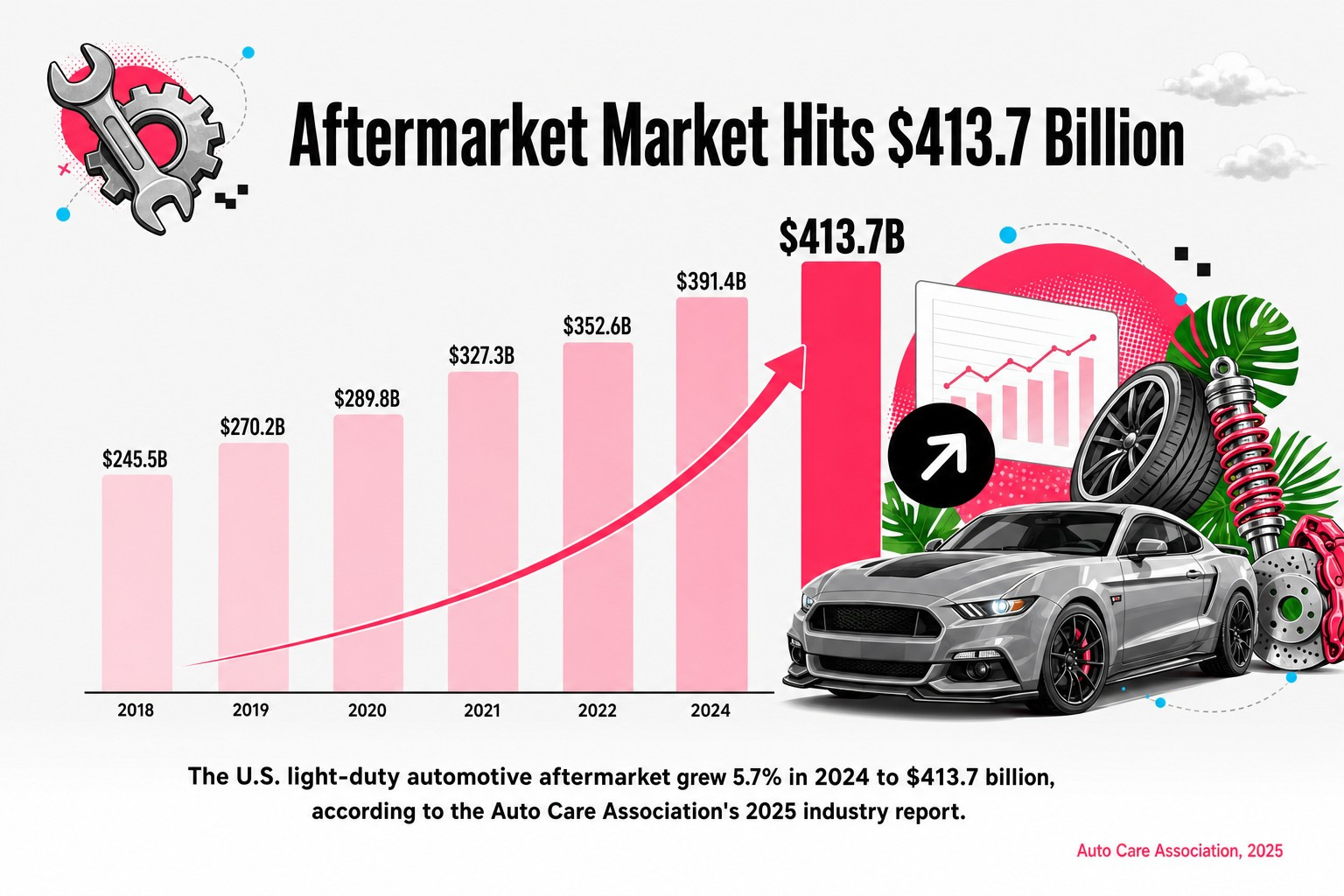
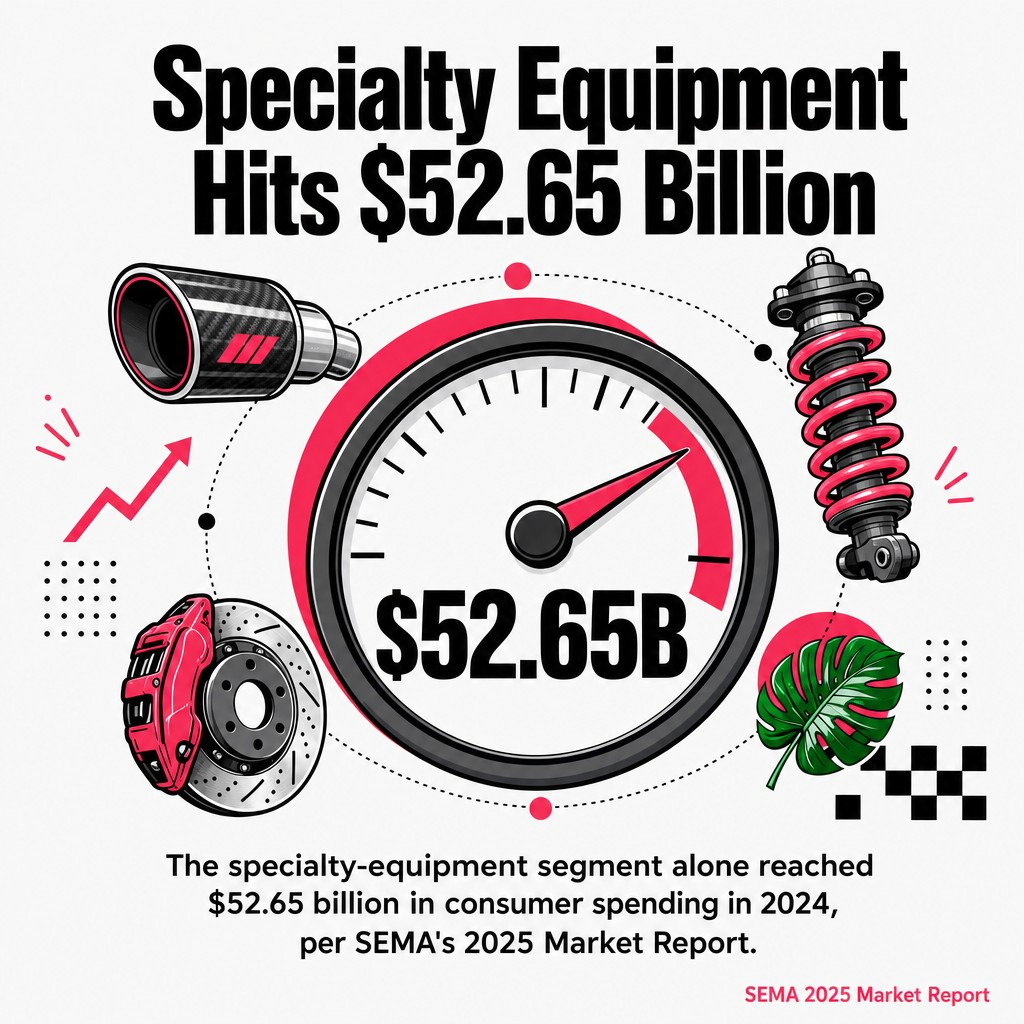
Aftermarket brand marketing is the practice of building demand, trust, and loyalty for auto parts, accessories, and performance products sold outside the original equipment manufacturer channel. The U.S. light-duty automotive aftermarket grew 5.7% in 2024 to $413.7 billion according to the Auto Care Association's 2025 industry report, and the specialty-equipment segment alone reached $52.65 billion in consumer spending that same year per SEMA's 2025 Market Report. That is not a niche. That is a category where serious marketing systems separate brands that scale from brands that stall.
I work with ecommerce brands selling parts, not vehicles. And the number of aftermarket brands I see with great products and genuinely broken marketing infrastructure is staggering. Strong SKU count, weak brand strategy. Big catalog, no coherent message. It does not have to be that way.
Aftermarket brand marketing covers every activity an auto parts or accessories brand uses to attract buyers, build preference, and drive repeat purchases outside the OEM channel.
The difference from most product categories is buyer sophistication. Car enthusiasts and performance enthusiasts do not just want a part. They want proof it fits, proof it performs, and proof the brand behind it knows what it is talking about. You cannot fake that. Generic "buy now" messaging lands flat with an audience that reads dyno sheets for fun.
The other difference is the catalog. A single aftermarket brand might stock thousands of SKUs across hundreds of vehicle applications. That complexity creates real marketing problems: fitment messaging, year/make/model targeting, inventory alignment. OEM parts marketing does not face this the same way. The dealer handles fitment by default. The aftermarket brand has to earn that trust explicitly.
Brands that get this right build marketing systems that account for complexity from the start. They don't bolt on strategy after the catalog grows to 10,000 SKUs. They design brand architecture, channel logic, and content infrastructure early. That is what "holding up at scale" actually means.
OEM parts marketing relies on captive distribution, while aftermarket marketing competes for attention across open, fragmented channels where brand trust is earned, not assumed.
Consider what an OEM parts team actually has: franchise dealer networks, mandatory service intervals, and a customer already in their ecosystem when a car goes to the shop. The aftermarket brand has none of that. It has to find the buyer, convince them the part fits, and then beat both OEM parts and competing aftermarket parts on value or performance.
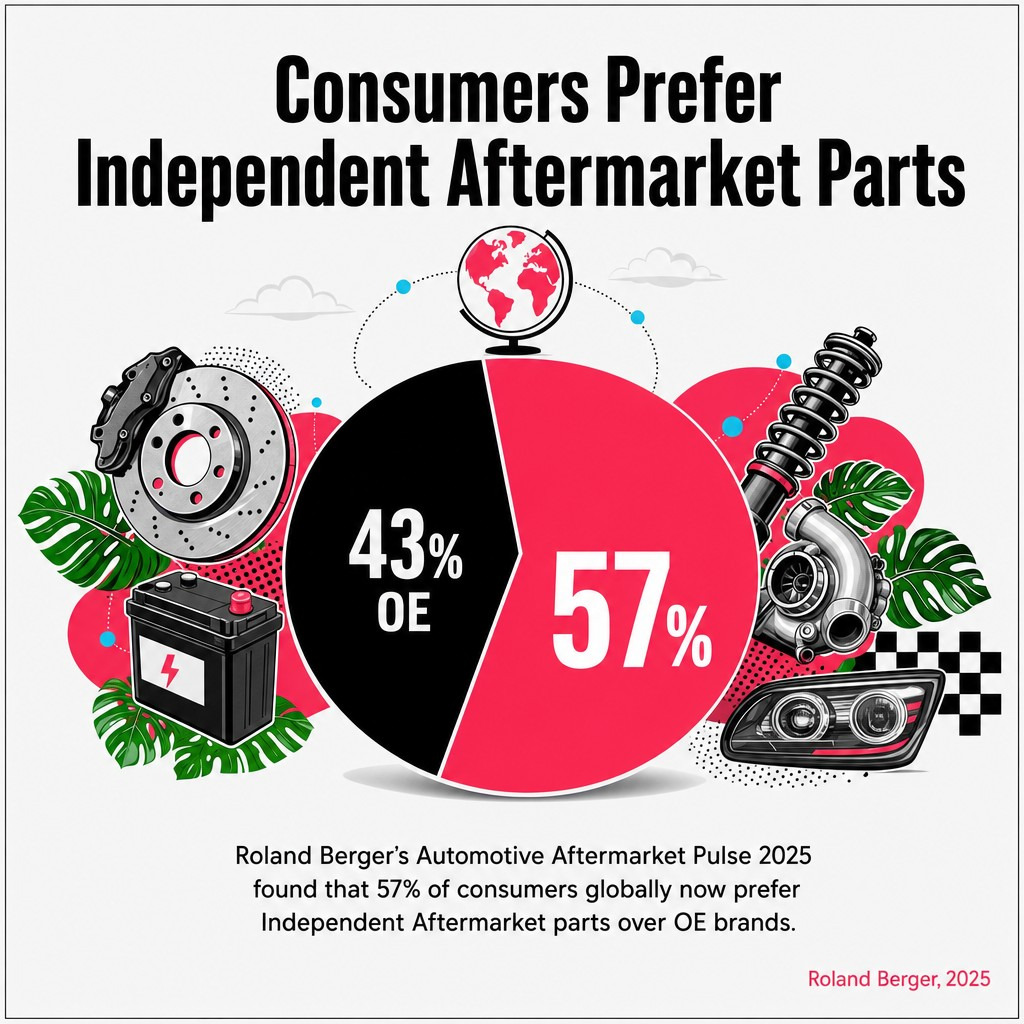
The purchase psychology is also different. Roland Berger's Automotive Aftermarket Pulse 2025 found that 57% of consumers globally now prefer Independent Aftermarket parts over OE brands. That preference shift is real. But preference alone does not drive purchase. Aftermarket marketing has to convert that preference into action, which means SEO that surfaces the right SKU, paid search that targets the right vehicle query, and content that closes the "will this actually fit?" objection.
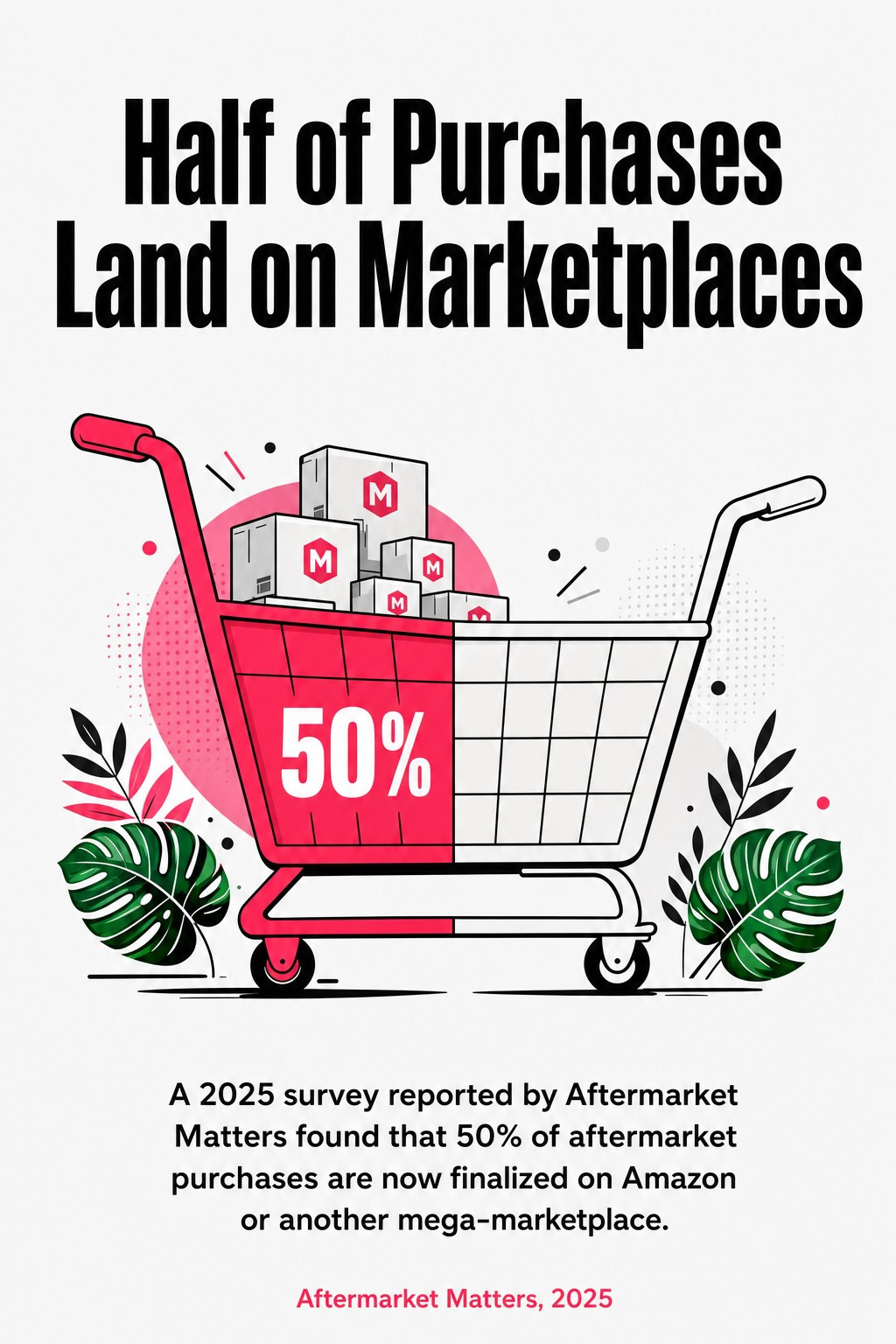
The distribution question matters too. A 2025 survey reported by Aftermarket Matters found that 50% of aftermarket purchases are now finalized on Amazon or another mega-marketplace. Half. That changes where aftermarket brand strategy needs to live. An OEM parts team does not worry about Amazon Buy Box suppression. An aftermarket brand absolutely does.
A working aftermarket brand strategy framework has four components: positioning, audience segmentation, channel architecture, and a content engine that ties them together.
Positioning is where most aftermarket brands get vague. "High quality at a fair price" is not a position. It is a press release. Strong aftermarket brand positioning answers a specific question: why should a performance enthusiast or a DIY mechanic choose your part over the three other options that fit the same vehicle? The answer lives in product specifics, brand heritage, or category expertise. Pick one and go deep.
Aftermarket audiences split into at least three distinct buyer types, and each needs different messaging.
Performance enthusiasts want specs, dyno data, and community proof. They watch YouTube builds, follow Instagram accounts with modified vehicles, and buy based on what people they respect are running. DIY mechanics want fitment certainty and installation confidence. They want torque specs, fitment guides, and a brand that picks up the phone. Fleet and commercial buyers want price, availability, and catalog breadth. One brand voice does not serve all three equally. Smart brand strategy either commits to one segment or builds clear sub-brand architecture that speaks to each.
Channel architecture defines where each part of the marketing system lives and how the channels feed each other.
A common mistake: aftermarket brands treat every channel as independent. Paid search brings traffic. Email sends promotions. Social posts product shots. Nothing connects. A scalable system runs paid search traffic to landing pages optimized for the exact vehicle query, captures emails with fitment-specific lead magnets, and retargets based on what the buyer looked at. The channels amplify each other. That is the difference between a marketing budget and a marketing system. For a deeper look at how one brand built exactly this kind of infrastructure, the Holley aftermarket brand marketing breakdown is worth reading in full.
The core competencies that separate successful aftermarket brands from forgettable ones are product development rigor, fitment data accuracy, customer service as a marketing function, and category authority through content.
Product development is a core competency in a way that OEM parts brands rarely have to treat it. Aftermarket brands live and die on whether a product actually delivers what the catalog promises. One bad batch, one incorrect fitment note, one misleading dyno claim, and the forums light up. Performance enthusiasts have long memories and loud voices. Building product development processes that feed accurate claims into marketing materials is not a back-office function. It is brand strategy.
Accurate fitment data is the unglamorous core competency that drives conversion for aftermarket brands more reliably than any creative campaign.
A buyer searching for a specific part for a 2018 truck with a specific engine configuration needs to land on a page that confirms fit immediately. If your product data is incomplete or your fitment lookup is broken, that buyer leaves. And they probably do not come back. Investing in clean ACES/PIES data and a reliable fitment widget is a marketing decision, not just an operations one. The brands that have done this well have made it a point of differentiation worth promoting explicitly.
Customer service is a visible marketing signal for aftermarket brands because enthusiast communities share both good and bad experiences publicly and loudly.
This is not abstract. A single resolved complaint thread on a popular forum can generate more brand trust than a paid campaign. A single ignored warranty claim can do the opposite. Aftermarket brands that treat customer service as part of brand strategy, not a cost center, build compounding social proof that paid media cannot replicate. Train your support team on technical specs. Give them authority to resolve issues fast. That is marketing.
The digital marketing channels that deliver consistent returns for aftermarket brands are paid search targeting vehicle-specific queries, Google Shopping, SEO built around fitment and application content, and email and SMS for lifecycle retention.
Paid search for aftermarket parts works best when campaigns are structured around vehicle applications, not just product categories. "Performance exhaust" is a broad match nightmare. "2020 F-150 5.0 cat-back exhaust" is a buyer. The specificity of aftermarket marketing queries is an advantage if your campaign structure matches it, and a budget leak if it does not.
Google Shopping campaigns for auto parts require clean product data, accurate fitment attributes, and deliberate bid strategy by margin tier.
The catalog complexity that makes aftermarket brand marketing hard also makes Shopping campaigns rewarding when structured correctly. You can bid aggressively on high-margin SKUs, protect brand searches, and use smart segmentation to surface the right products for the right vehicle queries. Running it flat with one campaign and one bid is leaving serious revenue behind. For a full strategic playbook on this, the 2025 automotive digital marketing strategy playbook covers the channel mix in detail.
Email and SMS marketing for aftermarket brands perform best when segmented by vehicle type and purchase history, not broadcast as generic promotions to the full list.
A buyer who purchased suspension components for a Jeep does not need emails about sedan floor mats. Segment by vehicle platform, purchase category, and engagement level. Build automated flows triggered by fitment lookups that did not convert. Set up post-purchase sequences that cross-sell compatible products. The brands doing lifecycle automation well are building repeat purchase rates that their paid media costs cannot match on acquisition alone.
Influencer marketing for aftermarket brands generates the highest trust conversion when it targets micro-creators with established expertise in a specific vehicle platform or performance category, rather than chasing follower counts alone.
Car enthusiasts trust other car enthusiasts. A channel with 40,000 subscribers who build the specific platform your product fits will outperform a generic automotive channel with 400,000 every time. The audience knows their expert. When that person installs your part, films the process, and gives an honest take, that is not an ad. That is a recommendation from someone they already trust. That distinction matters enormously to performance enthusiasts.
YouTube, Instagram, and TikTok each serve different functions in an aftermarket brand's social media strategy, and conflating them wastes both budget and creative effort.
YouTube is the research phase. Long-form install videos, product comparisons, and before-and-after performance content live here. Buyers come back to these repeatedly. Instagram handles visual identity and community. Modified vehicles, lifestyle content, and brand aesthetic live here. TikTok reaches a younger demographic of car enthusiasts who are earlier in their buying journey but building brand familiarity fast. Post the same content everywhere and you will do none of it well. Build platform-specific content that matches how each audience actually uses that platform.
The brands that have figured this out are worth studying closely. The Hoonigan brand-building case study is one of the clearest examples of an aftermarket-adjacent brand using social media platform architecture to build genuine community at scale.
Authenticity with enthusiast audiences is not a brand value to put on a website. It is a requirement for survival in aftermarket marketing.
Performance enthusiasts have finely tuned sensors for marketing that does not know what it is talking about. Wrong terminology, inaccurate spec claims, or influencer partnerships with creators who visibly have no connection to the vehicle platform will get noticed and called out. Hire people who actually work on cars. Partner with creators who run your products. Let them be honest about limitations. Honest endorsements from credible voices build more durable brand equity than polished campaigns from people who cannot tell a coilover from a strut.
Want to read all of our aftermarket content? Check out our auto parts marketing guide.
Content marketing and SEO for aftermarket brands produce compounding returns when content is built around specific vehicle applications, installation guidance, and performance comparisons rather than generic automotive topics.
The aftermarket ecommerce SEO opportunity is enormous and underexploited. Most aftermarket brands have thin product pages and no supporting content. A buyer searching "does [product] fit [year/make/model]" has high purchase intent and a very specific question. A brand with a well-structured application guide for that query captures that buyer. A brand with only a product page probably does not rank for it at all.
Application-specific content also builds the kind of topical authority that search engines reward. If you make exhaust systems and publish detailed guides for 20 common platforms, you signal expertise in that category in a way that isolated product pages cannot. That authority feeds organic rankings, which reduces paid search dependency over time. The WeatherTech growth lessons post shows exactly how a commitment to product-specific content compounds over time for an aftermarket brand.
One practical approach: audit your top 50 SKUs by revenue, identify the vehicle platforms they fit, and create one detailed application guide per platform. That is a 50-piece content plan with built-in SEO value that directly supports your existing catalog. Not abstract thought leadership. Fitment-specific content that converts.
Scaling aftermarket marketing systems requires measuring the right leading indicators: cost per acquisition by channel, repeat purchase rate by product category, and organic traffic share versus paid, not just total revenue.
Total revenue is a lagging metric. It tells you what happened. Leading indicators tell you what is about to happen and where the system is breaking down. If organic traffic share is declining while paid spend is holding revenue flat, you are on a treadmill. The paid channel is propping up a gap that content and SEO should be filling.
The macro conditions right now favor aftermarket brands that have built strong retention systems. The average age of U.S. light vehicles reached a record 12.8 years in 2025, and new vehicle financing rates near 7.6% and used vehicle rates near 11.4% as of early 2026 are pushing consumers to hold onto their vehicles longer. Older vehicles need more maintenance parts and present more upgrade opportunities. Aftermarket brands with solid email and SMS retention infrastructure, strong SEO for application-specific queries, and a trusted brand presence with enthusiast communities are positioned well for this environment.
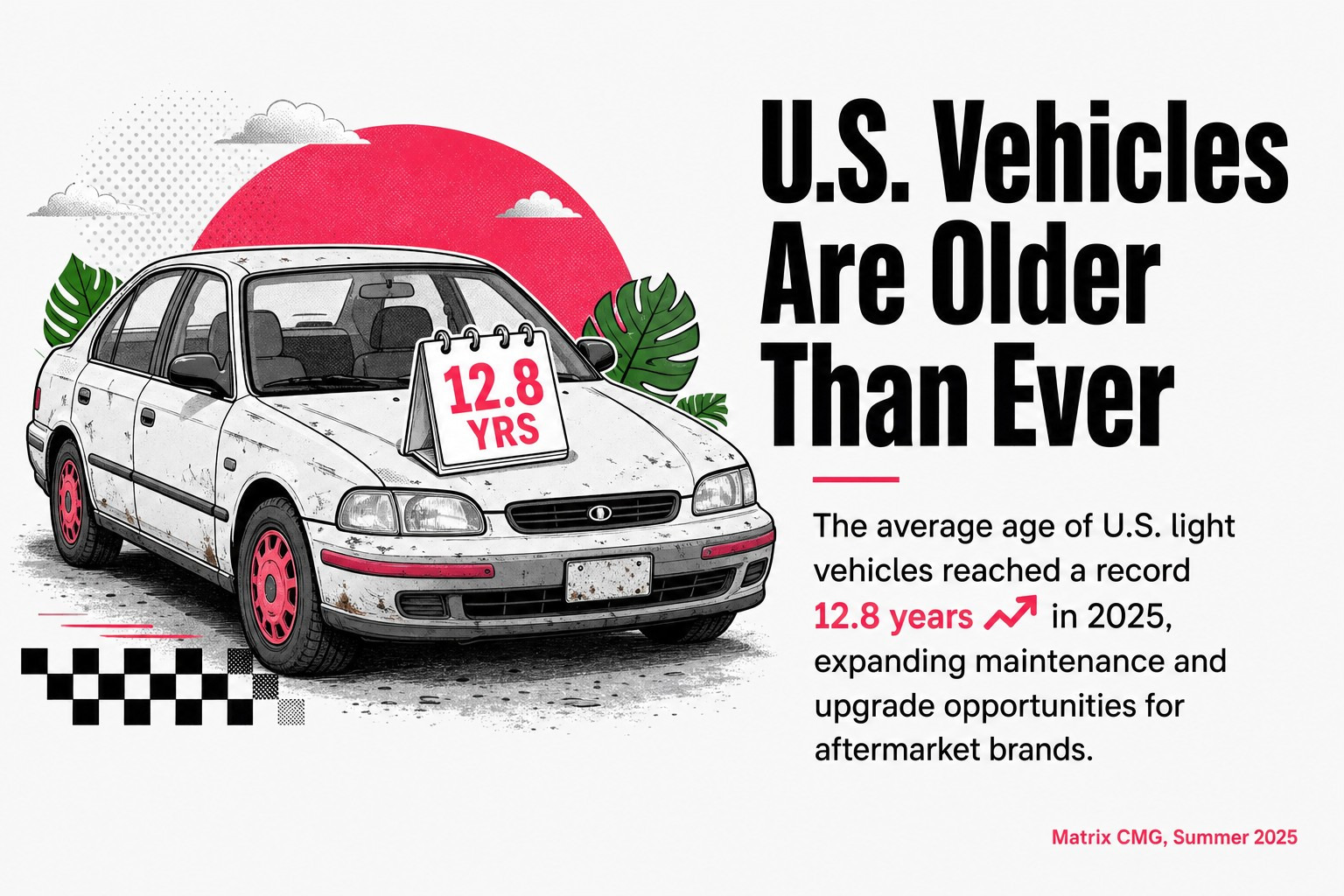
Average U.S. vehicle age hit a record 12.8 years in 2025 — expanding maintenance and upgrade demand.
The brands that will struggle are the ones that built revenue on paid acquisition alone, have thin content, and have not invested in brand trust with enthusiast audiences. When acquisition costs go up, and they will, there is no retention system to fall back on. Build the system before you need it. That is what scaling actually looks like in the automotive aftermarket.
If you want to see what a full-scale aftermarket brand strategy looks like in practice, the Flowmaster brand-building marketing breakdown covers how a legacy aftermarket brand built durable marketing infrastructure across channels. The principles hold whether you are a startup with 200 SKUs or an established performance brand looking to tighten up a system that has gotten messy at scale.
Aftermarket brand marketing is the set of strategies and tactics auto parts, accessories, and performance brands use to build awareness, drive purchases, and create customer loyalty outside the OEM dealer channel. It covers digital marketing, content, influencer partnerships, paid search, SEO, and brand positioning.
Aftermarket marketing requires earning buyer trust from scratch, managing complex catalog fitment messaging, and competing across open distribution channels including Amazon, brand websites, and distributors. OEM parts marketing operates within a captive dealer ecosystem where brand trust is inherited from the vehicle manufacturer.
Paid search targeting vehicle-specific queries, Google Shopping with clean fitment data, SEO built around application guides, and email and SMS lifecycle automation produce the most consistent returns for aftermarket brands. Social media platforms including YouTube and Instagram are important for brand building and influencer marketing with car enthusiasts.
Influencer marketing is highly effective for aftermarket brands when it targets creators with genuine expertise in a specific vehicle platform. Micro-influencers with dedicated enthusiast audiences typically outperform large generalist automotive channels because their audience trusts their product recommendations.
Application-specific content targeting year/make/model queries, installation guides, fitment confirmation pages, and performance comparison content drive the most valuable organic traffic for aftermarket brands. These content types match high-intent buyer searches and build topical authority that supports broader ranking performance over time.