
Most ad agencies run the same playbook regardless of what you sell. For large auto parts catalogs where fitment, compatibility, and spec data drive the sale, that playbook holds ROAS steady while margin quietly thins out underneath it. SCUBE fixes the product feed, fitment data, and campaign structure that generic accounts miss. Built for high-SKU, spec-driven auto parts catalogs.







When a shopper searches for brake pads for their 2018 Ford F-150 3.5 EcoBoost, they know exactly what they want. If Google Shopping surfaces a generic "brake pad" product listing without including the specific year or trim level of the vehicle model within its title, the shopper will still click through to the website. However, when they arrive at the website, they cannot confirm whether the product is an appropriate fit for their vehicle model. This ultimately leads to no sale being made. The money spent from the ad is real; however, the potential sales revenue generated from the ads is nonexistent.
This describes the typical paid search dilemma found in auto parts e-commerce. It is typically not a pricing or budget dilemma. Rather, as you delve into larger catalogs, the primary concern is that the feed controls what products campaigns can display, what keywords these campaigns can trigger based upon the search query entered by the consumer, and where spends go in terms of what products generate actual revenue. Thusly, a Shopping Campaign operating off of a poor-quality feed does not produce less efficient spending. Instead, it is incapable of presenting the correct product for each related search.
Ultimately, ROAS may appear healthy due to a small number of high-volume branded SKUs carrying the bulk of the accounts overall performance. Conversely, the majority of available demand (long-tail fitment-specific, non-branded demand) is either unable to be displayed correctly or never displays at all. The account appears to function well. However, it fails to capture value from the vast majority of its potential target audience based upon how poorly it is configured.
A structure-based solution is required. To achieve sustainable and scalable results from paid search throughout your entire large-fitment heavy catalog, you need to ensure your feed quality, campaign architecture, and branded/non-branded segmentation align. Once you address these issues, spend will follow contributions rather than volumes, and your account will be able to truly scale.
Large auto parts catalogs are a prime example of how misleading ROAS can be. An auto parts catalog may have a small number of high-selling branded products, and a larger number of low volume or poorly performing SKUs. As a result, an account level ROAS will look great; however, the true picture regarding margins is far less appealing.
This is the most common type of structural failure with auto parts PPC accounts: The account is using a metric (ROAS) to measure performance that does not clearly show where dollars are being spent. As spend scales, you don’t get proportional increases in revenue. Instead, you further widen the gap between the top-performing SKUs, which continue to drive sales, and the bottom performing SKUs that continue to capture additional budget.
When branded and non-branded campaigns aren't separated — in structure, in reporting, and in bid strategy — branded performance masks non-branded underperformance. A buyer searching 'brake pads for 2018 F-150 3.5 EcoBoost' is not searching for a specific brand. They're searching by fitment. When that search lands on a branded campaign with generic ad copy and a weak product feed, the click happens and the conversion doesn't. The account reports the spend. It doesn't isolate where the loss occurred.
When you don’t include the year, make, model & trim in your titles, Google Shopping will surface the wrong products. When your listings lack part number or OEM cross-reference, the exact match demand is lost. When MPNs are either missing or are being provided inconsistently, Google Shopping has no way to tell which items have similar SKUs and spends your ad dollars guessing.
Not having a quality feed not only hurts your performance but also eliminates any benefit to campaign optimization. Regardless of how much bid adjustment, audience segmentation and budget allocation changes occur at the campaign level, it cannot recover the structural issue that is causing the underlying issue.
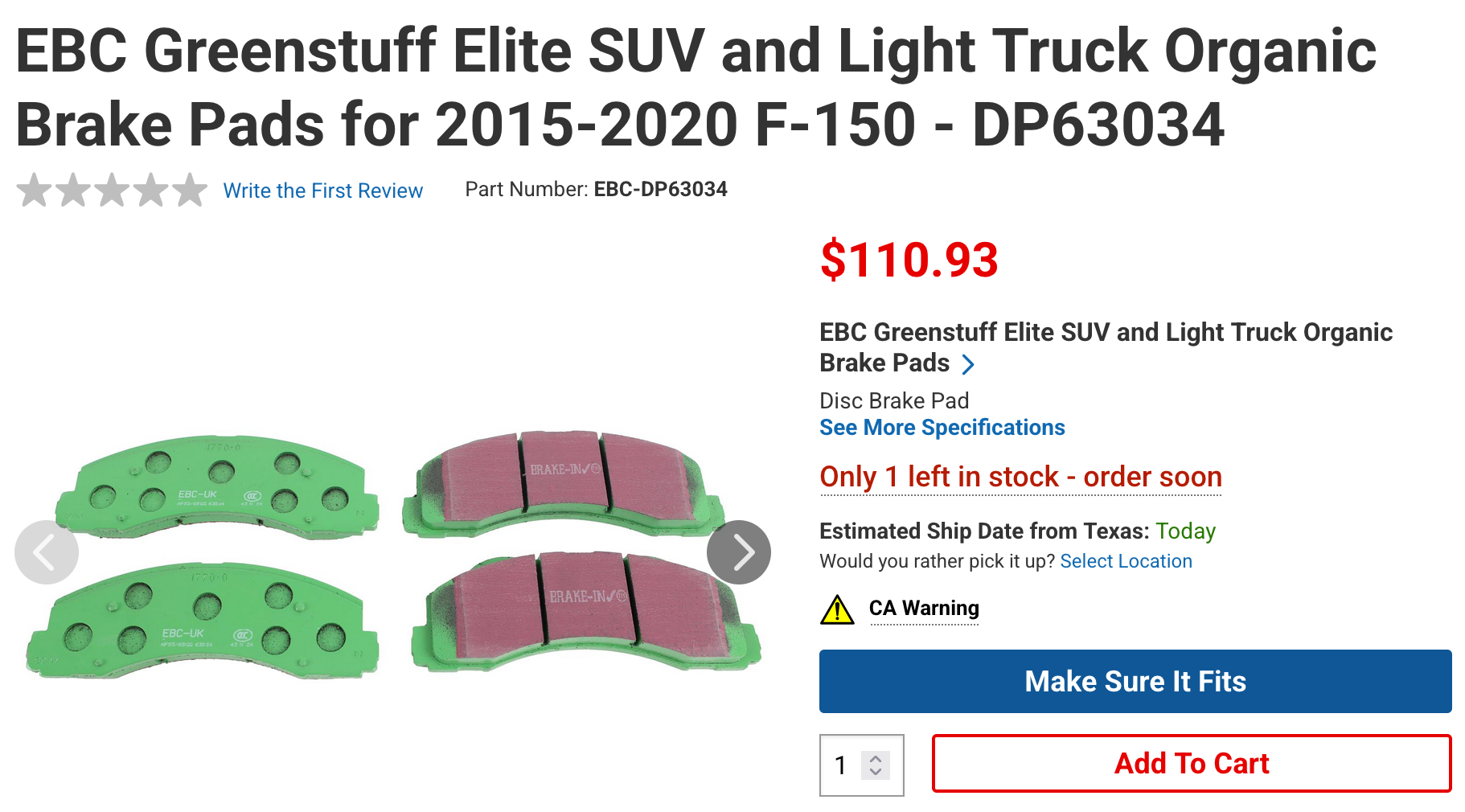
Proper year, make, model information in product title
Throwing more budget at an auto parts ad account with structural issues will just amplify those problems. It results in budget going to the wrong SKUs. More impressions but irrelevant clicks. Blended reporting that obscures non-branded and branded demand.
An auto parts account shows acceptable efficiency at moderate spend, so budget increases. ROAS softens. The assumption is that the channel is maturing. The real issue is that the structural problems that were manageable at lower spend become load-bearing at higher spend. The account was small enough that the problems hadn't compounded yet.
In auto parts PPC, the main determinant of which SKUs get shown is the product feed. After the feed is structurally sound, then optimizations like campaign structure, bid strategy, audience targeting can occur. But without a strong feed, you’re throwing money at Google, whose systems don’t have the proper data to match a query to your product, and will end up guessing, leading to wasted clicks.
Consider a shopper who knows exactly what they want: brake pads for 2018 Ford F-150 3.5 EcoBoost. If your shopping listing doesn’t contain the YMM, your product is not going to show. It may surface for a generic term like “brake pads”. But that’s much lower intent and higher competition. That's the gap between a feed built for catalog management and a feed built for paid search performance.
Search queries that reflect the demand a properly structured feed can capture:
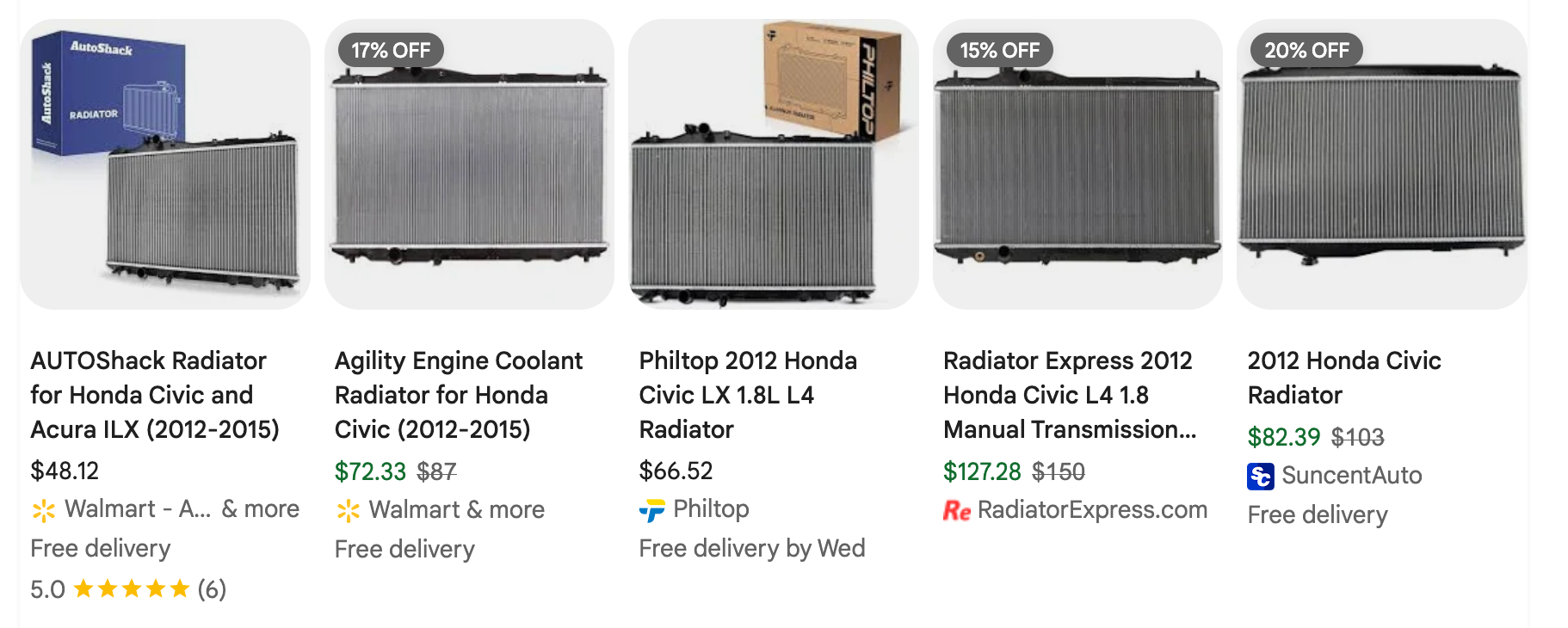
Each of those queries has a buyer who has already identified their vehicle and their need. The only variable is whether the feed surfaces a product that matches the fitment context they searched with. Feeds that include year, make, model, engine, and trim in titles and attributes match. Feeds that don't, don't.
Not every category maps to fitment the same way, and that matters more in Shopping than anywhere else. A mismatched attribute doesn't just weaken a page. It routes spend to the wrong query entirely.
For example, let’s take wheels as a category. They are filterable two ways: by vehicle year, make, and model, or independently by bolt pattern, since every Y/M/M maps to a specific one. A feed built only around Y/M/M titles misses buyers searching bolt pattern directly, and Shopping has no attribute to match against.
Tires behave differently too. For OEM-spec replacement, year/make/model predicts a tire size reliably, so vehicle context still earns its place in the title. But that same size, often the identical SKU, cross-references across many vehicles. The relationship is many-to-many, not one-to-one. Once a buyer is upgrading rather than replacing, size alone stops being enough. Clearance and offset need their own attributes, or the feed will confidently surface a size that fits the number and not the vehicle.
A significant share of auto parts paid search intent arrives through part numbers, OEM references, and aftermarket cross-references. These buyers have already identified the exact part — they're looking for a source, comparing prices, or confirming that an equivalent will work. They convert at high rates when the right product surfaces. They leave when it doesn't, because the search itself was the qualification.
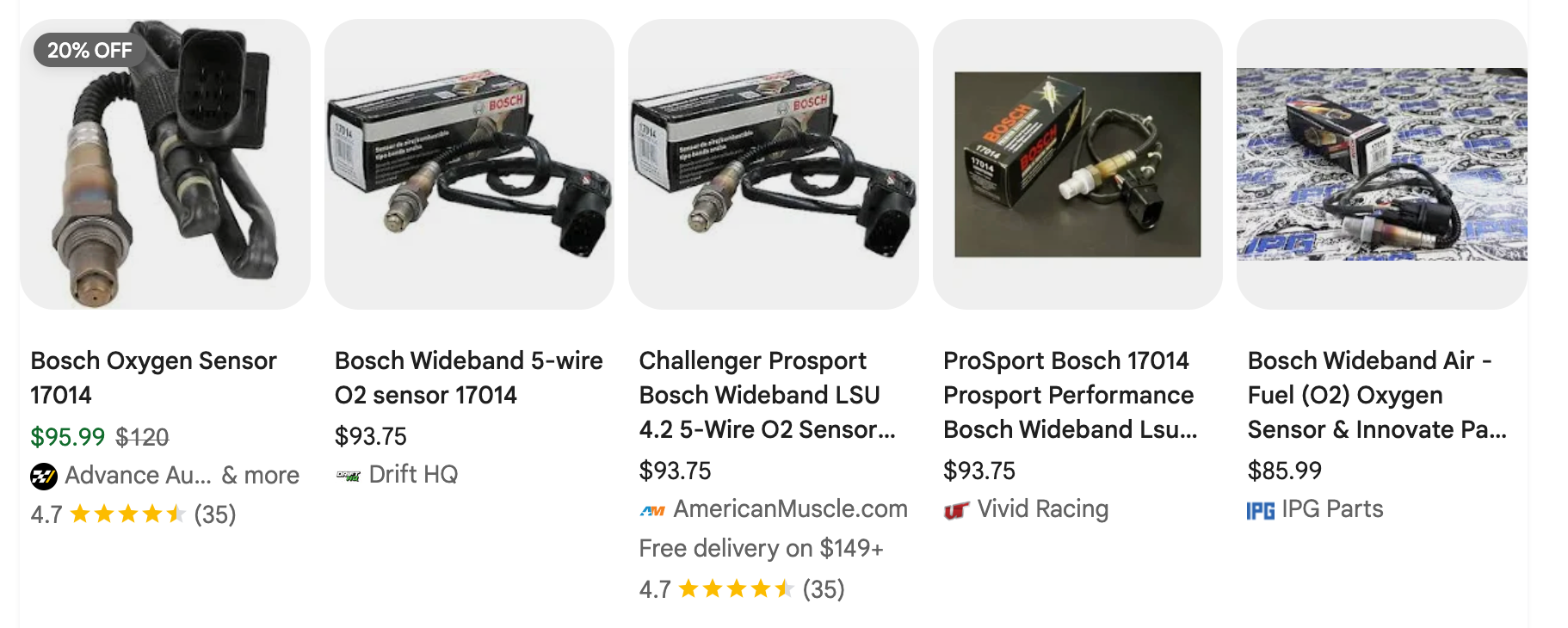
Example query patterns that part number and cross-reference data in the feed can capture:
When MPNs, OEM part numbers, and aftermarket cross-references are present in feed attributes, Shopping can match these queries to the right product. When they're absent, the query produces no match or a wrong match and the spend goes elsewhere.
OEM and aftermarket buyers evaluate products differently, search differently, and need different signals to convert. OEM searches carry higher price tolerance and lower willingness to accept ambiguity about fit. The buyer needs to see that the part matches the original specification. Aftermarket searches often include explicit comparison intent: equivalent, alternative, replacement. The page, and the ad, needs to do persuasion work OEM searches don't require.
When OEM and aftermarket SKUs are structured identically in the feed, with the same title format and the same attributes, Shopping treats them interchangeably. Spend distributes based on bid and relevance signals that don't reflect how differently those two buyer types behave. Separating them (in feed structure, in campaign organization, and in ad copy) lets each serve the intent that actually produced the click.
There's a second split worth building into ad copy and feed segmentation alongside OEM versus aftermarket: replacement buyers versus upgrade buyers. A replacement buyer wants the fastest possible confirmation that a listing matches what failed. Speed and certainty win. An upgrade buyer is comparing specs and isn't in a hurry. The same product can need two different ad angles depending on which buyer the query signals.
There’s no shortage of demand for aftermarket parts. Your campaigns aren’t creating that demand, you’re trying to capture and convert it. That’s done only when the campaign structure, feed quality, and landing pages are capable.
A buyer searching for a specific part for a specific vehicle is a near-complete purchase signal. The campaign running for that search should be one of the easiest conversions in the account. When it isn't (when spend is absorbed by the wrong SKUs, the wrong match types, or landing pages that don't confirm fitment) there’s usually a clear reason.
A weak feed means a Shopping campaign that can match query keywords but not fitment. To illustrate, take a search for a 2017 WRX STI coilover. Lack of feed data means that search shows your listing, but with no vehicle data. The customer clicks, because they see the part name, but they land on a product page with no fitment details. They end up leaving. A high-intent purchase lost due to lack of data.
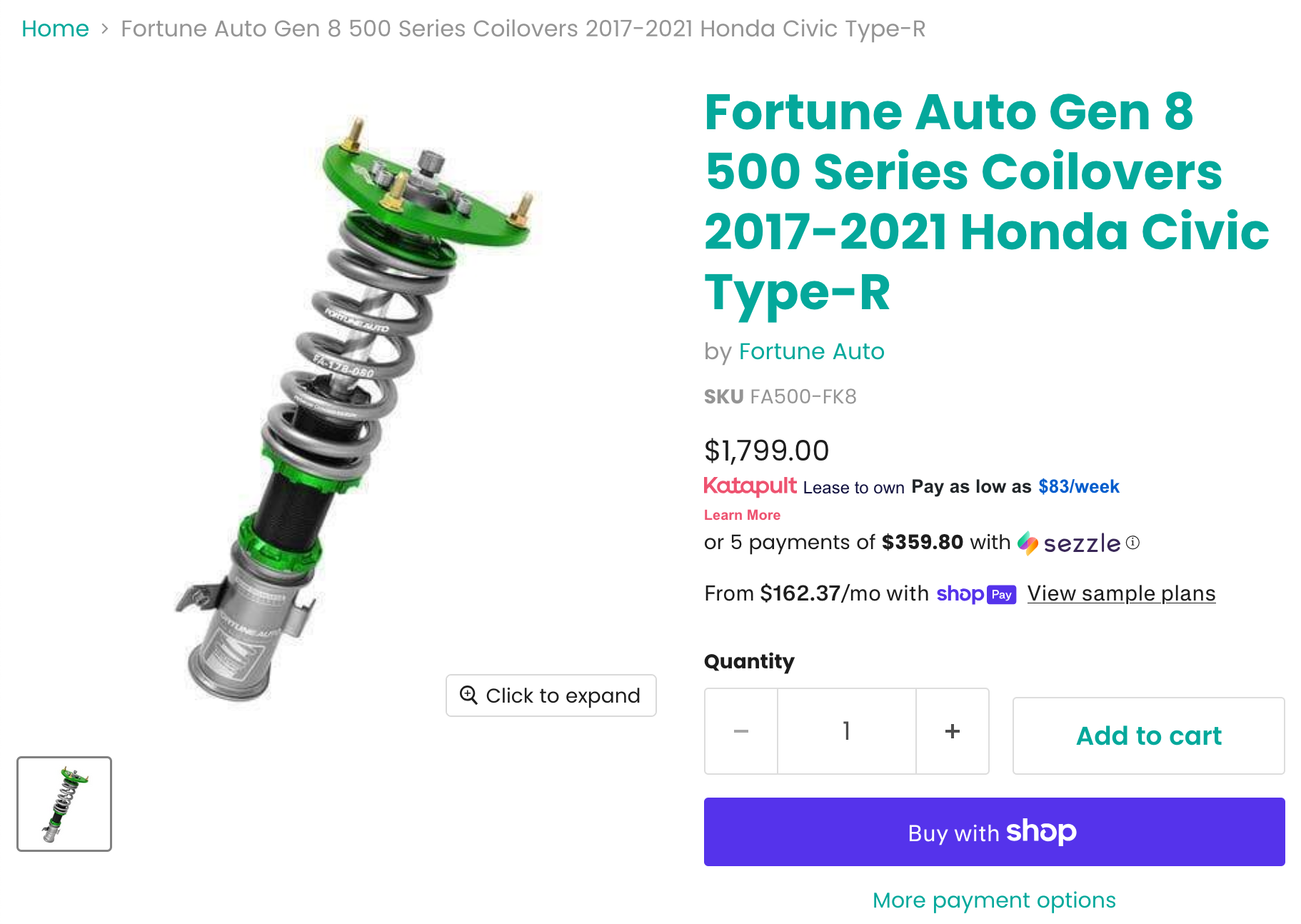
As that example illustrates, it’s both a feed and a landing page problem. But, a feed fix can stop that wrong click from happening as often. A recovery path saves the ones that still land wrong, and it's usually cheaper to build than people assume.
This failure mode is invisible in campaign reporting because the click registered and the impression count looks normal. The conversion gap shows up in ROAS breakdowns by SKU — when you can see that spend is concentrating on a small number of performing products while hundreds of others absorb budget and return nothing. Without that visibility, the account looks like it's working at the aggregate level while leaking margin at the SKU level.
Search campaigns in auto parts accounts that aren't structured around fitment intent match broad query patterns instead of specific vehicle-and-part combinations. A campaign targeting 'brake pads' will match 'brake pads for 2018 F-150 3.5 EcoBoost' but the ad copy, the landing page, and the bid were set for a generic query, not a fitment-specific one. The click cost the same as a fitment-matched click. The conversion rate was lower, and the buyer who didn't find confirmation left.
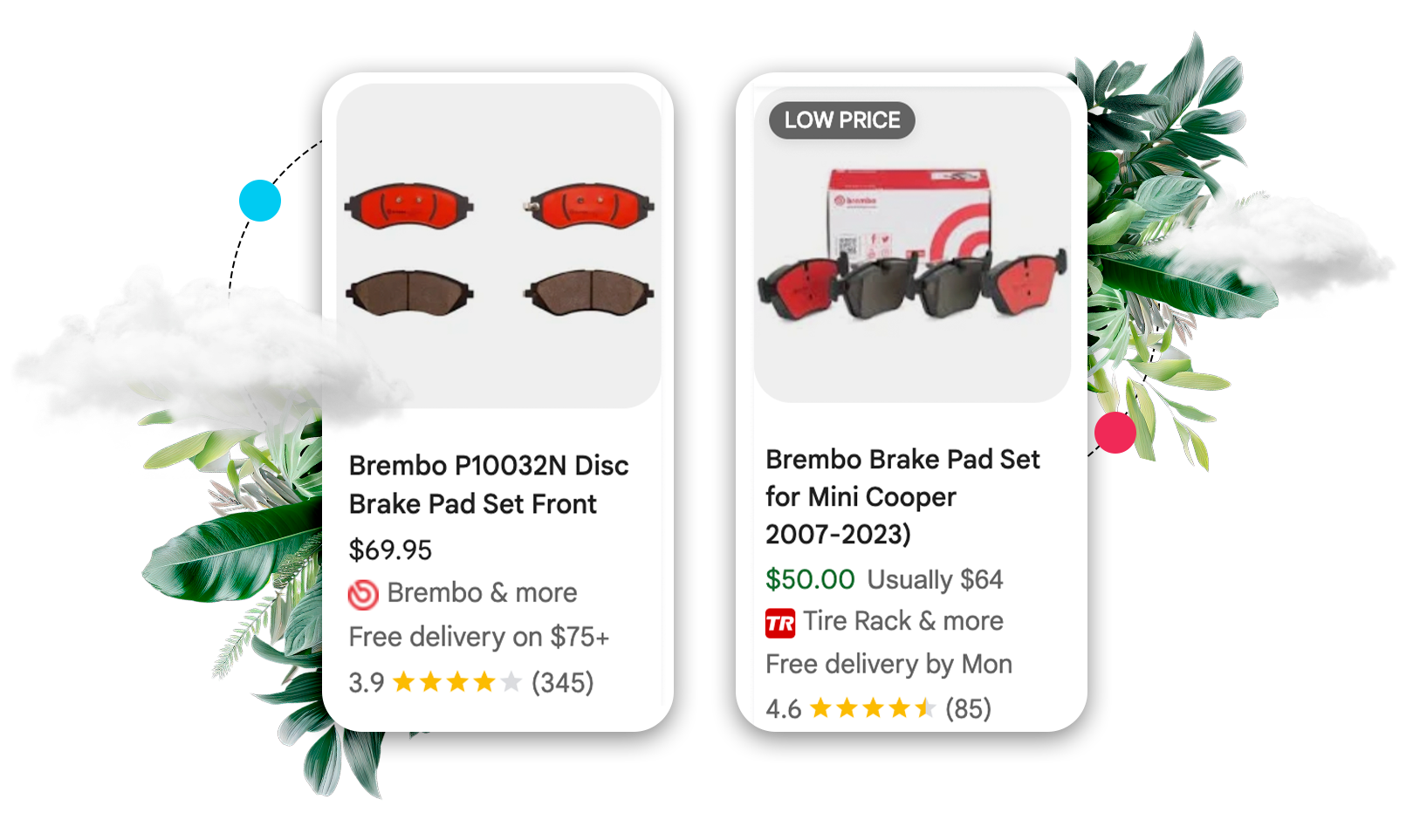
Structuring Search campaigns around fitment intent (with ad groups built around vehicle families, model years, and part categories) changes what the campaign can do. Ad copy can reference the specific vehicle. Landing pages can surface fitment-matched inventory. Bids can reflect the higher conversion probability of a buyer who searched with their vehicle already identified.
Performance Max isn’t wrong for auto parts, but there needs to be structure in place. Otherwise, these campaigns default to branded queries, returning visitors, and the highest-converting SKUs, the paths of least resistance. But that means non-branded fitment demand gets cast aside, because PMax’s optimization signal isn’t being directed that way.
Asset groups built around vehicle makes, product categories, and fitment tiers give the algorithm a cleaner signal about where to find demand. Feed segmentation that separates high-margin from low-margin SKUs keeps PMax from optimizing toward volume at the expense of contribution. Without that structure, PMax learns from whatever the account has been doing — which often means compounding existing biases toward branded and repeat-purchase traffic.
Auto parts PPC underperformance comes from the same structural sources in most large accounts: a feed that doesn't expose fitment data at the query level, spend split between branded and non-branded demand without separation, campaigns built around keyword volume rather than buyer intent, and ROAS used as a success metric instead of a constraint. The fix sequence follows the diagnosis: clean up what's distorting performance, then build the structure that can scale.
Having ACES/PIES data in the system isn't the same as having a feed that converts it. Standardized fitment data still has to be decomposed into the specific titles, attributes, and identifiers Shopping actually matches against. A clean data source with no reconstruction work behind it will still surface the wrong product for a fitment-specific query — it's clean, it's just not built for what Shopping is asking of it.
Feed reconstruction starts with titles. Year, make, model, engine, and trim get pulled from fitment data and structured into title formats that match how buyers search. Part numbers, OEM references, and aftermarket cross-references get added to attributes so Shopping can match exact-intent queries. SKUs with incomplete fitment data get identified and either enriched or removed from paid paths where they're absorbing spend without producing matches.
This is the structural work that everything else depends on. A campaign running on a rebuilt feed operates differently than one running on an export from the catalog management system. The products that surface change. The queries they match change. The clicks that come in carry higher purchase intent because the feed is now serving fitment-specific results to fitment-specific searches instead of generic products to broad queries.
Branded and non-branded campaigns can’t be treated the same. They need separate budgets, bid strategies and, often overlooked, reporting. Branded campaigns protext existing demand and bring back high-intent return buyers efficiently. New buyer acquisition is done through non-branded campaigns built to capture part-number, fit-ment specific searches.
Getting these two types of campaigns separated means you’ll see a more accurate picture of ROAS. Because branded campaigns often mask non-branded underperformance. And now each campaign can optimize toward the right signal.
Shopping and PMax campaigns get segmented by margin tier and fitment completeness, not just by product category. High-contributing SKUs with complete fitment data run in tightly structured campaigns with clear asset groups and specific ROAS targets that reflect their actual margin. Low-margin or feed-incomplete SKUs get removed from paid paths or placed in lower-priority campaigns where spend is capped.
ROAS in this structure functions as a floor, not a target. It prevents spend from going to SKUs that can't return it. Actual success is measured in contribution after ad spend — which SKUs are generating profitable orders, which categories are growing non-branded demand, and where scaling spend would increase margin rather than just volume.
Search campaigns get restructured around how auto parts buyers actually search: by vehicle make and model family, by part category and fitment tier, and by the specific part-number and cross-reference queries that indicate a buyer who has already done the identification work. Ad copy references the vehicle context when the query carries it. Landing pages surface fitment-matched inventory rather than generic category pages.
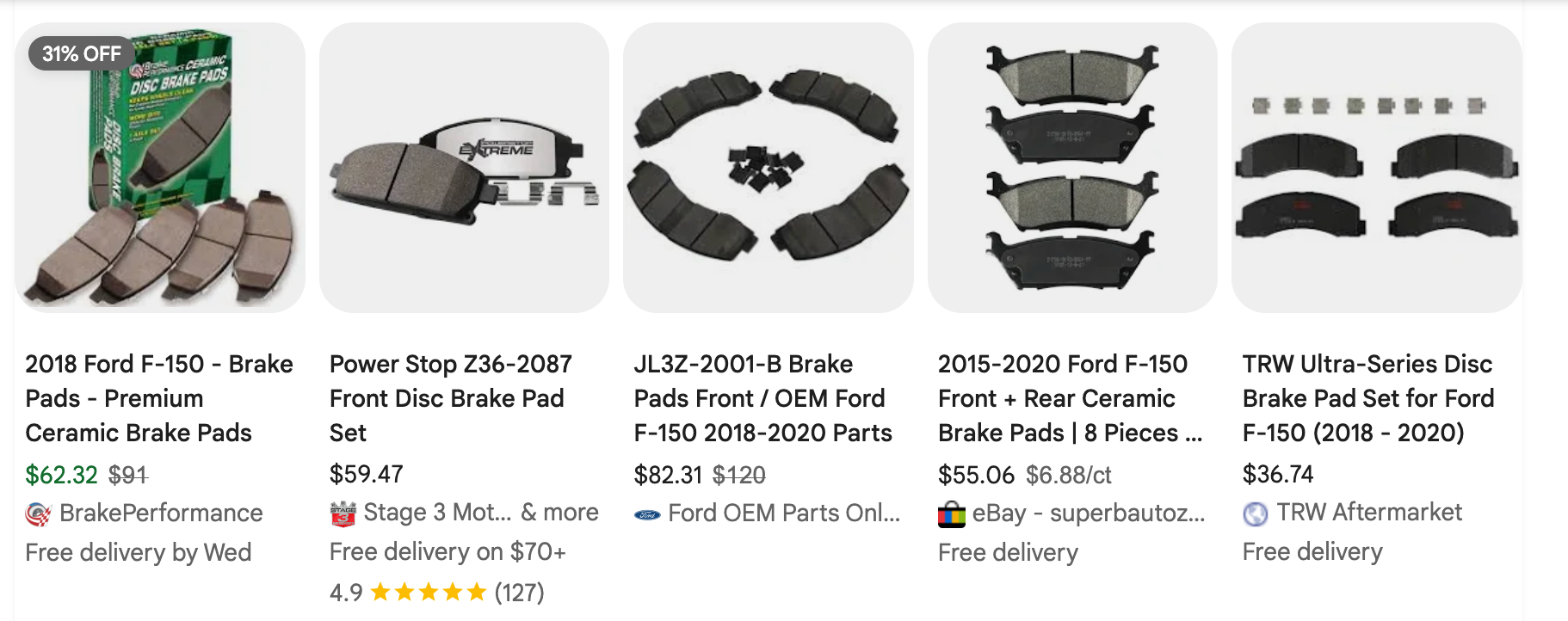
Example demand patterns that get mapped to structured Search campaigns:
When that structure is in place, Search spend lands on queries the account was built to convert, rather than queries that happened to match a broad keyword.
The first measurable changes come from rebuilding the feeds and the structural adjustments to campaigns. When Shopping surfaces fitment-matched products, the click quality will improve before the click quantity will. All the spend previously being directed at lower converting SKUs are now directed toward the ones that generate orders. These are not dramatic jumps in account performance. It’s simply the account performing closer to where the product offerings and margins should already produce.
Reporting and insights change once branded and non-branded campaigns are separated. Non-branded performance becomes visible on its own — what it costs, what it converts, and where it's underperforming relative to the available fitment-specific demand in the market. That visibility changes what decisions get made. Budget that was reinforcing branded demand starts moving toward non-branded acquisition where the new buyer growth actually is.
A feed built around fitment data, campaigns segmented by contribution tier, and spend separated by demand type creates an account structure that can absorb more budget without amplifying existing problems. New SKUs enter a feed framework that already knows how to expose them to the right queries. New vehicle fitment coverage gets added to campaigns that are already structured around vehicle intent. Scaling spend produces proportional revenue growth because the structure that determines where spend goes was built for scale from the start.
The compounding here is different from SEO. It's faster to establish and more directly tied to budget decisions. But the durability is structural in the same way: an account built on feed quality and fitment data doesn't lose its advantage when a competitor raises bids. It holds it because the products it's surfacing are matching the intent the buyer arrived with, and the products competing against it aren't.
This service produces results for auto parts catalogs with paid search spend and structural problems preventing that spend from returning what it should.
This service is not suited for accounts that want campaign optimization layered on top of a weak feed without fixing the feed. Bid adjustments, audience exclusions, and automated bidding strategies all operate downstream of product data quality. When the feed is surfacing the wrong products to the wrong queries, no campaign-level change corrects that. The structural work has to happen first.
It's also not suited for early-stage stores with thin catalogs, no fitment data in their product system. The right time for this work is when the catalog has depth, spend has accumulated, and the gap between what the account should be producing and what it's actually producing has become visible.
Because an aggregate ROAS is blending SKUs that behave very differently. Branded parts can inflate ROAS while non-branded SKUs absorb spend and don’t convert well. The account ROAS will look fine, but it’s not telling you the full story. ROAS is useful as a floor — it prevents the worst waste. It's not useful as a success metric in a large catalog with uneven SKU performance.
Feed reconstruction comes first: year, make, model, and trim into titles, part numbers and cross-references into attributes, low-performing or feed-incomplete SKUs removed from paid paths. Then campaign restructuring: branded and non-branded demand separated, Shopping and PMax segmented by margin tier, Search campaigns built around fitment intent rather than broad keywords. The campaign-level work only produces the right results when the feed underneath it is exposing the right products to the right queries.
In most accounts, meaningful improvement requires feed work but not necessarily a full rebuild at once. The prioritization follows the same logic as the account: which categories have the most spend, the weakest fitment data in titles, and the largest gap between clicks and conversions. Feed work concentrated there first produces measurable changes faster than trying to enrich every SKU simultaneously. The full catalog improves over time. The highest-impact categories improve in the first cycle.
Not on scale. Large marketplaces carry more SKUs and more reviews than most independent catalogs will. They compete on fitment speed — buyers can evaluate compatibility and options quickly. That gap closes when your Shopping listings surface fitment-matched products with fitment-specific titles, so the buyer who searched by vehicle sees a product that matches their context before they see a marketplace listing that requires them to filter. At the individual query level, a fitment-specific listing from a specialist catalog outperforms a generic marketplace listing when the data behind it is stronger.
Feed changes show up faster than SEO structural work because Shopping reflects updated feed data within days of resubmission. Campaigns restructured around separated branded and non-branded demand typically show cleaner performance separation within the first billing cycle. Meaningful non-branded ROAS improvement (where new buyer acquisition is happening at target cost of sale) is usually visible within 60 to 90 days of the structural work going live, depending on how much existing performance data the account has to learn from.
SEO and PPC address the same fitment-specific demand but serve different moments in the buying relationship and different parts of the query landscape. Paid search captures high-intent queries immediately — part number searches, exact fitment queries, comparison searches — where organic results may not yet rank or may rank lower. SEO compounds over months and captures long-tail demand that paid search can't cost-effectively run on at individual query level. The feed work that strengthens Shopping performance also strengthens organic product visibility. The fitment data and catalog structure improvements that drive ecommerce SEO gains also improve what Shopping has to work with. The two reinforce each other when they're built on the same product data foundation.
The traits clients value about partnering with SCUBE on their growth projects.


"Thanks to the efforts of the SCUBE Marketing team, the company has hit all of their monthly goals since launching the e-commerce platform in 2019. The ROI in particular exceeded their expectations and credit it to the team's attention to detail and clear communication throughout the partnership."







The SCUBE Game Plan is a focused review of how complex, spec-driven catalogs behave inside paid channels. It’s designed to surface what’s contributing to performance, what’s masking underlying issues, and where structure is quietly working against you. If there’s a fit, we walk through the findings in a ~60 minute conversation, looking at:
The goal is a clearer picture of how the system is behaving, so decisions stop relying on averages or assumptions.
.avif)