
The automotive parts retail space has transformed dramatically in the digital age. Car dealers and auto dealerships alike now compete for attention across crowded digital channels, not just showroom floors. As someone who’s helped numerous eCommerce businesses navigate the complex world of paid advertising, I’ve seen firsthand how the right PPC strategy can accelerate growth for automotive parts retailers, helping them drive sales, generate leads, and attract car shoppers actively searching online. I’ve also witnessed the costly mistakes that happen when businesses dive in without proper preparation, wasting every dollar spent on inefficient PPC channels.
Pay-per-click advertising on Google offers automotive parts retailers unprecedented access to motivated buyers actively searching for products for the same vehicle or a specific repair need. Unlike traditional automotive advertising, banner ads, or social ads where you cast a wide net and hope for the best, PPC allows you to place your parts and accessories directly in front of car shoppers who are already using services online to find solutions. When built with the right keywords and proper keyword match types, PPC becomes a powerful tool to increase sales and generate new leads.
If you're evaluating whether to manage this in-house or with a specialist, see how SCUBE handles Google Ads for auto parts brands — from feed structure to campaign segmentation →
However, the automotive PPC company landscape comes with unique challenges and opportunities that require specialized knowledge. From selecting broad keywords versus specific keywords to choosing the right match types and geo targeting, success depends on understanding how search intent works in different geographic locations and local markets. In this comprehensive guide, I’ll walk you through everything automotive retailers need to know before launching their first automotive PPC campaigns on Google Ads.
Before launching your first campaign, you need to understand how the automotive parts industry performs in the PPC arena across different PPC channels. This applies not only to parts retailers but also to car dealers and auto dealerships trying to improve dealership’s visibility online. Let’s look at some crucial benchmarks that will help set realistic expectations and identify real sales opportunities.
Before launching your first campaign, you need to understand how the automotive parts industry performs in the PPC arena. Let's look at some crucial benchmarks that will help set realistic expectations.
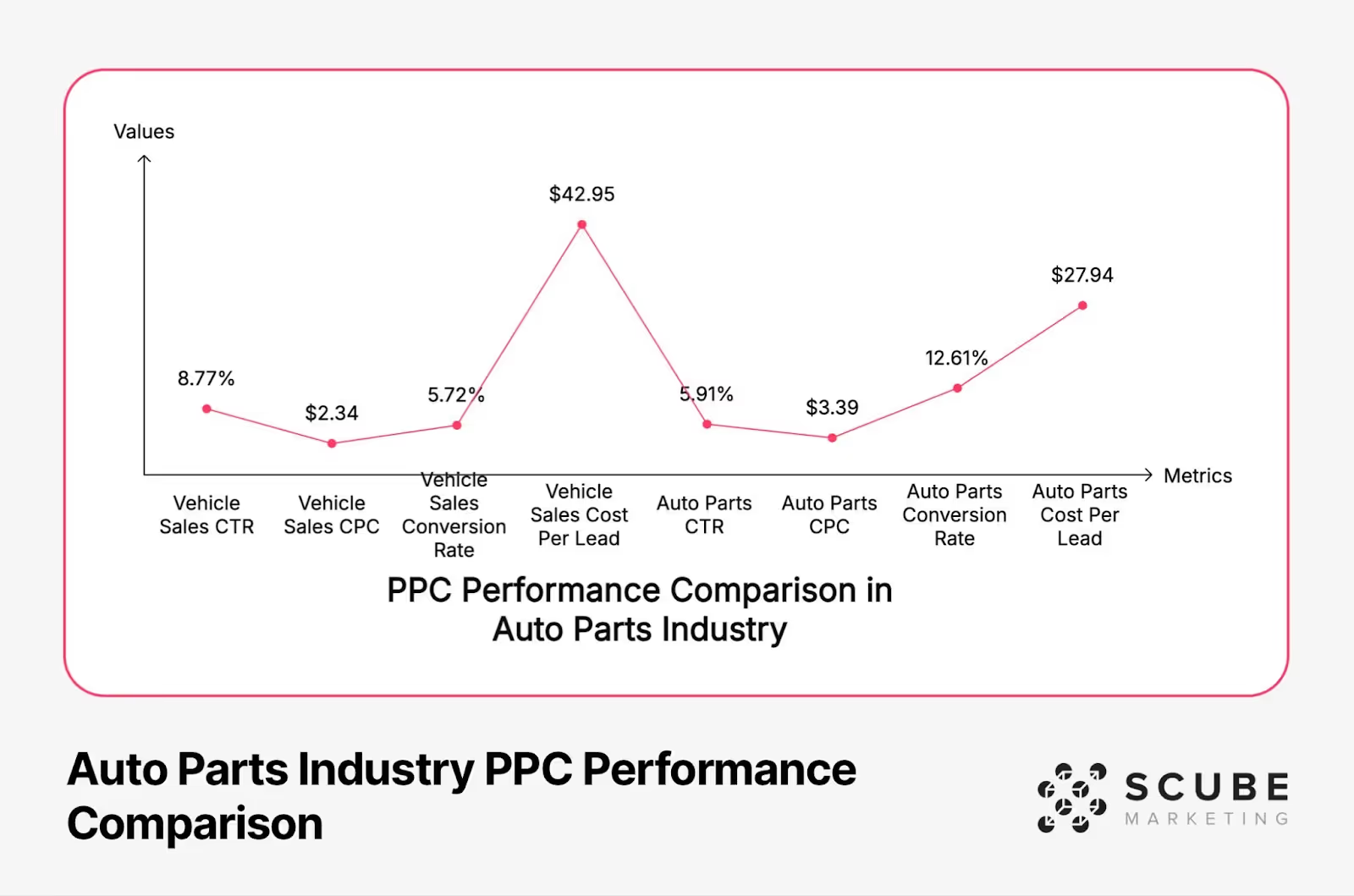
The automotive industry sees distinct performance differences between vehicle sales and parts and repair segments. Auto parts and repair businesses achieve a click-through rate (CTR) of 5.91 percent compared to 8.77 percent for vehicle sales. (Source: Promodo)
While this might initially seem discouraging, the parts segment actually has significant advantages in other key metrics. Let me break this down further with a comprehensive comparison that highlights how PPC can drive more leads when campaigns are structured correctly.
The data tells an interesting story. While auto parts retailers might get fewer clicks and pay more per click, those who do click are more than twice as likely to convert. This results in a significantly lower cost per lead, meaning each dollar spent delivers more value. When measured properly in Google Analytics, PPC proves to be an efficient way to generate leads and increase sales for parts-focused retailers.
The automotive parts retail space online is dominated by a few major players. Amazon commands 16.2 percent of all clicks in the auto parts category, followed by AutoZone at 14.51 percent and Advance Auto Parts at 12.93 percent. (Source: Adthena)
This concentration means smaller retailers, car dealers, and regional auto dealerships must be strategic about where and how they compete in their local market. The good news is that there are plenty of specialized niches where focused retailers can gain a competitive edge by using Google’s Keyword Planner to uncover specific keywords and avoid overly competitive broad keywords.
The automotive sector sees significant results from PPC efforts, with 66 percent of automotive-related calls from search engines originating from PPC ads rather than organic search. (Source: LLC Buddy) This reinforces how paid search, dynamic ads, and other PPC channels can directly influence sales opportunities when executed correctly.This reinforces how paid search, dynamic ads, and other PPC channels can directly influence sales opportunities when executed correctly.
Today’s auto parts buyers and car shoppers are thoroughly research-driven, often interacting with multiple digital channels before converting. A remarkable 95 percent of vehicle buyers use digital sources during their research process. (Source: Invoca)
While this statistic refers to vehicle purchases, parts buyers show similar behavior. They research compatibility for the same vehicle, compare prices, evaluate brand recognition, and look for the best shipping options before making a decision. This research-heavy approach creates multiple touchpoints where PPC, supported by geo targeting and smart campaign structure, can influence the buyer’s journey and deliver more leads.
By aligning your main keyword strategy with buyer intent, using the right keywords informed by Google’s Keyword Planner, and tracking performance through Google Analytics, automotive retailers can turn PPC into a reliable engine to drive sales, improve dealership’s visibility, and generate new leads consistently across geographic locations.
Looking for a clear, connected view of how auto parts marketing actually works across SEO, PPC, feeds, and marketplaces? Explore our complete guide to auto parts marketing and ecommerce →
Having worked with numerous eCommerce businesses, I've noticed that the most successful PPC campaigns are built on thorough preparation. For automotive parts retailers, this preparation phase is absolutely critical.
Before spending a single dollar on PPC, automotive marketers need clear, measurable goals. Are you looking to increase overall sales? Promote specific product categories? Clear excess inventory of particular parts? Launch a new product line? Each goal requires a different approach.
Your PPC strategy should align with your broader business objectives. Here’s a framework I recommend for automotive retailers setting up their first campaign:
With clear goals established, you can build automotive ppc campaigns that drive meaningful business results rather than just generating clicks or traffic.
Keyword analysis in the automotive space presents unique challenges. Parts compatibility, technical specifications, and brand preferences create a complex search landscape.
When conducting keyword research for auto parts, consider these categories:
The key to successful keyword research is understanding how your auto parts inventory management system organizes your products. This helps ensure your Google Ads account structure aligns with your product organization, making management more efficient.
Before launching campaigns, study what how your competitors drive targeted traffic using internet marketing on Google. Use tools like SEMrush or SpyFu to see your competitor keywords, what their ads look like, and what landing pages they’re using.
Pay special attention to:
This intelligence helps you identify gaps in the market and avoid direct competition with larger retailers who might have bigger budgets.
With your preparation complete, it's time to set up your Google Ads campaigns. Here's where many automotive retailers make costly mistakes. Let me walk you through the essential elements of proper campaign setup.
Your campaign structure should reflect both your business organization and how potential customers search for your products, organized into effective ad groups. For automotive parts retailers, I typically recommend a structure based on product categories and vehicle compatibility.
Here’s how you might structure campaigns for an auto parts retailer:
This multi-dimensional approach allows you to optimize for different search behaviors. Some potential customers search by part type, others by vehicle, and others by specific brands they trust.
When creating your Google Shopping campaign structure, you’ll want to organize products logically based on category, price point, and margin to enable strategic bidding. You don't want to use general automotive ppc campaigns to attract customers as they may be too generic and yield low ROI.
Google Shopping ads are particularly effective for automotive parts retailers because they showcase your products visually right in the search results. However, they require a properly formatted product feed.
For automotive parts, your product feed needs several critical elements:
Google Vehicle Ads require even more detailed feeds, including specific make, model, price, and mileage information. (Source: Promodo)
Beyond basic setup, several account-level optimizations can significantly improve performance for automotive retailers, helping to optimize campaigns effectively:
First, implement proper tracking to measure the full customer journey. Many auto parts purchases involve multiple research sessions before buying. Understanding how to properly track customer behavior through your sales funnel is essential for optimizing campaigns.
Second, set up audience lists based on user behavior. Someone who viewed brake parts but didn’t purchase is a prime candidate for remarketing. Creating these target audience segments allows for more personalized messaging.
Finally, utilize negative keywords aggressively. The automotive space has many ambiguous terms. For example, if you sell aftermarket accessories but not OEM replacement parts, you’ll want to add terms like “OEM,” “factory,” and “original” as negatives to avoid irrelevant clicks.
Determining the right budget for your PPC campaigns is crucial. Too small, and you won't generate meaningful data or results. Too large, and you risk inefficient spending before optimizing your campaigns.
Determining the right ad budget for your PPC campaigns is crucial. Businesses across industries typically invest between $9,000 and $10,000 per month on PPC advertising. (Source: eCommerce Bonsai)
However, this figure varies widely based on business size, goals, and competitive landscape. For automotive parts retailers just starting with PPC, I usually recommend a more modest initial investment focused on learning and optimization.
Here’s a practical budget planning framework specifically for automotive parts retailers to effectively allocate their marketing budget:
The key is to start with a budget that allows for sufficient data collection while limiting risk. For most automotive retailers, this means ensuring you can get at least 100 clicks per campaign before making ongoing optimization decisions.
Setting realistic ROI expectations is crucial for automotive retailers to measure and optimize campaign performance. While the average cost per lead for auto parts and repair businesses is $27.94, your specific numbers will vary based on your product prices and margins. (Source: Promodo)
To calculate your target cost per acquisition (CPA), use this formula:
Target CPA = Average Order Value × Profit Margin × Target ROAS Percentage
For example, if your average order is $85 with a 40% margin, and you want a 3x return on ad spend:
Target CPA = $85 × 0.4 × 33% = $11.33
This means you should aim to spend no more than $11.33 to acquire a customer to achieve your target ROI.
Proper budget allocation across different campaign types is critical for automotive retailers. I typically recommend this allocation approach:
As you gather data, adjust these allocations based on performance. Some retailers find shopping campaigns dominate their performance, while others see better results from targeted paid search campaigns.
Once you've built a solid foundation, several advanced strategies can significantly improve performance for automotive parts retailers.
Implementing AI-driven bidding can reduce the cost per click by 10-30% compared to manual management, which is crucial for how the advertiser pays for each click. (Source: Promodo)
Google’s automated bidding strategies work particularly well in the automotive space due to the complex relationship between search terms, user intent, and conversion likelihood. However, they require sufficient data to perform optimally.
For automotive parts retailers, I typically recommend this progression of bidding strategies:
The key is providing enough conversion data for Google’s AI to identify patterns in who converts and who doesn’t. Mastering Google Ads A/B testing can accelerate this learning process by quickly identifying what messaging and targeting works best.
Understanding advanced remarketing strategies can significantly improve your campaign ROI. For automotive parts retailers, creating these audience segments is particularly valuable for effective remarketing ads:
These segments allow you to create highly relevant remarketing campaigns that address specific user needs and objections.
Google’s Search Generative Experience (SGE) is changing how users interact with search engine results pages, requiring adaptive ad strategies due to potential CTR declines in shopping queries. (Source: Promodo)
For automotive parts retailers, this means placing greater emphasis on:
By optimizing for AI understanding, you position your products to be featured in both traditional ads and new AI-generated responses.
The final piece of the puzzle is measuring success and continuously optimizing your campaigns. For automotive retailers, several key metrics deserve special attention.
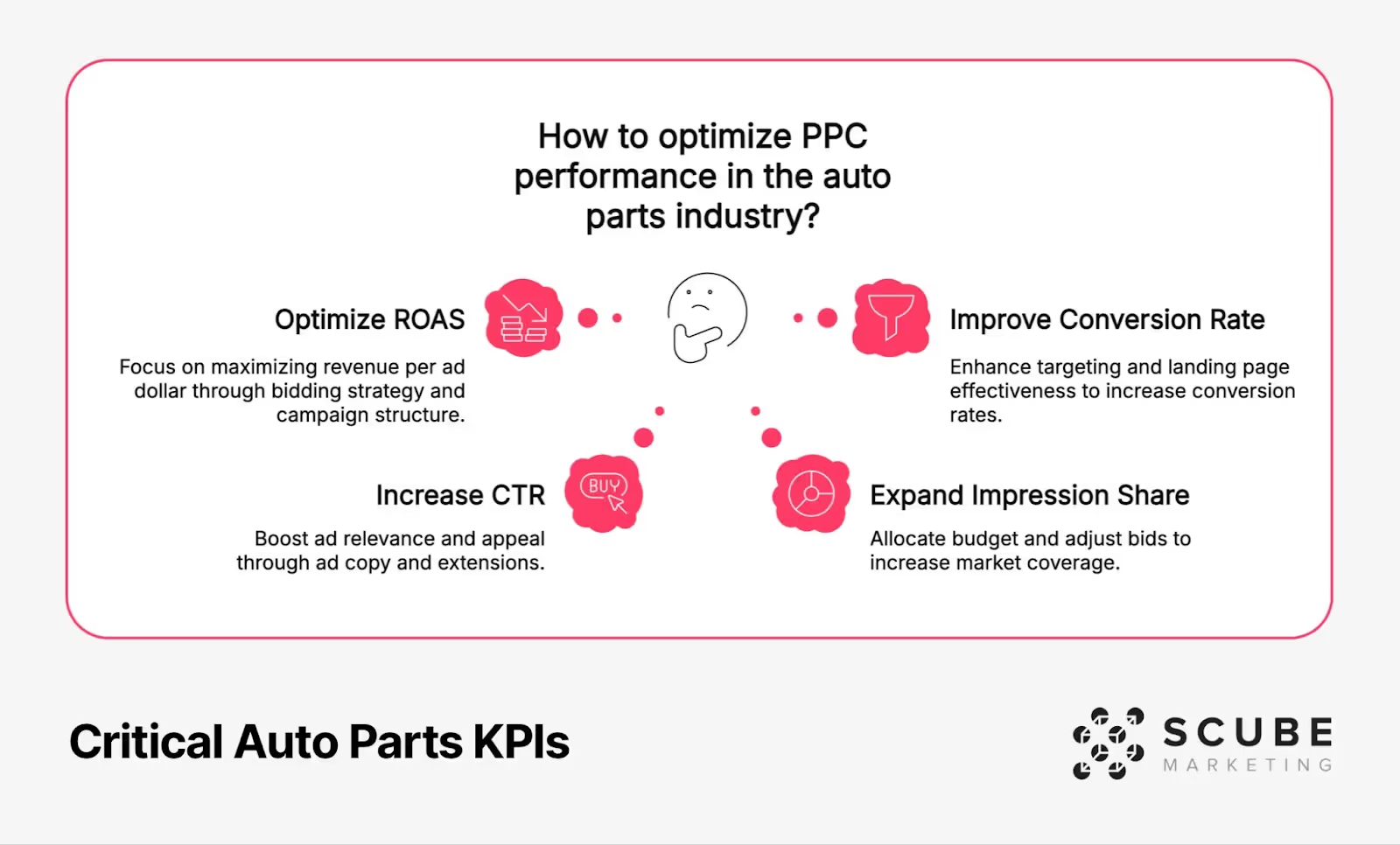
While every auto business has unique goals, these KPIs are particularly relevant for automotive parts retailers to measure their performance in search engine results:
Track these metrics religiously and establish a regular optimization schedule to know whats working and whats not for your automotive ppc performance. Weekly reviews for high-spend campaigns and bi-weekly for others is typically sufficient for your digital marketing strategy.
Continuous testing of compelling ad copy is essential for improving performance. For automotive parts retailers, these test elements typically yield the biggest improvements:
Many automotive retailers wonder how to effectively boost their social media presence alongside PPC. While paid social can complement search campaigns, I typically recommend establishing your Google Ads foundation first before expanding to social media platforms.
PPC success comes from continuous, conversion optimization. For automotive parts retailers, optimize campaigns starting with these high-impact areas:
Successful optimization requires both regular scheduled reviews and responsive adjustments when performance changes occur.
Starting PPC for your automotive parts retail business doesn’t have to be intimidating. With proper preparation, structure, and strategy, Google Ads can help your automotive business grow.
Remember these key takeaways:
The digital landscape for automotive parts continues to evolve rapidly. By establishing a strong PPC foundation now, you’ll be well-positioned to adapt to changes and outperform competitors who take a less strategic approach.
Ready to accelerate your automotive parts business with Google Ads? Start with the framework outlined in this guide, measure your results carefully, and optimize based on data. Your ideal customers are searching for your products right now - it’s time to make sure they find you.