
Aerospace buyers don't search for marketing slogans.
They search for AS9100 certification details, FAA inspection protocols, and specific aircraft platform qualifications. When they find vague marketing copy instead of documentation, they leave. When they find detailed compliance explainers and certification case studies, they stay, they read, and they eventually request quotes.
This is how aerospace SEO actually works. Your compliance documentation is your competitive advantage.
I've worked with technical B2B companies for years. The pattern is clear: companies that publish their internal compliance documentation outrank competitors with bigger marketing budgets. Procurement officers and engineers don't want to be sold to. They want proof you understand their regulatory requirements.
This article shows you how to turn your existing compliance work into SEO authority. You'll learn which compliance topics aerospace buyers actually search for, how to convert internal documentation into public-facing content, and why smaller MRO providers can outrank larger competitors by being more transparent about certifications.
Aerospace search behavior is different from consumer markets.
Your buyers aren't browsing. They're researching specific regulatory requirements for long-term partnerships worth hundreds of thousands or millions of dollars. The buying cycle takes 6-18 months because multiple stakeholders need to verify your qualifications.
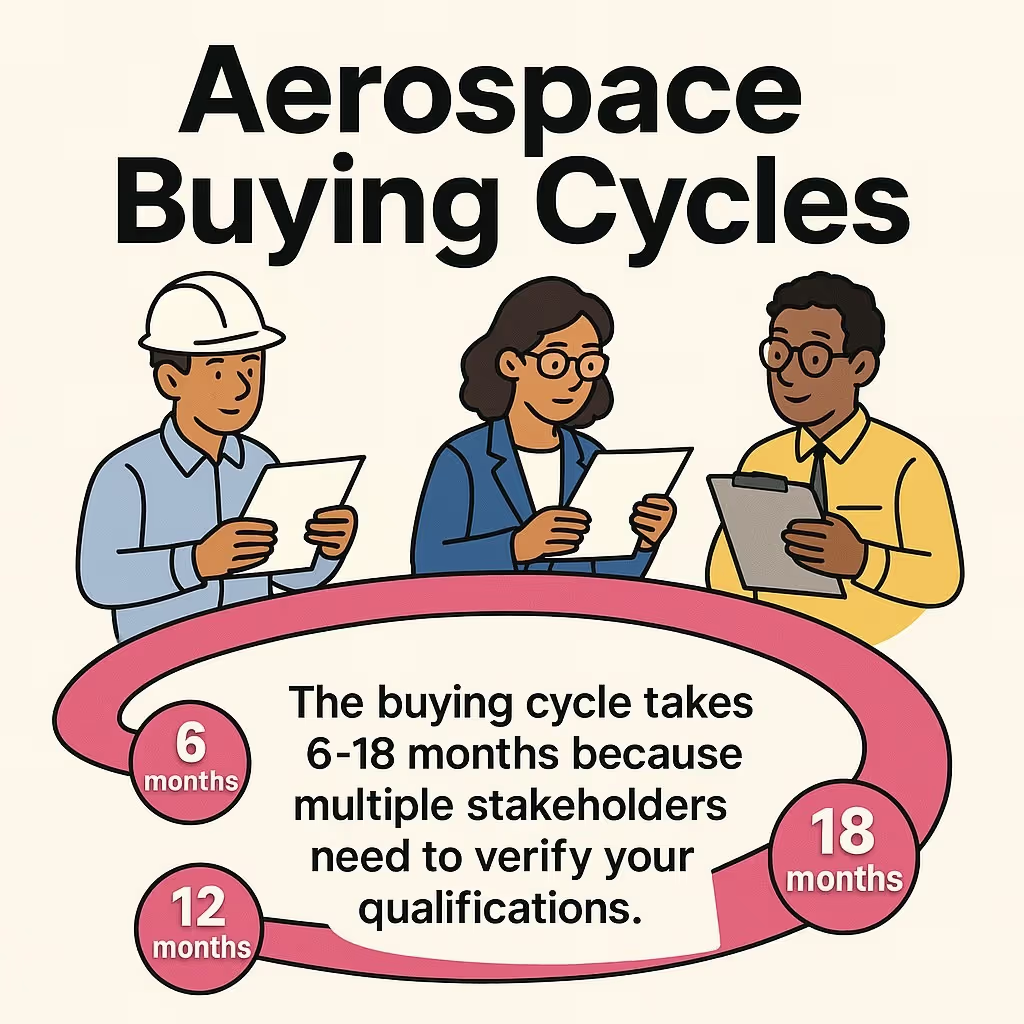
Aerospace B2B buying cycles often span 6–18 months with multiple stakeholders verifying qualifications.
Search terms reflect this reality. Aerospace buyers use queries like "AS9100 certified MRO for Airbus A320" or "FAA Part 145 repair station turbine blades." These searches have low volume but extremely high intent.
Most aerospace companies make three critical mistakes with SEO. They hide technical details behind contact forms, they use vague capability statements instead of specific certifications, and they treat compliance documentation as confidential when portions could be public.
The companies that rank well do the opposite. They publish detailed compliance case studies, they create searchable content around specific aircraft platforms and certifications, and they make technical specifications easy to find.
Your internal documentation already contains the exact information aerospace buyers search for. The challenge isn't creating new content. It's reformatting what you already have for search visibility.
Volume metrics don't matter in aerospace SEO. Getting 50 qualified visitors from procurement officers at defense contractors is more valuable than 5,000 random visitors.
Traditional SEO focuses on traffic growth. Aerospace SEO focuses on matching your capabilities to specific buyer requirements. A single qualified lead can result in a multi-year contract.
This changes how you measure success. Don't track total traffic. Track searches for your specific certifications, aircraft platforms you service, and regulatory compliance terms. These small numbers represent your ideal buyers.
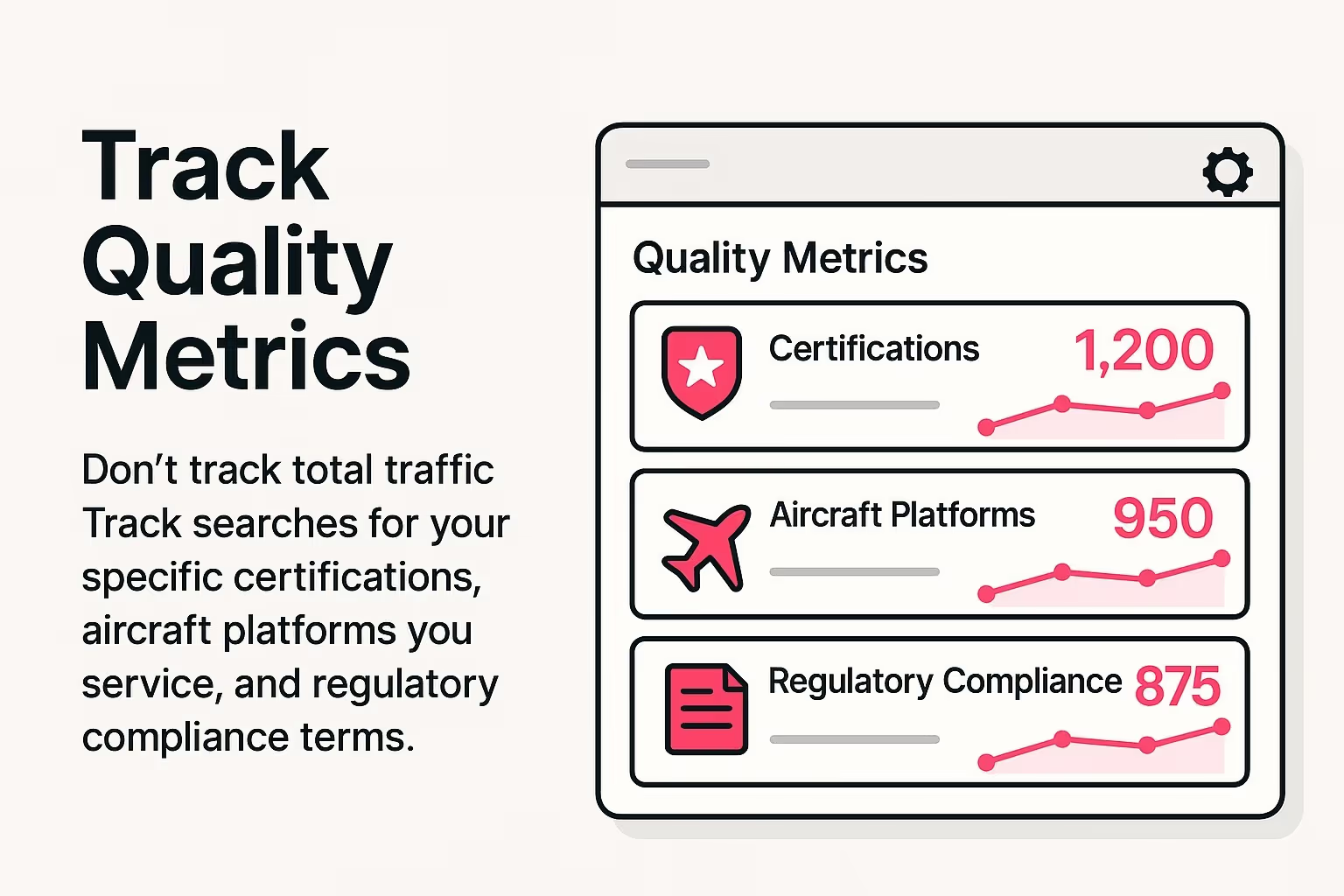
Measure what matters: track searches for certifications, platforms, and compliance terms—not total traffic.
Every certification you hold represents a content opportunity.
Buyers search for these certifications by name: AS9100, FAA Part 145, EASA, Nadcap, ITAR compliance. When you publish detailed explanations of how you maintain these certifications, you match their search intent perfectly.
Most competitors list certifications as logos on an "About" page. You can create dedicated pages explaining your certification process, the specific inspections involved, and how you maintain compliance. This content answers the exact questions aerospace buyers research before requesting quotes.
Your quality management documentation contains this information already. You're not creating new content from scratch. You're adapting existing compliance documentation for public visibility.
Now that you understand why aerospace buyers search differently, here's how compliance-focused content establishes your authority.
Compliance-focused content supports SEO authority by aligning with buyer search intent and demonstrating expertise, but search rankings also depend on technical site structure and overall quality signals.
When you publish detailed compliance content, you're proving you understand the regulatory environment your buyers operate in. This is more persuasive than marketing claims.
An MRO provider that publishes a 1,500-word guide explaining AS9100 Rev D audit preparation demonstrates more expertise than a competitor with generic quality statements. The detailed guide ranks for specific search terms and builds credibility with technical readers.
Your quality manual, audit reports, and certification maintenance procedures contain valuable content. You can't publish these documents directly, but you can create public-facing versions.
Start with your certification process. Write an article explaining the steps you took to achieve AS9100 certification: the gap analysis, corrective actions, internal audits, and external assessment. Remove confidential details but keep the process transparent.
Create content around specific compliance challenges you've solved. If you implemented a new traceability system to meet EASA requirements, write about the problem, your solution, and the results. This shows prospective clients you handle complex regulatory requirements.
Document your inspection processes with visuals. Photos of calibrated measurement equipment, inspection worksheets, and quality control checkpoints make abstract compliance concepts concrete. Buyers want to see your actual processes, not stock photography.
Aerospace buyers can spot imprecise language immediately.
Don't say you're "committed to quality." Explain your nonconformance reporting process, your corrective action procedures, and your internal audit schedule. Specific operational details build credibility.
Use exact terminology from regulatory standards. Reference specific FAA Advisory Circulars, cite EASA Part-145 requirements, and mention relevant industry specifications by number. This precision signals you're an industry insider, not a marketing team writing generic content.
When you publish technical content that uses correct terminology and references actual regulatory requirements, you attract the right audience. Procurement officers and quality managers recognize authentic expertise.
With compliance content established as your foundation, here's how to find the specific search terms aerospace buyers actually use.
Aerospace keyword research ignores traditional volume metrics. A search term with 20 monthly searches is valuable if those 20 searchers are all potential customers researching specific certifications you hold.
Start with your certifications and capabilities. List every certification, aircraft platform you service, specific components you repair, and regulatory standards you meet. Each item represents a potential search term.
Combine these elements into long-tail phrases: "AS9100 certified sheet metal fabrication for Boeing 737" or "FAA approved turbine blade repair NADCAP certified." These phrases have minimal search volume but maximum buyer intent.
Your sales team hears exact buyer language every day.
Ask your sales representatives what questions prospects ask during discovery calls. These questions are search queries. If buyers regularly ask about your ITAR compliance procedures, create content specifically addressing ITAR requirements for aerospace manufacturing.
Review your RFP responses. The technical requirements sections contain the exact terminology buyers use when researching suppliers. Extract these phrases and create content addressing each requirement.
Customer service inquiries reveal information gaps. When existing customers ask for certification documentation or compliance verification, that's content you should make publicly available on your website.
Aircraft platform-specific content attracts highly qualified traffic.
If you service Boeing 737 Next Generation aircraft, create detailed capability pages for specific 737NG systems: landing gear, APU, hydraulic components. Each platform-system combination represents a distinct search opportunity.
Military aircraft platforms are even more specific. Content about F/A-18 Super Hornet maintenance capabilities attracts defense contractors searching for qualified MRO providers. These searches have tiny volume but enormous contract values.
Don't create generic aerospace content. Create platform-specific, system-specific, certification-specific content that matches exact buyer requirements.
You've identified your target search terms. Now you need to use technical language appropriately without confusing your audience.
Aerospace content requires industry terminology. You can't avoid technical terms like "non-destructive testing," "materials review board," or "special process certifications." These terms are what buyers search for.
The key is using technical language precisely while providing enough context for readers at different expertise levels. Not every buyer has the same technical background.
A procurement officer might understand regulatory requirements without knowing specific inspection methodologies. An engineer knows the technical details but might not be familiar with your particular certification approach. Your content needs to serve both readers.
Structure your content in layers.
Start with a clear summary that defines the topic and explains why it matters. Use this opening to establish context and define any acronyms you'll use throughout the article.
Progress to specific technical details in the body content. This is where you use precise industry terminology without oversimplifying. Engineers and quality managers need to see you understand technical nuances.
Include practical examples that illustrate abstract concepts. Instead of just explaining "material traceability," describe your actual process: how you track material certificates, where you store records, and how you verify material compliance during inspections.
End sections with clear takeaways. Summarize the key points in non-technical language so all readers understand the main implications.
Aerospace communication relies heavily on acronyms. AS9100, FAA, EASA, MRO, OEM, NDT, and hundreds more.
Define acronyms on first use within each article, even if they're industry standard. Not every reader knows every acronym, and search engines can't interpret undefined abbreviations.
.avif)
Define acronyms on first use to improve clarity and help search engines interpret your content.
Format definitions clearly: "Material Review Board (MRB)" or "Non-Destructive Testing (NDT)." This makes content more accessible and helps search engines understand your topic.
After the first definition, use the acronym freely. You're writing for a technical audience that will recognize these terms once defined.
Now that you're using appropriate technical language, here's how to structure content that aerospace buyers actually want to read.
Content marketing in aerospace isn't about viral blog posts or social media engagement. It's about creating detailed technical resources that demonstrate your operational capabilities.
The most effective aerospace content formats are compliance case studies, technical process explainers, and certification maintenance guides. These formats directly address buyer research needs.
Case studies work when they're specific and technical.
Don't write generic success stories about "improving quality." Write detailed explanations of specific compliance challenges you've solved: how you achieved first-time AS9100 certification, how you implemented a new NDT procedure to meet customer requirements, or how you resolved a significant nonconformance and prevented recurrence.
Include actual process details. Describe the problem with enough technical specificity that readers understand the complexity. Explain your solution methodology, the corrective actions you implemented, and the verification process you used.
Quantify results when possible, but focus on compliance outcomes rather than business metrics. "Achieved zero findings on external audit" is more relevant than "increased revenue by 15%."
These detailed case studies rank for long-tail searches and build credibility with technical readers who recognize genuine expertise.
Create content explaining how you perform critical processes.
Write articles detailing your receiving inspection process, your calibration procedures, your internal audit methodology, or your corrective action workflow. These processes differentiate you from competitors.
Use visual documentation. Photos of actual equipment, annotated inspection checklists, and process flowcharts make abstract procedures concrete. Buyers want to see your actual operation, not generic descriptions.
Explain the "why" behind your processes. When you describe why you perform incoming material verification in a specific way, you demonstrate understanding of the risks you're mitigating. This depth builds confidence.
Create content about maintaining certifications, not just achieving them.
An article explaining your internal audit schedule, management review process, and continuous improvement initiatives shows buyers you take compliance seriously long-term. Certifications aren't one-time achievements. Maintaining them requires ongoing effort.
This content answers an important buyer question: "Will this supplier maintain compliance standards throughout our contract?" Your documentation provides evidence of systematic quality management.
Your compliance content is published and optimized. Here's how to build external authority signals that improve search rankings.
Backlinks in aerospace work differently than consumer industries. You're not trying to get mentioned on high-traffic blogs. You're building connections with industry publications, association websites, and regulatory bodies.
A single link from Aviation Week, AIN, or an industry association website carries more weight than dozens of links from generic business blogs. Focus on aerospace-specific authority sources.
Aerospace trade publications need expert contributors.
Reach out to Aviation Week, Aviation International News, MRO Network, or vertical-specific publications relevant to your niche. Pitch technical articles based on your compliance expertise: how to prepare for AS9100 audits, emerging trends in aerospace quality management, or lessons learned from certification processes.
These articles typically allow author bylines with company links. One article in a major trade publication can generate qualified traffic and valuable backlinks.
Focus your pitches on educational content, not promotional pieces. Publications want genuinely useful information for their readers, not advertising disguised as articles.
Join relevant aerospace industry associations and participate actively.
Organizations like SAE International, AIA, GAMA, and regional aerospace clusters often maintain member directories with website links. These are valuable, relevant backlinks from authoritative industry sources.
Contribute to association content initiatives. Write technical guidance documents, participate in working groups, or present at industry conferences. These activities generate natural backlinks and build recognition among potential customers.
Local aerospace development organizations and economic development councils often feature member companies. These local links help with geographic SEO if you serve specific regional markets.
List your company in aerospace-specific supplier directories.
Platforms like ThomasNet, aerospace supplier databases, and OEM-specific supplier portals provide valuable industry-relevant backlinks. Complete your profiles thoroughly and keep them updated.
These directories often rank well for specific capability searches. A complete profile with detailed certification information and capability descriptions can drive qualified traffic even before your own website ranks prominently.
You've created compliance content and built industry backlinks. Now ensure your website's technical foundation supports search visibility.
Technical SEO in aerospace matters as much as content quality. Your website needs to be fast, mobile-friendly, and structured properly for search engines to find and index your compliance documentation.
Page load speed affects both user experience and search rankings.
Aerospace buyers often research suppliers during work hours on corporate networks that may have bandwidth limitations. Fast page loads are essential.
Optimize images before uploading. Compliance documentation often includes detailed photos of equipment and processes. These images should be compressed and properly sized for web display.
Use a content delivery network if you serve international markets. Aerospace is a global industry. Your website should load quickly for buyers in Europe, Asia, and North America.
Test your site speed regularly using tools like Google PageSpeed Insights. Address performance issues systematically.
More aerospace research happens on mobile devices than you might expect.
Engineers and buyers review technical information on tablets during meetings and on phones during industry events. Your compliance content needs to be readable on all screen sizes.
Test your website on actual mobile devices, not just desktop browser simulations. Check that tables display properly, PDFs load correctly, and navigation works smoothly on touch screens.
Ensure contact forms work seamlessly on mobile. If buyers can't easily submit RFQ forms on their phones, you're losing opportunities.
Schema markup helps search engines understand your content structure.
Implement Organization schema to clearly identify your company information, certifications, and location. This structured data can appear in search results and knowledge panels.
Use FAQPage schema for compliance-related Q&A content. When you answer common certification questions, schema markup increases the chances your answers appear as rich results.
Product or Service schema helps search engines understand your specific capabilities. Mark up your service descriptions with relevant technical details and certifications.
Create and submit a clean XML sitemap to search engines.
Organize your sitemap logically by content type: certification pages, capability descriptions, case studies, and technical resources. This organization helps search engines understand your site structure.
Monitor indexing in Google Search Console. Verify that your compliance content is being indexed properly. Address crawl errors and indexing issues promptly.
Block low-value pages from search indexing using robots.txt. Internal employee portals, thank-you pages, and duplicate content shouldn't appear in search results.
Your technical infrastructure is optimized. Here's how to measure whether your compliance content strategy is actually working.
Traditional SEO metrics don't apply directly to aerospace. You're not tracking viral traffic growth or social shares. You're measuring highly qualified lead generation from specific compliance-related searches.
Focus on search rankings for your specific certification and capability terms.
Track whether you're ranking for searches like "AS9100 certified MRO [your location]" or "FAA Part 145 repair station [specific component]." These rankings directly correlate with qualified visibility.
Monitor organic traffic to your compliance content pages. Compare this traffic to overall site visits. Compliance pages should show increasing traffic from searches, not just navigation from your homepage.
Track form submissions and RFQ requests that come from organic search. Ask new prospects how they found you. When they mention finding your compliance case studies or certification pages through search, your strategy is working.
Measure qualified lead quality, not just quantity. Ten inquiries from aerospace procurement officers are more valuable than a hundred generic contact form submissions.
SEO authority in aerospace builds slowly but compounds over time.
Monitor whether aerospace industry publications are citing your compliance content. When your technical articles get referenced or linked by industry sources, you're building genuine authority.
Track keyword rankings over 6-12 month periods, not monthly. Aerospace buying cycles are long. Your content might rank well for months before generating qualified leads, then suddenly result in significant RFQ activity.
LinkedIn engagement rates in the MRO sector typically range from 0.4 to 0.8 percent, which might seem low but represents highly engaged industry professionals. Focus on the quality of engagement from decision-makers, not total follower counts. They also range from $0.50–$4.43 cost per click.
Track the full customer journey from search to contract.
When a new customer signs a contract, review how they initially discovered your company. If they found you through organic search for specific compliance terms, that's measurable SEO ROI.
Calculate the lifetime value of customers who found you through organic search versus other channels. Buyers who research your compliance credentials thoroughly before contacting you often convert at higher rates and become better long-term clients.
Document specific examples: "New customer found our AS9100 case study through search, resulted in $450K initial contract." These concrete examples justify continued investment in compliance content.
You understand the strategy. Here's your practical implementation roadmap.
Start with a compliance content audit. List every certification you hold, every aircraft platform you service, every regulatory standard you meet. This inventory becomes your content roadmap.
Prioritize content creation based on your differentiation and buyer search intent. If you have unique capabilities or hard-to-achieve certifications, create detailed content about these first. Your competitive advantages deserve prominent visibility.
Create a content calendar focused on compliance topics. Plan to publish at least one detailed compliance article or case study monthly. Consistency matters more than volume.
Repurpose internal documentation systematically. Review audit reports, corrective action records, and quality management procedures. Extract public-facing insights from confidential documents.
Month one: Create detailed pages for your top three certifications. Explain what each certification requires, how you maintain compliance, and why it matters to buyers.
Month two: Write three compliance case studies. Choose specific challenges you've solved that demonstrate technical capability and regulatory knowledge.
Month three: Develop platform-specific capability pages for your most important aircraft or component specializations. Include technical specifications and compliance requirements.
Throughout this period, optimize your technical SEO foundation. Ensure your site loads quickly, works on mobile devices, and uses proper schema markup.
Compliance content strategy isn't a one-time project.
Update your certification pages when you achieve new qualifications or renew existing certifications. These updates signal ongoing compliance and give you fresh content to share.
Document your continuous improvement initiatives. When you implement new quality procedures or upgrade equipment to meet higher standards, create content explaining these improvements.
Engage with industry publications and associations consistently. Building reputation takes time, but the compounding effects are substantial.
Your expertise already exists in your quality documentation and operational procedures. The opportunity is making this expertise visible to the aerospace buyers searching for exactly what you provide. Start with your strongest compliance credentials and work systematically through your capabilities. Each piece of detailed, technical, accurate content builds your search authority and attracts more qualified leads.
What is SEO compliance?
SEO compliance means ensuring a website follows search engine guidelines, such as Google Search Essentials, to meet technical, content, and policy requirements. This includes making sites crawlable, indexable, secure, and free from manipulative practices.
What are the 3 C's of SEO?
The 3 C's of SEO are content, code, and credibility. Content refers to quality and relevance, code involves technical structure and optimization, and credibility relates to trustworthiness and authority as perceived by search engines.
What are the four major types of factors involved in SEO?
The four major SEO factors are technical factors (site speed and mobile-friendliness), on-page factors (keyword usage and meta tags), off-page factors (backlinks and authority), and content factors (quality and relevance).