

A B2B industrial & safety supplies ecommerce distributor partnered with SCUBE to support the launch and growth of a new Shopify Plus site. The business sold functional, spec-driven products to professional buyers and relied on paid media to establish early demand and customer acquisition.
The goal was not short-term traffic generation. The distributor needed a paid media foundation that could support acquisition from zero, scale quickly, and operate with clarity as the ecommerce channel matured.
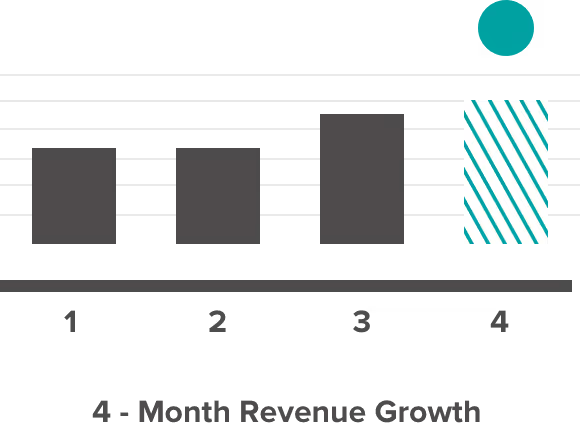
SCUBE designed and launched a Google Ads program structured around clean inputs, segmented demand, and disciplined execution. During the first 12 months after launch, the paid media system generated seven-figure online revenue and nearly 4,000 new customers. Campaigns continued into the following year with record year-over-year growth, reinforcing the role of paid media as a stable acquisition channel rather than a launch-only tactic.
Launching ecommerce at scale introduces a specific set of constraints.
There was no historical online demand to lean on, no legacy performance data to guide bidding, and no tolerance for inefficiency while the channel proved itself internally. Paid media needed to do two things at once: acquire customers quickly and establish a signal foundation that would hold as volume increased.
Without structure, early success would be fragile. Short-term wins could mask issues that would surface later as spend scaled.
SCUBE approached the launch as a system design problem, not a campaign rollout. The work focused on establishing control early so growth could compound without introducing instability.
Clear performance expectations were set from the outset, grounded in acquisition and contribution rather than surface platform metrics. This created a stable reference point for evaluating growth as spend increased.
Campaigns were structured by buyer journey stage to separate demand capture from demand development. Search, Shopping, and remarketing programs were designed to serve distinct roles rather than compete for credit.
Product feed management was treated as a core lever, ensuring that visibility and spend aligned with product relevance and buyer intent.
Offers, value propositions, and ad angles were tested selectively to inform structure rather than chase marginal gains. Keyword and query management reduced waste as volume increased, while a seasonal promotion calendar aligned paid activity with commercial priorities.
Across the system, ROAS functioned as a constraint. It limited downside risk but did not define success. The focus remained on customer acquisition and durable growth.
Within the first 12 months after launch:
In the following 12 months:
Performance was evaluated over time rather than through isolated launch metrics. As structure held, paid media remained a reliable contributor rather than a volatile acquisition lever.
“Thanks to the efforts of the SCUBE Marketing team, the company has hit all of their monthly goals since launching the e-commerce platform in 2019. The ROI in particular exceeded their expectations and credit it to the team's attention to detail and clear communication throughout the partnership.”
— Director of Operations, B2B Industrial Distributor
The outcome was not a successful launch alone. It was a paid media system capable of supporting growth beyond it.
The SCUBE Game Plan is a focused review of how large, spec-driven catalogs behave inside paid channels. It’s designed to surface what’s contributing to performance, what’s masking underlying issues, and where structure is quietly working against you.If there’s a fit, we walk through the findings in a ~60 minute conversation, looking at:
The goal is a clearer picture of how the system is behaving, so decisions stop relying on averages or assumptions.